English-language podcasts

TED-Ed

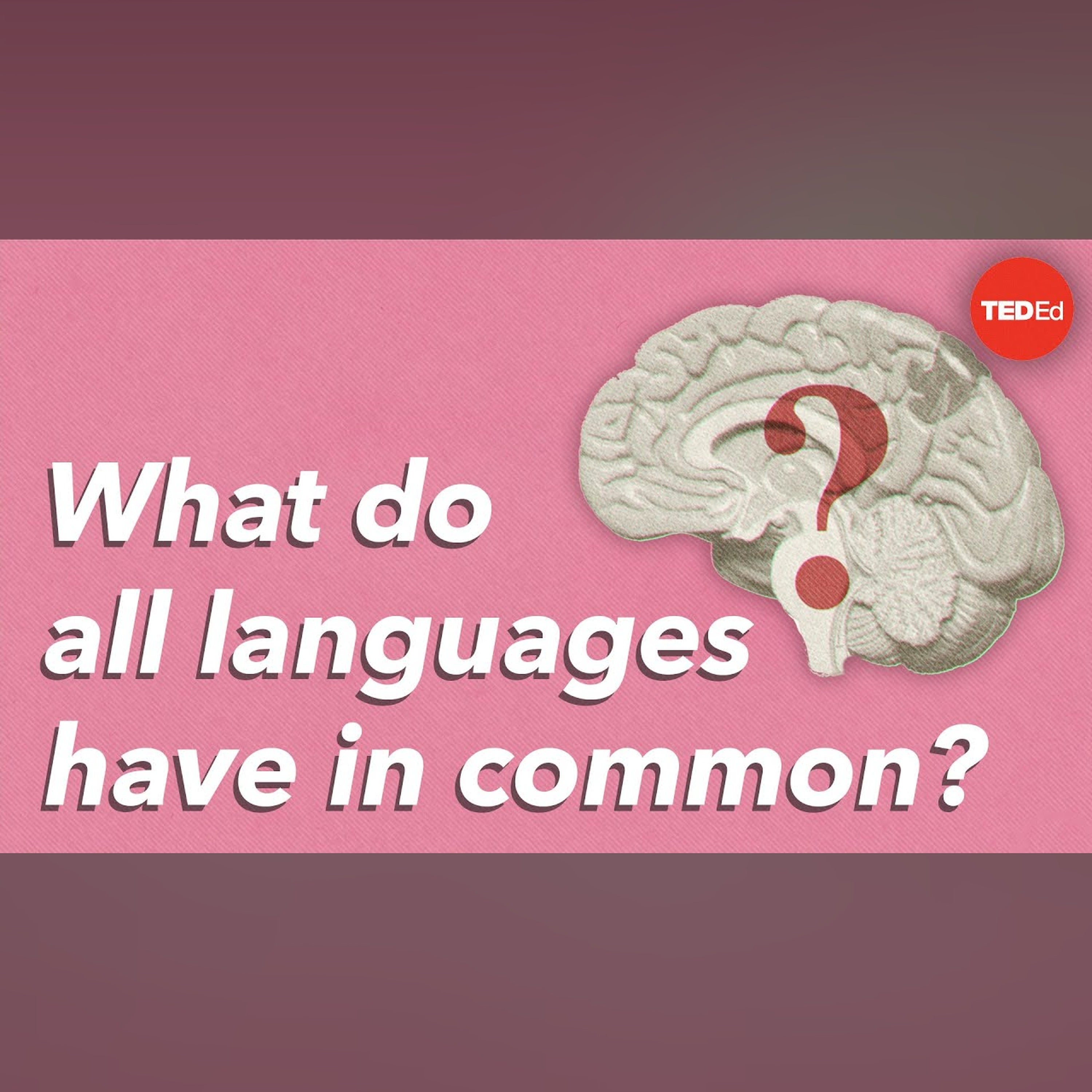
What do all languages have in common? - Cameron Morin
8 min

Listen through the publisher, then discuss the episode here or arrange an in-person Roundtable. Your city determines where to meet.

Roundtables are designed for groups of four, with a shared subject and room for everyone to speak. Come for discussion, with no dating expectation.

Dig into Noam Chomsky’s theory of universal grammar and decide: are there universal grammar rules and are they hardwired into our brains? Uploaded 29-06-20 -- Language is endlessly variable. Each of us can come up with an infinite number of sentences in our native language, and we’re able to do so from an early age— almost as soon as we start to communicate in sentences. How is this possible? In the early 1950s, Noam Chomsky proposed a theory that the key to this versatility was grammar. Cameron Morin details Chomsky's theory of universal grammar. Lesson by Cameron Morin, directed by Eoin Duffy. Animator's website: https://eoinduffy.me/ Sign up for our newsletter: http://bit.ly/TEDEdNewsletter Support us on Patreon: http://bit.ly/TEDEdPatreon Find us on Twitter: http://bit.ly/TEDEdTwitter Peep us on Instagram: http://bit.ly/TEDEdInstagram View full lesson: https://ed.ted.com/lessons/what-do-all-languages-have-in-common-cameron-morin Thank you so much to our patrons for your support! Without you this video would not be possible! Ivan Todorović, Alex Schenkman, Brittiny Elman, Ryohky Araya, Paul Coupe, David Douglass, Ricardo Paredes, Bill Feaver, Eduardo Briceño, Arturo De Leon, Christophe Dessalles, Janie Jackson, Dr Luca Carpinelli, Heather Slater, Yuh Saito, Quentin Le Menez, Mattia Veltri, Fabian Amels, Sandra Tersluisen, PnDAA, Hugo Legorreta, Zhexi Shan, Gustavo Mendoza, Bárbara Nazaré, Josh Engel, Natalia Rico, Andrea Feliz, Eysteinn Guðnason, Bernardo Paulo, Victor E Karhel, Sydney Evans, Latora Slydell, Oyuntsengel Tseyen-Oidov, Noel Situ, Elliot Poulin, emily lam, Juan, Jordan Tang, Kent Logan, Alexandra Panzer, Laura Cameron Keith, Jen, Ellen Spertus, Cailin Ramsey, Markus Goldhacker, Leora Allen, Andras Radnothy, Chris, Arpita Singh and Vijayalakshmi.

Episode information is provided by the publisher. Listening takes place on the publisher’s service.

Listen at the source ↗

Featured places to meet in Palo Alto, CA

Explore these places and arrange a conversation through ThinkMatch.

City guide for Palo Alto, CA

More from TED-Ed

TED-Ed

We need a "moral operating system" - Damon Horowitz

22 min

Damon Horowitz reviews the enormous new powers that technology gives us: to know more -- and more about each other -- than ever before. Drawing the audience into a philosophical discussion, Horowitz invites us to pay new attention to the basic philosophy -- the ethical principles -- behind the burst of invention remaking our world. Where's the moral operating system that allows us to make sense of it? (Filmed at TEDxSiliconValley.) Uploaded 08-08-13 Talk by Damon Horowitz.

Discuss this episode

TED-Ed

How to conquer a dragon with math - Garth Sundem

6 min

View full lesson: http://ed.ted.com/lessons/how-to-defeat-a-dragon-with-math-garth-sundem Having trouble remembering the order of operations? Let's raise the stakes a little bit. What if the future of your (theoretical) kingdom depended on it? Garth Sundem creates a world in which PEMDAS is the hero but only heroic when in the proper order. Lesson by Garth Sundem, animation by Mark Phillips.

Discuss this episode

TED-Ed

The secret lives of baby fish - Amy McDermott

6 min

View full lesson: http://ed.ted.com/lessons/the-secret-lives-of-baby-fish-amy-mcdermott Uploaded 11-08-14 Coral reef fish, like the yellow tang surgeonfish, begin life in a fascinating and weird way – as tiny floating larvae! These babies are capable of drifting thousands of miles on ocean currents, far from the reefs where they were born. Amy McDermott describes how these tiny trekkers travel across vast oceans, searching for the far-flung reefs they will one day call home. Lesson by Amy McDermott, animation by Reflective Films.

Discuss this episode

Community Poll

People selling health products should provide evidence for their claimed benefits.

Share your view, then see how readers voted. No sign-in required. This poll is shared across stories.

Do you agree or disagree?

Choose one answer

Common Quandary

A Common Quandary to discuss

Another conversation to explore, separate from this news story.

A pricey AI tutor can turn B students into A students. Should schools let them use it?

An effective AI tutor adapts to each student and dramatically improves performance, but its subscription is expensive. A public school cannot provide it to everyone and worries that allowing its use will deepen existing inequality.

Should access be limited when a beneficial tool cannot yet be shared fairly?

Explore this quandary