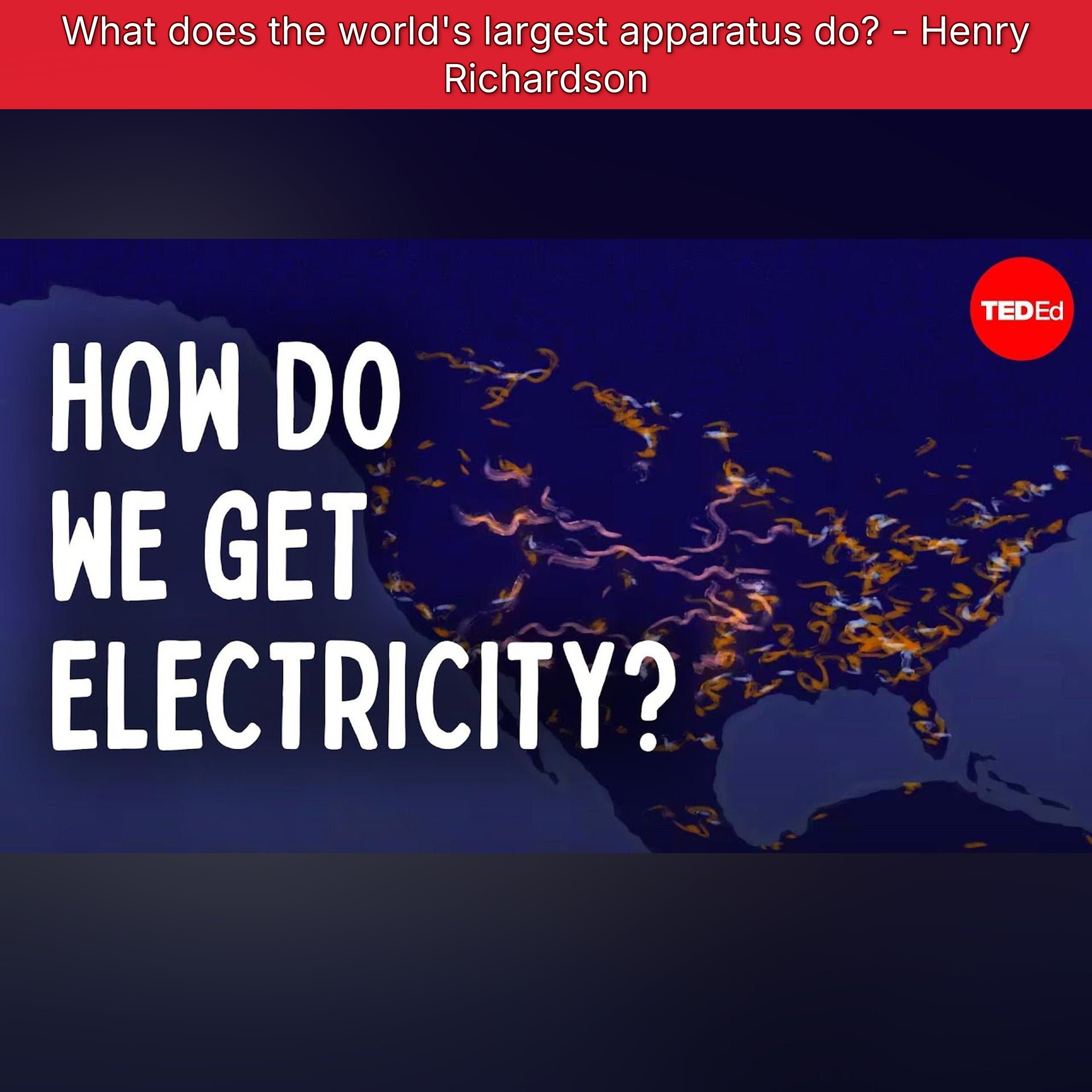
What does the world's largest apparatus do? - Henry Richardson
Listen through the publisher, then discuss the episode here or arrange an in-person Roundtable. Your city determines where to meet.
Roundtables are designed for groups of four, with a shared subject and room for everyone to speak. Come for discussion, with no dating expectation.
Dig into the delicate balancing act of how power grids supply energy to the world and how renewable energy factors into this process. -- In 1967, Homer Loutzenheuser flipped a switch and connected the power grids of the United States, forming one interconnected machine. Today, the US power grid is the world’s largest machine, containing more than 7,300 electricity-generating plants. So how exactly do these power plants work? Henry Richardson digs into the delicate balancing act of how power grids supply us energy. Lesson by Henry Richardson, directed by Anna Benner. Support Our Non-Profit Mission ---------------------------------------------- Support us on Patreon: http://bit.ly/TEDEdPatreon Check out our merch: http://bit.ly/TEDEDShop ---------------------------------------------- Connect With Us ---------------------------------------------- Sign up for our newsletter: http://bit.ly/TEDEdNewsletter Find us on Twitter: http://bit.ly/TEDEdTwitter Peep us on Instagram: http://bit.ly/TEDEdInstagram ---------------------------------------------- Keep Learning ---------------------------------------------- View full lesson: https://ed.ted.com/lessons/what-does-the-world-s-largest-machine-do-henry-richardson Dig deeper with additional resources: https://ed.ted.com/lessons/what-does-the-world-s-largest-machine-do-henry-richardson#digdeeper (https://ed.ted.com/lessons/what-does-the-world-s-largest-machine-do-henry-richardson) Animator's website: https://annabennerstudio.com (https://annabennerstudio.com/) Educator's website: https://www.watttime.org (https://www.watttime.org/) Music: https://www.tschernuth.com (https://www.tschernuth.com/) ---------------------------------------------- Thank you so much to our patrons for your support! Without you this video would not be possible! Hans Peng, Gaurav Mathur, Erik Biemans, Tony, Michelle, Katie and Josh Pedretti, Hoai Nam Tran, Kack-Kyun Kim, Michael Braun-Boghos, zjweele13, Anna-Pitschna Kunz, Edla Paniguel, Thomas Mungavan, Jaron Blackburn, Venkat Venkatakrishnan, ReuniteKorea, Aaron Henson, Rohan Gupta, Begum Tutuncu, Brian Richards, Jørgen Østerpart, Tyron Jung, Carsten Tobehn, Katie Dean, Ezgi Yersu, Gerald Onyango, alessandra tasso, Doreen Reynolds-Consolati, Manognya Chakrapani, Ayala Ron, Eunsun Kim, Phyllis Dubrow, Ophelia Gibson Best, Paul Schneider, Joichiro Yamada, Henrique Cassús, Karthik Cherala, Clarence E. Harper Jr., Vignan Velivela, Ana Maria, Exal Enrique Cisneros Tuch, Tejas Dc, Khalifa Alhulail, Martin Stephen, Jose Henrique Leopoldo e Silva, Mandeep Singh, Abhijit Kiran Valluri, Morgan Williams, Devin Harris, Pavel Zalevskiy, Karen Goepen-Wee and Filip Dabrowski.
Episode information is provided by the publisher. Listening takes place on the publisher’s service.
Listen at the source ↗