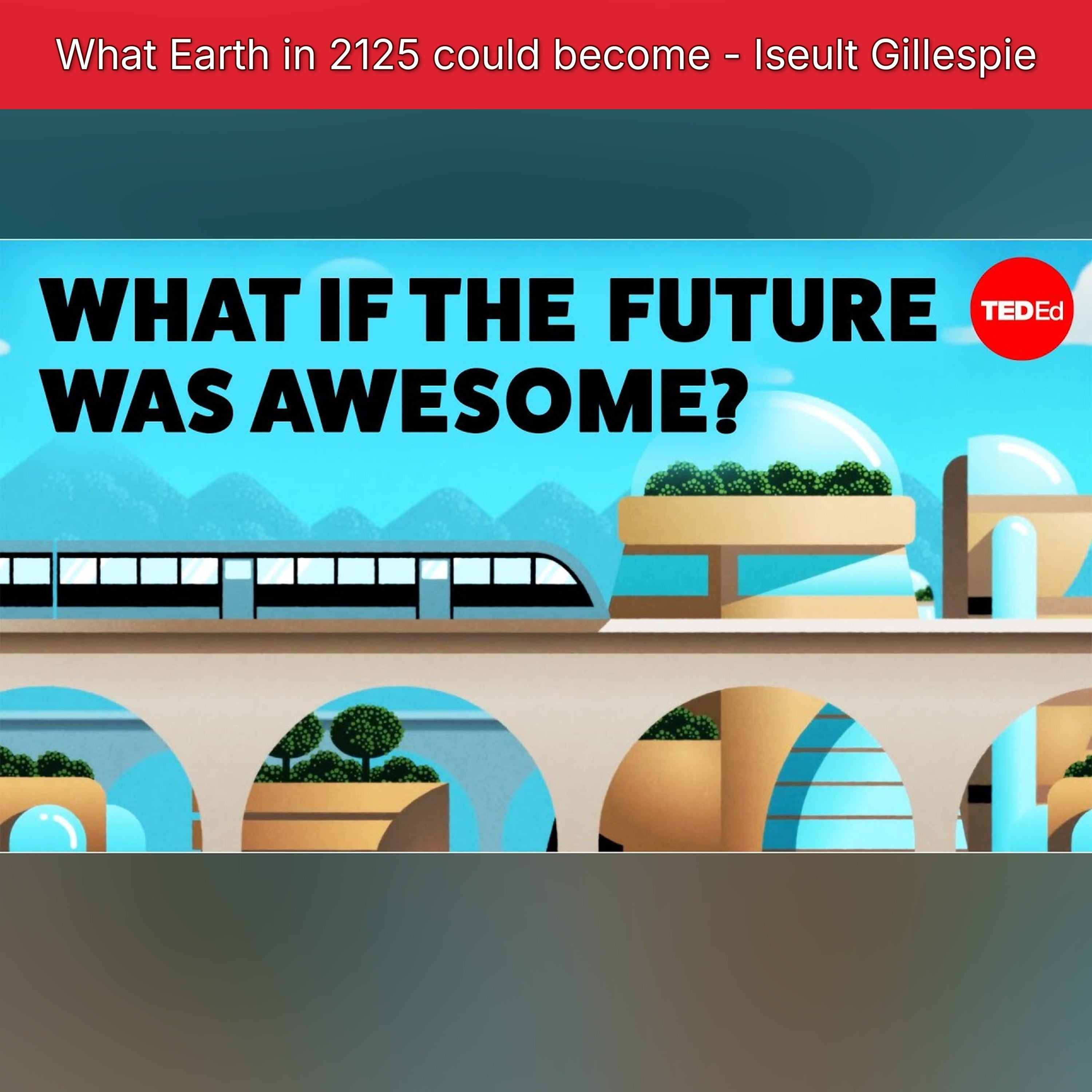
What Earth in 2125 could become - Iseult Gillespie
Listen through the publisher, then discuss the episode here or arrange an in-person Roundtable. Your city determines where to meet.
Roundtables are designed for groups of four, with a shared subject and room for everyone to speak. Come for discussion, with no dating expectation.
What could our future look like if we harness our technology to create a sustainable world? Take a look at the possibilities. -- Faced with the realities of current crises, it’s easy to assume our world is headed in a bleak direction. But there’s good reason to be hopeful— with developments in science and technology, a positive future is more viable than ever before. So, what if the future was awesome? Iseult Gillespie explores what three cities could look like in 100 years if we harness the tools we have at our disposal. Lesson by Iseult Gillespie, directed by Devin Clark, Augenblick Studios. This video made possible in collaboration with Speed & Scale Learn more about how TED-Ed partnerships work: https://bit.ly/TEDEdPartner Support Our Non-Profit Mission ---------------------------------------------- Support us on Patreon: http://bit.ly/TEDEdPatreon Check out our merch: http://bit.ly/TEDEDShop ---------------------------------------------- Connect With Us ---------------------------------------------- Sign up for our newsletter: http://bit.ly/TEDEdNewsletter Find us on Twitter: http://bit.ly/TEDEdTwitter Peep us on Instagram: http://bit.ly/TEDEdInstagram ---------------------------------------------- Keep Learning ---------------------------------------------- View full lesson: https://ed.ted.com/lessons/what-earth-in-2125-could-look-like-iseult-gillespie Dig deeper with additional resources: https://ed.ted.com/lessons/what-earth-in-2125-could-look-like-iseult-gillespie/digdeeper Animator's website: https://www.augenblickstudios.com (https://www.augenblickstudios.com/) ---------------------------------------------- Thank you so much to our patrons for your support! Without you this video would not be possible! Doug Henry, Keven Webb, Mihai Sandu, Deepak Iyer, Javid Gozalov, Kyanta Yap, Rebecca Reineke, William Biersdorf, Patricia Alves Panagides, Yvette Mocete, Cyrus Garay, Samuel Barbas, LadyGeek, Marin Kovachev, Penelope Misquitta, Hans Peng, Gaurav Mathur, Erik Biemans, Tony, Michelle, Katie and Josh Pedretti, Hoai Nam Tran, Kack-Kyun Kim, Michael Braun-Boghos, zjweele13, Anna-Pitschna Kunz, Edla Paniguel, Thomas Mungavan, Jaron Blackburn, Venkat Venkatakrishnan, ReuniteKorea, Aaron Henson, Rohan Gupta, Begum Tutuncu, Brian Richards, Jørgen Østerpart, Tyron Jung, Carsten Tobehn, Katie Dean, Ezgi Yersu, Gerald Onyango, alessandra tasso, Doreen Reynolds-Consolati, Manognya Chakrapani, Ayala Ron, Eunsun Kim, Phyllis Dubrow, Ophelia Gibson Best, Paul Schneider, Joichiro Yamada, Henrique Cassús, and Karthik Cherala.
Episode information is provided by the publisher. Listening takes place on the publisher’s service.
Listen at the source ↗