What happens when you make an entire curriculum AI-ready?
31 min
Listen through the publisher, then discuss the episode here or arrange an in-person Roundtable. Your city determines where to meet.
Roundtables are designed for groups of four, with a shared subject and room for everyone to speak. Come for discussion, with no dating expectation.
What happens when you make an entire curriculum AI-ready? What if the biggest opportunity for AI in education isn't a better AI model, but making our national curricula accessible to AI in the first place? In this episode, Ray and Dan talk with John Roberts (https://www.linkedin.com/in/johnrobertsuk/), CEO of Oak National Academy (https://www.thenational.academy/), about how England is building the digital foundations for AI in education, and why other countries should be paying attention. Born during the pandemic, Oak now provides over 13,000 curriculum-aligned lessons. But its most significant contribution might be turning curriculum knowledge, teaching resources, prerequisite skills and common misconceptions into structured, machine-readable data that anyone can build upon. We explore how this open approach is helping EdTech companies innovate, why Oak's AI assistant Aila has demonstrated measurable benefits in independent research, and what Australia and other countries could learn from England's approach. The bigger question: Should every country be building open, AI-ready curriculum infrastructure, rather than leaving the foundations of educational AI to commercial technology companies? Links and resources Oak National Academy https://www.thenational.academy/ Oak's AI lesson assistant, Aila https://www.thenational.academy/teachers/aila Education Endowment Foundation: Independent evaluation of Aila https://educationendowmentfoundation.org.uk/projects-and-evaluation/projects/aila-teacher-choices-trial Oak's Github, and their ontology - the open curriculum data and API https://github.com/oaknationalhttps://github.com/oaknational/oak-curriculum-ontology
Episode information is provided by the publisher. Listening takes place on the publisher’s service.
If you really want lasting change, real results that stick around, what do you have to do? Tony Robbins is asked this all the time. His answer is always the same: For your life to change, you have to change. For things to get better, you have to get better. You need to create new patterns that facilitate progress and eliminate the patterns that don’t. Your life isn’t determined by what you do some of the time. It’s determined by what you do consistently. If you’re serious about getting results, you need a system. Tony Robbins Immersion Coaching can provide that system. For three decades, Tony has built his brand based on one thing: Robbins = Results. His system of Immersion Coaching is unlike anything else in the world. He is the Father of the Coaching Industry and his coaches' standards and training for success coaching are the best in the industry. We provide general Immersion Coaching as well as Specialized Curriculum Coaching Courses on the areas of life that matter most. As Tony s
Remove your personal information from the web at https://joindeleteme.com/SPACETIME One of the most important reasons we go to space is to know our own planet better. Today I'm going to tell you about an orbiting facility that literally watches Earth's biosphere breath and grow and die with incredible resolution. I'll talk about its profound existential and economic importance, and about why it's in danger of being lost. PBS Member Stations rely on viewers like you. To support your local station, go to:http://to.pbs.org/DonateSPACE Sign Up on Patreon to get access to the Space Time Discord! Check out the Space Time Merch Store Pale Blue Dot By Carl Sagan Search the Entire Space Time Library Here: https://search.pbsspacetime.com/ Hosted by Matt O'Dowd Written by Fernando Franco Félix & Matt O'Dowd Post Production by Leonardo Scholzer, Yago Ballarini & Stephanie Faria Directed by Andrew Kornhaber Associate Producer: Bahar Gholipour Executive Producer: Andrew Kornhaber Executive in Charge
FORCE Yourself to TAKE ACTION – Jim Rohn Motivation #jimrohn #motivation #selfdiscipline #personaldevelopment #successmindset Uploaded 31-01-25 ► Speaker: Jim Rohn (AI Voice Over by Jim Rohn Academy) The difference between success and failure comes down to one thing—action. In this powerful video, inspired by the wisdom of Jim Rohn, discover why taking immediate, decisive action is the key to transforming your life. No more waiting. No more excuses. It’s time to push past hesitation, fear, and procrastination and step into the life you were meant to live. Key Topics Covered: The Myth of Motivation: Why waiting to "feel ready" is the biggest mistake you can make. Overcoming Resistance: Learn how to break through self-doubt, fear, and mental roadblocks. The Power of Taking Action: Success doesn’t happen by chance—it happens by choice. Eliminating Excuses: Identify the mindset traps that keep you stuck and replace them with an unstoppable work ethic. Creating Discipline: Learn how to take
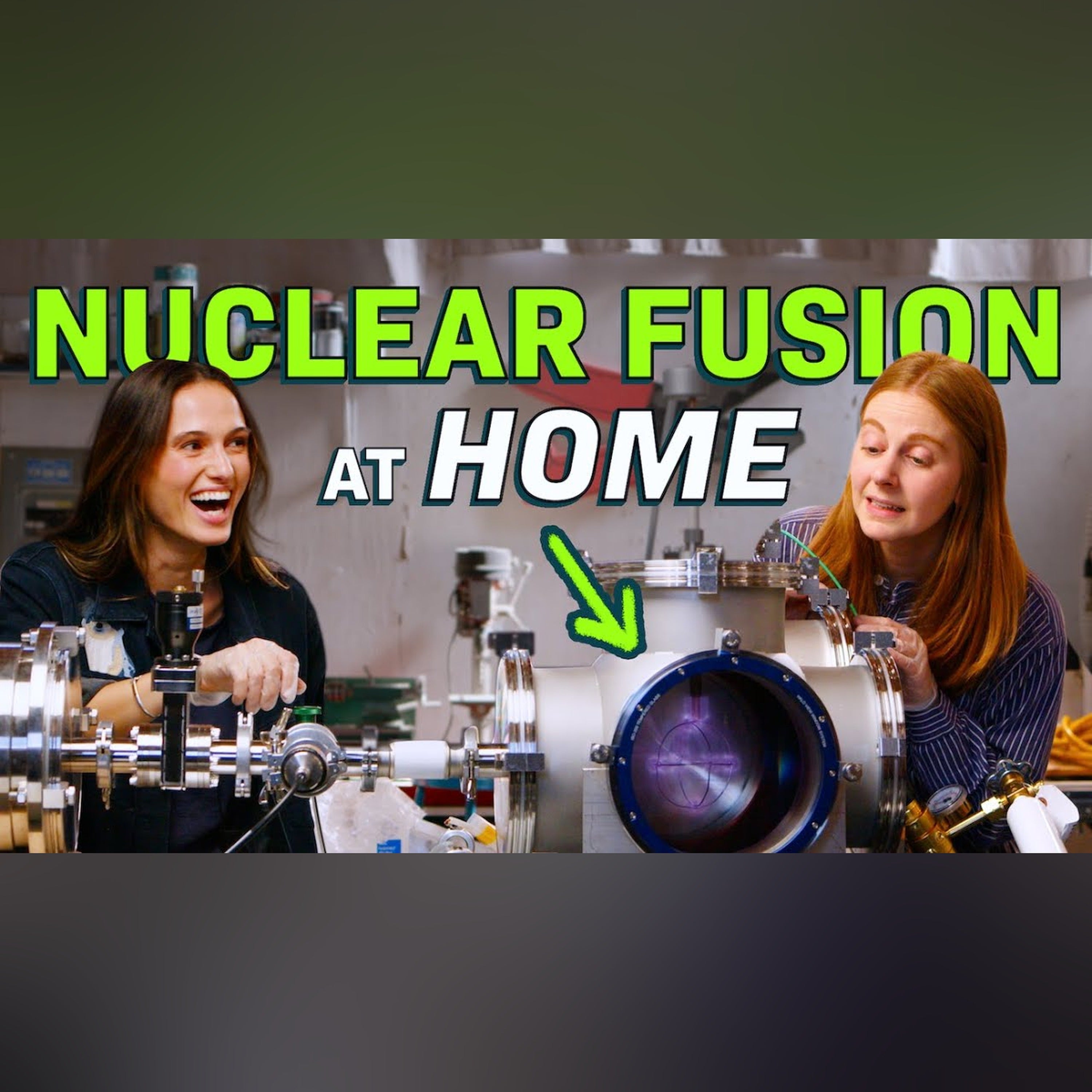
We attempted nuclear fusion. In Simone’s workshop. Disclaimer: This build was supervised by experts at Helion. Do not try this at home. I still can’t believe this video really happened. Back in May, I interviewed Helion CEO David Kirtley. I was trying to understand nuclear fusion: Is nuclear fusion possible now? How does fusion actually work? And most importantly, is nuclear fusion the future? Then, at the end of the interview, I asked David about headlines I’d seen about people building nuclear fusion devices in their backyards - what were they doing? “Oh,” David replied, “you can build one.” What followed is the biggest adventure yet on Huge If True. Together with the team at Helion and my friend fellow YouTuber Simone Giertz, we BUILT A NUCLEAR FUSION DEVICE to show how nuclear fusion works, what the big remaining challenges are, and how it might help us all in the future. Then, the last step was to try to turn it on… WATCH "FUSION, EXPLAINED: PART 1" HERE: https://youtu.be/piPbnKdv
Happy Sunday! Welcome to Heal Squad’s The Sunday Set Up. Life lessons to help you start the week. How much of success comes down to simply showing up? This week, we talk keeping an open mind, taking chances, and recognizing the doors that open along the way. From Olympic athletes appearing on national television alongside Mercedes Moné to performers who keep showing up week after week hoping for their big break, we explore why success isn't always about talent or luck. Sometimes it's about making connections, putting in the effort, and being willing to try without knowing what we'll get in return. We talk knowing when to stop investing time in people who aren't willing to help themselves, and why even experiences that don't work out can teach us something valuable. The takeaway: don't wait for the perfect moment or expect someone else to make things happen. Be willing to take a chance, walk through the doors that open, and remember that half of life is just showing up. Plus, a little b
Get the 200+ Page Optimal Living Daily Workbook (PDF) - Free. Want to turn today's episode into an actionable plan? Episode 4233: Kate Galliett explains three reasons we make health, fitness and life harder than they need to be: ignoring how the body works as a connected system, trusting only extreme intensity, and leaking the energy that fuels motivation and discipline. She makes the case that appropriate effort, not maximum effort, is the only sustainable path to lasting results. Read along with the original article(s) here: https://fitforreallife.substack.com/p/why-you-make-everything-harder-than Quotes to ponder: "The better way is to give appropriate effort and get appropriate results. This is the only sustainable way." "If you try and live at the extremes, you will constantly ping-pong back and forth from one extreme to the other." "Just imagine - you might not actually lack discipline after all, you just might be leaking energy that feeds your ability to be disciplined." We spen
What if giving students access to AI tutors actually makes them learn less? This week, Ray and Dan examine two new randomised trials that challenge some of the assumptions about AI in education. One found that AI tutoring was as effective as expert human tutoring, but students covered less material and saw no improvement in final test scores. Another found that students offered AI tutors performed worse, participated less, and rarely used the tools. We explore what these findings mean for student motivation, engagement and the future of teaching. News this episode: Universities embrace ChatGPT: Princeton (https://oit.princeton.edu/news/announcing-princeton-chatgpt-pilot) and Carnegie Mellon (https://www.cmu.edu/computing/news/2026/chatgptedu_plus.html) announce wider access, while Dartmouth's provost resigns (https://president.dartmouth.edu/news/2026/10/update-provost-review) amid controversy over AI-written content. Google changes course: Gemini will no longer be enabled by default in
An athlete's recovery should take priority over pressure to return for an important game.
Share your view, then see how readers voted. No sign-in required. This poll is shared across stories.
Do you agree or disagree?
Common Quandary
A Common Quandary to discuss
Another conversation to explore, separate from this news story.
You love the free sample but will never buy it. How many times may you circle back?
A warehouse store is offering delicious samples. You have no intention of purchasing the product, but the employee seems bored and has trays to spare. After taking two, you consider removing your jacket and returning for a third.
Is exploiting generosity wrong when the giver appears not to care?