English-language podcasts

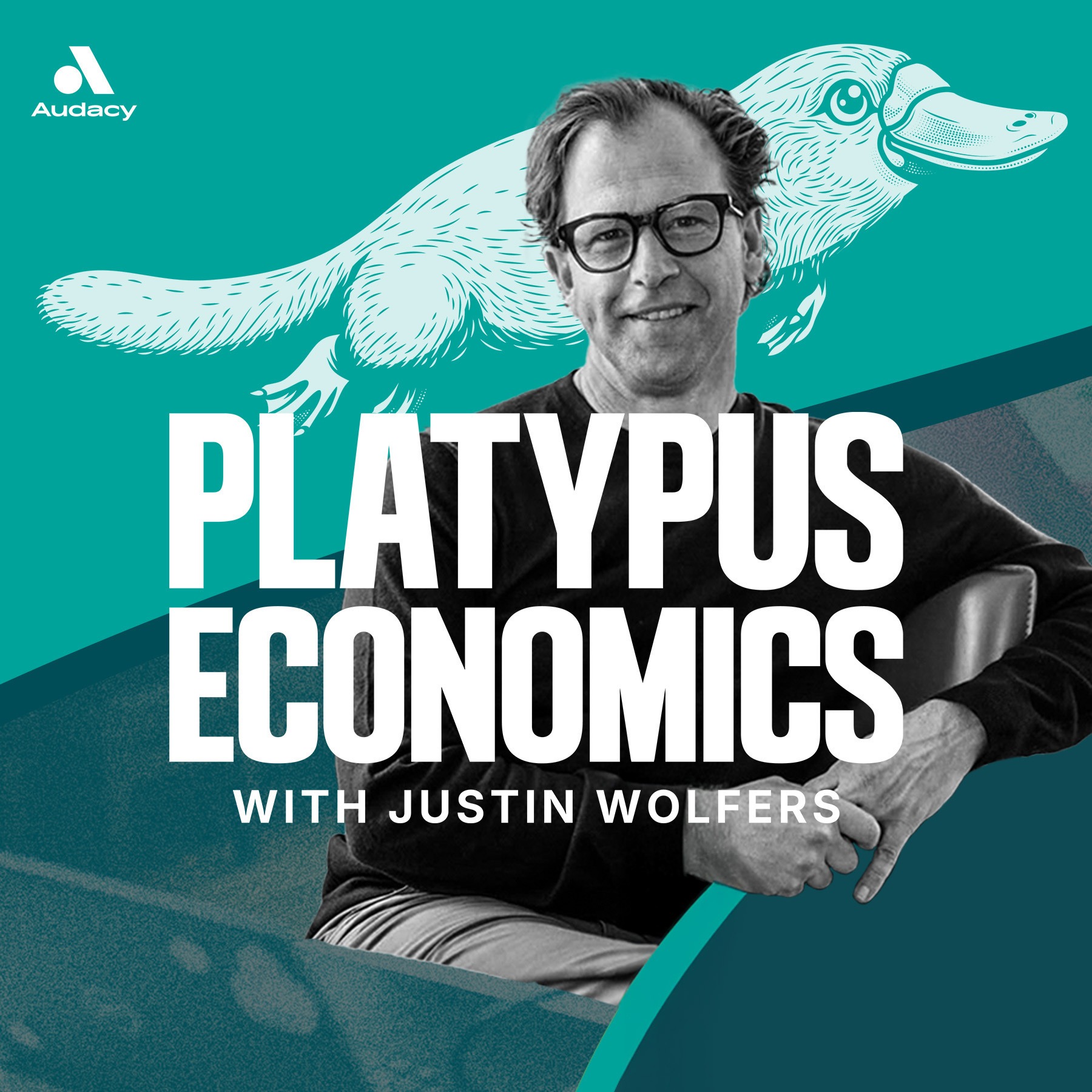
Platypus Economics with Justin Wolfers

What Have We Learned in Six Months of Platypus Economics? | Diving In
58 min

Listen through the publisher, then discuss the episode here or arrange an in-person Roundtable. Your city determines where to meet.

Roundtables are designed for groups of four, with a shared subject and room for everyone to speak. Come for discussion, with no dating expectation.

What do immigration, AI safety and a free press teach us about how the economy works? Justin Wolfers marks six months of Diving In with three stories about the half of an economic argument you might not see at first glance. Immigrants aren't just workers competing for jobs—they're customers helping create them. Justin examines why White House advisers lowered their monthly jobs benchmark from about 200,000 to 50,000 as immigration slowed, and what that reveals about the claim that newcomers take your job. For artificial intelligence, the question isn't only how much richer it could make you. It's whether paying more for safety is worth the cost—and how potential medical breakthroughs change that trade-off. Justin explains why powerful technology needs independent scrutiny, not just assurances from the people building it. That same logic applies to government. Research shows how independent reporting changes officials' incentives, exposes corruption and helps voters hold politicians accountable. The stakes reach your neighborhood: after local newspapers close, governments can face higher borrowing costs, leaving less money for schools, roads and water systems. You'll see how the economy works beyond the headline—and why looking for the missing half matters for your job, your health and your community. on YouTube on Substack the Podcast Follow on Social Media @PlatypusEconomics and @JustinWolfers

Episode information is provided by the publisher. Listening takes place on the publisher’s service.

Listen at the source ↗

Featured places to meet in Palo Alto, CA

Explore these places and arrange a conversation through ThinkMatch.

City guide for Palo Alto, CA

More from Platypus Economics with Justin Wolfers

Platypus Economics with Justin Wolfers

Who’s Actually Paying for America’s Debt? | The Professor Is In

32 min

Could an AI boom rescue America’s finances? And if not, who ends up paying the bill? In this edition of The Professor Is In, producer Augusta brings Justin Wolfers your follow-up questions about his debt math episode, which found the U.S. would need about 6% real growth every year to stabilize its debt. Justin explains why AI’s productivity gains are still hard to spot in the data, and what the personal computer revolution say about how long these booms take to show up. He also explains why he’d bet a million dollars at even money against 6% growth. Along the way, he covers why economists and technologists mean very different things by an “AI revolution,” and teaches the rule of 72. Then it’s back to the accounting. Justin explains why net debt, which Treasury calls debt held by the public, is a better measure than the $40 trillion gross figure, and why Social Security makes even that question fuzzy. A viewer in Denmark asks who is actually paying for U.S. borrowing and what Americans

Discuss this episode

Platypus Economics with Justin Wolfers

Can America Grow Its Way Out of Debt? | Diving In

26 min

Treasury Secretary Scott Bessent says economic growth can tame the national debt, so Justin Wolfers tests that claim with some simple budget arithmetic. He explains why net government debt of about $32 trillion, rather than the $40 trillion gross figure, is the number that matters, and why economists measure it against GDP, which is a country’s income. Then he splits the $2 trillion deficit into interest and the primary deficit. Even if Washington paid zero interest, it would still be borrowing nearly 3 cents of every dollar the economy produces. Justin builds the debt equation one piece at a time to show that everything depends on “r minus g,” the real interest rate compared with the economic growth rate. The payoff is that with today’s primary deficit, the debt only stops rising relative to GDP if real growth beats real interest rates by about 3 points. That works out to roughly 6% growth every year, forever. America hasn’t sustained that for even one decade since World War II, and t

Discuss this episode

Platypus Economics with Justin Wolfers

Are AI Stocks in a Bubble? | Off The Clock

62 min

Are we in an AI stock bubble, or are investors betting on a genuinely bigger economy? Justin Wolfers examines AI stock valuations with Stacey Vanek Smith, separating what the technology could do for the economy from what investors might actually earn. A deliberately hypothetical valuation exercise shows why a trillion-dollar company isn't automatically absurd—but a breakthrough for society doesn't guarantee profits for shareholders. Competition can give you powerful tools at low prices while squeezing the companies selling them. The Thanksgiving turkey problem illustrates why a long run of good news can hide rare, severe risks. Justin connects that analogy to fat tails and the peso problem, then explains why spotting a bubble and successfully betting against it are different challenges. He also unpacks what the CAPE ratio can—and can't—tell you about whether stocks are overpriced. The stakes are your savings, not just Wall Street's scoreboard: Justin discusses an S&P 500 decline of 7.5

Discuss this episode

Community Poll

New local ventures should actively contribute to the surrounding community.

Share your view, then see how readers voted. No sign-in required. This poll is shared across stories.

Do you agree or disagree?

Choose one answer

Common Quandary

A Common Quandary to discuss

Another conversation to explore, separate from this news story.

Someone reserves the best gym machine with a towel. When may you move it?

At a crowded gym, a towel has occupied the most popular machine for fifteen minutes while its owner chats across the room. Gym rules prohibit reserving equipment, but everyone occasionally steps away between sets.

How long may convenience masquerade as continued use?

Explore this quandary