Listen through the publisher, then discuss the episode here or arrange an in-person Roundtable. Your city determines where to meet.
Roundtables are designed for groups of four, with a shared subject and room for everyone to speak. Come for discussion, with no dating expectation.
Have you ever looked closely at the top of someone's head and noticed a little swirl where their hair spins out? That is called a crown, and did you know that mathematics says it has to be there? Welcome to the wild and wonderful world of the Hairy Ball Theorem! In this mind-blowing episode, Mira and Finn discover a fascinating math rule first proved by French mathematician Henri Poincaré in 1885. Imagine a perfect sphere, like a tennis ball or a coconut, completely covered in thick hair. If you try to comb all that hair perfectly flat without a single cowlick or bald spot, you literally cannot do it! The math says it is impossible! But this rule goes way beyond messy hair. It also explains the weather! Because the Earth is a giant sphere covered in blowing wind, the theorem guarantees that at every single moment, there is at least one place on our planet where the wind is completely still. Wow! Join us as we explore hairy coconuts, invisible cowlicks made of air, and why a hairy doughnut is the only shape you can comb perfectly flat!
Episode information is provided by the publisher. Listening takes place on the publisher’s service.
Did you know your mouth is a nonstop biological water park?! Every single day, your body makes enough saliva to fill up to four whole water bottles! But spit isn't just warm water—it's a magical biological potion packed with incredible superpowers. Join Mira and Finn as they explore the wild world of saliva! Discover how a microscopic machine called amylase starts digesting your favorite foods the exact millisecond you take a bite. Find out how spit turns sharp, crunchy chips into soft, squishy balls to protect your throat! Plus, did you know saliva actually builds invisible armor for your teeth by filling in holes with special minerals like calcium and phosphate? It even works as a magical liquid key to unlock flavors—without saliva, chocolate and pizza would taste like absolute cardboard! From amazing spit factories hiding inside your cheeks to real-life birds that build entire nests out of spit, get ready for a mind-blowing biological adventure! Tune in to find out why your mouth is
Have you ever seen pictures of giant stone heads sitting in the grass and wondered how they got there? Get ready for a mind-blowing adventure to one of the most remote places on Earth: Rapa Nui, also known as Easter Island! About 800 years ago, expert Polynesian sailors found this tiny island in the middle of the Pacific Ocean using only the stars and ocean currents to guide them. Once there, they carved nearly a thousand massive stone statues called moai! But here is the biggest surprise: these statues aren't just heads—they have full bodies buried underground! Some weigh as much as 40 cars, and the islanders moved them without wheels, cranes, or metal tools. How did they do it? The local legends say the statues literally walked to their places, waddling side to side with the help of ropes and incredibly smart human engineering! Join Mira and Finn as they uncover the secrets of the moai, find out how the island got its English name from a Dutch captain, and learn all about the giganti
You went back. Maybe not to the same person, but to the idea of them. You rehearsed the conversation again in your mind. You thought of better words, sharper examples, a clearer way to say the thing you'd already said. You kept trying to win an argument that was already over, with a person who had already walked away. Uploaded 13-10-26 That hunger to be understood is one of the most natural things in the world. And it is also one of the quietest thieves of a person's peace that I know of. You explain yourself to one person, feel relief for a day, and then someone else shakes their head, and you're back building the case for your own life all over again. Here is the truth: it is not another person's job to understand you. It is your job to understand yourself. And once you've done that interior work, the opinions of people who don't understand you go from feeling like a verdict to feeling like weather. This seminar unpacks the single mechanic behind why you keep over-explaining your lif
You're not a victim in your life, you're a co-creator with it. In this video, Sage Robbins shares the practice of Taking Full Responsibility. It's not about self-blame, it's about recognizing that our choices, our words, our actions, and even where we place our attention shape everything we feel and experience. Uploaded 12-07-26 Sage walks through a simple question she asks herself the moment she feels resistance or tension in a relationship: "Am I cultivating harmony right now, or am I adding to the discord?" And she shares what it actually sounds like to repair a moment in real time — "I'm sorry. Can we begin again?" If you've ever caught yourself waiting for someone else to change before you can feel okay, this one's for you. Watch more videos like this I Was Humiliated… And It Made Me Who I Am: https://youtu.be/-YDXWSJ-gu0 How to Find Compassion When Someone Wrongs You: https://youtu.be/uRi3xrVjjVA The #1 Secret to Helping ANY Child Self Regulate Their Emotions: https://youtu.be/Pw
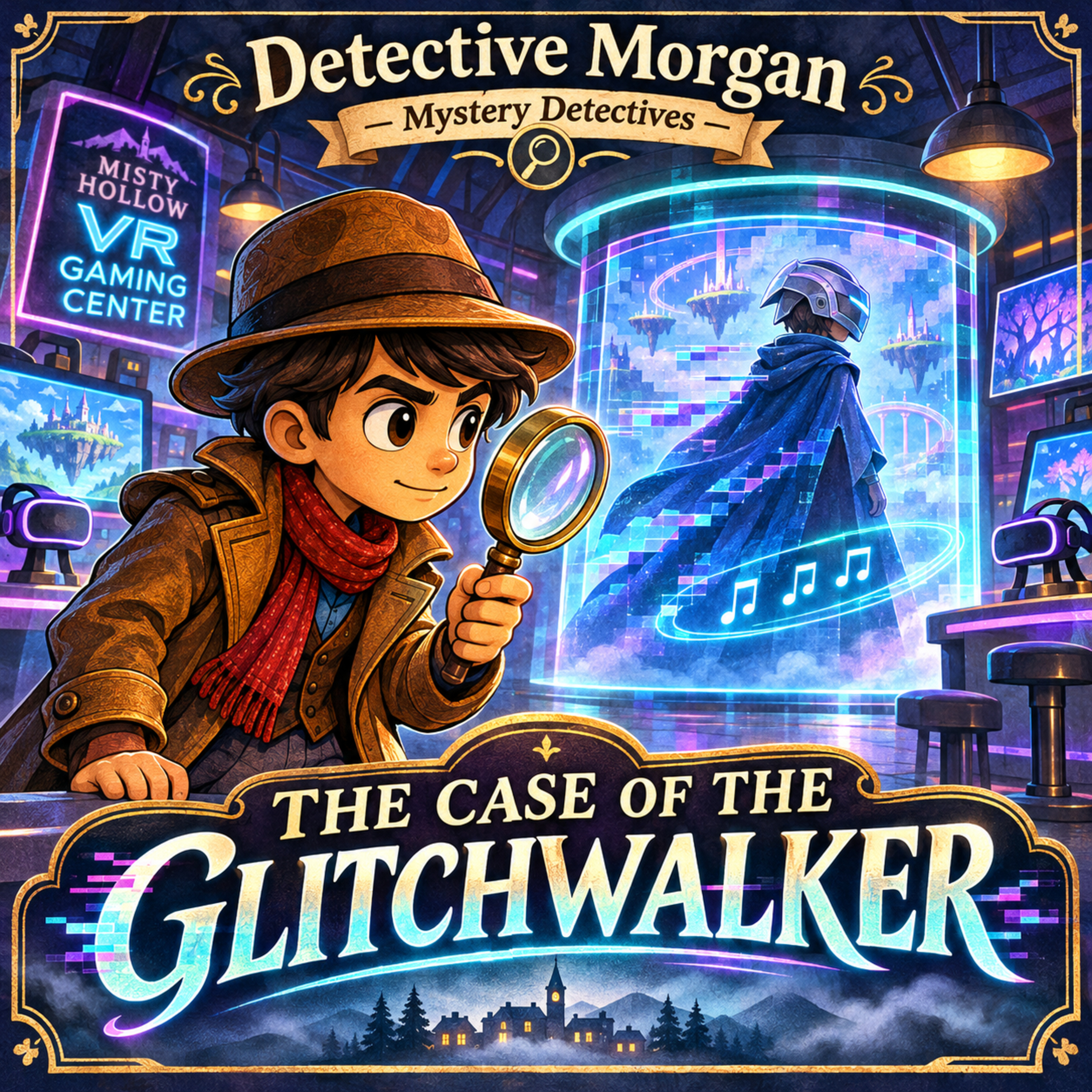
Something strange is happening at Misty Hollow's brand-new VR gaming center! Players are reporting a mysterious figure appearing inside their games. Wearing a silver helmet and a flowing blue cape, the stranger stands perfectly still... until someone approaches. Then, three strange electronic notes play, and the figure vanishes! Some say it's the Glitchwalker, a forgotten video game character wandering between virtual worlds, searching for a place to call home. But is it really a ghost in the game, a secret player, or something else entirely? Join Detective Morgan and his new friend Axel as they explore incredible virtual worlds, uncover three puzzling clues, and discover what's really happening behind the screen. Grab your detective notebook. Every mystery has a solution! A fun, interactive mystery adventure for curious kids and families.
Uploaded 11-12-17 View full lesson: https://ed.ted.com/lessons/why-is-herodotus-called-the-father-of-history-mark-robinson 2,500 years ago, the writing of history as we know it didn’t exist. The past was recorded as a list of events, with little explanation for their causes beyond accepting things as the will of the gods. Herodotus wanted a deeper understanding, so he took a new approach: looking at events from both sides to understand the reasons for them. Mark Robinson explains how “history” came into being. Lesson by Mark Robinson, directed by Remus and Kiki Thank you so much to our patrons for your support! Without you this video would not be possible! Daniel Day, Nick Johnson, Bruno Pinho, Javier Aldavaz, Rodrigo Carballo, Marc Veale, Boytsov Ilya, Bozhidar Karaargirov, Darren Toh, ilya bondarik, maxi kobi einy, Runarm , Misaki Sato, Peter Koebel, Levi Cook, Alex Kongkeo, Craig Sheldon, Andrew Bosco, Catherine Sverko, Nik Maier, Robert Sukosd, Mark Morris, Tamás Drávai, Adi V, Pet
Have you ever told someone, "Thanks a million!" or claimed you have "a million toys to clean up"? We use the word "million" all the time to mean "a whole lot," but have you ever stopped to wonder just how big a real million actually is? Join Mira and Finn on a mind-blowing math adventure as they discover the quiet power of giant numbers! Imagine counting one number every single second without ever stopping to eat or sleep. It wouldn't take a few hours or a long weekend—it would take you about eleven and a half days just to reach one million! And what about its giant neighbor, the billion? Counting to a billion the exact same way would take a whopping thirty-two years. That's a grown-up's whole life so far! In this amazing episode, we won't just look at numbers on a page; we’ll learn to feel their true size. Find out how much space a million grains of rice would take up, and discover exactly how far a million footsteps would carry you. Get ready to stretch your brain and learn why being
Have you ever played a game that entirely plays itself? Welcome to the astonishing Game of Life! Invented in 1970 by a brilliant British mathematician named John Conway at Cambridge University, this isn't a normal board game. All you need is a blank grid of squares and four super simple rules. But what happens next is pure magic—well, actually, it's maths! When you colour in a few squares and follow the rules, the patterns seem to come alive! Some shapes blink like traffic lights, some freeze forever, and one little shape called a "Glider" actually stands up and walks across the paper endlessly! The game became so famous that scientists everywhere were secretly playing it on giant computers. A team led by Bill Gosper even discovered a "Glider Gun" that shoots out new walking shapes like a factory! Join Mira and Finn as they explore this tiny, endless universe built entirely on paper. You will discover how four simple rules can explain the beautiful, unpredictable patterns in our real w
Have you ever wondered why different shapes roll in completely different ways? If you push a ball, it rolls smoothly in any direction you choose. If you push a soup can on its side, it rolls in a perfectly straight line. But if you push a party hat, it spins round and round in a circle! Why does this happen? It all comes down to a secret rule of the universe: how a shape is curved decides exactly how it moves! Join Mira and Finn as they uncover the hidden instructions built into every shape. You will learn why we don't make car wheels out of spheres, and why the wide base of a cone always outruns its pointy tip. Then, travel back to 1929 Switzerland to meet inventor Paul Schatz, who created an incredible, mind-bending new shape called the oloid! This strange, twisted shape doesn't roll straight or in a circle—it dances and wobbles, touching every single part of its skin to the ground as it moves. Get ready to look at everyday objects in a totally new way!
Public spaces should allow peaceful disagreement while preventing intimidation.
Share your view, then see how readers voted. No sign-in required. This poll is shared across stories.
Do you agree or disagree?
Common Quandary
A Common Quandary to discuss
Another conversation to explore, separate from this news story.
Your friend spent five years writing a terrible novel. What do you say?
A close friend asks for your candid opinion of a novel they have spent five years writing. You find it confusing and unlikely to be published, but writing it has given them purpose during a difficult period.
Is kindness sometimes a reason to withhold an honest judgment?