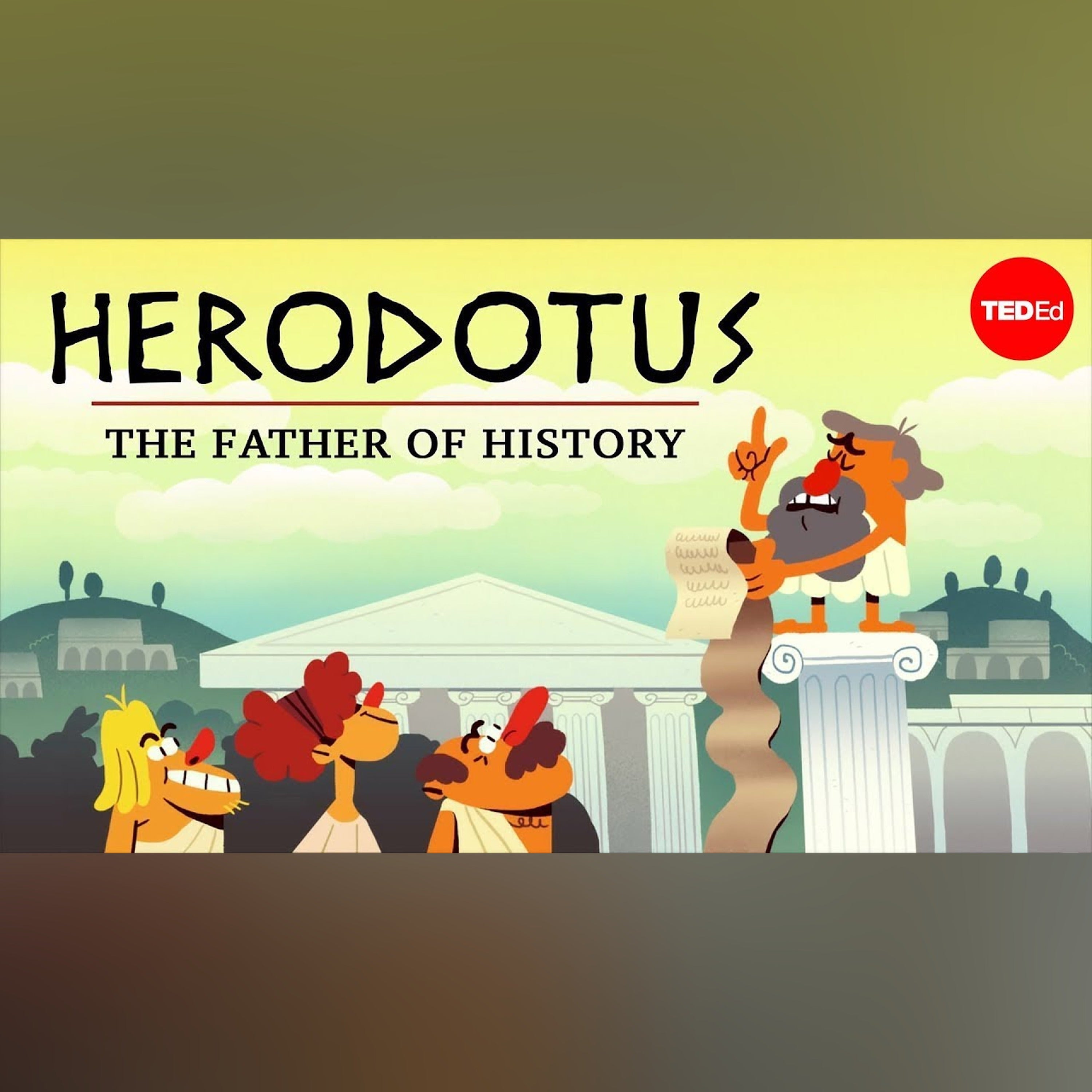
Why is Herodotus called “The Father of History”? - Mark Robinson
Listen through the publisher, then discuss the episode here or arrange an in-person Roundtable. Your city determines where to meet.
Roundtables are designed for groups of four, with a shared subject and room for everyone to speak. Come for discussion, with no dating expectation.
Uploaded 11-12-17 View full lesson: https://ed.ted.com/lessons/why-is-herodotus-called-the-father-of-history-mark-robinson 2,500 years ago, the writing of history as we know it didn’t exist. The past was recorded as a list of events, with little explanation for their causes beyond accepting things as the will of the gods. Herodotus wanted a deeper understanding, so he took a new approach: looking at events from both sides to understand the reasons for them. Mark Robinson explains how “history” came into being. Lesson by Mark Robinson, directed by Remus and Kiki Thank you so much to our patrons for your support! Without you this video would not be possible! Daniel Day, Nick Johnson, Bruno Pinho, Javier Aldavaz, Rodrigo Carballo, Marc Veale, Boytsov Ilya, Bozhidar Karaargirov, Darren Toh, ilya bondarik, maxi kobi einy, Runarm , Misaki Sato, Peter Koebel, Levi Cook, Alex Kongkeo, Craig Sheldon, Andrew Bosco, Catherine Sverko, Nik Maier, Robert Sukosd, Mark Morris, Tamás Drávai, Adi V, Peter Liu, Leora Allen, Hiroshi Uchiyama, Michal Salman, Julie Cummings-Debrot, Gilly , Ka-Hei Law, Maya Toll, JAVIER MARTINEZ LORENZO, Aleksandar Srbinovski, Jose Mamattah, Mauro Pellegrini, Ricardo Rendon Cepeda, Renhe Ji, Andrés Melo Gámez, Tim Leistikow, Moonlight , Shawar Khan, Chris , Alex Serbanescu, Megan Douglas, Barbara Smalley, Filip Dabrowski, Joe Giamartino, Clair Chen, Vik Nagjee, Karen Goepen-Wee, Della Palacios, Rui Rizzi, Bryan Blankenburg, Bah Becerra, Stephanie Perozo, Marc Bilodeau, Ruby Solorzano, Minh Tran, Ivan Tsenov, Claudia Mayfield, Justus Berberich, André Spencer, Pavel Zalevskiy, Yankai Liu, Duo Xu, Ghassan Alhazzaa, Miloš Stevanović.
Episode information is provided by the publisher. Listening takes place on the publisher’s service.
Listen at the source ↗