Listen through the publisher, then discuss the episode here or arrange an in-person Roundtable. Your city determines where to meet.
Roundtables are designed for groups of four, with a shared subject and room for everyone to speak. Come for discussion, with no dating expectation.
Imagine you have to deliver birthday invitations to ten friends in your neighborhood. Sounds super easy to find the shortest route, right? Just look at a map and go to the closest house first! But wait—what if we told you that finding the true, guaranteed shortest path is actually one of the most brain-bending mysteries in the entire universe?! Welcome to the Travelling Salesperson Problem! It turns out that for just ten stops, there are over 180,000 different possible routes you could take. And if you want to visit just a few dozen houses, there are more route choices than there are grains of sand on every beach on Earth! Join Mira and Finn as they explore this incredible math monster. Discover how supercomputers took 85 years of brainpower just to find the best route through Sweden, and why nobody in the world knows a quick math trick to solve it every time. Plus, find out how tiny, fuzzy bumblebees with brains the size of a sesame seed can solve this exact same puzzle perfectly! It is time to dive into a massive, invisible math explosion hiding in your very own neighborhood!
Episode information is provided by the publisher. Listening takes place on the publisher’s service.
Did you know your mouth is a nonstop biological water park?! Every single day, your body makes enough saliva to fill up to four whole water bottles! But spit isn't just warm water—it's a magical biological potion packed with incredible superpowers. Join Mira and Finn as they explore the wild world of saliva! Discover how a microscopic machine called amylase starts digesting your favorite foods the exact millisecond you take a bite. Find out how spit turns sharp, crunchy chips into soft, squishy balls to protect your throat! Plus, did you know saliva actually builds invisible armor for your teeth by filling in holes with special minerals like calcium and phosphate? It even works as a magical liquid key to unlock flavors—without saliva, chocolate and pizza would taste like absolute cardboard! From amazing spit factories hiding inside your cheeks to real-life birds that build entire nests out of spit, get ready for a mind-blowing biological adventure! Tune in to find out why your mouth is
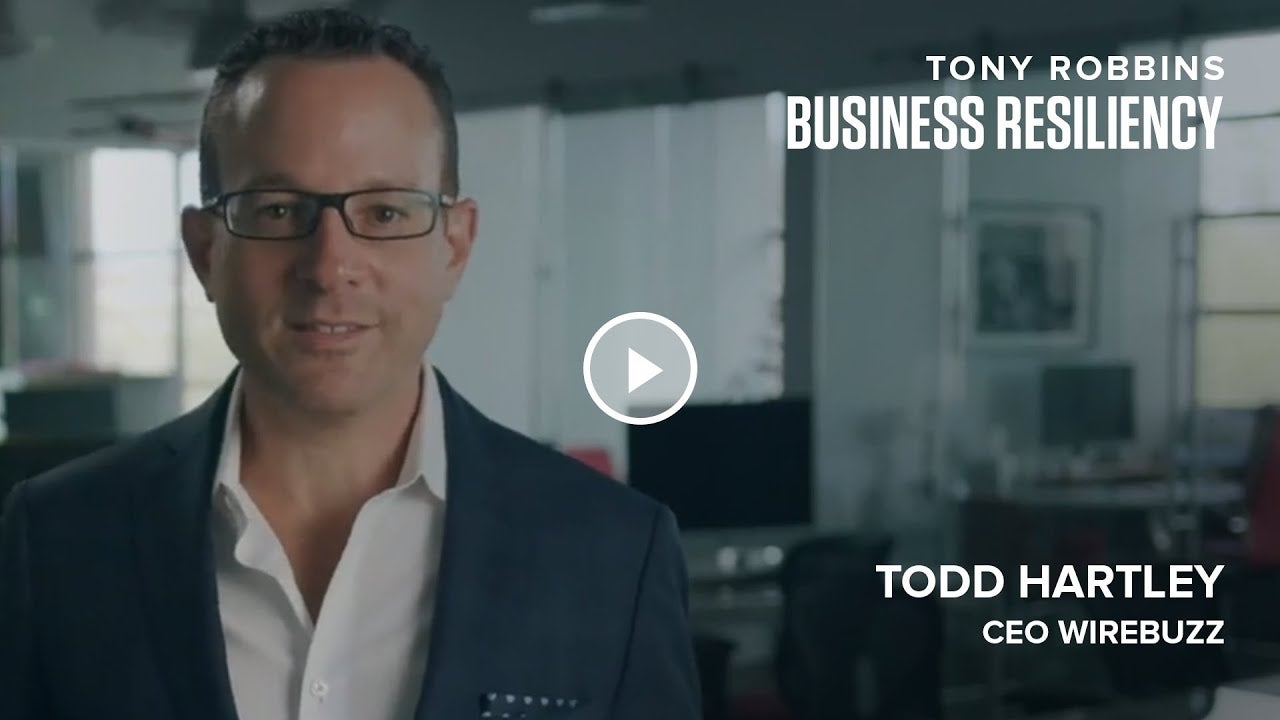
We’re living in a new world filled with new business challenges. Salesperson access is at an all-time low as prospects gravitate toward on-demand and remote buying experiences. It’s a real challenge for many businesses, but as Tony teaches, within every challenge is an opportunity. In this video you’ll hear from Todd Hartley, renowned expert in remote selling and sales optimization, on how you can better engage your prospects using new channels and strategies. Uploaded 27-04-20 As Todd shares, right now, your website needs to be your best salesperson. It must inspire people to either learn more or make a purchase. Like a superstar salesperson, it must pull your prospects through the funnel with a powerful message that leads to an on-demand buying experience. An effective sales page will deliver only the highest-quality leads to your team and ensure your business runs at peak efficiency. Discover how to build a killer team to follow up on those leads at https://www.tonyrobbins.com/ask-t
Sign up for our newsletter and never miss an animation: http://bit.ly/TEDEdNewsletter Uploaded 10-01-19 View full lesson: https://ed.ted.com/lessons/can-you-solve-the-multiplying-rabbits-riddle-alex-gendler After years of experiments, you’ve finally created the pets of the future – nano-rabbits! They’re tiny, they’re fuzzy ... and they multiply faster than the eye can see. But a rival lab has sabotaged you, threatening the survival of your new friends. Can you figure out how to avert this hare-raising catastrophe? Alex Gendler shows how. Lesson by Alex Gendler, directed by Artrake Studio. Thank you so much to our patrons for your support! Without you this video would not be possible! Dan Paterniti, Jerome Froelich, Tyler Yoshizumi, Martin Stephen, Justin Carpani, Faiza Imtiaz, Khalifa Alhulail, Tejas Dc, Benjamin and Shannon Pinder, Srikote Naewchampa, Sage Curie, Exal Enrique Cisneros Tuch, Ana Maria, Vignan Velivela, Ahmad Hyari, eden sher, Travis Wehrman, Louisa Lee, Kiara Taylor, А
Have you ever seen pictures of giant stone heads sitting in the grass and wondered how they got there? Get ready for a mind-blowing adventure to one of the most remote places on Earth: Rapa Nui, also known as Easter Island! About 800 years ago, expert Polynesian sailors found this tiny island in the middle of the Pacific Ocean using only the stars and ocean currents to guide them. Once there, they carved nearly a thousand massive stone statues called moai! But here is the biggest surprise: these statues aren't just heads—they have full bodies buried underground! Some weigh as much as 40 cars, and the islanders moved them without wheels, cranes, or metal tools. How did they do it? The local legends say the statues literally walked to their places, waddling side to side with the help of ropes and incredibly smart human engineering! Join Mira and Finn as they uncover the secrets of the moai, find out how the island got its English name from a Dutch captain, and learn all about the giganti
Viewers like you help make PBS (Thank you ) . Support your local PBS Member Station here: https://to.pbs.org/DonateSPACE Uploaded 10-10-18 Physics seems to be telling us that it’s possible to simulate the entire universe on a computer smaller than the universe. You can further support us on Patreon at https://www.patreon.com/pbsspacetime Space Time Challenge Winners Jin Du Loren Booker Kevin Selva Prasanna May Awbin John Reza Ian Grams Challenge Winners: Please [email protected] with your name, address, US t-shirt size – small, medium, large, extra large, or extra-extra-large and let us know which T you’d like. Get your own Space Time t-shirt at http://bit.ly/1QlzoBi Tweet at us! @pbsspacetime Facebook: facebook.com/pbsspacetime Email us! pbsspacetime [at] gmail [dot] com Comment on Reddit: http://www.reddit.com/r/pbsspacetime Help translate our videos! Previous Episode: How to Detect Extra Dimensions Hosted by Matt O'Dowd Written by Matt O'Dowd Graphics by Luke Maroldi Assistant
What if success isn't something you chase, but something you attract through the person you become? Real success begins with personal growth, self discipline, and the value you bring to the world. Instead of constantly searching for shortcuts or waiting for opportunities, focus on developing the skills, mindset, and character that make meaningful achievements possible. This powerful motivational speech explores timeless principles of success, wealth creation, personal development, and the importance of becoming more valuable to others. Discover why your personal growth influences your results, how daily discipline shapes your future, and why helping others achieve their goals can become one of the most powerful foundations for your own success. In this motivational journey, you'll explore: • The Attraction Principle: Why success is connected to the person you become rather than simply what you pursue. • The Marketplace Rule: How developing valuable skills and contributing to others can
Have you ever told someone, "Thanks a million!" or claimed you have "a million toys to clean up"? We use the word "million" all the time to mean "a whole lot," but have you ever stopped to wonder just how big a real million actually is? Join Mira and Finn on a mind-blowing math adventure as they discover the quiet power of giant numbers! Imagine counting one number every single second without ever stopping to eat or sleep. It wouldn't take a few hours or a long weekend—it would take you about eleven and a half days just to reach one million! And what about its giant neighbor, the billion? Counting to a billion the exact same way would take a whopping thirty-two years. That's a grown-up's whole life so far! In this amazing episode, we won't just look at numbers on a page; we’ll learn to feel their true size. Find out how much space a million grains of rice would take up, and discover exactly how far a million footsteps would carry you. Get ready to stretch your brain and learn why being
Have you ever played a game that entirely plays itself? Welcome to the astonishing Game of Life! Invented in 1970 by a brilliant British mathematician named John Conway at Cambridge University, this isn't a normal board game. All you need is a blank grid of squares and four super simple rules. But what happens next is pure magic—well, actually, it's maths! When you colour in a few squares and follow the rules, the patterns seem to come alive! Some shapes blink like traffic lights, some freeze forever, and one little shape called a "Glider" actually stands up and walks across the paper endlessly! The game became so famous that scientists everywhere were secretly playing it on giant computers. A team led by Bill Gosper even discovered a "Glider Gun" that shoots out new walking shapes like a factory! Join Mira and Finn as they explore this tiny, endless universe built entirely on paper. You will discover how four simple rules can explain the beautiful, unpredictable patterns in our real w
Have you ever wondered why different shapes roll in completely different ways? If you push a ball, it rolls smoothly in any direction you choose. If you push a soup can on its side, it rolls in a perfectly straight line. But if you push a party hat, it spins round and round in a circle! Why does this happen? It all comes down to a secret rule of the universe: how a shape is curved decides exactly how it moves! Join Mira and Finn as they uncover the hidden instructions built into every shape. You will learn why we don't make car wheels out of spheres, and why the wide base of a cone always outruns its pointy tip. Then, travel back to 1929 Switzerland to meet inventor Paul Schatz, who created an incredible, mind-bending new shape called the oloid! This strange, twisted shape doesn't roll straight or in a circle—it dances and wobbles, touching every single part of its skin to the ground as it moves. Get ready to look at everyday objects in a totally new way!
A workable temporary compromise is often better than delaying all action.
Share your view, then see how readers voted. No sign-in required. This poll is shared across stories.
Do you agree or disagree?
Common Quandary
A Common Quandary to discuss
Another conversation to explore, separate from this news story.
A stranger is behaving horribly in public. Do you record them?
You witness a stranger berating a service worker in public. Recording could create accountability and protect the worker, but posting the video could expose everyone involved to a permanent online audience.
Who gets to decide when public behavior becomes public content?