What's New in Science with Sabine and Lawrence | From White Dwarfs to Red Dots
66 min
Listen through the publisher, then discuss the episode here or arrange an in-person Roundtable. Your city determines where to meet.
Roundtables are designed for groups of four, with a shared subject and room for everyone to speak. Come for discussion, with no dating expectation.
In this episode of The Origins Podcast, Sabine and I happily didn’t discuss AI at all! A first in awhile. Instead, the topics we discussedd spanned science in three different ways. First we just discussed topics that were simply really cool.. in one case literally. We discussed a new result that showed that White Dwarfs come in all colors! Even Green (beware Superman!). Then a result from China on the coldest temperature ever produced: 8 trillionths of a degree above absolute zero. Next we discuss how in science we sometimes explore things to illuminate ideas that are really ill-defined, hoping that nature will guide our thinking. The two examples we discussed are an effort to Reverse Physics, to try and find mathematical principles that are consistent and fundamental across all of physics in order to explore where aspects of physics, like quantum mechanics, might be incomplete. The second involves trying to understand consciousness by exploring how neurons react to oscillating images in an optical illusion. Can we understand why we are conscious of one image or another when our eyes actually see both images?And finally we confront the most interesting area of science: paradoxes. Places where the data doesn’t agree with theory, or at least doesn’t appear to. The two examples we explored included a recent result from the Large Hadron Collider on the decay of particles called B-mesons, where the properties of certain very rare decays disagrees with the predictions of The Standard Model. Could this be the first inkling of new fundamental physics? Then we moved from there to discussing mysterious red dots seen in James Webb Space Telescope images. Are they images of nascent supermassive black holes in the early universe, or new types of stars with a black hole in their center? Or neither?The breadth of topics and the differences in our understanding of each illustrates why science never gets boring. Enjoy! As always, an ad-free video version of this podcast is also available to paid Critical Mass subscribers. Your subscriptions support the non-profit Origins Project Foundation, which produces the podcast. The audio version is available free on the Critical Mass site and on all podcast sites, and the video version will also be available on the Origins Project YouTube. Get full access to Critical Mass at lawrencekrauss.substack.com/subscribe (https://lawrencekrauss.substack.com/subscribe)
Episode information is provided by the publisher. Listening takes place on the publisher’s service.
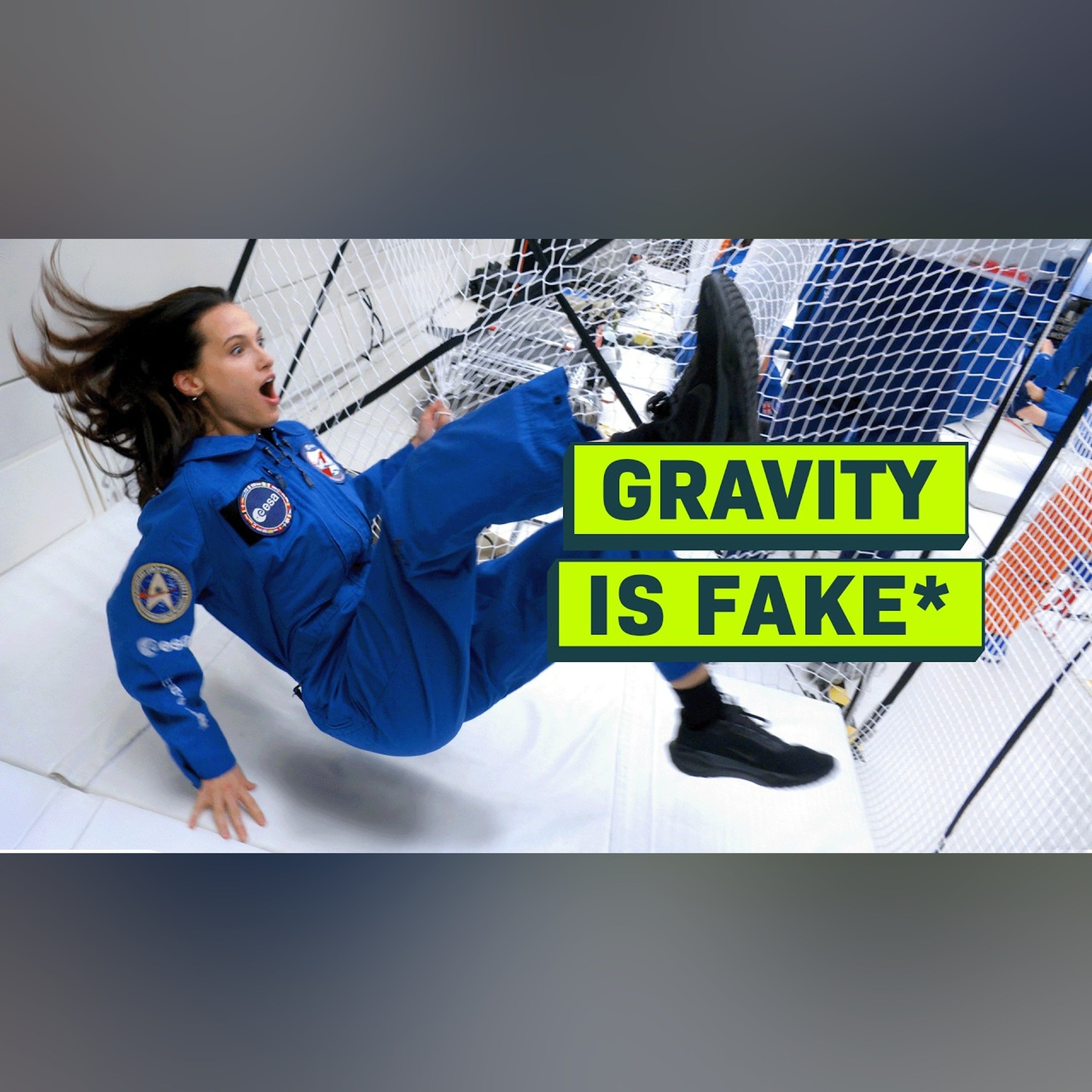
There’s a big problem with gravity… Build and learn with KiwiCo! Gravity is a lie. I went into zero gravity to explain why… But it won't be easy because gravity is actually one of the most controversial subjects in all of physics. This is not some philosophical debate. A huge amount of the tech you use every day depends on our current (limited) understanding of gravity. If we can understand gravity a little bit better, we can build more things that are huge if true! So in this video, I joined the European Space Agency on a real zero gravity flight and interviewed theoretical physicists to understand: What really IS gravity? And what are the real life sci-fi ways we might use it in the future? Chapters: 0:00 The big problem with gravity 0:58 What is a zero gravity flight? 1:40 What is gravity? 2:49 What’s Einstein’s equivalence principle? 3:40 What does zero gravity feel like? 5:52 Why is falling the same as floating? 6:58 How did gravity disappear? 9:28 Why is gravity not a force? 11:3
PBS Member Stations rely on viewers like you. To support your local station, go to: http://to.pbs.org/DonateSPACE ↓ More info below ↓ Uploaded 10-08-20 The second in our two event series about Theories of Everything! Watch the first one: https://www.youtube.com/watch?v=_izocEgArtQ Please subscribe to Brian Keating's YouTube Channel to watch one-on-one interviews with the guest speakers and more: https://www.youtube.com/DrBrianKeating Existing Theories of Everything have not yet produced experimental evidence that solves the fundamental challenges facing physics. That lack of progress has opened up a sea of controversy, from disagreements about the very necessity of TOEs, to questioning the cost/benefit of mega-billion dollar particle accelerators in search of them, to the emergence of competing TOEs from physicists outside of the academic community. In this 90 minute chat we dive into the existential questions around TOEs. Special thanks to Brian Keating, Lee Smolin, Sabine Hossenfelde
Explore how the Hubble Space Telescope reveals the Universe, from iconic images to major discoveries, and how it complements the James Webb Space Telescope. "ASTROMAN: the Dark Sky Guardian" is a podcast channel that aims to explore popular science in multiple disciplines and research on interdisciplinary approaches, such as sustainability, dark-sky protection, astrophotography, space exploration, astronomy innovation, inclusive science communication, and STEAM Education by integrating science and arts. Exodus Chun-Long Sit, also known as the ASTROMAN, is a transmedia astronomy educator, popular science author, STEAM educator, and science communicator in Hong Kong. He is recently the National Astronomy Education Coordinator (Chair of Hong Kong, China) of the International Astronomical Union and President of Starrix. He was also an International Committee Member of the Dark Sky International, regularly organizing public lectures at the Hong Kong Space Museum and the Hong Kong Science Mu
In this week's Podcast: I’ve just pumped out a 300kg barrel of honey and at the bottom was a thick, granulated layer of sugary goodness. It got me thinking about why honey granulates, the science behind it all, why that’s a good thing and how, we beekeepers, can use it to our advantage. Hi, I’m Stewart Spinks, welcome to Episode 418 of my podcast, Beekeeping Short and Sweet. References: Manikis, I., & Thrasivoulou, A. (2001). The relation of physicochemical characteristics of honey and the crystallization rate. Apiacta, 36(2), 106–112. Escuredo, O., Míguez, M., Fernández-González, M., & Seijo, M. C. (2014). Nutritional value and antioxidant activity of honeys produced in a European Atlantic area. Food Chemistry, 154, 44–51. Venir, E., Spaziani, M., & Maltini, E. (2010). Crystallization in “Tarassaco” (Dandelion) Italian honey studied by DSC. Food Chemistry, 122(2), 410–415. Krishnan, R., Mohammed, T., Kumar, G. S., & Arunima, S. H. (2021). Honey crystallization: Mechanism, evaluation a
For some reason, it did not stop him.Now I just want to ask you something real quick to put you in the mind of a bear. If you found some of your favorite food just left out and you somehow, like me most of the time, just couldn’t resist the temptation. Bears live and eat by what is detected by their noses, so logically, after eating its fill, a proper expectation would be that the bear would go sleep off a large meal upwind of where its food was cached. The wind carries both scent and sound to the bear as it rests and acts as an alarm to it to defend its cache. The hide was still up in the birch, untouched. He dropped his packboard at the base of the tree and glanced up to see where he would need to climb. Movement in the brush, some three hundred feet away, caught his eye. Two bears, roughly thirty feet apart, moved through the brush. From their color and build, he identified them as grizzlies, also called coastal brown bears.Up to that day, every bear he had met in the wild had chose
If you appreciate nuanced science and learning about human metabolism, check out StayCurious Metabolism, now a Top Overall Best-Seller in Science globally: https://staycuriousmetabolism.com (https://staycuriousmetabolism.com/) Start by checking out the Heart Health Archives. Papers: Seven Years of 700 Cholesterol Without Coronary Atherosclerosis: https://www.mdpi.com/2079-9721/14/5/168 Lipid Energy Model: https://pubmed.ncbi.nlm.nih.gov/35629964/ Oreo vs Statin Paper: https://pubmed.ncbi.nlm.nih.gov/38276308/ Cholesterol Code Movie: https://cholesterolcodemovie.com (https://cholesterolcodemovie.com/) Description For seven years, I’ve been living with cholesterol levels that most doctors would say should have killed me by now — not just high, but astronomical — and I did it intentionally because I believe there’s something fundamentally misunderstood about cholesterol, heart disease, and people like me that modern medicine doesn’t understand. If I’m right, the implications could challen
Many of the same questions that provoke our imagination about our universe today were asked by the ancients. How did the universe begin? What is it made of? etc. What is particularly interesting is how the ancients addressed the question of how to get something from nothingness, and ultimately how the notion of the aether evolved. In this lecture I discuss the ancient greek philosophers’ ideas of the stuff of matter and the origin of the universe, and contrast that with our modern understanding. While our modern picture of the universe is vastly different than that of the ancients and we dispensed with the idea of an aether in the early 20th century, we have now replaced it with something even stranger, in which the dominant energy of the universe is contained in empty space. In some ways, the more things change, the more they stay the same. And the most beautiful thing of all is that the mysteries continue... As always, an ad-free video version of this podcast is also available to pai
Students should help shape decisions about what and how they learn.
Share your view, then see how readers voted. No sign-in required. This poll is shared across stories.
Do you agree or disagree?
Common Quandary
A Common Quandary to discuss
Another conversation to explore, separate from this news story.
You both hate the invitation. Which partner has to become the excuse?
A couple receives an invitation neither wants to accept. One suggests claiming the other is ill, reasoning that friends will question a vague excuse but respect sickness. The proposed patient dislikes lying but also wants to stay home.
Is a shared lie fair when only one person's reputation carries it?