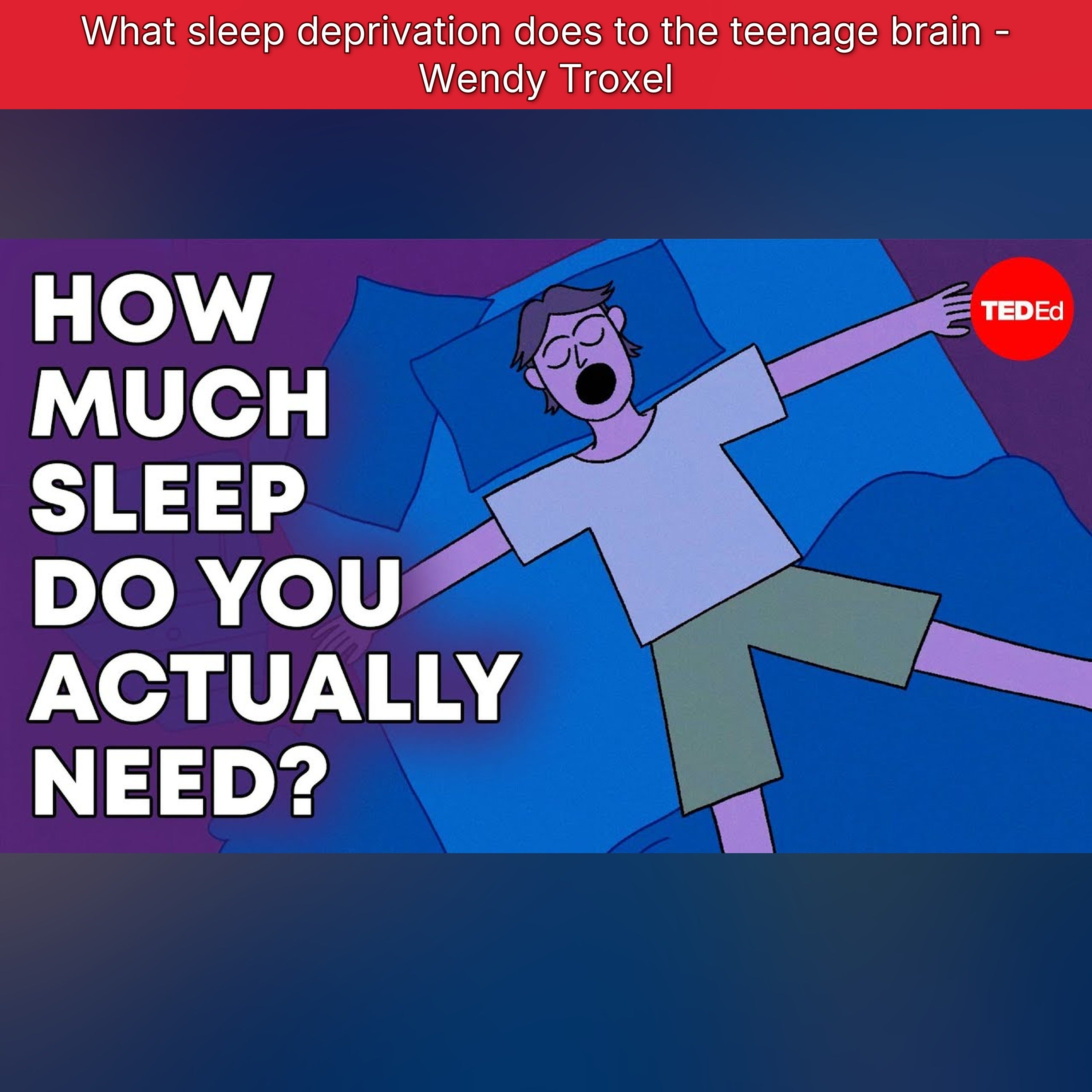
What sleep deprivation does to the teenage brain - Wendy Troxel
Listen through the publisher, then discuss the episode here or arrange an in-person Roundtable. Your city determines where to meet.
Roundtables are designed for groups of four, with a shared subject and room for everyone to speak. Come for discussion, with no dating expectation.
Dig into how sleep deprivation affects the teenage body and brain, and what can be done to help adolescents get enough sleep. -- Sleep deprivation among American teenagers is an epidemic. Only about 1 in 10 teens gets the 8 to 10 hours of sleep per night recommended by sleep scientists and pediatricians. So, what’s going on? And what changes can be made to address this issue? Wendy Troxel shares how early school start times and public policy are depriving adolescents of sleep at a time when they need it most. Directed by Laura Jayne Hodkin. This is an animated adaptation of a TEDx Talk given by Wendy Troxel. You can watch the talk in full here: https://www.youtube.com/watch?v=TS6lFDVR-3g Education is the ultimate idea worth spreading. That’s why we’ve launched InnovaTED — a program that helps educators develop their brightest ideas and share them with the world. Learn more: https://ed.ted.com/edtalks Support Our Non-Profit Mission ---------------------------------------------- Support us on Patreon: http://bit.ly/TEDEdPatreon Check out our merch: http://bit.ly/TEDEDShop ---------------------------------------------- Connect With Us ---------------------------------------------- Sign up for our newsletter: http://bit.ly/TEDEdNewsletter Find us on Twitter: http://bit.ly/TEDEdTwitter Peep us on Instagram: http://bit.ly/TEDEdInstagram ---------------------------------------------- Keep Learning ---------------------------------------------- View full lesson: https://ed.ted.com/lessons/what-sleep-deprivation-does-to-the-teenage-brain-wendy-troxel Dig deeper with additional resources: https://ed.ted.com/lessons/what-sleep-deprivation-does-to-the-teenage-brain-wendy-troxel/digdeeper Animator's website: https://laurajaynehodkin.com (https://laurajaynehodkin.com/) ---------------------------------------------- Thank you so much to our patrons for your support! Without you this video would not be possible! Hans Peng, Gaurav Mathur, Erik Biemans, Tony, Michelle, Katie and Josh Pedretti, Hoai Nam Tran, Kack-Kyun Kim, Michael Braun-Boghos, zjweele13, Anna-Pitschna Kunz, Edla Paniguel, Thomas Mungavan, Jaron Blackburn, Venkat Venkatakrishnan, ReuniteKorea, Aaron Henson, Rohan Gupta, Begum Tutuncu, Brian Richards, Jørgen Østerpart, Tyron Jung, Carsten Tobehn, Katie Dean, Ezgi Yersu, Gerald Onyango, alessandra tasso, Doreen Reynolds-Consolati, Manognya Chakrapani, Ayala Ron, Eunsun Kim, Phyllis Dubrow, Ophelia Gibson Best, Paul Schneider, Joichiro Yamada, Henrique Cassús, Karthik Cherala, Clarence E. Harper Jr., Vignan Velivela, Ana Maria, Exal Enrique Cisneros Tuch, Tejas Dc, Khalifa Alhulail, Martin Stephen, Jose Henrique Leopoldo e Silva, Mandeep Singh, Abhijit Kiran Valluri, Morgan Williams, Devin Harris, Pavel Zalevskiy, Karen Goepen-Wee, and Filip Dabrowski.
Episode information is provided by the publisher. Listening takes place on the publisher’s service.
Listen at the source ↗