Listen through the publisher, then discuss the episode here or arrange an in-person Roundtable. Your city determines where to meet.
Roundtables are designed for groups of four, with a shared subject and room for everyone to speak. Come for discussion, with no dating expectation.
Former DOJ antitrust leadership Jonathan Kanter and Doha Mekki discuss exiting the Justice Department to launch FluxCap, an AI platform designed for complex litigation. They break down the shift from standard legal tech to specialized investigative AI, the post-election regulatory landscape, and why prosecutors must learn to interrogate algorithms. -- Follow MTS: Spotify |https://open.spotify.com/show/4HUNNmV1pjV7CW6Lphm1rM Apple |https://podcasts.apple.com/us/podcast/mts/id1891088763 Interested in sponsoring the show? [email protected] – Brought to you by: Mongo DB - Anyone can prototype an agent. Lovable - Turn ideas into software people love with Lovable. Start today at https://lovable.dev/ Larridin - Finally prove what your AI investment is worth. Neon (by Databricks) - Get up to $100K in credits for your startup at https://neon.com/mts (https://neon.com/mts%E2%81%A0) Kong - The AI connectivity platform. Head over to http://getvcx.com (http://getvcx.com/) to learn more Ship 5x faster. https://blitzy.com (https://blitzy.com/) AdQuick - Make your brand a billboard. – Timestamps: (00:00) Introduction (00:44) Leaving DOJ to Build FluxCap (02:17) Why Big Legal Tech Fails (05:23) Policing AI-Driven Monopolies (09:58) Election Shifts and Tech Regulation (13:19) Interrogating Algorithms in Modern Litigation (16:12) Deep Tech Deployment and Timelines (17:47) Scaling Beyond Antitrust Practice Areas –
Episode information is provided by the publisher. Listening takes place on the publisher’s service.
Google’s Gemini Neon edged out Fable on a coding benchmark, but its best pitch may be as a second opinion. NLW shares how Neon helped him find the story in an oil episode that Claude and ChatGPT kept turning into a Wikipedia entry, and what happened when he pushed back on its ideas. In the headlines: Anthropic closes its first day of trading up 17%, and Chinese AI labs warn that new U.S. chip restrictions could delay model releases. LATEST EPISODE: How We Got Here - 'How GTA 6 Explains America" Brought to you by: Gartner - AI strategy, trends and insights - https://www.gartner.com/ai Granola - The AI notepad for people in back-to-back meetings. Try it free granola.ai/brief (http://granola.ai/brief) Newsletter: https://aidailybrief.beehiiv.com/ Interested in sponsoring the show? [email protected]
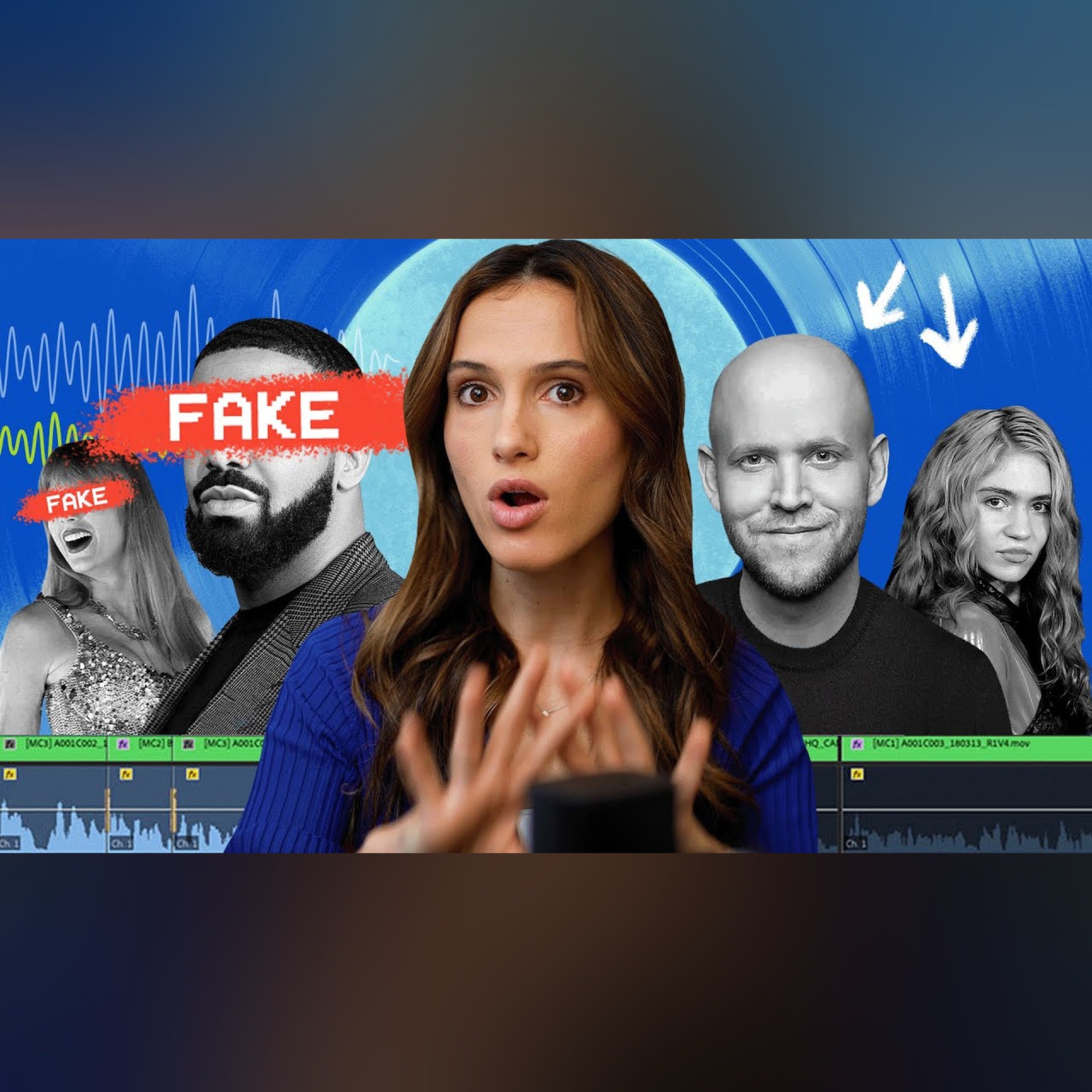
When should artists get paid in a world with AI music? Artificial intelligence is changing how music gets made - and how musicians get paid. AI is letting people clone artists’ voices, create completely new songs as fake collaborations, generate lyrics in seconds, even produce full tracks just by typing in a few words. It’s all causing some to say AI will be “the death of music.” Technology causes turning points in history. And I think we’re in one right now for music. The stakes are high: If we get this wrong, we could jeopardize how human musicians make money and art. But if we get it right, we have an opportunity to leap ahead in how we as humans get to express ourselves. To really understand what’s happening with AI music, you need to understand how the music industry ALREADY works - and how it could be changing. In this video, I took a deep dive into that topic with the help of two people right in the thick of it: The artist Grimes and CEO of Spotify Daniel Ek. Chapters: 00:00 Wha
Project Synapse: Markets in Freefall, Fragile Infrastructure, and AI's Perfect Storm The hosts banter through the show's intro before focusing on a sense that "things are out of control," citing a WallStreetBets suicide-hotline post amid a market crash and discussing cascading system failures involving Microsoft, the FAA, and a reported NSA internal communications outage. They argue politicians and leadership lack technical competence and clear messaging, increasing panic, while emphasizing that many problems stem from aging, underfunded infrastructure and complex, brittle software (PHP, NGINX, Java), not proven AI attacks—more a "perfect storm" of crises. They debate whether AI should help fix complexity, stressing critical thinking, accountability, and using multiple AIs to verify each other. In a lightning round they cover Anthropic's IPO performance, mixed reactions and token limits with ChatGPT 6.2 (favoring "Sol" over "Astra"), Google's cheaper Neon model and confusing UX, Loblaw
About 10 hours of fully charging and draining a battery is currently needed to assess its health, adding a barrier to reuse. I explain the alternative in plain terms: short electrical pulses go into each cell, and software reads the response to assess its condition. The UNSW prototype works with LFP and nickel-based NMC batteries, which matters to recyclers handling whatever arrives—but real-battery trials still lie ahead.
There is a corruption at the heart of American politics, caused by the dependence of Congressional candidates on funding from the tiniest percentage of citizens. That's the argument at the core of this blistering talk by legal scholar Lawrence Lessig. With rapid-fire visuals, he shows how the funding process weakens the Republic in the most fundamental way, and issues a rallying bipartisan cry that will resonate with many in the U.S. and beyond. Uploaded 23-08-13 Talk by Lawrence Lessig.
Malo Bourgon, CEO of the Machine Intelligence Research Institute (MIRI), explains why the organization pivoted away from technical alignment research toward communications and Washington, D.C. governance to buy time before superintelligence arrives. He argues that AI capabilities are scaling more predictably than fundamental alignment breakthroughs, leaving humanity unprepared if superintelligence arrives within one to five years, and contends that frontier labs will not reliably slow down on their own due to competitive pressures and deceptive alignment risks. -- MTS chronicles the singularity, live. Monitoring the situation of tech and AI. Follow MTS: Spotify |https://open.spotify.com/show/4HUNNmV1pjV7CW6Lphm1rM Apple |https://podcasts.apple.com/us/podcast/mts/id1891088763 – Brought to you by: Mongo DB - Anyone can prototype an agent. Lovable - Turn ideas into software people love with Lovable. Start today at https://lovable.dev/ Factory - A 24/7 system turning signals into productio
Asana Chief Product Officer Arnab Bose discusses how enterprises deploy human-agent teams in production, why organizational alignment is the primary bottleneck over raw model intelligence, and how self-driving organizations will materialize by 2027. He also shares concrete customer results from FedEx and Washmen and explains how Asana’s own R&D team is expanding rather than shrinking as AI accelerates product development. MTS chronicles the singularity, live. Monitoring the situation of tech and AI. Follow MTS: Spotify |https://open.spotify.com/show/4HUNNmV1pjV7CW6Lphm1rM Apple |https://podcasts.apple.com/us/podcast/mts/id1891088763 – Brought to you by: Mongo DB - Anyone can prototype an agent. Lovable - Turn ideas into software people love with Lovable. Start today at https://lovable.dev/ Factory - A 24/7 system turning signals into production software. Visithttps://factory.com/ Neon (by Databricks) - Scale your startup on Neon. The Postgres backend for apps and agents. Built by Datab
Kyle Chan, a fellow at the Brookings Institution and author of the newsletter High Capacity, breaks down the shifting US-China AI landscape. He discusses Trump’s APEC summit with Xi Jinping, China’s push for an indigenous semiconductor supply chain, Beijing’s pullback from open-source frontier models like Qwen 4 Max over cyber risks, and how Nvidia’s ecosystem will change without Jensen Huang. MTS chronicles the singularity, live. Monitoring the situation of tech and AI. Follow MTS: Spotify |https://open.spotify.com/show/4HUNNmV1pjV7CW6Lphm1rM Apple |https://podcasts.apple.com/us/podcast/mts/id1891088763 – Brought to you by: Mongo DB - Anyone can prototype an agent. Lovable - Turn ideas into software people love with Lovable. Start today at https://lovable.dev/ Factory - A 24/7 system turning signals into production software. Visithttps://factory.com/ Neon (by Databricks) - Scale your startup on Neon. The Postgres backend for apps and agents. Built by Databricks.https://neon.com/mtshtt
Public spaces should allow peaceful disagreement while preventing intimidation.
Share your view, then see how readers voted. No sign-in required. This poll is shared across stories.
Do you agree or disagree?
Common Quandary
A Common Quandary to discuss
Another conversation to explore, separate from this news story.
Your neighbor's doorbell camera watches everyone entering your home. Is that their business?
A neighbor installs a doorbell camera that records your front yard and every visitor entering your home. They say the wide angle is necessary to capture package theft and the footage is rarely reviewed.
Where should private security stop in a shared public view?