English-language podcasts

TED-Ed

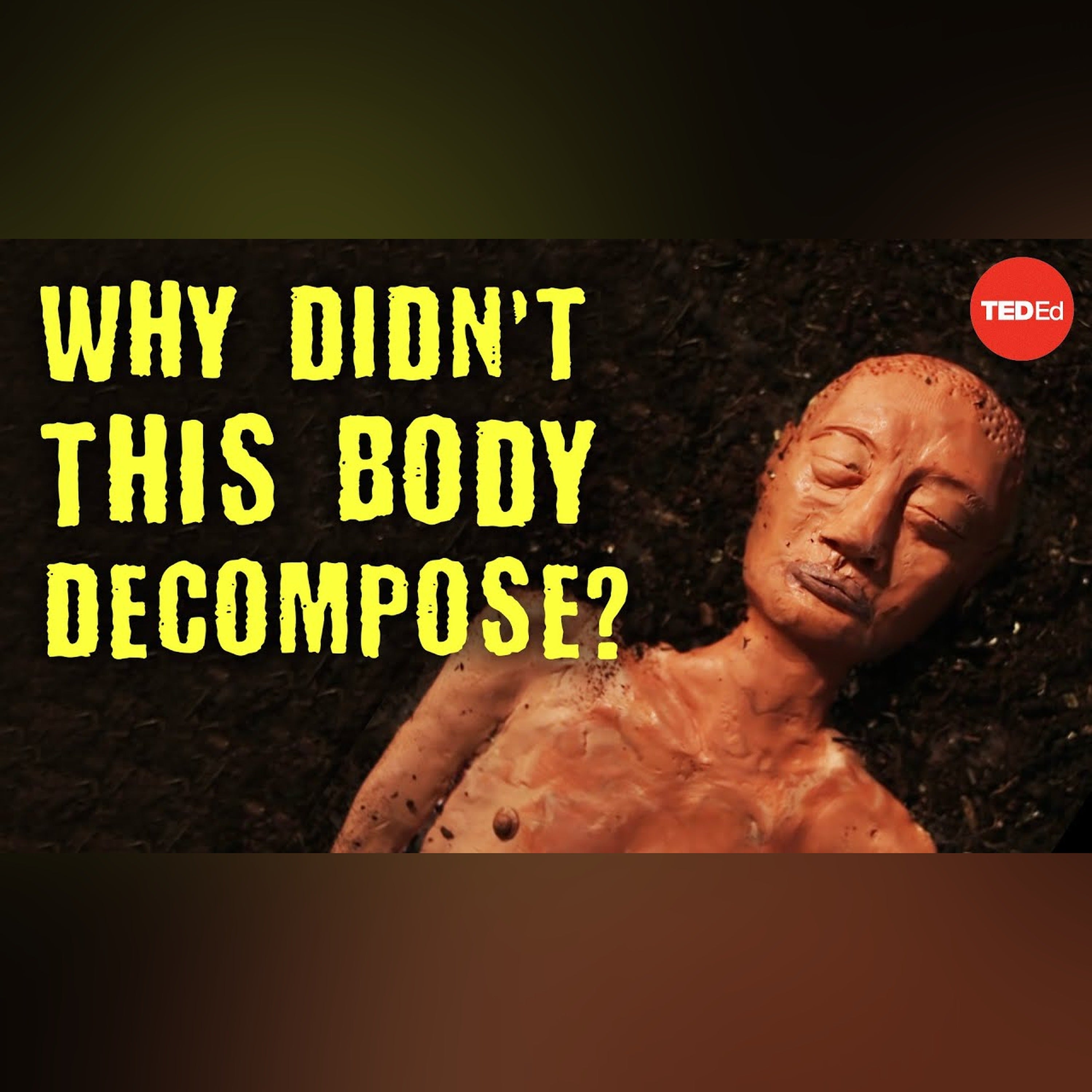
Why didn’t this 2,000 year old body decompose? - Carolyn Marshall
7 min

Listen through the publisher, then discuss the episode here or arrange an in-person Roundtable. Your city determines where to meet.

Roundtables are designed for groups of four, with a shared subject and room for everyone to speak. Come for discussion, with no dating expectation.

Discover the surprising biodiversity of soil, and how its microbes help support all life on Earth. Uploaded 04-02-21 -- It may not appear very lively six feet underground, but a single teaspoon of soil contains more organisms than there are human beings on the planet. From bacteria and algae to fungi and protozoa, soils are home to one quarter of Earth’s biodiversity. And perhaps soil’s most important inhabitants are its microbes. Carolyn Marshall digs into how soil’s invisible helpers support all life on Earth. Lesson by Carolyn Marshall, directed by Ivana Bošnjak and Thomas Johnson. Support Our Non-Profit Mission ---------------------------------------------- Support us on Patreon: http://bit.ly/TEDEdPatreon Check out our merch: http://bit.ly/TEDEDShop ---------------------------------------------- Connect With Us ---------------------------------------------- Sign up for our newsletter: http://bit.ly/TEDEdNewsletter Find us on Twitter: http://bit.ly/TEDEdTwitter Peep us on Instagram: http://bit.ly/TEDEdInstagram ---------------------------------------------- Keep Learning ---------------------------------------------- View full lesson: https://ed.ted.com/lessons/why-didn-t-this-2-000-year-old-body-decompose-carolyn-marshall Dig deeper with additional resources: https://ed.ted.com/lessons/why-didn-t-this-2-000-year-old-body-decompose-carolyn-marshall#digdeeper (https://ed.ted.com/lessons/why-didn-t-this-2-000-year-old-body-decompose-carolyn-marshall) ---------------------------------------------- Thank you so much to our patrons for your support! Without you this video would not be possible! Karthik Cherala, Joshua Merchant, Clarence E. Harper Jr., Clarissa Bartolini-Toro, Exal Enrique Cisneros Tuch, Srikote Naewchampa, Tejas Dc, Khalifa Alhulail, Martin Stephen, Dan Paterniti, Jose Henrique Leopoldo e Silva, Elnathan Joshua Bangayan, Jayant Sahewal, Mandeep Singh, Abhijit Kiran Valluri, Morgan Williams, Kris Siverhus, Devin Harris, Joy Love Om, Pavel Zalevskiy, Marc Bilodeau, Karen Goepen-Wee, Filip Dabrowski, Barbara Smalley, Megan Douglas, Chris, Tim Leistikow, Renhe Ji, Ka-Hei Law, Leora Allen, Mark Morris, Misaki Sato, EdoKun , Boytsov Ilya, SookKwan Loong, Bev Millar, Lex Azevedo, Noa Shore, Kyle Nguyen, Michael Aquilina, MJ Tan Mingjie, Dawn Jordan, Prasanth Mathialagan, Samuel Doerle, David Rosario, Siamak H, Manav parmar, David Lucsanyi, Anthony Kudolo and Ryohky Araya.

Episode information is provided by the publisher. Listening takes place on the publisher’s service.

Listen at the source ↗

Featured places to meet in Palo Alto, CA

Explore these places and arrange a conversation through ThinkMatch.

City guide for Palo Alto, CA

More from TED-Ed

TED-Ed

Withstanding a nuclear attack - Irwin Redlener

33 min

View full lesson: http://ed.ted.com/lessons/surviving-a-nuclear-attack-irwin-redlener The face of nuclear terror has changed since the Cold War, but disaster-medicine expert Irwin Redlener reminds us the threat is still real. He looks at some of history's farcical countermeasures and offers practical advice on how to survive an attack. Talk by Irwin Redlener.

Discuss this episode

TED-Ed

The true reason polio poses such a threat

10 min

Explore what makes polio so dangerous, what is causing the 21st century resurgence of cases, and how we can eradicate the disease. -- In 1952, polio was everywhere: killing or paralyzing roughly half a million people annually. Yet just 10 years later, paralytic polio cases in the US dropped by 96% and we were on track to get rid of polio for good. But in recent years, the virus started striking back. So, what’s behind these recent spikes? Explore the dangers of poliovirus and the possibility of eradicating this deadly disease. Directed by Anton Bogaty. This video made possible in collaboration with Gates Ventures Learn more about how TED-Ed partnerships work: https://bit.ly/TEDEdPartner A special thanks to Ananda Bandyopadhyay, Amber Zeddies, and Kathleen O'Reilly who provided information and insights for the development of this video. Support Our Non-Profit Mission ---------------------------------------------- Support us on Patreon: http://bit.ly/TEDEdPatreon Check out our merch: htt

Discuss this episode

TED-Ed

How to fool a GPS - Todd Humphreys

21 min

Todd Humphreys forecasts the near-future of geolocation when millimeter-accurate GPS "dots" will enable you to find pin-point locations, index-search your physical possessions ... or to track people without their knowledge. And the response to the sinister side of this technology may have unintended consequences of its own. (Filmed at TEDxAustin.) Uploaded 26-06-13 Talk by Todd Humphreys.

Discuss this episode

Community Poll

Long-term public borrowing should account for the burden placed on future generations.

Share your view, then see how readers voted. No sign-in required. This poll is shared across stories.

Do you agree or disagree?

Choose one answer

Common Quandary

A Common Quandary to discuss

Another conversation to explore, separate from this news story.

Your family connection could get your child into their dream school. Do you use it?

A university argues that considering family ties builds loyalty and encourages donations that fund scholarships. Critics say the preference preserves inherited advantage and takes places from stronger applicants.

Can benefits to the whole institution justify an unequal admissions advantage?

Explore this quandary