Why do cockroaches prove so hard to kill? - Ameya Gondhalekar
Listen through the publisher, then discuss the episode here or arrange an in-person Roundtable. Your city determines where to meet.
Roundtables are designed for groups of four, with a shared subject and room for everyone to speak. Come for discussion, with no dating expectation.
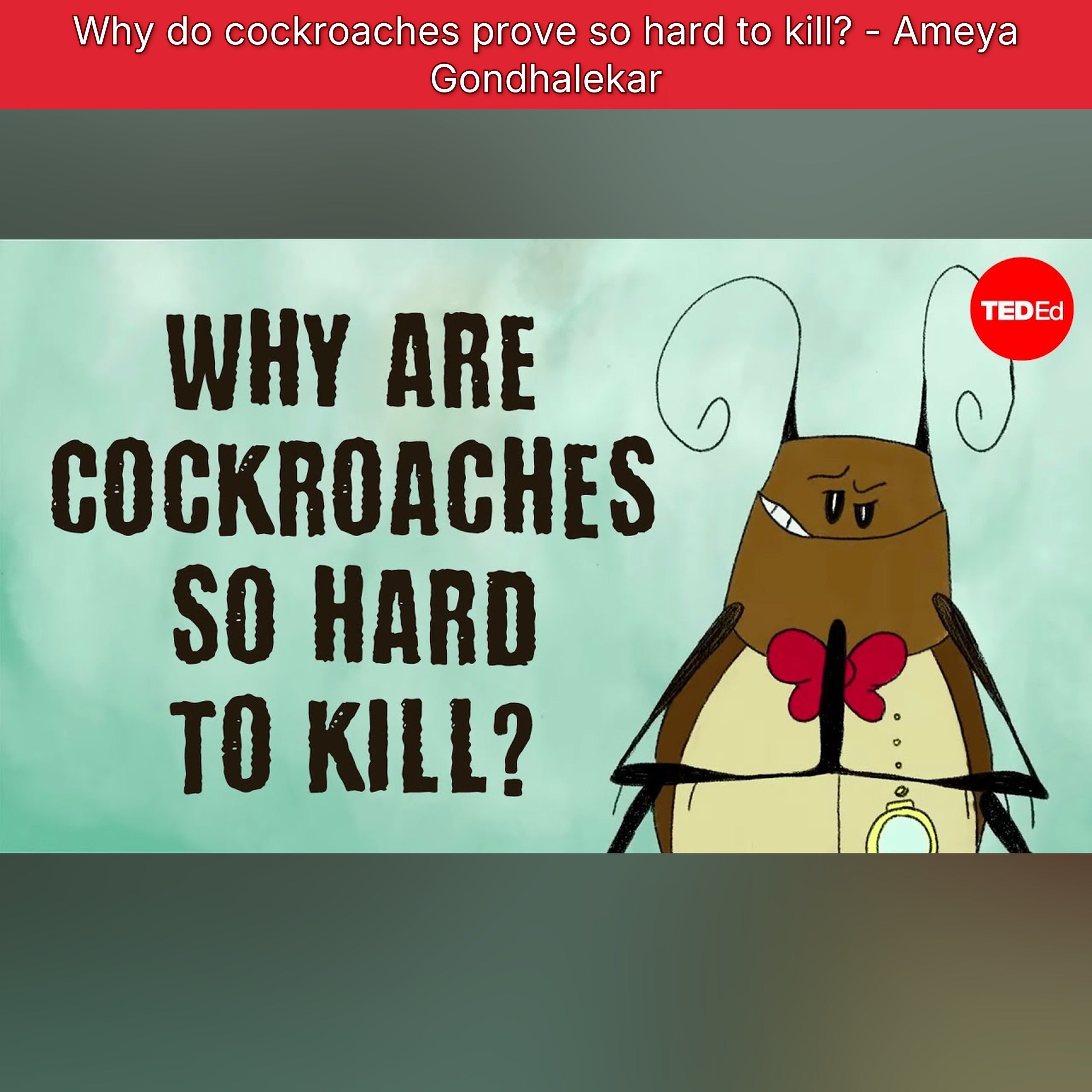
Dig into the genetic adaptations of cockroaches, and find out what makes it so hard to get rid of these tenacious creatures. -- In ancient Egypt, there was a spell that declared, “Be far from me, O vile cockroach.” Thousands of years later, we’re still trying to oust these insects. But from poison traps to brandished slippers, cockroaches seem to weather just about everything we throw at them. So, what makes cockroaches so hard to kill? Ameya Gondhalekar digs into the genetic wonders of this troublingly tenacious creature. Lesson by Ameya Gondhalekar, directed by Irida Zhonga. In order to visualize and dramatize the lives of these fascinating creatures, the artists have chosen to playfully anthropomorphize cockroaches. In real life cockroaches don’t dine like humans, go shopping for organic matter, and most unfortunately, don’t wear lederhosen (at least, to the best of our knowledge). Support Our Non-Profit Mission ---------------------------------------------- Support us on Patreon: http://bit.ly/TEDEdPatreon Check out our merch: http://bit.ly/TEDEDShop ---------------------------------------------- Connect With Us ---------------------------------------------- Sign up for our newsletter: http://bit.ly/TEDEdNewsletter Find us on Twitter: http://bit.ly/TEDEdTwitter Peep us on Instagram: http://bit.ly/TEDEdInstagram ---------------------------------------------- Keep Learning ---------------------------------------------- View full lesson: https://ed.ted.com/lessons/why-are-cockroaches-so-hard-to-kill-ameya-gondhalekar Dig deeper with additional resources: https://ed.ted.com/lessons/why-are-cockroaches-so-hard-to-kill-ameya-gondhalekar#digdeeper (https://ed.ted.com/lessons/why-are-cockroaches-so-hard-to-kill-ameya-gondhalekar) Animator's website: http://www.iridazhonga.com (http://www.iridazhonga.com/) Music & sound: https://www.philbrookes.com (https://www.philbrookes.com/) & https://www.instagram.com/philbrookesuk ---------------------------------------------- Thank you so much to our patrons for your support! Without you this video would not be possible! Maxwell Ramsby, Dmitry Yuryev, Denis Chon, Julian Oberhofer, Monte Carroll, Eddy, Jay M, Constantino Victor Delgado, Andrea Galvagni, Andrew Tweddle, Laurel-Ann Rice, Fernando A. Endo, Helen Lee, pam morgan, sarim haq, Juan Pablo Rodriguez Morales, ANNE FINE, Gerardo Castro, Siddharth Toshniwal, Michel-Ange Hortegat, Enes Kirimi, Amaury BISIAUX, Aravind C V, ND, Samyogita Hardikar, Vanessa Graulich, Vandana Gunwani, LvL042, Abdulmohsin Almadi, Andrew Brodski, AJ Lyon, Anandha Krishnan, Geoffrey Bultitude, Mi Mi, Thomas Rothert, Christopher McVay, Carlo Solaroli, Javier Aldavaz, Ivan Yeung, Brian Elieson, Grayson Garbarino, Oge O, Weronika Falkowska, Stefano Esposito, Nevin Spoljaric, Yvonne Feijoo, Sid Chanpuriya, Arjay Arcinue Dineros, Anoom Yasmin and Anoop Varghese.
Episode information is provided by the publisher. Listening takes place on the publisher’s service.
Listen at the source ↗