Why Foundational Math Still Matters in the AI Era | Math Academy
44 min
Listen through the publisher, then discuss the episode here or arrange an in-person Roundtable. Your city determines where to meet.
Roundtables are designed for groups of four, with a shared subject and room for everyone to speak. Come for discussion, with no dating expectation.
Justin Skycak from Math Academy discusses recent AI math breakthroughs like the Riemann hypothesis and Navier-Stokes, arguing that LLMs act as a skill multiplier rather than a replacement for human expertise. He explains why foundational math skills remain essential to avoid being led astray by AI, and breaks down the cognitive science behind Math Academy’s adaptive learning system, including mastery learning and spaced repetition. MTS chronicles the singularity, live. Monitoring the situation of tech and AI. Follow MTS: Spotify |https://open.spotify.com/show/4HUNNmV1pjV7CW6Lphm1rM Apple |https://podcasts.apple.com/us/podcast/mts/id1891088763 – Brought to you by: Mongo DB - Anyone can prototype an agent. Lovable - Turn ideas into software people love with Lovable. Start today at https://lovable.dev/ Visithttps://factory.com/ Neon (by Databricks) - Scale your startup on Neon. The Postgres backend for apps and agents. Head over to http://getvcx.com (http://getvcx.com/) to learn more Kong - The AI connectivity platform. Larridin - Finally prove what your AI investment is worth. Ship 5x faster. https://blitzy.com (https://blitzy.com/) AdQuick - Make your brand a billboard. Horizon3 - Don't assume you're secure. Prove it. Go hack yourself with AI. https://horizon3.ai/nodezero/ SRS Acquiom - Delivering shareholder rep, payments, and escrow solutions that streamline how deals get done https://www.srsacquiom.com/mts – Timestamps: (00:00) Introduction (00:59) AI Solving the Riemann Hypothesis (02:42) Future of AI in Math (10:01) AI Multiplies Human Expertise (13:02) Why Learning Math Still Matters (15:00) Inside Math Academy’s Learning System (23:17) How Spaced Repetition Works (29:26) Using AI to Learn Faster –
Episode information is provided by the publisher. Listening takes place on the publisher’s service.
Myke and Jason review the iPhone Duo after one month of heavy use, including the results of Apple's rapid Duo software updates. Also, Apple staffs up for AI, Full Disk Access is redefined, and Apple's AI limits are puzzling. This episode of Upgrade is sponsored by: Fitbod (http://fitbod.me/upgrade): Get stronger, faster with a fitness plan that fits you. Sentry (https://sentry.io/): Mobile crash reporting and app monitoring. New users get $100 in Sentry credits with code upgrade26. Base44 (https://base44.com/upgrade): Build the real thing with Base44. Describe the software you need in your own words and get a working build. Links and Show Notes: Get Upgrade+. More content, no ads. (https://relay.fm/upgrade/join) Check out Upgrade merch! (https://cottonbureau.com/people/upgrade) Submit Feedback (https://relay.fm/upgrade/feedback) Give the Gift of Relay (https://www.giverelay.com/) The Upgradies Nomination Form (https://docs.google.com/forms/d/e/1FAIpQLSflRJcj1f2Bou9YLeRwJLwtzERw76j3IlCc
Interview with Jeremiah Grossman Once again, we're discussing the state of vulnerability discovery and vulnerability management with Jeremiah Grossman, the CEO and co-founder of Root Evidence. For this interview, I’m calling our topic the “commons dilemma”, which is related to the tragedy of the commons. To quote Wikipedia: the commons dilemma is a specific class of social dilemma in which people’s short-term selfish interests are at odds with long-term group interests and the common good. We discuss the disconnect between vulnerability discovery, defenders, and attackers. Some find vulns for clout, some do it for marketing, while others are honestly trying to get dangerous bugs fixed to make the Internet more secure. Topic Segment Our topic segment comes from Mike Privette's Security, Funded newsletter (https://www.returnonsecurity.com/subscribe). Which security category makes a resurgence in Q4 2026? AI SOC API security Email security Security awareness training Other (tell me) Mike’
Bitwise Head of Research Ryan Rasmussen joins The Rollup at Solana Breakpoint to break down how investors should value SOL, from Solana's 40% share of tokenized stock volume to why tokens without strong tokenomics are set to underperform. We also cover the sharpest stablecoin drawdown Ryan has seen, the CFTC's perps ruling with Backpack, and why Bitwise views today as a buying opportunity. Stabled Up is presented by Frax. Ryan Rasmussen is the Head of Research at Bitwise. Live from the financial capital of the world. Timestamps: 00:00 Intro 00:45 Why Stablecoin AUM Is Falling 02:30 Climbing The Wall Of Worry 04:53 The Genius Act And Payment Stablecoins 05:42 Perps Come To The US Via Backpack 08:20 Tokenization Is Only 0.01% Of The Market 10:24 Who Wins The Tokenization Race 11:09 Do Tokenomics Matter? 13:21 A New Cohort Of Winners 14:57 Why Holding Periods Matter 16:09 Bitwise's Long-Term View On Solana Guest Socials Ryan Rasmussen X: https://x.com/RasterlyRock Bitwise X: https://x.com
Is Siri AI worth using if you're blind? Steven Scott and Shaun Preece go through your emails: listeners split on Siri AI, a smart lock you can fit with no sighted help, and a free ear training app that works with screen readers. There's also a new AI voice reading your messages. Steven has a plan for his tangled cable boxes, using PenFriend audio labels and freezer bags. Shaun gives it a few days. They also wish someone made a tester that tells charging cables apart from data cables. Next, meet Wren, the new voice for listener emails. Steven explains why it runs on a local Qwen 3 model on his Mac Studio: it keeps costs down, and your email addresses never go to the cloud. Kamal recommends the August smart lock. It fits over your existing deadbolt, the app is accessible, and you can unlock with your phone or Apple Watch. That leads to video doorbells, smart doors, and a firm debate over saunas versus hot tubs. On Siri AI, Nikki in Texas finds it great for digging through old emails and
View full lesson: http://ed.ted.com/lessons/inside-okcupid-the-math-of-online-dating-christian-rudder When two people join a dating website, they are matched according to shared interests and how they answer a number of personal questions. But how do sites calculate the likelihood of a successful relationship? Christian Rudder, one of the founders of popular dating site OKCupid, details the algorithm behind 'hitting it off.' Lesson by Christian Rudder, animation by TED-Ed.
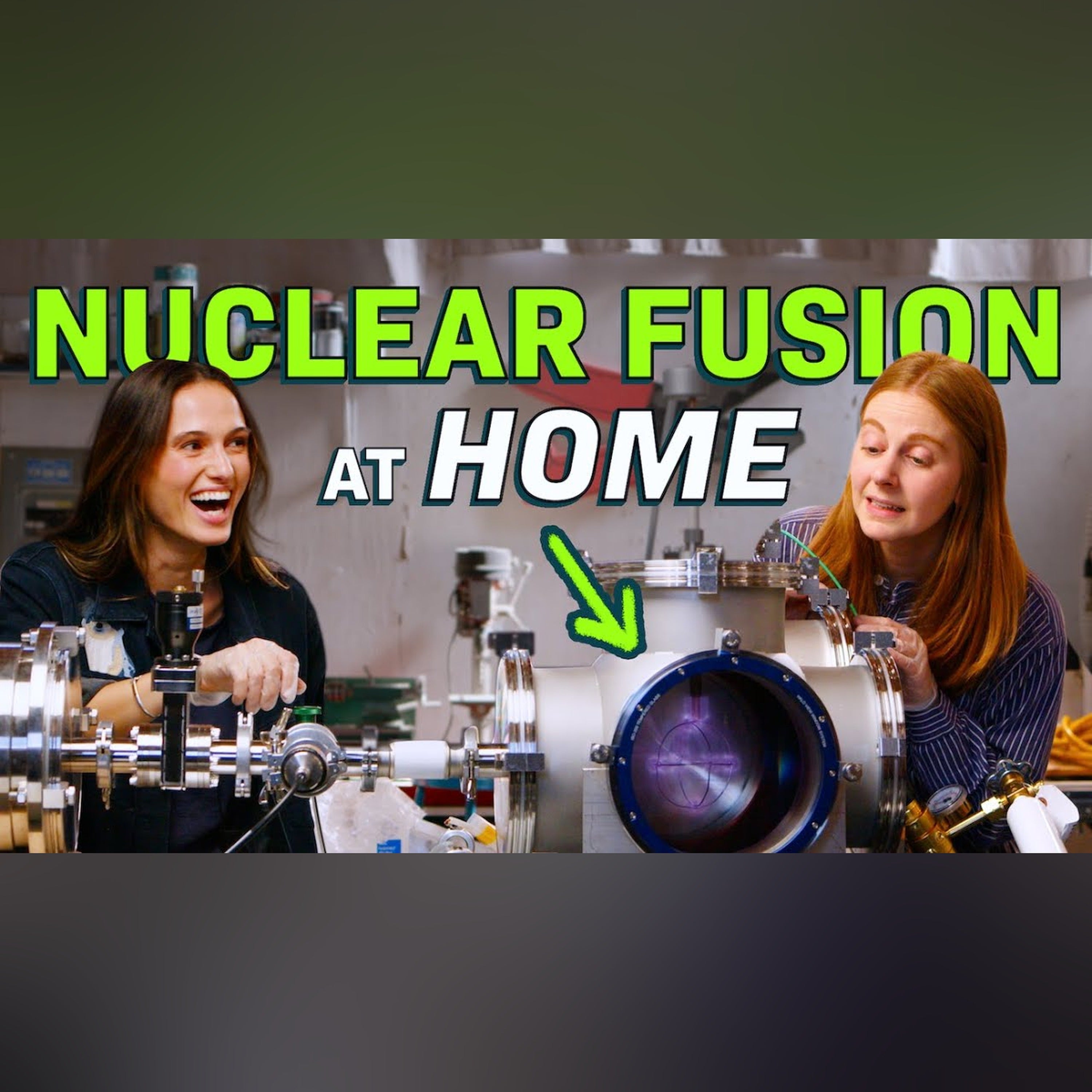
We attempted nuclear fusion. In Simone’s workshop. Disclaimer: This build was supervised by experts at Helion. Do not try this at home. I still can’t believe this video really happened. Back in May, I interviewed Helion CEO David Kirtley. I was trying to understand nuclear fusion: Is nuclear fusion possible now? How does fusion actually work? And most importantly, is nuclear fusion the future? Then, at the end of the interview, I asked David about headlines I’d seen about people building nuclear fusion devices in their backyards - what were they doing? “Oh,” David replied, “you can build one.” What followed is the biggest adventure yet on Huge If True. Together with the team at Helion and my friend fellow YouTuber Simone Giertz, we BUILT A NUCLEAR FUSION DEVICE to show how nuclear fusion works, what the big remaining challenges are, and how it might help us all in the future. Then, the last step was to try to turn it on… WATCH "FUSION, EXPLAINED: PART 1" HERE: https://youtu.be/piPbnKdv
Palantir Forward Deployed Engineer Chad Wahlquist explains how Palantir deploys sovereign AI infrastructure—including edge models on ships and modular data centers—so countries and enterprises maintain control over their IP and compute. He discusses why massive data centers face local backlash, how small modular setups and “compute co-ops” could shift the industry, and how forward deployed engineers bridge executive vision with on-the-ground execution. -- MTS chronicles the singularity, live. Monitoring the situation of tech and AI. Follow MTS: Spotify |https://open.spotify.com/show/4HUNNmV1pjV7CW6Lphm1rM Apple |https://podcasts.apple.com/us/podcast/mts/id1891088763 – Brought to you by: Mongo DB - Anyone can prototype an agent. Lovable - Turn ideas into software people love with Lovable. Start today at https://lovable.dev/ Visithttps://factory.com/ Neon (by Databricks) - Scale your startup on Neon. The Postgres backend for apps and agents. Head over to http://getvcx.com (http://getvcx.
Reactor CEO and co-founder Alberto Taiuti joins Sophia Dew to explain why real-time, interactive world models are the next frontier in AI, moving past slow, passive chatbots and video generators. He details Reactor’s new PixVerse R2 launch, their robotics partnership with Runway ML, and how Hollywood studios and VFX pioneers like John Gaeta are beginning to use real-time generation to let audiences explore existing franchises live. MTS chronicles the singularity, live. Monitoring the situation of tech and AI. Follow MTS: Spotify |https://open.spotify.com/show/4HUNNmV1pjV7CW6Lphm1rM Apple |https://podcasts.apple.com/us/podcast/mts/id1891088763 – Brought to you by: Mongo DB - Anyone can prototype an agent. Lovable - Turn ideas into software people love with Lovable. Start today at https://lovable.dev/ Visithttps://factory.com/ Neon (by Databricks) - Scale your startup on Neon. The Postgres backend for apps and agents. Head over to http://getvcx.com (http://getvcx.com/) to learn more Kong
Bain Capital Ventures partner Ajay Agarwal joins Sophia Dew to argue that two-legged humanoid robots are the wrong form factor for the next decade, contrasting hardware embodiment challenges with rapid gains in generalized AI intelligence like Astra. He also explains why frontier coding agents are commoditizing traditional software moats like CUDA and pushing top founders toward physical-world industries. MTS chronicles the singularity, live. Monitoring the situation of tech and AI. Follow MTS: Spotify |https://open.spotify.com/show/4HUNNmV1pjV7CW6Lphm1rM Apple |https://podcasts.apple.com/us/podcast/mts/id1891088763 – Brought to you by: Mongo DB - Anyone can prototype an agent. Lovable - Turn ideas into software people love with Lovable. Start today at https://lovable.dev/ Visithttps://factory.com/ Neon (by Databricks) - Scale your startup on Neon. The Postgres backend for apps and agents. Head over to http://getvcx.com (http://getvcx.com/) to learn more Kong - The AI connectivity plat
Anonymous sources are justified when naming them would prevent important public-interest reporting.
Share your view, then see how readers voted. No sign-in required. This poll is shared across stories.
Do you agree or disagree?
Common Quandary
A Common Quandary to discuss
Another conversation to explore, separate from this news story.
The best garden plot has been abandoned for months. Who gets to take it?
Garden plots have a three-year waiting list. One member's plot has gone untended for months and messages go unanswered, but other gardeners know they recently faced serious health problems.
How long should a shared resource remain reserved out of compassion?