Why Supernovae Can Outshine Entire Galaxies | Boring Science For Sleep
73 min
Listen through the publisher, then discuss the episode here or arrange an in-person Roundtable. Your city determines where to meet.
Roundtables are designed for groups of four, with a shared subject and room for everyone to speak. Come for discussion, with no dating expectation.
Fall asleep to this quiet science story. A Boring Science For Sleep episode about Why Supernovae Can Outshine Entire Galaxies. Why Supernovae Can Outshine Entire Galaxies Settle in for a quiet exploration of Why Supernovae Can Outshine Entire Galaxies. This episode follows A Star Outshines Its Galaxy; Collapsing Cores and New Nickel; How the Light Gets Out; The Puzzle of SN 2006gy; Spinning Engines and Faint Echoes. Listen closely or let the details drift past. If you enjoy this quiet science bedtime pace, you might also like Nature Documentary for Sleep on Spotify — same quiet rhythm, different night. Search Spotify for Nature Documentary for Sleep.
Episode information is provided by the publisher. Listening takes place on the publisher’s service.
In this calm and sleepy facts episode, we spend eight peaceful hours exploring some of the quietest wonders of the natural world. We begin beneath a gathering thunderstorm, following warm air as it rises into towering clouds and learning how a single flash of lightning can briefly heat the air to several times the temperature of the surface of the Sun. From there we settle into the hidden world of hibernation, where animals slow their breathing and their heartbeats to just a few beats a minute and wait out the long winter in stillness. Next, we wander among the trees, discovering how they lift water hundreds of feet into the air without a single moving part and quietly record each passing year in rings of wood. Finally, we cross the deserts, where the heat of the day gives way to cold, clear nights and some dunes hum softly as the sand slides down their slopes. Each story unfolds slowly and gently, with no sudden sounds, so the whole night can pass in calm and quiet wonder. Let these c
If you're interested in going deeper, check out our StayCurious Metabolism library on "Peptides and More" https://staycuriousmetabolism.substack.com/p/peptides Referenced Letters Russian Longevity Peptides: https://staycuriousmetabolism.substack.com/p/can-these-longevity-peptides-be-real?r=40ekz2 Pinealon and Sleep: https://staycuriousmetabolism.substack.com/p/why-im-trying-this-peptide-for-sleep?r=40ekz2 To Try Pinealon Thymic Health and Longevity: https://open.substack.com/pub/staycuriousmetabolism/p/the-most-overlooked-organ-in-aging?utm_campaign=post-expanded-share&utm_medium=web (https://open.substack.com/pub/staycuriousmetabolism/p/the-most-overlooked-organ-in-aging) Chapters 0:00 – Are These Russian Longevity Peptides Real?! 1:57 – Part 1, All Roads Lead Back to Russia 6:24 – Part 2, How These Peptides Work 10:20 – Part 3, My Personal Experience 14:28 – Part 4, Looking Towards the Future Can short peptides really influence aging, immunity, sleep, and even mortality? In this vide
One evening, a mother was putting her three-year-old son to bed, just as she'd done countless times before. She read him a story, rubbed his back, and waited for him to fall asleep. But for no apparent reason, she suddenly became overwhelmed by sadness. The feeling was so intense that she began to cry. Later that night, she woke to the unmistakable sounds of someone playing with her son's favorite building blocks. When she went to investigate, she found him sound asleep and his toys put away. But something in the room wasn't quite as she'd left it. Over the following nights, that same unexplained sadness returned. It wasn't until she thought about the time of year, and a heartbreaking loss she'd experienced a decade earlier, that she began to wonder whether these strange occurrences might be connected. Could someone she'd lost have found a way to visit? #RealGhostStoriesOnline #TrueGhostStories #SpiritVisitations #AfterDeathCommunication #SignsFromBeyond #ChildSpirit #ParanormalEncount
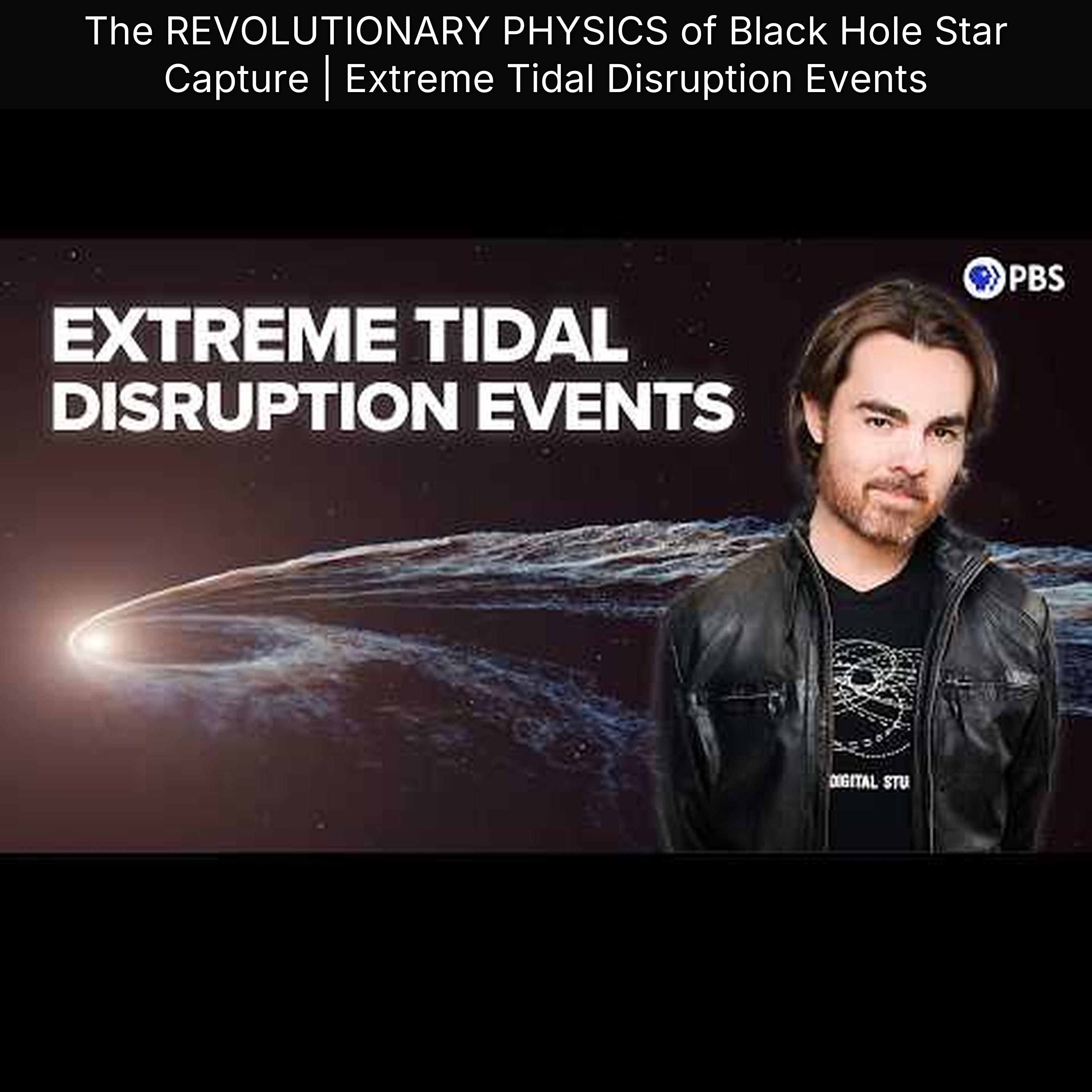
PBS Member Stations rely on viewers like you. To support your local station, go to:http://to.pbs.org/DonateSPACE Sign Up on Patreon to get access to the Space Time Discord! If you track the motion of individual stars in the ultra-dense star cluster at the very center of the Milky Way you’ll see that they swing in sharp orbits around some vast but invisible mass—that’s the Sagittarius A* supermassive black hole. These are perilous orbits, and sometimes a star wanders just a little too close to that lurking monster, leading to its utter destruction in the spectacular phenomenon known as a tidal disruption event. We’ve never seen a TDE in the Milky Way, but we’ve seen them in distant galaxies—and we now know how to spot stellar destructions so extreme that they reveal properties of the black hole itself. Check out the Space Time Merch Store Search the Entire Space Time Library Here: https://search.pbsspacetime.com/ Hosted by Matt O'Dowd Written by Matt Caplan, Andy Santarelli & Matt O'Dow
Sleep better with Pillow: https://pillow.app/bettersleep Immerse yourself in gentle storm and flood sounds that create a soothing ambient backdrop perfect for sleep, meditation, and deep relaxation. Let calming rain and nature’s rhythm ease your mind, helping you unwind and find peaceful rest. This episode includes AI-generated content.
Explore how pulling an all-nighter can impact your cognitive function, and find out what happens to your brain when you don't sleep. -- You’re just one history final away from a relaxing spring break. But you still have so much to study! You decide to follow in the footsteps of many students before you, and pull an all-nighter. So, what happens to your brain when you stay up all night? And does cramming like this actually help you prepare for a test? Anna Rothschild explores how a sleepless night impacts your cognitive function. Lesson by Anna Rothschild, directed by Biljana Labović. Animation by Noam Sussman & Ali Kellner, Homework Studio. This video made possible in collaboration with the Bezos Family Foundation Learn more about how TED-Ed partnerships work: https://bit.ly/TEDEdPartner A special thanks to Dr. Mathias Basner, Andrew Fuligni, Adriana Galván, and UCLA Center for the Developing Adolescent who provided information and insights for the development of this video. Support Ou
Fall asleep to this quiet science story. A Boring Science For Sleep episode about How Mechanical Clocks Turn Gears Into Time. How Mechanical Clocks Turn Gears Into Time Settle in for a quiet exploration of How Mechanical Clocks Turn Gears Into Time. This episode follows A Bell Without a Face; Iron, Brass, Gut and Oak; Counting Teeth Into Hours; The Swing and the Sea; Towers, Tanks and Long Clocks. Listen closely or let the details drift past. Chapters 00:00:00 How Mechanical Clocks Turn Gears Into Time 01:30:53 Graphite Pencils and the Clay Inside the Core 04:02:09 Wood Screws and the Cutting of Spiral Threads If you enjoy this quiet science bedtime pace, you might also like Psalms for Sleep (https://open.spotify.com/show/7zd2RN8SMTCheFA2ifYK0m) on Spotify — same quiet rhythm, different night.
Fall asleep to this quiet science story. A Boring Science For Sleep episode about How Concrete Turns From Wet Paste Into Solid Stone. How Concrete Turns From Wet Paste Into Solid Stone Settle in for a quiet exploration of How Concrete Turns From Wet Paste Into Solid Stone. This episode follows Heat Inside Hoover Dam; Cement, Stone And Water; How The Paste Joins Up; Keeping The Water In; Knowing When It's Ready. Listen closely or let the details drift past. Chapters 00:00:00 How Concrete Turns From Wet Paste Into Solid Stone 01:23:01 Gramophone Records and the Pressing of Grooves 03:55:53 Woven Wire Sieves and the Sizing of the Mesh If you enjoy this quiet science bedtime pace, you might also like True Crime for Sleep (https://open.spotify.com/show/05dzYD65s7sflbCdBiKBty) on Spotify — same quiet rhythm, different night.
Fall asleep to this quiet science story. A Boring Science For Sleep episode about Why the Periodic Table Has Repeating Patterns. Why the Periodic Table Has Repeating Patterns Settle in for a quiet exploration of Why the Periodic Table Has Repeating Patterns. This episode follows A chart on canvas; Families, octaves and gaps; Electrons and their rooms; Wrong weights, new gases; The rows that kept growing. Listen closely or let the details drift past. Chapters 00:00:00 Why the Periodic Table Has Repeating Patterns 01:31:53 Why Neutron Stars Pack So Much Into So Little 04:00:42 Tennis Balls and the Stitching of Felt Covers If you enjoy this quiet science bedtime pace, you might also like Psalms for Sleep (https://open.spotify.com/show/7zd2RN8SMTCheFA2ifYK0m) on Spotify — same quiet rhythm, different night.
Synthetic images and videos should carry clear labels when presented as real events.
Share your view, then see how readers voted. No sign-in required. This poll is shared across stories.
Do you agree or disagree?
Common Quandary
A Common Quandary to discuss
Another conversation to explore, separate from this news story.
Your carry-on fits only if you sit on it. Do you try the airport sizer?
Your suitcase is slightly larger than the airline allows, although it has fit overhead on previous flights. Checking it costs extra and risks missing a connection. Other passengers have equally questionable bags and staff are checking inconsistently.
Does uneven enforcement weaken a traveler's duty to follow the rule?