Listen through the publisher, then discuss the episode here or arrange an in-person Roundtable. Your city determines where to meet.
Roundtables are designed for groups of four, with a shared subject and room for everyone to speak. Come for discussion, with no dating expectation.
All societies have spoken or signed language, but not all languages have a written form. Since writing developed in different ways in different places, writing systems differ greatly around the world. In this final episode of Crash Course Linguistics, we’ll learn about writing systems, also called orthographies, the different components that make up a writing system, the development of different writing systems over time, and more! Want even more linguistics? Check out the Lingthusiasm podcast, hosted by the writers of Crash Course Linguistics: lingthusiasm.com *** Watch our videos and review your learning with the Crash Course App! Download here for Apple Devices: https://apple.co/3d4eyZo Download here for Android Devices: https://bit.ly/2SrDulJ Crash Course is on Patreon! Thanks to the following patrons for their generous monthly contributions that help keep Crash Course free for everyone forever: Eric Prestemon, Mark, DAVID MORTON HUDSON, Perry Joyce, Isaac Liu, Scott Harrison, Mark & Susan Billian, Junrong Eric Zhu, Alan Bridgeman, Jennifer Smith, Matt Curls, Tim Kwist, Jonathan Zbikowski, Jennifer Killen, Sarah & Nathan Catchings, Brandon Westmoreland, team dorsey, Trevin Beattie, Eric Koslow, Indika Siriwardena, Khaled El Shalakany, Shawn Arnold, Siobhán, Ken Penttinen, Nathan Taylor, William McGraw, Jirat, Brian Thomas Gossett, Ian Dundore, Jason A Saslow, Jessica Wode, Caleb Weeks __ Want to find Crash Course elsewhere on the internet? Facebook - http://www.facebook.com/YouTubeCrashCourse Twitter - http://www.twitter.com/TheCrashCourse Tumblr - http://thecrashcourse.tumblr.com (http://thecrashcourse.tumblr.com/) Support Crash Course on Patreon: http://patreon.com/crashcourse CC Kids: http://www.youtube.com/crashcoursekids
Episode information is provided by the publisher. Listening takes place on the publisher’s service.
PBS Member Stations rely on viewers like you. To support your local station, go to: http://to.pbs.org/DonateSPACE ↓ More info below ↓ Uploaded 12-01-21 Erratum: Figures in episode should be Minev et al. (2019), not Minney et al. (2009). Our apologies to the authors! This is the experiment we talk about: To Catch and Reverse a Quantum Jump Mid-Flight Minev, Mundhada, Shankar, Reinhold, Gutiérrez-Jáuregui, Schoelkopf, Mirrahimi, Carmichael and Devoret (2019), Nature, v.570, p.200 Sign Up on Patreon to get access to the Space Time Discord! Since the very beginning of quantum mechanics, a debate has raged about how to interpret its bizarre predictions. And at the heart and origin of that debate is the quantum jump or quantum leap - the seemingly miraculous and instantaneous transitions of quantum systems that have always defied observation or prediction. At least, until now. Check out the Space Time Merch Store Sign up for the mailing list to get episode notifications and hear special anno
Until a little under two weeks ago, Silicon Valley Bank was the sixteenth largest bank in the United States, the favoured choice of tech startups due to the tailored services it provided. But by 10th March 2023, American authorities were taking control of SVB following its collapse. It had assets of over $200bn, making for the second biggest bank failure in US history. There were a number of factors behind the collapse, and it’s causing concern as it’s common for one bank collapse to be followed by another, due to what’s called financial contagion. Indeed, just a few days later it was the turn of New York-based Signature Bank to collapse. And over in Europe, Switzerland’s second largest bank Crédit Suisse had to take out a $54bn to stay afloat, before then being bought out by the country’s largest bank UBS, in a bid to halt the crisis. Why did Silicon Valley Bank collapse? How do stock market crashes happen? In under 3 minutes, we answer your questions! To listen to the last episodes,
Discover how scientists developed atomic clocks, which use the vibrations of atoms to measure and maintain a globally consistent time. Uploaded 19-01-21 -- In 1967, researchers gathered to answer a long-running scientific question: just how long is a second? It might seem obvious at first. A second is the tick of a clock, the swing of a pendulum, the time it takes to count to one. But how precise are those measurements? And what is that length based on? John Kitching digs into how we scientifically define this fundamental unit of time. Lesson by John Kitching, directed by Tjoff Koong. Support Our Non-Profit Mission ---------------------------------------------- Support us on Patreon: http://bit.ly/TEDEdPatreon Check out our merch: http://bit.ly/TEDEDShop ---------------------------------------------- Connect With Us ---------------------------------------------- Sign up for our newsletter: http://bit.ly/TEDEdNewsletter Find us on Twitter: http://bit.ly/TEDEdTwitter Peep us on Instagram
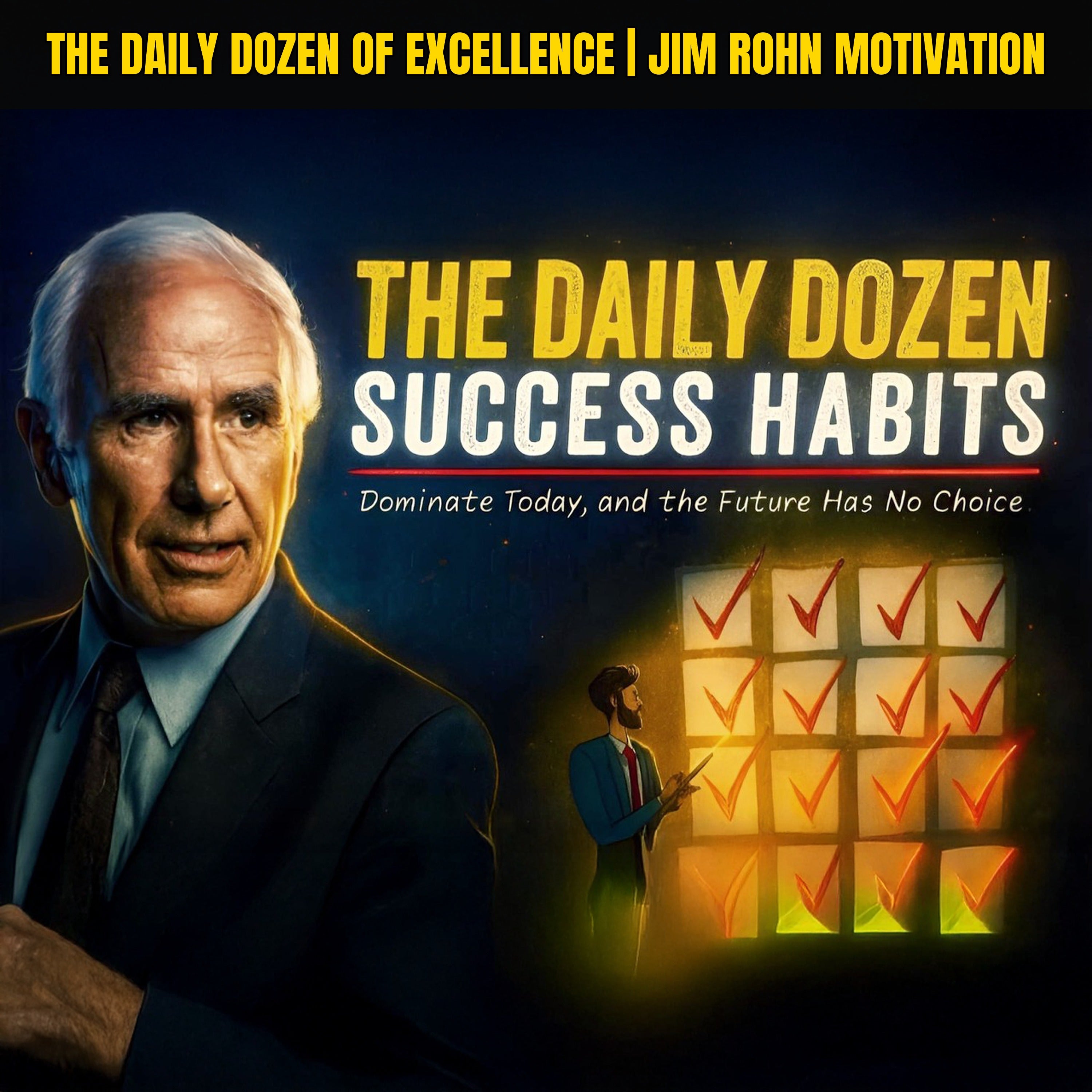
In this Jim Rohn Motivation video, learn how powerful daily habits—not bursts of action—build true success. Jim breaks down the importance of discipline, planning, reflection, and energy in achieving lasting personal growth. Key Topics From This Motivational Video: Success is built through small, consistent daily habits The importance of writing down goals and morning planning Why physical vitality drives mental clarity and progress Journaling, gratitude, and self-reflection for alignment Giving, contribution, and becoming more valuable Jim Rohn outlines a full system for personal transformation through intentional routines. This video walks you through his powerful 10-part daily discipline list, including early rising, morning planning, physical vitality, journaling, reflection, and contribution. Each habit is a building block toward self-mastery, and together, they form a strategy for creating an extraordinary life—on purpose. This Jim Rohn Motivational Video Is Perfect For: Anyone f
Join NCI University today to master human behavior and influence: Uploaded 02-11-22 Too much time has passed, and I've wanted a map for human influence and persuasion, so I built one - and it works everywhere. THE FOCUS VIDEO: https://www.youtube.com/watch?v=n5poKK4lR5c Join me at an upcoming course! Looking back, everyone can locate failure and success. What most people don't realize is that you can also trace back success and failure to human behavior factors alone. These skills are so vital to life that I've dedicated my life to exploring and building this field into a transformational system that will radically transform the RESULTS you get from the world. I hope to see you in the next one! ️ C Chapters: 0:00 - Introduction 1:43 - The essence of mapping human Behavior TAGS: persuasion, influence, psychology, Chase Hughes, behavior panel, Scott rouse, greg Hartley, mark Bowden, Spidey, hypnosis, profiling, body language, sales
How do you get your kids interested in learning without making it feel like homework? In today's episode, we're revisiting some of Ryan's favorite conversations with Kenny Curtis, host of Greeking Out (https://podcasts.apple.com/us/podcast/greeking-out-from-national-geographic-kids/id1483233279) and History Snacks (https://podcasts.apple.com/us/podcast/history-snacks/id1874130976), about how to encourage your kids' interests, nurture their natural curiosity, take those interests beyond a screen, and turn their curiosity into real-world experiences. Check out the full episodes with Kenny Curtis (https://podcasts.apple.com/us/podcast/greeking-outs-kenny-curtis-on-how-ancient-myths-teach/id1430315931?i=1000682597107)! | Apple Podcasts (https://podcasts.apple.com/us/podcast/greeking-outs-kenny-curtis-on-how-ancient-myths-teach/id1430315931?i=1000682597107), Spotify (https://open.spotify.com/episode/2CZPpfwjiwEsvb84EZyyz5), YouTube (https://www.youtube.com/watch?v=qAu5_O-KZNg) Pick up a cop
The majority of the universe is made up of a currently mysterious entity that pervades space: dark energy. We don’t know exactly what it is, but we do know that dark energy accelerates the expansion of space. We think this means the Universe will expand forever, even as our view of it shrinks while space expands faster all the time. Check out the Crash Course Astronomy solar system poster here: http://store.dftba.com/products/crashcourse-astronomy-poster If you want to learn more about the creation and death of the universe, watch Crash Course Big History here: https://youtube.com/playlist?list=PL8dPuuaLjXtMczXZUmjb3mZSU1Roxnrey -- Chapters: Introduction: The Expanding Universe 00:00 The Expansion of Space is Accelerating 2:17 What is Dark Energy? 4:19 Will the Universe Expand Forever? The Geometry of the Universe 5:20 The Cosmic Horizon of the Observable Universe 6:50 Review 10:20 -- GEOMETRY OF THE UNIVERSE RESOURCES Geometry: Expanding faster than light: General expansion: -- PBS Di
Have you ever wondered where cured meats like salami or pepperoni get their bright red color? Of course its from organic chemistry! A chemical called nitric acid gives them that bright color, while also increasing their shelf. It's also involved in some other interesting reactions. In this episode of Crash Course Organic Chemistry we'll see how nitrous acid reacts with primary amines to form diazonium salts, we'll learn about alkyldiazonium salts and aryldiazonium salts, and see what conditions are necessary for nucleophilic aromatic substitutions. Series Sources: Brown, W. H., Iverson, B. L., Ansyln, E. V., Foote, C., Organic Chemistry; 8th ed.; Cengage Learning, Boston, 2018. Bruice, P. Y., Organic Chemistry, 7th ed.; Pearson Education, Inc., United States, 2014. Clayden, J., Greeves, N., Warren., S., Organic Chemistry, 2nd ed.; Oxford University Press, New York, 2012. Jones Jr., M.; Fleming, S. A., Organic Chemistry, 5th ed.; W. W. Norton & Company, New York, 2014. Klein., D., Organ
Like a trendy dance, a fighting combo, or a secret handshake, organic reactions can be broken down into simpler steps. In this episode of Crash Course Organic Chemistry, we’ll specifically be looking at alkene addition reactions, and with each new reaction ask ourselves three questions to help us puzzle through the mechanism and understand what’s going on. Episode Sources: Le Couteur, P, Burreson, J. Napoleon’s Buttons: 17 molecules that changed history., Penguin, New York, 2004, Chapter 1. Whipps, H., “How the Spice Trade Changed the World,” https://www.livescience.com/7495-spice-trade-changed-world.html Last accessed, 3/28/2020. Henriques, Martha, “How spices changed the ancient world,” http://www.bbc.com/future/bespoke/made-on-earth/the-flavours-that-shaped-the-world/ Last accessed, 3/28/2020. Hashimoto, K., Yaoi, T., Koshiba, H., Yoshida, T., Maoka, T., Fujiwara, Y., Yaamoto, Y, Mori, K., “Photochemical Isomerization of Piperine, a Pungent Constituent of Pepper”, Food Sci. Technol.
Courts should protect careful consideration even when this slows case processing.
Share your view, then see how readers voted. No sign-in required. This poll is shared across stories.
Do you agree or disagree?
Common Quandary
A Common Quandary to discuss
Another conversation to explore, separate from this news story.
Your neighbor's doorbell camera watches everyone entering your home. Is that their business?
A neighbor installs a doorbell camera that records your front yard and every visitor entering your home. They say the wide angle is necessary to capture package theft and the footage is rarely reviewed.
Where should private security stop in a shared public view?