Zongzong Tao v. Simplex Investments LLC — 7th Cir. (Nov 5, 2026)
22 min
Listen through the publisher, then discuss the episode here or arrange an in-person Roundtable. Your city determines where to meet.
Roundtables are designed for groups of four, with a shared subject and room for everyone to speak. Come for discussion, with no dating expectation.
The Seventh Circuit hears Nicole Tao's discrimination case against Simplex Investments, her former employer. The dispute centers on a coding error in an automated trading program. It treated trading fees as one hundred times their proper size, causing it to pass up potentially profitable trades. Simplex blamed Tao for not detecting the problem while monitoring the strategy. After reviewing other aspects of her work, the firm fired her. Tao, a Chinese-American woman, will argue that comparable errors by male, non-Chinese traders brought less severe treatment. Simplex will respond that the relevant employees, mistakes, supervisors and knowledge of those mistakes were not comparable. The district court entered summary judgment for Simplex, ending the discrimination claims without a trial. It also excluded her expert's opinion that the coding error wasn't her fault, finding that opinion irrelevant to whether the firm honestly believed its stated reason. The appeal asks whether the evidence permits a reasonable jury to infer discrimination. Listen for the difference between criticizing a business decision and showing that its explanation is a cover for unlawful bias. Also ask which employees provide a meaningful comparison, and whether technical expert evidence could help answer that question. Zongzong Tao v. Simplex Investments LLC (No. 26-1676) — U.S. Court of Appeals for the Seventh Circuit, argued November 5, 2026. Sources: Argument audio — complete official Seventh Circuit recording, including original court preparation interval; routine volume and peak protection only: Case and argument date — official Seventh Circuit November 2026 archive, docket 26-1676, November 5: Background and appealed summary judgment — N.D. Illinois Document 120, March 9, 2026; court-authored record analysis and prior ruling, not the result of this appeal: Prior expert-evidence ruling — N.D. Illinois Document 113, March 17, 2025; exclusion on relevance grounds, not a finding that the expert was unqualified:
Episode information is provided by the publisher. Listening takes place on the publisher’s service.
The Fair Work Tribunals edition of Tuesday 17 November 2026: 129 decisions, one with a headnote: a Full Bench on redundancy pay reduced to nil where the employer itself found other acceptable employment, and what a reasons gap is worth on appeal. Fair Work Desk: redundancy pay, the job on offer and the reasons gap (opening story). Phuong Nam (Kenny) Ha v Asuria People Services Pty Limited [2026] FWCFB 289 (https://jade.io/article/1297741) - Asbury VP, Wright and Butler DP, 6 November 2026. Signal Practice & Procedure. Fair Work Act 2009 (Cth) ss 119(1)(a), 120(1)(b)(i), 120(2), 604. Whether other acceptable employment was obtained under s 120(1)(b)(i), and the s 120(2) discretion, attract the deferential House v The King standard; acceptability is assessed objectively against the employee's current role, not a withdrawn or alternative offer (those go to s 120(2)); the duty to give reasons extends to remedy, and a move to a nil reduction without disclosed reasoning is a gap in the path
“By a process of elimination, he didn't die from a natural cause. He didn't die from old age in his cell, and he didn't die from an accident. So the only option that we have is that he died as a result of a homicide.” BBC Newsnight presenter Victoria Derbyshire speaks to forensic medicine expert Michael Freeman, who says he's reviewed Jeffrey Epstein's autopsy records and contends Epstein's death in jail was the result of homicide rather than suicide. Epstein was a wealthy American financier and convicted sex offender, with links to prominent figures around the world. He died in a New York jail in 2019 while awaiting trial on charges of sex trafficking involving underage girls. His death was ruled a suicide by New York City's medical examiner. A subsequent FBI investigation found no evidence of criminal activity connected to his death, while the US Department of Justice’s Inspector General also concluded there was no evidence of foul play. In an interview with BBC Newsnight, Freeman ch
**ONE SOCIAL SECURITY MISTAKE COULD COST YOU THOUSANDS OF DOLLARS OVER YOUR LIFETIME!** Are you collecting Social Security retirement benefits, or getting ready to apply? There's one potentially devastating mistake that many Americans make without fully understanding the consequences. Need help with Medicare? Contact our friends at Chapter for FREE HELP! 352-841-0632 And here's the frightening part: **You may not realize what you've lost until years later, when it's too late to change your decision.** In today's video, **Dr. Ed Weir, a former Social Security Administration District Manager**, explains one of the most consequential Social Security retirement mistakes and why understanding the rules BEFORE you make a decision could protect thousands of dollars in future benefits. **IN THIS VIDEO, YOU'LL LEARN:** The Social Security mistake that could have lasting financial consequences. Why a decision that seems perfectly reasonable today could become costly years later. How certain reti
Training Wednesday is back, and Aaron, Trent, and Peaches spend the live answering Air Force Special Warfare candidate questions — but first, there is an update from the current SWAS class. According to the numbers discussed on the live, 78 candidates failed the initial IFT and 52 still failed the refire. The guys try to understand how that happens after months of development and preparation, discuss reports that some candidates struggled with the swim and high-volume masks, and once again return to the same message they keep giving candidates: you need to arrive ready. From there, the live turns into a full candidate-training clinic. The guys talk about periodizing strength and endurance work, building Zone 2 capacity, gradually increasing mileage, why running with a weighted vest is probably not solving the problem you think it is, preparing for A&S, training with the equipment you will actually use, and why the goal is not simply to pass a minimum standard. They also answer question
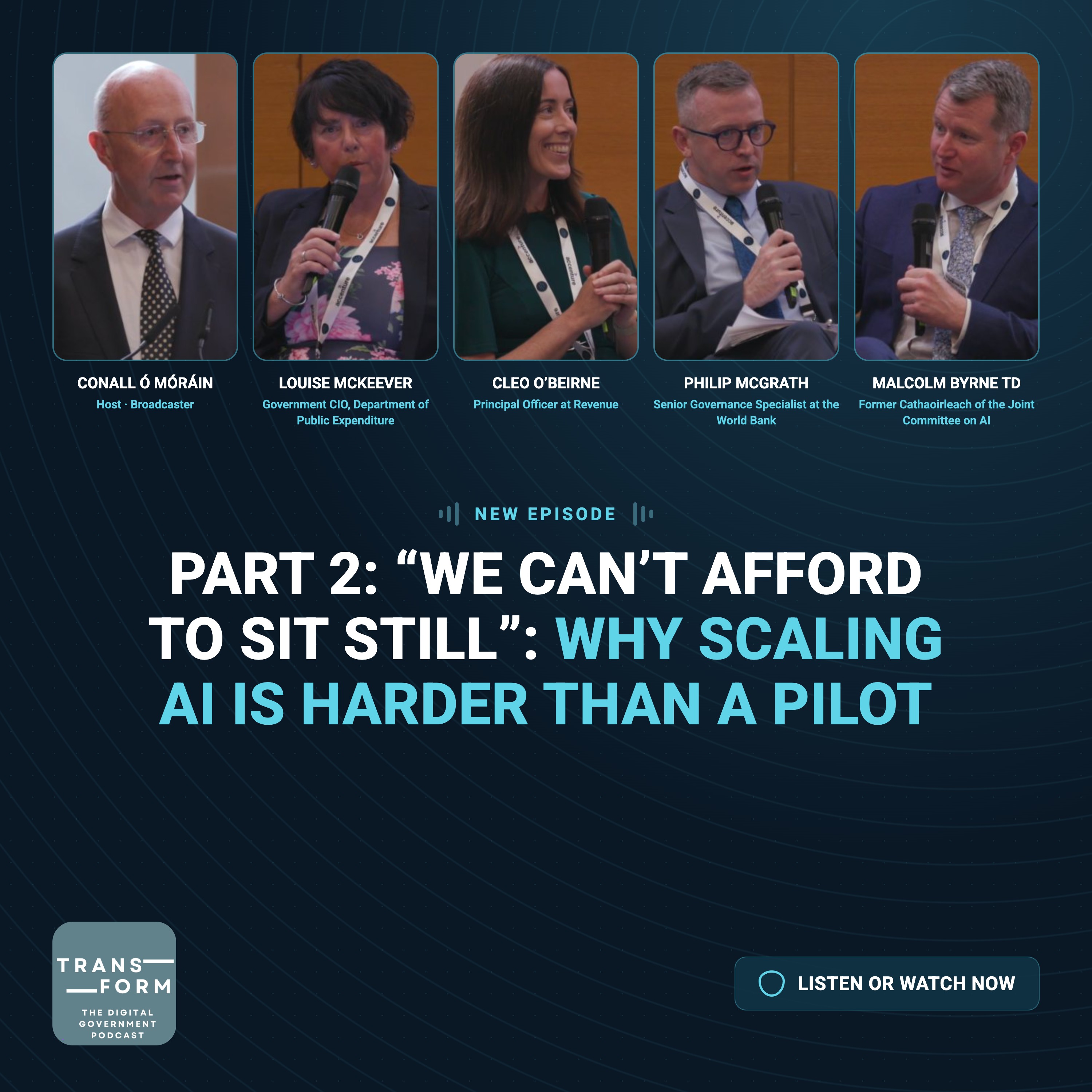
The pilot worked. Now what? In Part 2 of this panel discussion, four leaders explain how they're taking AI from pilot to scale, and what it takes to get data and governance right. This panel discussion took place at the Ireland eGovernment Awards and Leadership Summit 2026 on 24 September 2026 at UCD's O'Reilly Hall. We bring together Louise McKeever, Government CIO; Cleo O'Beirne, Principal Officer at Revenue; Philip McGrath, Senior Governance Specialist at the World Bank; and Malcolm Byrne TD, former Cathaoirleach of the Joint Committee on AI. The panel is chaired by Conall Ó Móráin. If you're taking AI beyond the pilot, here's what to do: Start small, prove it, then scale. Revenue tested agentic AI on a small application first, stage by stage. Redesign the whole process, not one stage. Individual productivity gains only go so far. Plan for lost knowledge, and recovered knowledge. As AI scales, people may know less, but AI can also capture knowledge that has already been lost. Reuse
After a week of tech chaos with flights grounded, plus outages at Microsoft, Apple, US banks, and the National Security Agency, questions continue to be asked about the cause of the disruption and whether it’s more than a series of coincidences. Now the government’s top cyber security official, Sean Cairncross, is leaving his post, with CBS reporting he was fired. Trump says these were “individual events”. But Republican Senator Josh Hawley says if it is all a coincidence, “it’s like the greatest coincidence in the history of the world”. So who’s right? In this episode, Sarah, Marianna and Anthony discuss the doubts over the official explanation, cuts to America’s cyber defences, and whether people trust what they’re being told by the White House. Plus, Sarah talks to the cybersecurity and cyberespionage expert Dmitri Alperovitch about the fall of Nvidia’s Jensen Huang and the race with China over AI chips. Are rushed fixes for problems found by AI behind the disruption? HOSTS • Sarah
The Ninth Circuit considers a shareholder's challenge to disclosures used to sell UserTesting. During negotiations, Thoma Bravo reduced a proposed ten-dollar-a-share offer to seven dollars and fifty cents. The board initially rejected that lower price, but later recommended a deal at that price to shareholders. The shareholder alleges that the merger's proxy statement wrongly made the company's revenue performance look worse than it was. The disputed sentence grouped revenue with calculated billings and said both had fallen short of expectations. Her theory is that this depressed picture helped persuade shareholders to accept too little for their stock. That is an allegation, not a finding that the deal was unfair. The district court dismissed the revised complaint. Although it had treated the disputed sentence as false or misleading, it said the allegations still sounded in fraud and failed the stricter requirements for pleading the executive's responsibility. The shareholder will arg
The Second Circuit considers a plan to help homebuyers who need mortgages compete with cash offers. Canandaigua National Corporation, a New York financial holding company, wanted to guarantee purchases arranged through its mortgage subsidiary. If a preapproved customer failed to obtain final mortgage approval, the company would buy the home itself and later resell it. The proposal capped the value of homes held at any one time at five million dollars and promised resale within two years. Canandaigua says those safeguards make the risk small. The Federal Reserve Board rejected the plan on safety-and-soundness grounds, looking beyond the risk to this particular company. It did not finally decide the remaining statutory factors. Canandaigua will argue that the Board ignored the limits in its actual application. The Board will defend considering what could happen if financial holding companies generally began buying property under such guarantees. This is a dispute over permission for a pr
The Ninth Circuit hears a dispute over a proposed waste-processing project in California. Nortech already operated the Western Placer Waste Management Authority's facility. It worked with EcoHub on a proposal for the facility's future, first seeking a contract extension and then preparing for competitive bidding. The collaboration broke down. Nortech ended discussions after EcoHub failed to produce a requested financing commitment. EcoHub says the financing demand was a pretext, and that Recology pushed Nortech to abandon their joint effort. EcoHub and Nortech eventually submitted separate bids. Neither won. EcoHub nevertheless says their work together had already created a legal partnership, with duties Nortech could not simply walk away from. The district court ruled against EcoHub before trial, finding insufficient evidence of shared control. It also found EcoHub's interference claims against Recology were brought too late. EcoHub will argue that the companies' conduct and board dis
Supporters should be consulted before major changes in their club's ownership or location.
Share your view, then see how readers voted. No sign-in required. This poll is shared across stories.
Do you agree or disagree?
Common Quandary
A Common Quandary to discuss
Another conversation to explore, separate from this news story.
One sibling did years of caregiving. Should they get more of the inheritance?
One sibling lives near an aging parent and handles appointments, errands, and emergencies. The others live far away, call regularly, and assume the nearby sibling will receive the same inheritance despite years of unpaid work.
When does family care become labor that should be repaid?