How do you recover from becoming world famous at 16 years old? Gabby is joined by footballing legend Wayne Rooney. They talk about the impact of being thrust into the spotlight; why it bothers him that he lost his chance to get an education and what it meant to become a role model around the world. After years of heavy drinking Wayne has now quit booze, and coffee, and explores what that’s meant for his parenting and his marriage. Wayne’s now joined Gabby in the world of punditry, and they discuss the pressure of a live sports coverage and the art of dissecting a match. Now Wayne is about to start a new adventure…in the jungle. Gabby learns what made him sign up and why he didn’t feel he could do it until now. Hosted on Acast.
We're all asking the same question in a loop: am I messing up? Actress, comedian, and author Jenny Slate (https://www.thejennyslate.com/) says she's spent her whole life in that loop. Terrified of looking bad, afraid of not doing enough, convinced that each moment is a referendum on whether she's doing this right. But onstage or onscreen, performing, there's no judgment. There's preparation, flexibility, invention. There's trust in the process. So what if parenting worked more like that? In this conversation, Jenny and Dr. Becky get into the specifics: why shame runs so deep, how depression can feel like being separated from the things you love most, what your kid actually needs when she's jumping off the furniture, and how one book in seventh grade changed everything. She also talks about her essays for a new anthology called Notes to New Mothers (https://www.amazon.com/dp/1324117052?channelId=500&lv=shuf&plpRedirect=mhFallback). * Thank you to our partners for making this episode pos
Last time we learned about the Enlightenment, and the philosophers and thinkers whose ideas would shape governance for hundred of years. This week, we're learning how monarchs across Europe were influenced by those ideas. Adoption of Enlightenment ideas across Europe was...uneven, to say the least. In this episode you'll learn about Catherine the Great of Russia, Frederick the Great of Prussia, Maria Theresa of the Habsburg Dynasty, and Joseph II, her successor. We'll also get into the impact the Enlightenment had on a series of Louis in France. Sources -Elliot, John H. Empires of the Atlantic World: Britain and Spain in America, 1492-1830. New Haven: Yale University Press, 2006. -Judson, Pieter M. The Habsburg Empire. A New History. Cambridge: Harvard University Press, 2016. -Hosking, Geoffrey. Russia: People and Empire. Cambridge: Harvard University Press, 1997. -Spielvogel, Jackson J. Western Civilization. 7th ed. Belmont, CA: Thompson Wadsworth, 2009. -Vermes, Gábor. Hungarian Cult
Get to know the Japanese legend of Hōichi the earless, a monk summoned by a mysterious samurai to perform songs of past battles. -- Long ago, a temple was built near the site of a naval battle that concluded the long and gruesome conflict known as the Genpei Wars. For centuries after, performers throughout the country honored this tragic past in beautiful, haunting performances. But the most skilled storyteller of all was a monk from this very temple. Jeffrey Angles digs into the Japanese legend of Hōichi the earless. Lesson by Jeffrey Angles, directed by Masayoshi Nakamura, Good General. Music and sound design by Zak Engel. Support Our Non-Profit Mission ---------------------------------------------- Support us on Patreon: http://bit.ly/TEDEdPatreon Check out our merch: http://bit.ly/TEDEDShop ---------------------------------------------- Connect With Us ---------------------------------------------- Sign up for our newsletter: http://bit.ly/TEDEdNewsletter Find us on Twitter: http:/
Have you ever been at the gym watching someone grind through their push-ups and thought, "I wish somebody could just do that for me"? It sounds absurd. Nobody can do your push-ups for you. But those same people walk out of the gym and spend the rest of their day trying to get somebody else to do the equivalent of their push-ups in every other area of life. Uploaded 09-04-26 This seminar is about the things that cannot be borrowed, inherited, or handed off — your habits, your choices, and your daily effort. These are the non-transferables. And they are the only things that will ever truly build you. Key Topics Covered: ▸The non-transferables — why habits, choices, and daily effort belong to you alone ▸Why preparation becomes a hiding place and how to tell the difference ▸The cascading cost of waiting and what "almost" really means ▸Reasonable excuses — the most effective killers of unreasonable dreams ▸Other people's success is evidence, not entertainment ▸The private hours — why what y
Patreon/Supercast Special Release – Bonus – The Art of Differentiation: Finding Balance Between Me and We with Ann & Sue (317) This is a sneak peek of our newest episode – available only on our Premium Supercast and Patreon platforms. For as little as $5/month you can have access to special releases like this one, first-to-know about upcoming events and discounts and an ad-free feed. Click here to join & finish the episode!! (http://therapistuncensored.com/join) Differentiation is crucial for healthy relationships. Ann and Sue delve into differentiation—the ability to maintain your own thoughts, feelings, and needs while staying emotionally connected to others. Drawing on attachment science and Bowen family systems theory, they explore why healthy relationships require a balance between independence and connection, and how easily we can become emotionally fused or disconnected when our sense of security feels threatened. From recognizing emotional activation to navigating boundaries wi
In which John Green teaches you the history of the Indian Ocean Trade. John weaves a tale of swashbuckling adventure, replete with trade in books, ivory, and timber. Along the way, John manages to cover advances in seafaring technology, just how the monsoons work, and there's even a disembowelment for you Fangoria fans. Chapters: Introduction 00:00 Indian Ocean Trade 0:58 Monsoon Winds 2:19 How did trading work along the Indian Ocean? 3:43 An Open Letter to Kota Rani 4:57 Benefits of seaborne trade 6:14 How Indian Ocean trade facilitated the spread of technology 7:06 Indian Ocean Trade and the spread of Islam 7:33 Geography, Politics, and Indian Ocean Trade 10:13 Crash Course is on Patreon! Want to find Crash Course elsewhere on the internet? Facebook - http://www.facebook.com/YouTubeCrashCourse Twitter - http://www.twitter.com/TheCrashCourse Instagram - https://www.instagram.com/thecrashcourse/ CC Kids: http://www.youtube.com/crashcoursekids
In Star Trek, Star Wars, and other space operas, starships can zip across light-years in days or even hours – blazing along at many times the speed of light. But in the real world, it takes a little longer. In fact, the most distant object ever launched from Earth is scheduled to achieve a major milestone early tomorrow: It will reach a distance from Earth of one light-day. And it’s taken almost half a century to get there. Voyager 1 is one of the most remarkable space missions in history. The craft was launched in 1977 to explore the outer planets. After stunning encounters with Jupiter and Saturn, it headed toward interstellar space. And it’s been cruising in that region for years, telling us what conditions are like between the stars. In the wee hours of tomorrow morning, Voyager will be almost 16.1 billion miles from Earth. That’s exactly how far light travels in a single day – one light-day. It’s the equivalent of almost 34,000 round-trips between Earth and the Moon. A light-year
Robert Greene spent decades studying power, ambition, and control. Then a devastating stroke left him unable to control his own body. What happened next surprised even him. Why would coming so close to death make life feel more extraordinary? And what did Greene discover that the rest of us could learn without nearly dying? Greene, the bestselling author of The 48 Laws of Power, reveals: How a grasshopper in his backyard changed the way he saw the world Why success, power, and control may leave us feeling strangely empty Why AI could erode some of the abilities that make us human What ancient civilizations understood about awe that we've largely forgotten How to recapture the wonder we experienced as children Robert Greene's new book is The Law of the Sublime.
This week I sat down with Cooper Woods, and he is an Olympic gold medallist. Cooper won the men’s moguls at the Winter Olympics, Australia’s 7th ever Winter Olympic gold, and he did it by beating one of the greatest to ever do it, Mikael Kingsbury, on a tiebreak. Cooper grew up in Merimbula on the NSW south coast with three younger brothers, in a family with a long history in mogul skiing. We talk about how he got into the snow, what it was like growing up in that house, and what it took to get from the south coast to the top of the sport. We go through the whole journey. His first Olympics in Beijing, his breakthrough World Cup podium, and then the Olympic final, where he skied the two best runs of his career back to back, first in the semi final and then in the final. Best result ever, at the best time ever. A big part of this chat is self belief. Cooper is honest about doubting himself, how that shifted, and what it took to back himself when it mattered most. This is a good one. If
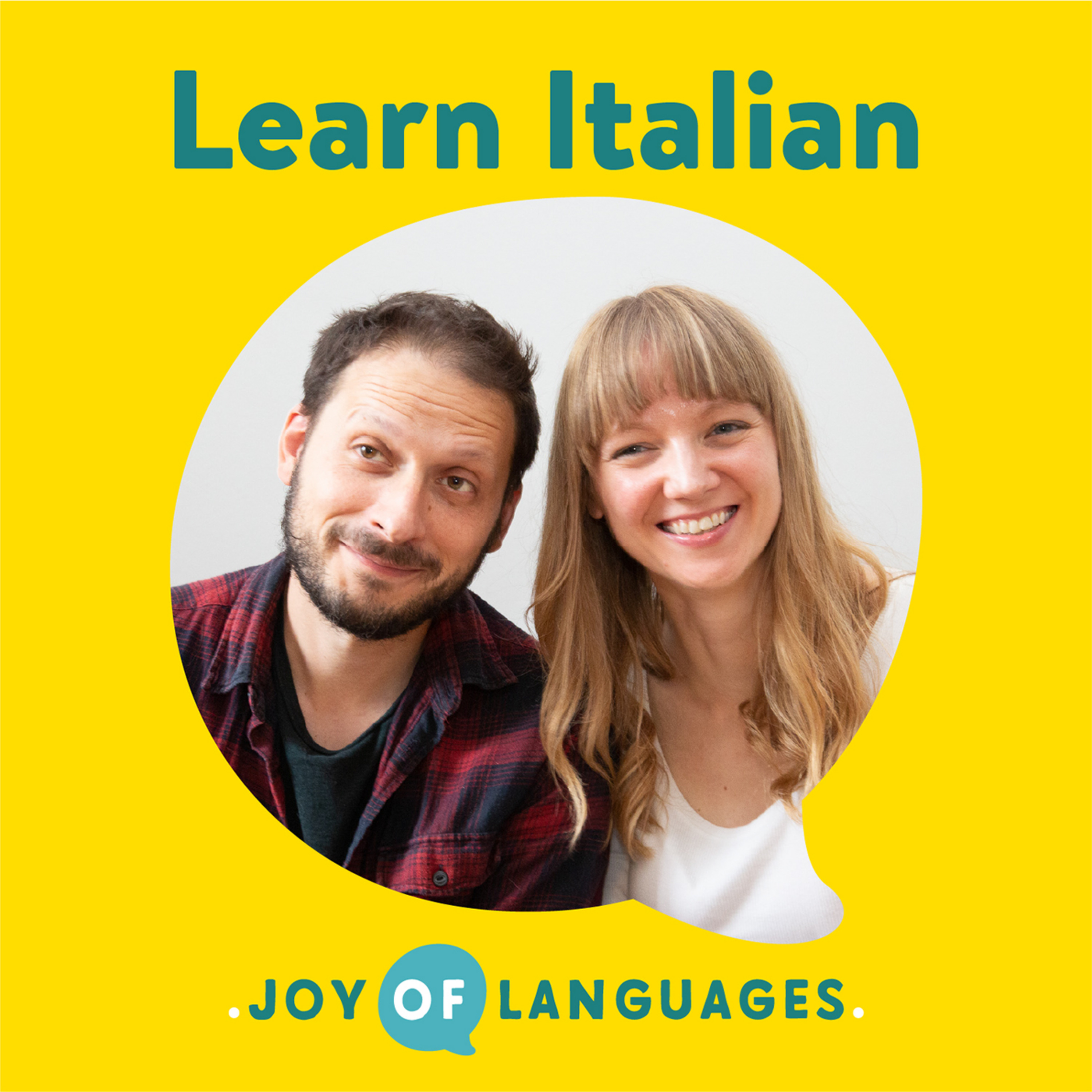
Learn how direct object pronouns in Italian work with words like lo, la, li and li (Italian for “it” and “them”). If you want to get notified when the next episode's out, you can sign up to our newsletter: https://joyoflanguages.online/italian-school Get the bonus materials for this episode: https://italian.joyoflanguages.com/podcast/direct-object-pronouns-lo-la-li-le Today's Italian words: Lo dividiamo? = Shall we share it? (it = il dolce) La posso provare? = Can I try it on? (it = la giacca) Li vendono qui = They sell them here (them = i souvenir) Le vendono qui= They sell them here (them = le magliette) Non li posso mangiare = I can’t eat them (them = i profiteroles)
What do you do when there's always another reason not to buy your first investment property? And which figure deserves your attention when you're comparing deals? It's Tuesday! Which means it's time for another episode of Ask Rob & Rob. (00:19) Charlie has had a deposit ready for a while, but first mortgage rates and then the Renters' Rights Act spooked him. Should he give up and put it all in his stocks and shares ISA instead? Rob D shares who to lean on when the doubts creep in, and Rob B suggests a different kind of fear that might get him over the line. (04:25) Tom is lining up new deals. Should he judge them on gross yield, or on the net return his cash makes? Rob B explains when each number earns its place, and Rob D points to two more that most investors never look at. Enjoy the show? Got a question? DM us a video message on Facebook (https://www.facebook.com/propertyhubuk/) or Instagram (https://www.instagram.com/propertyhubuk/)
This episode I'm going to list a full life job description taking into consideration: Life admin, home admin, kids, work. From there I will see what I can (in this order): Eliminate Automate Delegate I'll split delegation between chat GPT and a virtual assistant. Remember you can always delegate in other ways, for example you could split school runs with a neighbour or friend, alternate cooking sunday roast with other households in your family or friends, delegate to a partner etc... I'm excited for the possibilities here to be honest! Please do share your versions of this and what you've eliminated, automated and delegated with us all!
Today on The Literary Life we continue our re-airing of our season 1 series on Jane Austen's Northanger Abbey (https://amzn.to/35LzDEn), covering chapters 11-27. Today's conversation with Angelina, Cindy, and Thomas gets into the subtext surrounding what was expected of young ladies to be acceptable in society. A major theme in this book, and particularly in these chapters, is Catherine's learning to discern between what is simply appearance and what is reality. We learn even more in these chapters how inconstant and deceptive the Thorpes are, especially in contrast to the Tilneys. Angelina highlights some of the scenes Austen uses to illustrate when it is right for Catherine to buck the rules of propriety as opposed to Isabella's impropriety at the wrong time. Thomas brings up the question of what reasons we have thus far to like Henry Tilney even though we do not know overly much about him yet. Cindy points out some of Austen's ideas on education and the similarities to Charlotte Mas
What makes a fact truly a fun fact? Neil deGrasse Tyson, comedian Paul Mecurio, Senior StarTalk Producer Lindsey Nyx Walker, and astrophysicist Charles Liu break down the art of choosing 5,000 facts for the book Lost in Space. Thanks to our Patrons Dee Y, Keith, Chris Littleton, Michael Sabbeth, Valerie Waites, George Henry-Schneider, Jeffery Carel, Terry McConnell, Duncan, D. Franklin’s studio, Bruce Sedloff, NoxDNA, Jovan Robinson, Jerome Shaw III, Saad, Priya Gobal, Maxwell Anderson, Dj Mula, AKA Pella21, Miguel, Arash Baratloo, Dana Browne, and Jim Beyster for supporting us this week. Hosted by Simplecast, an AdsWizz company.
One of the biggest things holding women back is the fear that someone, somewhere, might think they're a b*tch. We want to be successful, ambitious, respected, and financially independent, but we also want everyone to like us while we're doing it. In this episode, I'm joined by my friend Keltie Knight, a three-time Emmy Award winner, television host, and bestselling author of The F*ck Them Theory, to talk about why it's time for women to get a little more comfortable being the villain. We discuss how women can be so afraid of crossing the line into being selfish or difficult that they never even get close to it, and why you might need to be a little less concerned with being the good girl if you want to build a life that actually works for you. Get full show notes, transcript, and more information here: https://schoolofnewfeministthought.com/545 Follow Kara on Instagram: instagram.com/karaloewentheil/ (https://www.instagram.com/karaloewentheil/) Get Keltie's new book here: https://www.f
David Malouf, one of Australia’s most loved and respected novelists and poets, died this year. We revisit his writing life and his celebrated novella An Imaginary Life, about the poet Ovid’s life in exile from Rome, after writing his own most celebrated poetry. In David Malouf’s own words, An Imaginary Life solved the problem of the “difficult second novel” by getting as far away from his successful first novel Johnno, a vivid depiction of friendship and growing up in Malouf’s hometown, Brisbane, in the late 50s and 60s. Malouf pivoted away from tropical Australia to Romania under the Caesars. He called it “part prose poem, part speculative essay, part dramatic monologue.” But Malouf – in an audacious repackage – describes An Imaginary Life as being as just Australian as Johnno and his other novels and poems set in Queensland. We’re going to put that claim to the test today, and take a close look at how and why Malouf tackles Ovid, classical writing and exile to write a very unexpected
Hannah Spencer is no ordinary MP. A plumber by trade, she made history as the first Green MP in the north of England - taking a rather unconventional route from fixing boilers and fitting bathrooms to the corridors of Westminster. Along the way, she’s challenged expectations about who gets to do what, and who gets to have a seat at the table. In this episode, Hannah talks candidly about leaving sixth form to become a plumber, being told she wouldn’t make it, and why those doubts only made her more determined. She opens up about being a working-class woman in politics, the sexism and abuse women in public life face, and her first impressions of a Parliament that didn’t feel built for someone like her. And she explains why, rather than asking whether she belongs, her response has always been: “Why shouldn't I be here?” If you enjoyed the show, follow us at… Hannah - @hannahtheplumbermcr (https://www.instagram.com/hannahtheplumbermcr/?hl=en) Sisters of Defiance is nourished by Ancient + B
Discover how point of view can transform a story, and find out how to choose between first, second, and third person in your writing. Uploaded 25-06-20 -- Who is telling a story, and from what perspective, are some of the most important choices an author makes. Told from a different point of view, a story can transform completely. Third person, first person, and second person perspectives each have unique possibilities and constraints. So how do you choose a point of view for your story? Rebekah Bergman explores the different ways to focus a story. Lesson by Rebekah Bergman, directed by Gibbons Studio. Animator's website: http://www.gibbonsstudio.net/ Sign up for our newsletter: http://bit.ly/TEDEdNewsletter Support us on Patreon: http://bit.ly/TEDEdPatreon Find us on Twitter: http://bit.ly/TEDEdTwitter Peep us on Instagram: http://bit.ly/TEDEdInstagram View full lesson: https://ed.ted.com/lessons/first-person-vs-second-person-vs-third-person-rebekah-bergman Thank you so much to our pa
#JimRohnMotivation #JimRohn #JimRohnSpeech In this Jim Rohn Motivation video, Jim Rohn breaks down the most powerful shift you can make: transforming your mindset. When your thoughts align with your values and your identity rises to match your vision, everything changes. Not overnight—but through awareness, ownership, and consistency. Key Topics From This Motivational Video: Why mindset is the root of transformation How your beliefs shape your behavior and results The difference between thinking positively and thinking powerfully What it means to live from identity—not emotion How to build a mindset that becomes your internal compass This Jim Rohn motivational video dives deep into what it takes to rewire your thinking and stop living on autopilot. From confronting mental patterns to elevating your internal standard, it’s a masterclass in building clarity, resilience, and self-leadership. When you own your mind, you own your future. This Jim Rohn Motivational Video Is Perfect For: Anyo
You can say whatever you want about your values, your dreams, and what matters most to you. But your calendar will either back you up or call you out — and your calendar has better evidence. Uploaded 13-04-26 This seminar is about the most honest document you'll ever produce: your schedule. Not the one you wish you had. The one you're actually living. We break down why the gap between what people say they want and how they actually spend their hours is where dreams quietly go to die — and what to do about it, starting tonight. What You'll Learn: Why your calendar is a confession, not a planning tool — and how to read what it's really telling you about your life. Why designed days beat reactive days every single time. The concept of Anchor Hours — non-negotiable blocks of time that belong to your future, not just your present. How the Phantom Schedule silently takes over when you leave your hours unassigned. The devastating math behind "I'll get to it later." Why 30 minutes a day, compo
What is Traditional Ecological Knowledge? And can it lead a path forward through climate change? In the final episode of Crash Course Native of American History, we’ll explore Native peoples’ expertise on the places they’ve lived for generations—and why it matters today. Introduction: Climate in Alaska 00:00 Traditional Ecological Knowledge 0:36 Controlled Burns 2:45 Effects of Climate Change 4:29 Environmental Justice 5:59 Review & Credits 9:11 Sources: Want to know more about how this series was made? Learn more here: https://docs.google.com/document/d/17yp3u28s40TdjyrJniIf4U9YA8wPtvQ1g1B-HSHQ2Q4/edit?tab=t.0#heading=h.6vtzps565m2 (https://docs.google.com/document/d/17yp3u28s40TdjyrJniIf4U9YA8wPtvQ1g1B-HSHQ2Q4/edit?tab=t.0) *** Support us for $5/month on Patreon to keep Crash Course free for everyone forever! https://www.patreon.com/crashcourse Or support us directly: https://complexly.com/support Join our Crash Course email list to get the latest news and highlights: https://mailchi
Continuing in our journey of understanding motion, direction, and velocity... today, Shini introduces the ideas of vectors and scalars so we can better understand how to figure out motion in 2 dimensions. But what does that have to do with baseball? Or two baseballs? *** Produced in collaboration with PBS Digital Studios: http://youtube.com/pbsdigitalstudios *** Crash Course is on Patreon! Thanks to the following Patrons for their generous monthly contributions that help keep Crash Course free for everyone forever: Mark, Eric Kitchen, Jessica Wode, Jeffrey Thompson, Steve Marshall, Moritz Schmidt, Robert Kunz, Tim Curwick, Jason A Saslow, SR Foxley, Elliot Beter, Jacob Ash, Christian, Jan Schmid, Jirat, Christy Huddleston, Daniel Baulig, Chris Peters, Anna-Ester Volozh, Ian Dundore, Caleb Weeks -- Want to find Crash Course elsewhere on the internet? Facebook - http://www.facebook.com/YouTubeCrashC... Twitter - http://www.twitter.com/TheCrashCourse Tumblr - http://thecrashcourse.tumblr.
Explore the haunting and intimate works of poet Sylvia Plath, who digs into issues of mental health, trauma and sexuality in works like “The Bell Jar.” Uploaded 07-03-19 -- Under her shrewd eye and pen, Sylvia Plath turned everyday objects into haunting images: a “new statue in a drafty museum,” a shadow in a mirror, a slab of soap. Her breathtaking perspectives and unflinching language made her a touchstone for readers seeking to break the silence around issues of trauma, frustration and sexuality. Iseult Gillespie shares why Plath's writing continues to captivate. Lesson by Iseult Gillespie, directed by Sarah Saidan. Sign up for our newsletter: http://bit.ly/TEDEdNewsletter Support us on Patreon: http://bit.ly/TEDEdPatreon Find us on Twitter: http://bit.ly/TEDEdTwitter Peep us on Instagram: http://bit.ly/TEDEdInstagram View full lesson: https://ed.ted.com/lessons/why-should-you-read-sylvia-plath-iseult-gillespie Thank you so much to our patrons for your support! Without you this vide