Listen through the publisher, then discuss the episode here or arrange an in-person Roundtable. Your city determines where to meet.
Roundtables are designed for groups of four, with a shared subject and room for everyone to speak. Come for discussion, with no dating expectation.
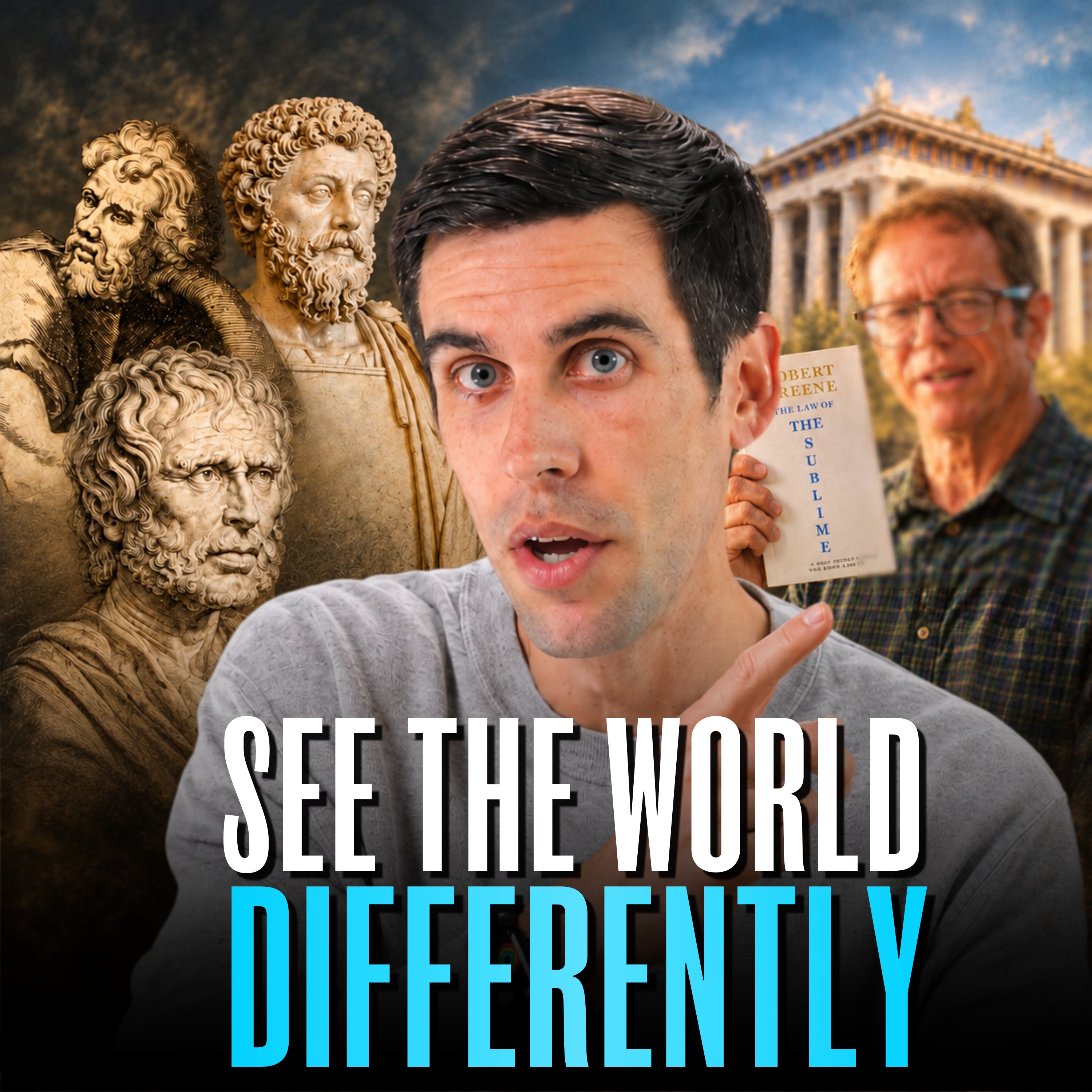
Robert Greene spent decades studying power, ambition, and control. Then a devastating stroke left him unable to control his own body. What happened next surprised even him. Why would coming so close to death make life feel more extraordinary? And what did Greene discover that the rest of us could learn without nearly dying? Greene, the bestselling author of The 48 Laws of Power, reveals: How a grasshopper in his backyard changed the way he saw the world Why success, power, and control may leave us feeling strangely empty Why AI could erode some of the abilities that make us human What ancient civilizations understood about awe that we've largely forgotten How to recapture the wonder we experienced as children Robert Greene's new book is The Law of the Sublime.
Episode information is provided by the publisher. Listening takes place on the publisher’s service.
We spend so much time caught up in the demands of everyday life that we forget to appreciate how extraordinary it is to be alive. Inspired by Robert Greene's new book, The Law of the Sublime (https://www.thepaintedporch.com/products/the-law-of-the-sublime?_pos=13&_sid=e0d7a8c03&_ss=r), Ryan explores what the Stoics understood about finding beauty in the ordinary, seeing life from a different perspective, recognizing our connection to something bigger than ourselves, and remembering just how lucky we are to be alive. Watch this episode (https://www.youtube.com/watch?v=eCjqWcbsK1M) on YouTube: https://www.youtube.com/watch?v=eCjqWcbsK1M Watch the NEW Robert Greene Daily Stoic Podcast Episode HERE (https://www.youtube.com/watch?v=Kp_wYiuPD_o): https://www.youtube.com/watch?v=Kp_wYiuPD_o If you want to get your own dedicated privacy specialist and an emergency threat response team who can protect the privacy of you and your family, go to https://incogni.com/dailystoic Hosted on Acast.
Join NCI University today to master human behavior and influence: Uploaded 05-11-21 This is a dive to discover the possibilities, not the case itself. Sirhan Sirhan, in full Sirhan Bishara Sirhan, (born March 19, 1944, Jerusalem), Palestinian-born Jordanian citizen who was convicted (1969) of fatally shooting U.S. Sen. Robert F. Kennedy on June 5, 1968. He received the death penalty, but the sentence was later commuted to life. Sirhan, a Christian Palestinian, was born in Jerusalem. In 1948 Jordan took control of East Jerusalem and what is now the West Bank, and the following year it granted citizenship to people living in those areas. It is believed that this is how Sirhan became a Jordanian citizen. In the 1950s, he and his family moved to the United States and eventually settled in Pasadena, California. There he attended Pasadena City College and later held odd jobs, notably working at a horse stable and later at a health food store. During this time, Sirhan became vocal in his oppo
Imagine if every big change in our lives came with a whole community stepping up beside us… In this episode, I sit down with Dr Arne Rubinstein, former GP and emergency doctor, founder of the Rites of Passage Institute, and a man who's spent more than 30 years walking young people across the threshold into adulthood. Arne's work began around a fire at his very first men's gathering, listening to a hundred men wrestle with the same handful of wounds. Then in the Emergency Dpt, he kept meeting teenagers who'd pushed it one step too far... kids trying to become adults with nobody there to hold them. He came to believe every young person will go through a rite of passage either way. The question is whether we leave them to create their own, or gather around and help. We talk about why our culture is so good at turning away from the big moments - from first periods to menopause to death - and what opens up when we turn towards them. We explore: Separation, transformation and integration, an
FORCE Yourself to TAKE ACTION – Jim Rohn Motivation #jimrohn #motivation #selfdiscipline #personaldevelopment #successmindset Uploaded 31-01-25 ► Speaker: Jim Rohn (AI Voice Over by Jim Rohn Academy) The difference between success and failure comes down to one thing—action. In this powerful video, inspired by the wisdom of Jim Rohn, discover why taking immediate, decisive action is the key to transforming your life. No more waiting. No more excuses. It’s time to push past hesitation, fear, and procrastination and step into the life you were meant to live. Key Topics Covered: The Myth of Motivation: Why waiting to "feel ready" is the biggest mistake you can make. Overcoming Resistance: Learn how to break through self-doubt, fear, and mental roadblocks. The Power of Taking Action: Success doesn’t happen by chance—it happens by choice. Eliminating Excuses: Identify the mindset traps that keep you stuck and replace them with an unstoppable work ethic. Creating Discipline: Learn how to take
Prince Harry makes a lively appearance on Britain's This Morning, revealing his thoughts on the new James Bond, Meghan Markle's former television series Suits, and why he considers Glastonbury and Coachella a nightmare. The Duke of Sussex endorses Robert Pattinson as the next 007, chooses Suits over EastEnders, and reveals that he tried to FaceTime presenter Alison Hammond with Prince Archie and Princess Lilibet, only for her to ignore his calls. Harry also helps prepare a Christmas cake alongside Invictus Games veterans, shares a laugh involving a prosthetic hand, and enjoys a shot of whisky. He's later spotted at London's Savoy hotel. But Harry's latest television appearance sparks criticism from Daily Express columnist Alicia Liberty, who questions how his highly publicized appearances fit with his longstanding concerns about security in Britain. Meanwhile, former Margaret Thatcher aide Nile Gardiner calls for Harry and Meghan to be stripped of their royal titles, accusing the Susse
This is a Grave Talks CLASSIC EPISODE! For Melissa Clevenger, the spirit world has never been a distant mystery—it has been a lifelong reality. Since the age of five, Melissa has been able to see and hear spirits. But her early encounters weren’t comforting or controlled. The voices didn’t ask permission. The apparitions didn’t wait for understanding. What began as terrifying childhood experiences slowly evolved into something she could manage—and eventually embrace. As she matured, the chaos of those early years transformed into meaningful communication, guiding her toward a deeper understanding of her abilities and the messages coming through. Today, Melissa shares her journey from fear to purpose, reflecting on what it means to live with heightened sensitivity and dedicate her life to connecting the living with those who have passed on. On this episode of The Grave Talks, we explore the reality of growing up with psychic abilities, the challenges of navigating unseen energies, and t
What do you do when you've already lost the battle with Microsoft? Why would Steve Jobs put his stores in the one place he hated most? And why would Apple build a store that doesn't want to sell you anything? Ron Johnson was recruited by Steve Jobs to do something almost everyone thought was a bad idea: open stores. For his first year at Apple, Steve called him almost every night. Ron went on to create the Apple Store and worked alongside Jobs for more than a decade. Six months into building the very first one, he told Steve the whole thing was wrong. He discusses: ● Why Steve Jobs hated malls, and the conversation that changed his mind ● The sports metaphor that convinced Steve that Apple hadn't lost yet ● Why the Apple Store was designed not to sell you anything ● What ChatGPT would have told them to do, and why it would have been wrong ● The sleepless night that made Ron tell Steve the store was all wrong ● What happened after a 10-minute car ride in complete silence ● How the world
A daycare started fining parents for picking up their children late. Instead of arriving on time, parents started arriving even later. Why would a punishment encourage the very behavior it was meant to stop? Stephen Dubner, bestselling co-author of Freakonomics and longtime host of Freakonomics Radio, has spent more than 20 years uncovering the hidden forces behind human behavior. What he's discovered challenges some of our most deeply held assumptions about why people do what they do. In this conversation, discover: Why punishing bad behavior can actually encourage more of it Why rewarding students for perfect attendance can make them show up less The shocking discovery about teachers who secretly changed their students' test answers What drug dealers living with their mothers reveal about how the world really works Why Stephen Dubner thinks we're asking the wrong question about AI What he believes we'll look back on in 20 years and wonder how we ever accepted The surprising lesson ab
Retraining programs should provide financial support as well as new skills.
Share your view, then see how readers voted. No sign-in required. This poll is shared across stories.
Do you agree or disagree?
Common Quandary
A Common Quandary to discuss
Another conversation to explore, separate from this news story.
You inherit a fortune made in ways you despise. Can you keep it?
You inherit a substantial sum from a relative who accumulated it through practices you consider exploitative. Keeping it would improve your family's security; donating it could support people harmed by similar practices.
Can ownership be morally clean when its history is not?