Why Apple Stores Don’t Try to Sell You Anything (#327)
22 min
Listen through the publisher, then discuss the episode here or arrange an in-person Roundtable. Your city determines where to meet.
Roundtables are designed for groups of four, with a shared subject and room for everyone to speak. Come for discussion, with no dating expectation.
What do you do when you've already lost the battle with Microsoft? Why would Steve Jobs put his stores in the one place he hated most? And why would Apple build a store that doesn't want to sell you anything? Ron Johnson was recruited by Steve Jobs to do something almost everyone thought was a bad idea: open stores. For his first year at Apple, Steve called him almost every night. Ron went on to create the Apple Store and worked alongside Jobs for more than a decade. Six months into building the very first one, he told Steve the whole thing was wrong. He discusses: ● Why Steve Jobs hated malls, and the conversation that changed his mind ● The sports metaphor that convinced Steve that Apple hadn't lost yet ● Why the Apple Store was designed not to sell you anything ● What ChatGPT would have told them to do, and why it would have been wrong ● The sleepless night that made Ron tell Steve the store was all wrong ● What happened after a 10-minute car ride in complete silence ● How the world's most famous control freak became the best delegator Ron ever worked for ● Whether Steve Jobs was really as brutal as his reputation suggests ● The store that was meant to be asleep, and what happened between 11pm and 8am ● The night before the first iPhone went on sale, and the phone call Ron will never forget ● Who was really better at retail: Ron or Steve? The legend of Steve Jobs doesn't tell the whole story. Ron Johnson reveals what Steve was like when the cameras were off, why the best ideas can't survive early sceptics, and the mistake he made when he tried to repeat Apple's success somewhere else.
Episode information is provided by the publisher. Listening takes place on the publisher’s service.
You've been tired for years. You know it. The people around you know it. And every solution you've tried — going to bed earlier, sleeping in on weekends, taking naps, drinking more coffee, drinking less coffee, trying new mattresses, trying new vitamins — none of it has actually fixed the problem. Uploaded 16-06-26 You're still tired. Not falling-asleep tired. Just heavy. Just dragged. Just running on a battery that never seems to charge all the way back, no matter how many hours you put your head down. Here's the truth: most of the tiredness you carry is not about sleep. And that is why none of the sleep-based solutions have worked. You've been treating the wrong condition for years. You've been adding hours of rest to a body that fundamentally doesn't need more rest. It needs something else entirely. The chronic, low-grade, never-quite-go-away exhaustion most adults carry is not physical fatigue. It is a different kind of tiredness with completely different causes. And until you unde
We’re about to time travel into the future Sam Altman is building… I interviewed Sam Altman, the CEO of OpenAI, the company behind ChatGPT. They’re trying to build a “superintelligence” that could far exceed humans in almost every field – and they just released their most powerful tool yet, GPT-5. A few years ago, that would’ve sounded like science fiction! Not anymore. In fact, they’re not alone. We’re in the middle of the most high stakes global race any of us have ever seen. Hundreds of billions of dollars and an unbelievable amount of human work… It’s a profound moment. Most people never see a huge technological shift like this in their lives and it’s happening all around us right now. So in this conversation, I’m going to try to time travel into the future with Sam Altman, to see what he’s trying to build… so you and I can really understand what’s coming. Welcome to HUGE* Conversations. Chapters: 0:00 What future are we headed for? 2:06 What can GPT-5 do that GPT-4 can’t? 6:57 Wha
Have you ever tried something so hard, failed, and then tried again anyway? Meet Tony Hawk, the boy who turned his restless energy into skateboarding history! Growing up in sunny San Diego, California, Tony was a frustrated kid until his brother gave him a scratched-up blue skateboard. It was pure magic! By age 14, he was a fearless professional skater inventing wild, sky-high tricks on massive wooden ramps. Imagine being at the 1999 X Games, watching Tony attempt the ultimate, "impossible" trick: the 900! That's two and a half dizzying spins high in the air. Crash after crash, he fell ten times. But on his eleventh try? He landed it perfectly, while the crowd went absolutely wild! That same year, his smash-hit video game made him a superstar all around the world. But Tony didn't just want fame. He wanted every kid to have a safe place to ride, fall, and get back up. Through his charity, he has helped build hundreds of free public skateparks everywhere! Grab your helmet and drop in as
Two members of this family knelt beside wounded strangers this week. Only one was seen doing it. Mark Francis on the week India went perfectly for William and Kate — street cricket with Sachin Tendulkar, sixty rupees on the Metro, five Earthshot winners, and Kate alone at a Mumbai maternity hospital on the final day, holding the hand of a mother who had just lost one of her newborn twins. And on Harry in Lviv, meeting the newest members of Ukraine’s Invictus community, in a visit that landed on the one weekend nobody could look — followed by a Telegraph interview in which he said that if asked to sign up again, “I will 100 per cent be there to serve my country”. Plus Camilla’s private letter, Charles and the Butlin’s holiday he never got, and the royal accounts welcoming Robert Pattinson: “Welcome to His Majesty’s Secret Service, Mr Bond.” One subscription, the whole family, no ads. Try it free for 30 days: tap Try Free in Apple Podcasts. Got an App Store gift card? This is a good use
Join NCI University today to master human behavior and influence: Uploaded 05-11-21 This is a dive to discover the possibilities, not the case itself. Sirhan Sirhan, in full Sirhan Bishara Sirhan, (born March 19, 1944, Jerusalem), Palestinian-born Jordanian citizen who was convicted (1969) of fatally shooting U.S. Sen. Robert F. Kennedy on June 5, 1968. He received the death penalty, but the sentence was later commuted to life. Sirhan, a Christian Palestinian, was born in Jerusalem. In 1948 Jordan took control of East Jerusalem and what is now the West Bank, and the following year it granted citizenship to people living in those areas. It is believed that this is how Sirhan became a Jordanian citizen. In the 1950s, he and his family moved to the United States and eventually settled in Pasadena, California. There he attended Pasadena City College and later held odd jobs, notably working at a horse stable and later at a health food store. During this time, Sirhan became vocal in his oppo
This week on The Necessary Conversation, it's Chad, Haley, and Mary Lou. Bob is still recovering but sent in a video message about Trump calling Putin his friend that we watch together. 🇷🇺 Trump held the first-ever three-way talks with Putin and Xi, called it a "12 out of 10," and produced nothing. Then at a press conference he called Putin his friend — and when asked if Putin is a friend to America, the president of the United States said, "I can't speak to America." That same day, Trump's friend Putin launched massive strikes into Ukraine, hit Poland with two missiles — an act of war against a NATO ally — then struck near a Ukrainian restaurant and drone-bombed the first responders, killing a 7-year-old child and a 20-year-old paramedic. We watch Bob's video and ask Mary Lou: is Russia our friend? 🇨🇳 The House Foreign Affairs Committee revealed Trump's Commerce Department approved nearly 880,000 advanced AI chips for Chinese military-linked companies including Alibaba, Tencent, a
Robert Greene spent decades studying power, ambition, and control. Then a devastating stroke left him unable to control his own body. What happened next surprised even him. Why would coming so close to death make life feel more extraordinary? And what did Greene discover that the rest of us could learn without nearly dying? Greene, the bestselling author of The 48 Laws of Power, reveals: How a grasshopper in his backyard changed the way he saw the world Why success, power, and control may leave us feeling strangely empty Why AI could erode some of the abilities that make us human What ancient civilizations understood about awe that we've largely forgotten How to recapture the wonder we experienced as children Robert Greene's new book is The Law of the Sublime.
A daycare started fining parents for picking up their children late. Instead of arriving on time, parents started arriving even later. Why would a punishment encourage the very behavior it was meant to stop? Stephen Dubner, bestselling co-author of Freakonomics and longtime host of Freakonomics Radio, has spent more than 20 years uncovering the hidden forces behind human behavior. What he's discovered challenges some of our most deeply held assumptions about why people do what they do. In this conversation, discover: Why punishing bad behavior can actually encourage more of it Why rewarding students for perfect attendance can make them show up less The shocking discovery about teachers who secretly changed their students' test answers What drug dealers living with their mothers reveal about how the world really works Why Stephen Dubner thinks we're asking the wrong question about AI What he believes we'll look back on in 20 years and wonder how we ever accepted The surprising lesson ab
An institutional apology should include a concrete plan to prevent repetition.
Share your view, then see how readers voted. No sign-in required. This poll is shared across stories.
Do you agree or disagree?
Common Quandary
A Common Quandary to discuss
Another conversation to explore, separate from this news story.
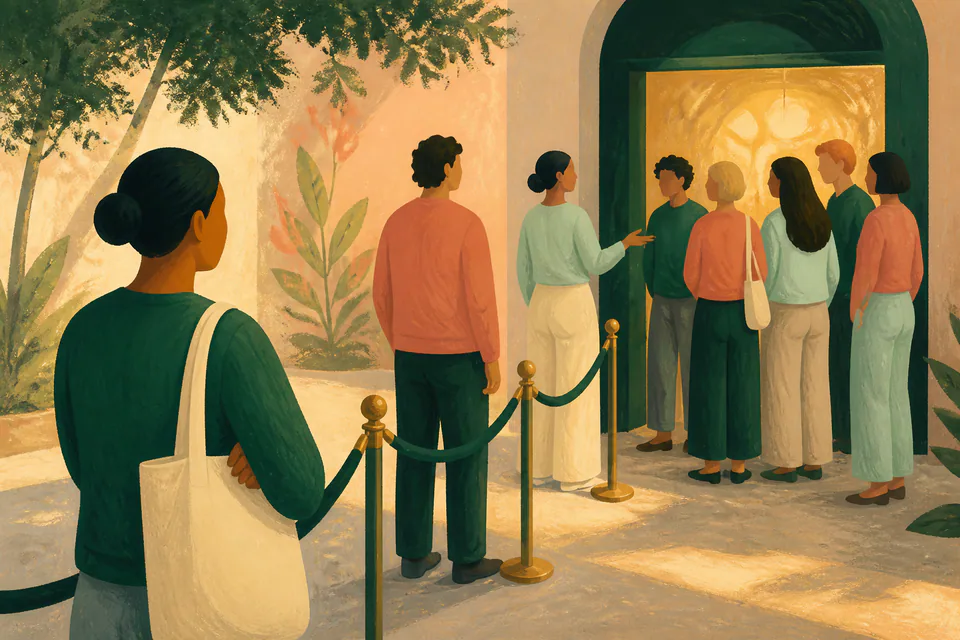
Five friends join the person ahead of you after a forty-minute wait. Do you object?
You wait forty minutes for a popular event. Just before the doors open, five friends join the person directly ahead of you, who says they have been holding everyone's place from the beginning.
What unwritten agreement does joining a line create?