Listen through the publisher, then discuss the episode here or arrange an in-person Roundtable. Your city determines where to meet.
Roundtables are designed for groups of four, with a shared subject and room for everyone to speak. Come for discussion, with no dating expectation.
A daycare started fining parents for picking up their children late. Instead of arriving on time, parents started arriving even later. Why would a punishment encourage the very behavior it was meant to stop? Stephen Dubner, bestselling co-author of Freakonomics and longtime host of Freakonomics Radio, has spent more than 20 years uncovering the hidden forces behind human behavior. What he's discovered challenges some of our most deeply held assumptions about why people do what they do. In this conversation, discover: Why punishing bad behavior can actually encourage more of it Why rewarding students for perfect attendance can make them show up less The shocking discovery about teachers who secretly changed their students' test answers What drug dealers living with their mothers reveal about how the world really works Why Stephen Dubner thinks we're asking the wrong question about AI What he believes we'll look back on in 20 years and wonder how we ever accepted The surprising lesson about parenting that changed his own life What if some of our biggest mistakes come not from failing to think, but from being too sure we already know the answers?
Episode information is provided by the publisher. Listening takes place on the publisher’s service.
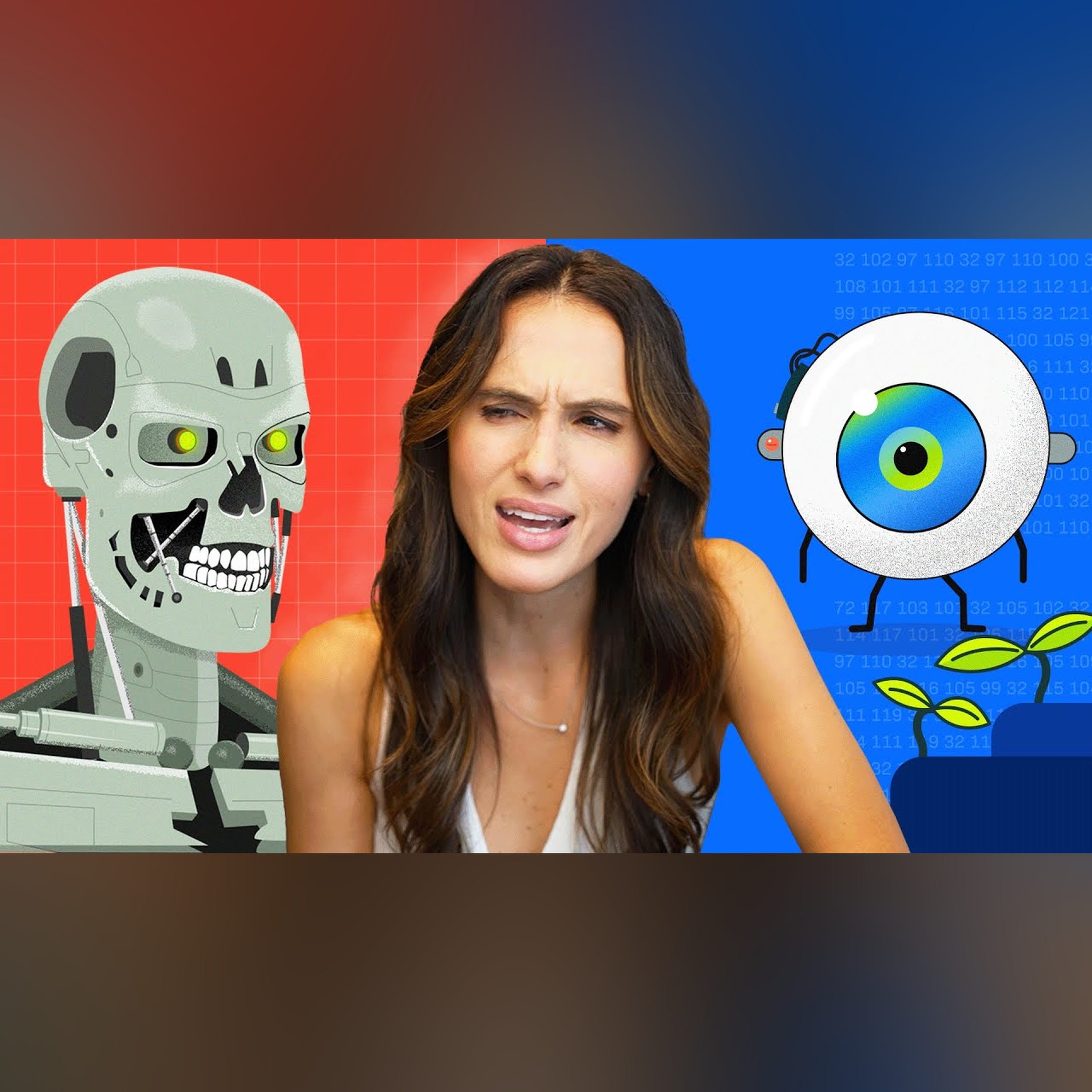
AI is here. Now what? Everyone’s talking about artificial intelligence and machine learning. There are lots of names thrown around - OpenAI’s ChatGPT and DALLE-2, Google’s Bard, Meta’s LLaMa 2, Midjourney, AlphaFold… Right now, we’re in this weird moment where lots of smart people agree we’re on the cusp of a truly world-changing technology. But some seem to be saying it's going to lead to human extinction while others are saying it’s “more profound than fire.” But it all feels so VAGUE. I want to know: How specifically would AI kill me? Or totally transform my life for the better? In this video, that’s what I’m going to try to learn. We dive into what the most extreme bad and good AI futures actually look like, so that you and I can get ready. And more importantly, so we can make sure that we get our real future RIGHT. Chapters: 00:00 Why is AI so confusing? 1:13 What is AI? 2:37 Why is everyone talking about AI now? 5:12 Why is AI dangerous? 6:22 How would AI kill me? 8:08 Should we
Obsessions, Addictions, and Compulsions | The Dangers of Your Smartphone Addiction | Tony Robbins Podcast Uploaded 30-05-19 Did you know that the average American checks email within 6 seconds of arriving at work? Or that 75% of adults say they spend the entire day within an arm’s reach of their phones? Whether we want to admit it or not, the smartphone has become a critical extension of our lives. And it’s easy to understand why. Smartphone technology allows us a number of communication options including voice calls, text messages, video chat and instant messenger. We have immediate access to the information and are constantly connected to the web. And with the advancement of mobile technology, we can do our banking, shop online, check movie times, check our heart rates, edit photos, publish blog posts – anytime, anywhere. But what is this convenience really costing us? In this episode of the Tony Robbins Podcast, we’re talking with renowned social psychologist, Adam Alter. Adam is an
#JimRohn, #MotivationalSpeech, #WhyNotYou, #SuccessMindset, #SelfDiscipline, This powerful 34-minute motivational speech inspired by Jim Rohn’s legendary wisdom will challenge your mindset, ignite self-belief, and push you toward becoming the person you were born to be. If you've ever doubted yourself, felt stuck, lacked motivation, struggled with discipline, or wondered if success is really possible for you — this speech is exactly what you need. Uploaded 18-05-26 In this life-changing motivational journey, you'll discover the hidden truth about discipline, consistency, success psychology, mindset transformation, daily habits, personal growth, purpose, self-belief, overcoming fear, pain vs regret, and building the future you deserve. This is more than motivation. This is a wake-up call. Because the question is no longer “Why them?” The real question is: “WHY NOT YOU?” Watch this speech till the end if you're serious about changing your life, building discipline, escaping excuses, and
Master the skills that change lives — enroll in your free human behavior course today: https://nci.university/learn Uploaded 15-01-26 EXECUTIVE SUMMARY: Video: What It Feels Like to See Into People Purpose: Reframe how human behavior is actually driven and perceived Outcome: Permanent shift in how you experience people and conversations CORE IDEA: Human behavior is not driven by beliefs, opinions, or logic. Those are after-action reports. Behavior is driven by the nervous system’s constant assessment of: • safety • approval • power • avoidance of shame Decisions are made before conscious thought. Beliefs are constructed afterward to justify what already happened. WHY THIS MATTERS: Most people spend their lives interacting with: • beliefs • arguments • explanations • surface narratives As a result, they miss the layer where real decisions are made. This video focuses on that lower layer — the one that actually governs: • conflict • influence • attraction • resistance • leadership • trus
Today, Mel is doing something she's never done before on The Mel Robbins Podcast. She's bringing members of her team into the studio for live coaching with world-renowned communications expert Vinh Giang. Vinh is known for teaching millions of people online how to stop sounding insecure, speak more clearly, and get people to listen when you talk. And when you hear him coaching today, it will be like he’s coaching you. One person freezes when they're put on the spot. Another can't stop interrupting people. Someone else has great ideas but stays quiet because they're afraid of being judged. Does any of that sound familiar? And Vinh isn't just giving advice. He's coaching real people through practical exercises, right there in the studio, so you can hear the difference and start making those same changes in your own life. As Mel says, put yourself in their shoes. As Vinh works with each person, you'll recognize things you struggle with, too. You'll learn: -What to do when your mind goes b
Get the 200+ Page Optimal Living Daily Workbook (PDF) - Free. Want to turn today's episode into an actionable plan? Episode 4232: Chris Guillebeau shares a candid, funny account of his lack of qualifications, from a short-lived dishwashing job to failing his way through statistics and shrink-wrapping pallets. He argues that formal credentials matter far less than people think, and that anyone who builds a good life without them should treat that work with gratitude and diligence. It is an encouraging take on personal development for anyone who has ever felt like an imposter. Read along with the original article(s) here: https://chrisguillebeau.com/qualifications/ Quotes to ponder: "First, forget about what you're actually qualified to do. It's irrelevant and no one cares." "Fourth, when you do find something that works for you, you should be very grateful, every day." "Regardless of your actual qualifications, there's one thing that no one can give you and no one can take away: the wil
Robert Greene spent decades studying power, ambition, and control. Then a devastating stroke left him unable to control his own body. What happened next surprised even him. Why would coming so close to death make life feel more extraordinary? And what did Greene discover that the rest of us could learn without nearly dying? Greene, the bestselling author of The 48 Laws of Power, reveals: How a grasshopper in his backyard changed the way he saw the world Why success, power, and control may leave us feeling strangely empty Why AI could erode some of the abilities that make us human What ancient civilizations understood about awe that we've largely forgotten How to recapture the wonder we experienced as children Robert Greene's new book is The Law of the Sublime.
What do you do when you've already lost the battle with Microsoft? Why would Steve Jobs put his stores in the one place he hated most? And why would Apple build a store that doesn't want to sell you anything? Ron Johnson was recruited by Steve Jobs to do something almost everyone thought was a bad idea: open stores. For his first year at Apple, Steve called him almost every night. Ron went on to create the Apple Store and worked alongside Jobs for more than a decade. Six months into building the very first one, he told Steve the whole thing was wrong. He discusses: ● Why Steve Jobs hated malls, and the conversation that changed his mind ● The sports metaphor that convinced Steve that Apple hadn't lost yet ● Why the Apple Store was designed not to sell you anything ● What ChatGPT would have told them to do, and why it would have been wrong ● The sleepless night that made Ron tell Steve the store was all wrong ● What happened after a 10-minute car ride in complete silence ● How the world
Established legal precedents should change when strong reasons outweigh the value of consistency.
Share your view, then see how readers voted. No sign-in required. This poll is shared across stories.
Do you agree or disagree?
Common Quandary
A Common Quandary to discuss
Another conversation to explore, separate from this news story.
An old friend refuses to use someone's new name. Do you correct them at the reunion?
At a reunion, an old friend repeatedly uses the name a former classmate had years ago. They say shared history gives the old name affectionate meaning; the classmate has clearly introduced themselves with a different name.
When does preserving your shared past deny who someone is now?