Join us in this episode of our language learning podcast as we explore the essentials of telling time in Spanish. Whether you're traveling, meeting friends, or simply practicing conversation, knowing how to say the time is a must. We'll cover easy phrases, clear examples, and real-life situations to help you confidently ask and answer "¿Qué hora es?" You'll learn how to express hours, minutes, and common expressions used in daily life. This episode is great for beginners and anyone looking to refresh their skills, this episode unlocks simple techniques to make telling time in Spanish natural, fun, and stress-free! You can find more resources at https://learningspanishforbeginners.com/62
There’s no place like Earth—and we’ve got the planet’s spectacular, one-of-a-kind geology to thank for it. In this episode of Crash Course Geology, we’ll explore how geology touches our lives, helps us solve mysteries about the planet’s past and its future, and puts our world life in perspective. Introduction: More Than Rocks 00:00 What is Geology 0:40 Fall Lines and Settlement Patterns 3:37 Jobs of Geologists 5:58 Review and Credits 7:59 Sources: https://docs.google.com/document/d/1RpwM8ZQPFk_DkzMJjMdtRrNGrJSNJ7FbgmQybSZ2Cqo/edit?tab=t.0 Check out our CC Geology Extracurricular Playlist here: https://www.youtube.com/playlist?list=PL8dPuuaLjXtOmqnkvEtNVOrm0eaIjFjJ7 *** Support us for $5/month on Patreon to keep Crash Course free for everyone forever! https://www.patreon.com/crashcourse Or support us directly: https://complexly.com/support Join our Crash Course email list to get the latest news and highlights: https://mailchi.mp/crashcourse/email Get our special Crash Course Educators n
Download a free audiobook and support TED-Ed's nonprofit mission: http://adbl.co/2om4O4Q Uploaded 22-02-18 Check out Neil Gaiman's "Norse Mythology": http://bit.ly/2opZptA View full lesson: https://ed.ted.com/lessons/the-myth-of-thor-s-journey-to-the-land-of-giants-scott-a-mellor Thor – son of Odin, god of thunder, and protector of mankind – struggled mightily against his greatest challenge yet: opening a bag of food. How had the mighty god fallen so far? Scott Mellor tells the myth of Thor's journey to Utgard. Lesson by Scott A. Mellor, animation by Rune F.B. Hansen. Thank you so much to our patrons for your support! Without you this video would not be possible! Alejandro Cachoua, Thomas Mungavan, Elena Crescia, Edla Paniguel, Sarah Lundegaard, Charlsey, Anna-Pitschna Kunz, Tim Armstrong, Alessandro, Erika Blanquez, Ricki Daniel Marbun, zjweele13, Judith Benavides, Znosheni Kedy, Caitlin de Falco, Scheherazade Kelii, Errys, James Bruening, Michael Braun-Boghos, Ricardo Diaz, Kack-Kyun
Follow along: https://colab.research.google.com/drive/1uYXTDeBbPeuJfM1teufZ9nUaiRIN9nHW Today we create a game and then build an AI to destroy it. Our game is called TrashBlaster, and it’s like Asteroids but with trash in the ocean, and instead of a spaceship John Green Bot is wielding a laser. We'll use machine learning techniques such as an evolutionary neural network alongside a carefully crafted fitness function to create an unstoppable AI. To install the game on your computer download our repo on Github: https://github.com/crash-course-ai/lab3-games Crash Course is produced in association with PBS Digital Studios: https://www.youtube.com/pbsdigitalstudios Crash Course is on Patreon! Thanks to the following patrons for their generous monthly contributions that help keep Crash Course free for everyone forever: Eric Prestemon, Sam Buck, Mark Brouwer, Indika Siriwardena, Avi Yashchin, Timothy J Kwist, Brian Thomas Gossett, Haixiang N/A Liu, Jonathan Zbikowski, Siobhan Sabino, Zach Van
Hank answers some questions and responds to some concerns about his video on water. Watch that video here: http://www.youtube.com/watch?v=HVT3Y3_gHGg Crash Course is on Patreon! Want to find Crash Course elsewhere on the internet? Facebook - http://www.facebook.com/YouTubeCrashCourse Twitter - http://www.twitter.com/TheCrashCourse Instagram - https://www.instagram.com/thecrashcourse/ CC Kids: http://www.youtube.com/crashcoursekids
Dig into how sleep deprivation affects the teenage body and brain, and what can be done to help adolescents get enough sleep. -- Sleep deprivation among American teenagers is an epidemic. Only about 1 in 10 teens gets the 8 to 10 hours of sleep per night recommended by sleep scientists and pediatricians. So, what’s going on? And what changes can be made to address this issue? Wendy Troxel shares how early school start times and public policy are depriving adolescents of sleep at a time when they need it most. Directed by Laura Jayne Hodkin. This is an animated adaptation of a TEDx Talk given by Wendy Troxel. You can watch the talk in full here: https://www.youtube.com/watch?v=TS6lFDVR-3g Education is the ultimate idea worth spreading. That’s why we’ve launched InnovaTED — a program that helps educators develop their brightest ideas and share them with the world. Learn more: https://ed.ted.com/edtalks Support Our Non-Profit Mission ---------------------------------------------- Support
Sara is a mom of seven, a master herbalist, an international board-certified lactation consultant, and the author of Moodtopia for Women and Moodtopia for Kids. She runs a pediatric and women’s clinic in Brooklyn, New York, and has worked with babies, children and their parents for more than three decades. In this conversation, Sara explains why babies start life used to sweetness, since breast milk is naturally sweet, and why that makes it normal for children to gravitate toward sugar. The real question, she says, is what we offer them once they move on to solid food. We talk about the difference between natural sugars and refined sugars, why protein matters for kids, and how the foods served at school can leave children with ups and downs in their mood and energy. Sara doesn’t recommend cutting sugar out completely, because in her experience kids will find a way to get it. Instead, she suggests filling the need for sweetness with whole fruit, fruit cooked into baking, and homemade tr
discover how to transform your life with 10 powerful habits rooted in discipline, clarity, and intention. From making your bed to ending your day on purpose, these tiny changes build momentum, self-trust, and a life of calm focus without hype or burnout. Key Topics From This Motivational Video: Why tiny habits create massive identity shifts How structure and reflection build self-leadership The connection between physical order and mental clarity How to protect energy with boundaries and pauses Ending your day with intention to rise stronger **Follow, Start listening and let Jim Rohn’s legacy inspire your path forward.** -----------------------------------03:12-11 ---
In which Hank does some push-ups for science and describes the "economy" of cellular respiration and the various processes whereby our bodies create energy in the form of ATP. Special thanks go to Stafford Fitness (www.staffordfitness.net) for allowing us to shoot the gym scenes in their facilities. This video uses sounds from Freesound.org Table of Contents: 1) Cellular Respiration 01:00 2) Adenosine Triphosphate 01:29 3) Glycolysis 4:13 A) Pyruvate Molecules 5:00 B) Anaerobic Respiration/Fermentation 5:33 C) Aerobic Respiration 6:45 4) Krebs Cycle 7:06 A) Acetyl COA 7:38 B) Oxaloacetic Acid 8:21 C) Biolography: Hans Krebs 8:37 D) NAD/FAD 9:48 5) Electron Transport Chain 10:55 6) Check the Math 12:33 Crash Course is on Patreon! Want to find Crash Course elsewhere on the internet? Facebook - http://www.facebook.com/YouTubeCrashCourse Twitter - http://www.twitter.com/TheCrashCourse Instagram - https://www.instagram.com/thecrashcourse/ CC Kids: http://www.youtube.com/crashcoursekids
Air Date: November 15th, 2026 with Barclays Hampden Hospitality and Events Hosts: Lord Willie Haughey and Sir Tom Hunter This week on the Go Radio Business Show with Hunter & Haughey they unpack the biggest business and economic stories locally and globally. Fresh off the triumphant Founders Conference at Gleneagles, the hosts celebrate Scotland’s unmatched entrepreneurial support network, featuring star turns from business icons like Dame Debbie Crosbie (Nationwide & Virgin Money) and Brian Duffy (Watches of Switzerland). They dive deep into major Glasgow retail and job investments, the latest massive funding wins for Scottish university spin-outs, and a fresh look at UK-EU trade agreements. Plus, they tackle global headlines, including the dramatic market fallout at Nvidia, Bailie Gifford's ongoing activist investor saga, and a bizarre story about a remote-working civil servant juggling five jobs at once! Key Highlights Gleneagles Founders Conference Recap: Tom and Willie reflect on
Today Hank gains insight from that most philosophical of figures...Leonardo DiCaprio. In this episode, we’re talking about the process of philosophical discovery and questioning the relationship between appearance and reality by taking a look at Plato’s famous Myth of the Cave. All with a little help from our good pal Leo. -- Images and video via VideoBlocks or Wikimedia Commons, licensed under Creative Commons by 4.0: https://creativecommons.org/licenses/by/4.0/ "Inception" stills copyright 2010 Warner Bros. Entertainment Inc. and Legendary Pictures -- Produced in collaboration with PBS Digital Studios: http://youtube.com/pbsdigitalstudios Crash Course Philosophy is sponsored by Squarespace. -- Want to find Crash Course elsewhere on the internet? Facebook - http://www.facebook.com/YouTubeCrashC... Twitter - http://www.twitter.com/TheCrashCourse Tumblr - http://thecrashcourse.tumblr.com (http://thecrashcourse.tumblr.com/) Support CrashCourse on Patreon: http://www.patreon.com/crashcour
While we can’t explore every cultural trait in the world, language is an important system of spoken, signed, or written symbols humans use to express themselves. It’s a major marker of identity that often unites members of the same nation, or people with similar cultural identity. And it’s a cultural trait that has enormous power because language helps other cultural traits move through the spoken, visual, tactile, and musical word. So today, we’re going to explore how words move, because the activities that prompt that movement can tell us a lot about how ideas as well move around the world. SOURCES Gregory, Derek, Ron Johnston, Geraldine Pratt, Michael Watts, and Sarah Whatmore, eds. 2009. The Dictionary of Human Geography. 5th ed. Willey-Blackwell. ISBN: 978-1-4051-3288-6 Getis, Bjelland, and Getis. Introduction to Geography, 15 ed. McGraw-Hill Education. 2017. ISBN: 978-1-259-57000-1 Hobbs, Joseph J. Fundamental of World Regional Geography, 4th ed. Cengage. 2017. Cracking the AP Hu
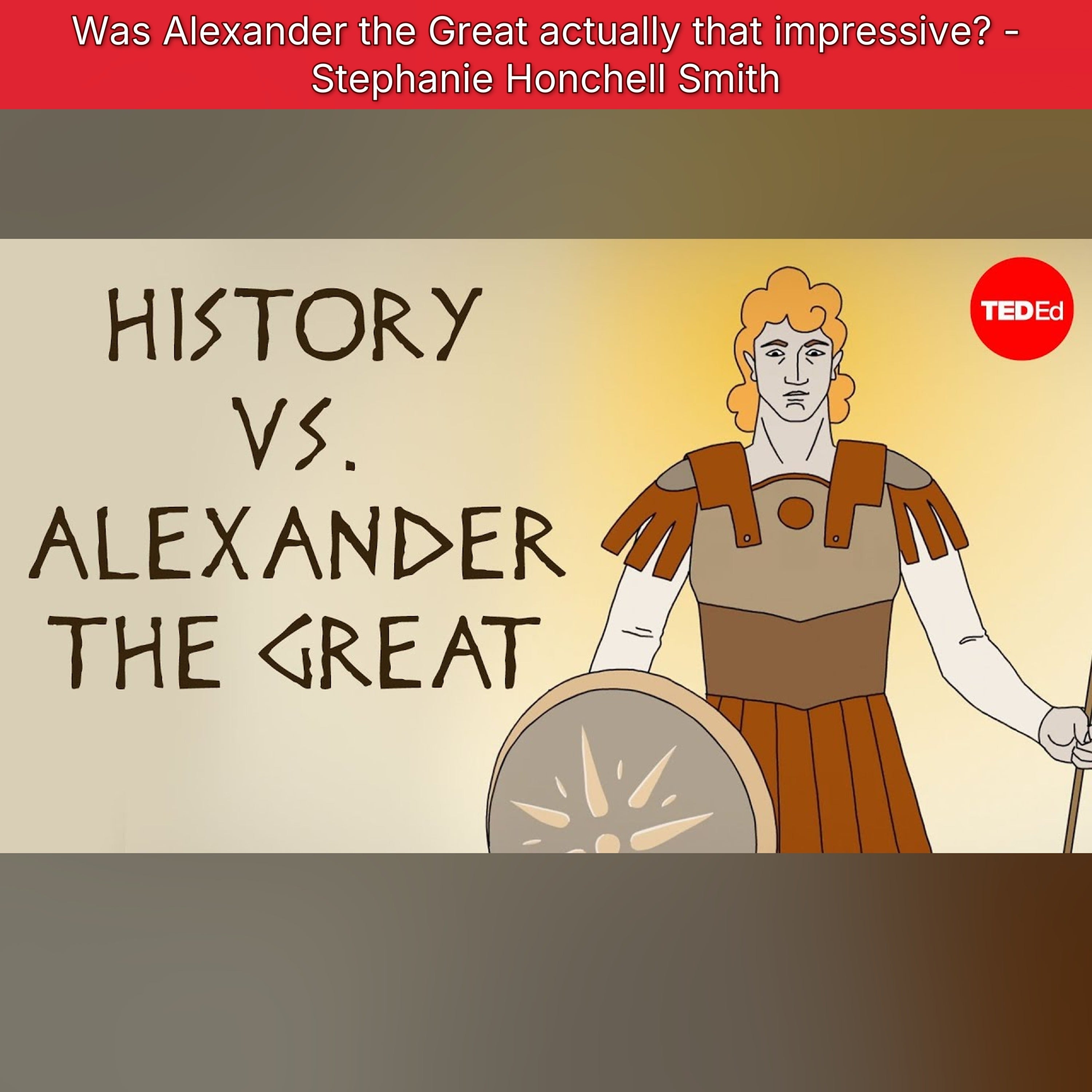
Alexander the Great transformed the world during his reign — but was he an embattled leader, or a ruthless conqueror? -- Alexander the Great fundamentally transformed the world during his 13-year reign. He conquered Persia when it was one of the world’s largest empires, and he was considered a living demi-god by Egyptians and Greeks. But was he a brilliant, embattled leader, or a ruthless, power-hungry conqueror? Stephanie Honchell Smith puts this controversial figure on trial in History vs. Alexander the Great. Lesson by Stephanie Honchell Smith, directed by Michael Kalopaidis, Zedem Media. Support Our Non-Profit Mission ---------------------------------------------- Support us on Patreon: http://bit.ly/TEDEdPatreon Check out our merch: http://bit.ly/TEDEDShop ---------------------------------------------- Connect With Us ---------------------------------------------- Sign up for our newsletter: http://bit.ly/TEDEdNewsletter Find us on Twitter: http://bit.ly/TEDEdTwitter Peep us on In
Life Doesn’t Always Give You a Win, But It Always Gives You a Lesson #Motivation, #MotivationalSpeech, #LifeLessons, #personaldevelopment This powerful motivational speech will help you change the way you see failure, overcome self-doubt, develop discipline, and turn life's challenges into opportunities for personal growth. Discover why setbacks are not always the end of your journey, how painful experiences can build resilience, and why your response to failure matters more than the failure itself. Uploaded 21-10-26 Remember, success is not about winning every battle. It is about learning from every experience, becoming stronger after every setback, and continuing to move forward when life becomes difficult. Your mistakes do not define your future. Your willingness to learn, adapt, and improve can change the direction of your life. Whether you are struggling with failure, financial pressure, disappointment, fear, or uncertainty about your future, this motivational speech will remind y
In this mindset shift from The Positive Mindset Podcast, Henry Lawrence reframes the hard part as a place to practice who you are becoming. You can choose thoughts that support your dream even when your feelings have not caught up, learn new responses through friction, and give yourself grace while you grow. An I-am visualization and breath invite you to experience the message from that higher-self perspective. You do not need the perfect dream before you begin, and you have permission to adjust it as you learn. This selection closes with teaching rather than a new prayer. In this episode: • "Who you're meant to become is worth the hard thing that's in front of you." • "All you can do is be the light from where you are." • "It's your own and it matters." • "This is an opportunity for me to be strong." • "I'm gonna look for proof that my dream is gonna happen." • "You're not going to be comfortable as that version." • "Step into that energy." • "So it's important to give yourself a litt
What can lift ocean creatures up to the top of Everest, bend rocks, cause earthquakes, and sink parts of continents under the sea? Join us on this week’s episode of Crash Course Geology as we investigate how some of the coolest geological forces around make mountains, faults, and may even one day turn Africa into a series of islands! Introduction: Mount Everest Fossils 00:00 Creating Faults 0:57 How Mountains are Made 4:05 How Valleys are Made 6:45 Review & Credits 8:24 Sources: https://docs.google.com/document/d/1RpwM8ZQPFk_DkzMJjMdtRrNGrJSNJ7FbgmQybSZ2Cqo/edit?tab=t.0 Check out our CC Geology Extracurricular Playlist here: https://www.youtube.com/playlist?list=PL8dPuuaLjXtOmqnkvEtNVOrm0eaIjFjJ7 *** Support us for $5/month on Patreon to keep Crash Course free for everyone forever! https://www.patreon.com/crashcourse Or support us directly: https://complexly.com/support Join our Crash Course email list to get the latest news and highlights: https://mailchi.mp/crashcourse/email Get our
Sunday is for looking ahead with God. Before the week begins, we pause and place what's coming into His hands. These Scripture-based Christian affirmations are a steady way to enter the week grounded, attentive, and trusting God to lead you one day at a time. I'll say each affirmation, pause so you can repeat it after me, and then read the Bible verse it comes from. Links AD-FREE Daily Affirmations are on my Patreon: Patreon (https://www.patreon.com/c/HearingJesus) Join me on an immersive Bible Study Experience. Learn more at BibleStudyLive.org (https://biblestudylive.org/) Have a question? Sunday affirmations and Scripture I place this coming week in God's hands.Psalm 31:15 — "My times are in Your hands." I trust God to guide my steps.Psalm 37:23 — "The Lord makes firm the steps of the one who delights in Him." I enter this week with expectancy, not fear.Romans 15:13 — "May the God of hope fill you with all joy and peace as you trust in Him." I invite God into every moment ahead.Prove
In the aftermath of the revolutions and upheaval in 18th and early 19th century Europe, there was a hunger for reform across the continent. Reformers like Robert Owen, Charles Fourier, and Auguste Comte proposed radical new ideas, and at the same time, regular people began to stand up and ask for greater equality, and a louder voice in how they were governed. Results were mixed, but a lot of the ideas that emerged during this time are still echoing in our world today. Sources -Hosking, Geoffrey. Russia: People and Empire. Cambridge: Harvard University Press, 1997. -Hunt, Lynn et al. The Making of the West: Peoples and Cultures. 6th ed. Boston: Bedford St. Martin’s, 2019. -Judson, Pieter M. The Hapsburg Empire: A New History. Cambridge: Harvard University Press, -Kent, Susan Kingsley. A New History of Britain: Four Nations and an Empire. New York: Oxford University Press, 2017. -Sperber, Jonathan. Revolutionary Europe 1780-1850. 2nd ed. London: Routledge, 2017. Crash Course is on Patreo
Join Selfish 30 in December (https://www.margaritanazarenko.com/selfish30?podcast=Episode+191) He was perfect at the beginning. He was planning things, texting back, laughing at your jokes. And then something shifted. Here is the truth. He might not have changed at all. You might have. In this episode Margarita breaks down exactly why relationships feel different once you fall in love, why trying harder almost always makes things worse, and what the woman who keeps her power actually does differently. In this episode: 1. The man you met versus the man you are dating now 2. Sometimes pursuit was the point and you need to know the difference 3. The moment you stop evaluating him and start seeking his approval 4. When love becomes fear and anxious attachment takes over 5. You start rewarding the behaviour you did not want 6. The difference between security and complacency 7. You made him the most important person in your life 8. Why trying harder almost always makes things worse 9. What t
What can a moon rock tell us about Earth’s distant past? All kinds of stuff! Like where its water came from, how it got its moon, and what its birth might have looked like. In this episode of Crash Course Geology, we’ll stroll down memory lane with the Earth’s baby book, and learn about some of the ways it might have formed. Introduction: An Earth Rock on the Moon 00:00 How the Earth Formed 0:36 How the Moon Formed 3:39 Where Earth's water came from 6:53 Where Earth's atmosphere came from 8:01 Review and Credits 8:48 Sources: https://docs.google.com/document/d/1RpwM8ZQPFk_DkzMJjMdtRrNGrJSNJ7FbgmQybSZ2Cqo/edit?tab=t.0 Check out our CC Geology Extracurricular Playlist here: https://www.youtube.com/playlist?list=PL8dPuuaLjXtOmqnkvEtNVOrm0eaIjFjJ7 *** Support us for $5/month on Patreon to keep Crash Course free for everyone forever! https://www.patreon.com/crashcourse Or support us directly: https://complexly.com/support Join our Crash Course email list to get the latest news and highlight
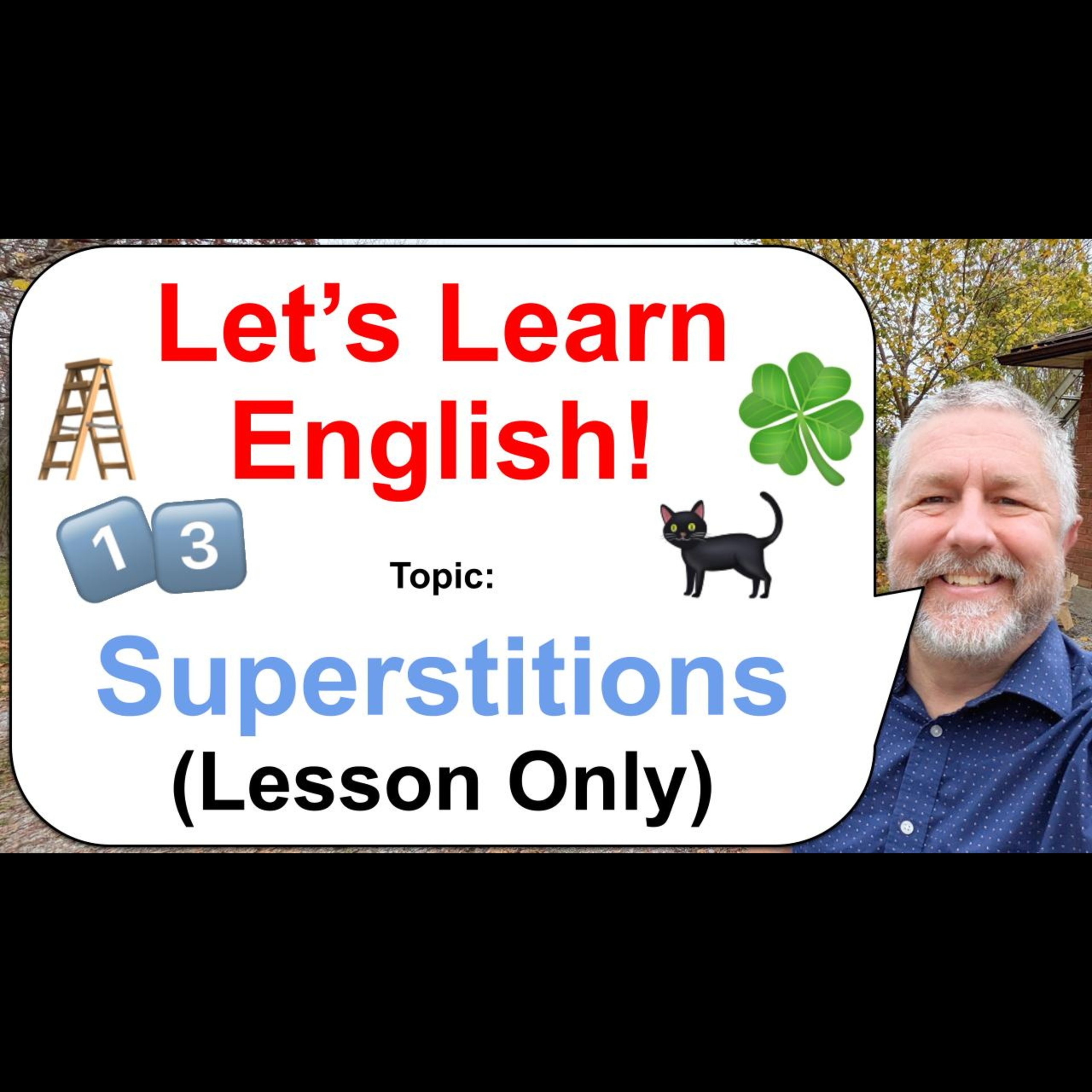
Do you believe in good luck and bad luck? Have you ever knocked on wood, crossed your fingers, or worried about Friday the 13th? In this English lesson, I'll help you learn words and phrases about superstitions! We'll talk about common superstitions in Canada and other English-speaking countries, including black cats, breaking mirrors, walking under ladders, four-leaf clovers, lucky numbers, and much more! You'll also learn useful English expressions like: break a leg, beginner's luck, bad things come in threes, and knock on wood. Along the way, I'll explain what these superstitions mean, why some people believe in them, and how to use the vocabulary in everyday English conversations. This lesson is also a fun way to learn a little about Canadian culture and the traditions and beliefs that are common in North America. So, whether you're superstitious or not, I hope you'll enjoy this English lesson. Maybe it will even bring you some good luck! Thanks for watching this English lesson abo
View full lesson: http://ed.ted.com/lessons/the-punishable-perils-of-plagiarism-melissa-huseman-d-annunzio Fighting plagiarism is serious business. From brainchild-snatching to wholly quotables, plagiarists have plenty of wily ways to pass others' work off as their own -- and all of them are threats to original thinking. Melissa Huseman D'Annunzio imagines what would happen if a Department of Plagiarism Investigation were on the case. Lesson by Melissa Huseman D'Annunzio, animation by Hache Rodriguez.
Happy Sunday! Welcome to Heal Squad’s The Sunday Set Up. Life lessons to help you start the week. Sometimes a single experience from childhood can affect the choices we make for the rest of our lives. This week, we talk overcoming limiting beliefs and discovering that it's never too late to do something we once thought impossible. From a seventh-grade teacher whose hurtful comments led to decades of avoiding public speaking to finally standing in front of an audience and receiving an overwhelmingly positive response. We talk about meaningful coincidences, feeling connected to loved ones we've lost, and how our perspective on difficult experiences can change over time. We also explore the unexpected opportunities that can come from recognizing talents we've overlooked. The takeaway: think about something you've avoided because of an experience in your past. Is it still something you can't do, or have you simply believed that for so long you've stopped questioning it? Sometimes we need t