Episode Highlights With Alexis How she went from a background in molecular biology to a focus on light What circadian biology is and how she got into it How a mouse study first opened her eyes to circadian biology What happens biologically when we interact with light Lux, brightness and temperature of light and how they impact us differently Mitochondria control health and life and your ability to sense your environment How mitochondria control the aging process Sunlight is not just about vitamin D and that idea is very unproductive What POMC is and why we need to know about it Beta-endorphins from sunlight- a powerful endogenous opioid molecule Our bodies are built to make their own healthy “drugs” when we get enough sunlight Many humans are effectively living in a forever winter and why this causes problems The primary signal from blue light and when it is problematic What the SCN is and why this master clock matters a lot! The sun doesn’t age us and actually does the reverse when we
Gen Gomlam explores Buddha’s transformative teaching that our mind and our world are intimately connected. Discover how purifying our thoughts, reducing delusions and cultivating love and compassion can change our personal experience of life. Through the analogy of a dream, she explains why developing wisdom offers a hopeful path towards lasting happiness and world peace.
The Power Hour is a weekly podcast where host Jack Spencer invites leading energy and environment policy experts to discuss the days most pressing issues. Informative and entertaining, the Power Hour gives listeners the opportunity to be a fly on the wall for no holds barred conversations that are sure to educate as well as, just maybe, put a smile on your face. Nuclear energy has bene in the new a lot lately. And for good reason. The United States is facing a massive upswing in power demand and nuclear power is close to the perfect energy source. It is safe, clean, reliable, and secure. Yet we haven’t built many new nuclear plants since in a long, long time. Today, however, with private investment and public spending (for better or worse), that could be about to change. That spending, though, has yet to translate into new power generation. On this episode, Jack invites Jennifer Gordon, Director of the Atlantic Council’s Nuclear Energy Policy Initiative, and one of the nation’s top nuc
Today we have Pete. He is 40 years old, from Aspen, CO, and took his last drink on May 3rd, 2026. This episode is brought to you by: Café RE (https://www.cafe-re.org/) – use code CONNECT for your first month free [02:53] Thoughts from Paul: Paul reflects on a message he wrote to himself in 2014 when he realized he could no longer have both alcohol and the happy, fulfilling life he wanted. He taped a reminder to his wall: "If you want this, then you can't have that". Meaning if he wanted meaningful relationships, time in nature, a healthy body and mind, family, hobbies, and goals, alcohol couldn't be part of the picture. After years of trying to moderate, Paul accepted that drinking the way he wanted to drink was incompatible with the life he hoped to build. He encourages listeners to ask themselves, without judgment, whether alcohol allows them to live the life they deserve. He acknowledges that choosing sobriety can mean making that decision repeatedly, especially in the beginning. Pa
In this episode you will hear: (04:50) Mark and Hillary discuss what to do when parents disagree with each other about the college process. Mark and Hillary explore some of the key areas where this disagreement may occur. (19:48) Mark interviews Steven Antonoff and Jay McCann about the most recent 800-page edition of their book, "College Finder". Part 1 of 3 ¢ Steven Antonoff has developed a cool that is indispensable when it comes to college list building; it is called the College Finder and we are going to discuss it over the next 3 episodes ¢ Dr. Steven Antonoff shares his background ¢ Jay McCann gives his backstory, and he explains how Jay and Steven met ¢ Steven shares the history of the book, "College Finder" and he tells us why he originally wrote it ¢ Steven gives an overview of the various editions of the book, College Finder ¢ Jay talks a lot about how Jay and Steven do the research to select the colleges that are included in the book, and he goes into some depth about some o
In this episode, we talk about Silicon Valley's namesake and how network solids are at the heart of it all. Hank also discusses Solid-State Semiconductors, N-Type and P-Type Semiconductors, Diodes, Transistors, Computer Chips, and Binary Code. All from the same thing that makes up sand! Pssst... we made flashcards to help you review the content in this episode! Find them on the free Crash Course App! Download it here for Apple Devices: https://apple.co/3d4eyZo Download it here for Android Devices: https://bit.ly/2SrDulJ -- Table of Contents Silicon Network Solids 1:25 Network Arrangements 1:52 Solid-State Semiconductors 5:08 N-Type and P-Type Semiconductors 5:11 Diodes and Transistors 6:10 Computer Chips and Binary Code 7:43 -- Crash Course is on Patreon! Want to find Crash Course elsewhere on the internet? Facebook - http://www.facebook.com/YouTubeCrashCourse Twitter - http://www.twitter.com/TheCrashCourse Instagram - https://www.instagram.com/thecrashcourse/ CC Kids: http://www.youtu
Do you use 'very' all the time in English? There's nothing wrong with it, but using it again and again can make your English sound repetitive. In this episode of Coffee Break English, Nick shows you how to use 'a bit', 'a little', 'so', 'extremely', 'absolutely' and 'really' to make your descriptions softer, stronger or more expressive. Your challenge: describe something that happened to you recently, but without using 'very'! Click here to download our free English Modifier Cheat Sheet (https://coffeebreaklanguages.kit.com/stopsayingvery) Click here to watch the video version of the episode (https://youtu.be/pBm4Cm-1390) ️ Love learning in short bursts? Our free weekly newsletter is packed with tips just like these (https://coffeebreaklanguages.kit.com/newsletter) Hosted on Acast. See acast.com/privacy (https://acast.com/privacy) for more information.
In this episode, discover how to focus on yourself, take control of your life, and become the best version of who you can be. Through the timeless wisdom of Stoicism, learn to stop comparing yourself to others, eliminate distractions, build self-discipline, and invest your energy in what truly matters. Develop a stronger mindset, take responsibility for your choices, and turn small daily actions into meaningful progress. Your life changes when you stop chasing approval and start working on yourself. Hosted by Simplecast, an AdsWizz company.
What should you do when your investments start losing money? One member of the Be Clever With Your Cash community recently invested £300 for the first time. Three weeks later, it was worth £295. Not a huge loss, but enough to make them wonder whether investing was really for them. And with stock markets having a turbulent week following the US Mid-terms, it's a question plenty of investors might be asking themselves. So, in this episode of Cash Chats, we're looking at what to do when your investments fall, when you should consider selling, and how to avoid making decisions in a panic. We'll also explore why so many UK savers are nervous about investing, what risks you need to understand before getting started, and whether investing is actually right for everyone. Plus, with the government keen to get more of us investing, could its plans really make a difference? ABOUT CASH CHATS BE CLEVER WITH YOUR CASH ON SOCIAL twitter.com/BeCleverCash (https://twitter.com/BeCleverCash) GET OUR WEEK
英語学習などにご活用を!リンク先の英文記事を見ながら、聴いていただけます。 ▼01.Shell residue likely caused blast that killed GSDF tankers( https://www.asahi.com/ajw/articles/17035020 (https://www.asahi.com/ajw/articles/17035020?ref=arukiki) ) ▼02.Arrest made in mobile phishing scheme targeting Chinese tourists( https://www.asahi.com/ajw/articles/17035085 (https://www.asahi.com/ajw/articles/17035085?ref=arukiki) ) ▼03.Chiba court rules to compensate trainee based on Japanese system( https://www.asahi.com/ajw/articles/17034695 (https://www.asahi.com/ajw/articles/17034695?ref=arukiki) ) ▼04.Cybersecurity package rolled out after attacks targeting GMO( https://www.asahi.com/ajw/articles/17034555 (https://www.asahi.com/ajw/articles/17034555?ref=arukiki) ) ▼05.Quake injures 22, damages homes and roads in central Japan( https://www.asahi.com/ajw/articles/17034563 (https://www.asahi.com/ajw/articles/17034563?ref=arukiki) ) このエピソードは音声合成システムにより、全自動で作成しています。
Send us Fan Mail (https://www.buzzsprout.com/2595160/fan_mail/new) What if the secret to happier family mealtimes isn't getting your kids to eat more, but helping them feel more connected? In this episode of Nutrition for the Early Years, Dr. Liz Daniels welcomes musician, camp director, and dad Craig Parks to share how simple moments of music, play, and laughter can make everyday parenting easier and more joyful. Craig introduces his Parenting A to E method and shares practical ways to build stronger connections with your kids without adding more to your busy schedule. From picky eating and mealtime struggles to supporting autistic and neurodivergent children through difficult transitions, you'll discover simple ideas you can try today. Learn how your voice, body language, and playful routines can help reduce stress, support emotional regulation, and create lasting family memories. Because meaningful connections don't require perfect parenting, just small moments of love and attention
Check out our partner, Hazard Co! Check out our tools partner! Bretts: https://bretts.com.au/ Checkout our the best timber out there! Follow me on my Socials! (https://www.instagram.com/duaynepearce/) (https://www.facebook.com/DuaynePearceBuild) (https://www.tiktok.com/@duaynepearcebuilder) Check out Luke’s other projects: Ivy Built - http://ivybuilt.com.au/ Check out Duayne’s other projects: Live Life Build — https://livelifebuild.com D Pearce Constructions — https://dpearceconstructions.com.au QuoteEaze — https://quoteeaze.com/Free-Offer.html Luke Kaal started his building business in 2018, right as COVID hit. For the first few years, he was working until midnight, up at 5am, anxious every time his phone rang, and drowning in cashflow stress with no systems and no routine. Today, he picks up his kids from school every afternoon, his team runs the site without him, and for the first time he found himself waiting for something to go wrong — because everything was running like clockwork
In the two weeks around Black Friday and Cyber Monday last year, I earned over 335,000 points from online shopping portals alone. That's roughly the value of two credit card welcome bonuses, earned on shopping I was going to do anyway, without opening a single new account. And with card approvals getting harder to come by, learning to squeeze more out of everyday online spending has gone from a nice bonus to a real strategy. Doing that well comes down to three strategies: the simple habit most people skip, a gift card technique that can multiply your earnings several times over, and a more advanced move I call super stacking that turned a single purchase into 29 times the points. These strategies work all year, but they shine during the holiday shopping period, when portal rates hit their highest of the year. If any of your holiday shopping is happening online, this is the episode that turns it into a serious points opportunity. Get full show notes and transcript: https://pointmetofirs
Etiquette, manners, and beyond! In this episode, Nick and Leah answer listener questions about making Thanksgiving plans, pointing out strangers' tags, requesting free concert tickets, and much more. Please follow us! (We'd send you a handwritten thank-you note if we could.) Have a question for us? Call or text (267) CALL-RBW or visit ask.wyrbw.com (https://www.wereyouraisedbywolves.com/p/ask/) QUESTIONS FROM THE WILDERNESS After my in-laws assumed we were "busy" and made their own Thanksgiving plans, should we offer to host again this year? What do you do with a gift of wine you can't use? Is it intrusive for a stranger at a bar to tell me my tag is out? How often can I ask my cousin for free concert tickets? Bonkers: Reading a colleague's weight off her driver’s license THINGS MENTIONED DURING THE SHOW Previous episode about regifting wine (https://www.wereyouraisedbywolves.com/toasting-in-hungary-dining-alone-regifting-host-gifts-and-more/) YOU ARE CORDIALLY INVITED TO... Share our
People often ask me how I manage to “do it all” between running businesses, raising kids, caring for animals, and juggling a million moving parts. I've always loved good systems and streamlining, but I've learned the hard way that even the best systems can't fix a life that's simply too full. In this episode, I'm sharing how I recognize the warning signs of overwhelm, the questions I ask when it's time to start cutting, and how the Pareto Principle helps me decide what actually deserves my time and energy. We'll also talk about the hidden cost of saying “yes,” why sometimes you have to say “no” to perfectly good things, and why the answer isn't always doing more efficiently—it's doing less. Podcast Episode Highlights: People wonder how I 'do it all' Life Cut Audit My love for streamlining and good systems When it's time to cut out things Signs & Symptoms of overwhelm Questions to ask yourself Pareto Principle Saying 'no' to good things The hidden cost of the 'yes' Final thoughts Resour
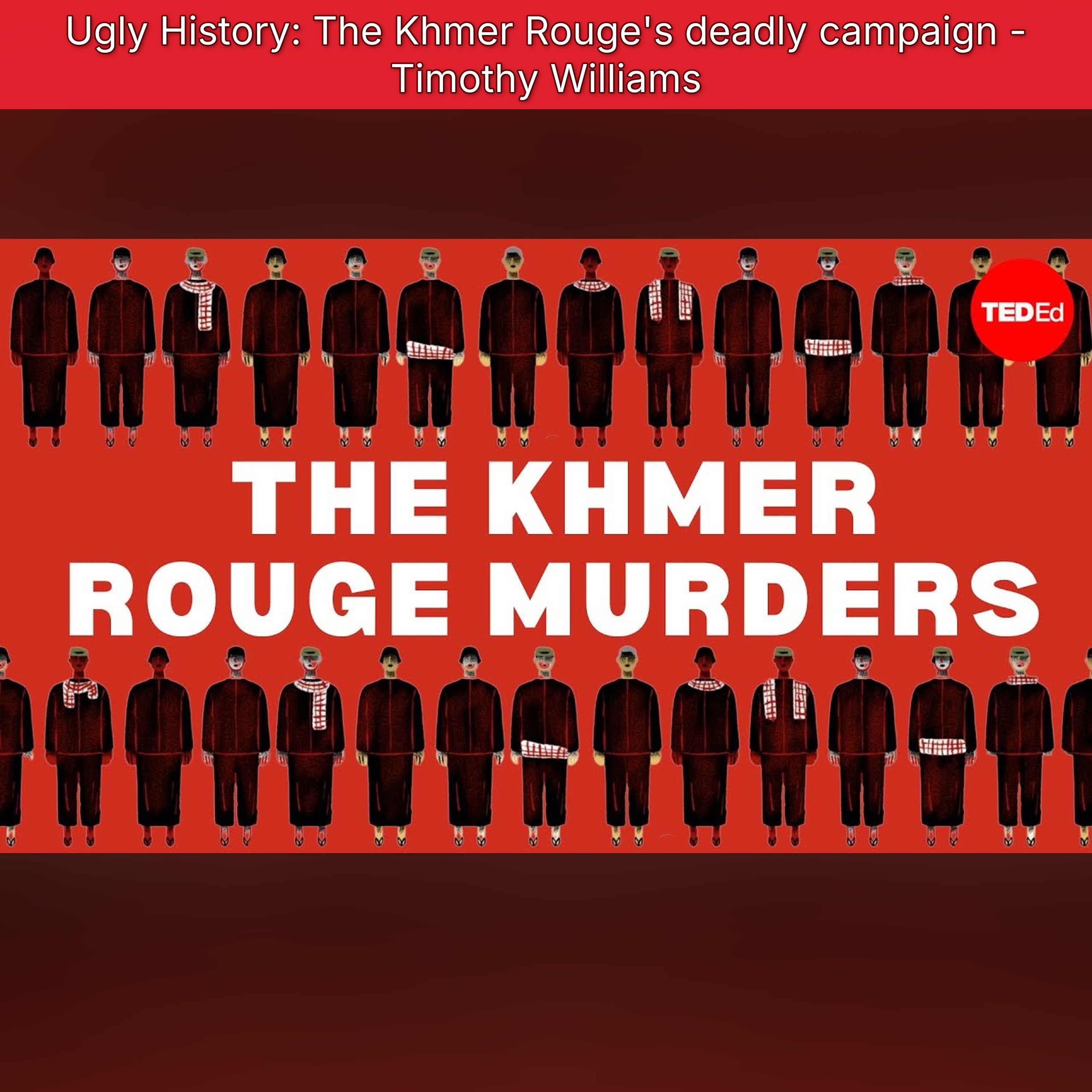
Dig into the era of the Khmer Rouge in Cambodia, which perpetuated a genocide that killed a quarter of the country’s population. -- From 1975 to 1979, the Communist Party of Kampuchea ruled Cambodia with an iron fist, perpetrating a genocide that killed one fourth of the country’s population. Roughly one million people were executed as suspected political enemies or due to their ethnicities, and another million died of starvation, disease, or overwork. How did this happen? Timothy Williams details the rise of the Khmer Rouge. Lesson by Timothy Williams, directed by Héloïse Dorsan-Rachet. Support Our Non-Profit Mission ---------------------------------------------- Support us on Patreon: http://bit.ly/TEDEdPatreon Check out our merch: http://bit.ly/TEDEDShop ---------------------------------------------- Connect With Us ---------------------------------------------- Sign up for our newsletter: http://bit.ly/TEDEdNewsletter Find us on Twitter: http://bit.ly/TEDEdTwitter Peep us on Instag
Why do super savers keep accumulating, and what is all that money really for? Amyr Rocha Lima, Certified Financial Planner from the U.K., shares tips from his new book "Enough for What". Key Takeaways: Ask "enough for what?" before asking "how much is enough?" Complete the Retirement Autopilot Test to uncover your priorities, fears, and unfinished goals. Define an ordinary Tuesday in retirement, covering structure, connection, usefulness, growth, and joy. Build your financial plan around your lifestyle first, then choose the investments and tax strategies that serve it. Recognize that loneliness is a real retirement risk, and plan for social connection early. Key moments: (00:00) Introduction and Guest Welcome (04:55) The Super Saver Default Mindset (06:10) Shifting from Saving to Spending (10:10) The Retirement Autopilot Test Exercise (14:30) Money, Happiness, and Ordinary Tuesdays (16:00) Five Essentials for a Happy Retirement (20:20) Retirement as Being Out of Service Resources: Ami
Why do we keep reacting in ways we don’t want to? Forrest sits down with the meditator and poet Yung Pueblo to talk about reactivity, letting go, and what it takes to slow down enough to choose something different. They get into why your first reaction usually isn’t the “real you,” how to stay present with someone else’s bad mood without getting pulled into it, and how to feel your feelings without becoming them. Key Topics: 00:00: Intro 01:22: Why aren’t men as interested in personal growth content? 05:29: Your first reaction isn't the real you 15:57: Staying present with someone else’s bad mood 22:47: Thoughts vs. what you feel in the body 28:45: Feeling without becoming the feeling 32:21: What is stress? 38:19: Writing Journey 43:27: Forgiveness without an apology 49:13: Who needs to let go, and who needs to try harder 52:48: Letting go of good attachments 1:02:14: Recap If you'd like to support the podcast, follow this link. (https://www.patreon.com/beingwellpodcast) Sponsors If yo
Text HYPNOSIS to 855-232-5483 to book your free Food Freedom Call Stop blaming yourself. Rewire your subconscious. Find food freedom. Ep 370 The 3 Types of Loneliness that Lead To Food Noise Loneliness isn't always about being physically alone. You can have a busy social life, a loving partner, and plenty of people around you while still feeling disconnected inside. In this episode, Leslie M. Thornton explores the three types of loneliness: intimate loneliness, relational loneliness, and collective loneliness and how identifying what you're missing can be the first step toward meaningful change. Leslie explains how loneliness, anxiety, sadness, and emotional emptiness can lead us to use food as a way to cope. Through her experience working with clients, she shares why even highly successful, intelligent, and capable people can struggle with food noise and emotional eating. Often, the issue isn't a lack of knowledge or willpower but deeper subconscious patterns that keep us from feeling
The ick. Is it an intuitive feeling in our body we should listen to? Or is it our brain mistakenly fixating on tiny things? I dive into a new study all about the science of the ick. Plus, I share an ick audit you can use to tell when to listen to it and when to ignore it. What you’ll learn: • What the first-ever study on “the ick” reveals about your relationships • Four hidden factors that could be fueling your icks • How to get past an ick • The “ick audit” to help you decide when to stay or go Ick Study: ScienceDirect Check out the previous episodes of The Liz Moody Podcast discussed today: “We Were Wrong About Secure Attachment & It's Ruining Our Relationships” • Listen on Apple (https://podcasts.apple.com/us/podcast/we-were-wrong-about-secure-attachment-its-ruining-our/id1398442165?i=1000789991310) • Watch/Listen on Spotify (https://open.spotify.com/episode/3Z1z8ri8pi2D1zrXiTdGDG) • Watch on YouTube (https://www.youtube.com/watch?t=1860s&v=DPxcjFvEMSU) “The Missing Tool to Finally
Can HRT stop menopause weight gain, or is something else going on when the scale keeps climbing? That's 1 of 9 listener questions I'm answering today, from men and women over 40 in very different situations, from lean lifters trying to recomp to people working around old injuries. You'll learn: What dozens of HRT trials found about your weight on the scale The question to answer before you take a diet break after 22 months of dieting Whether body recomposition still works when you're already at 13% body fat How deadlift injury risk compares with squats and with other sports A finding on salt and blood pressure to know before you buy electrolyte drinks If you want a straight answer to the question you've been stuck on, hit play! Get a 2-week free trial of MacroFactor (https://witsandweights.com/blog/macrofactor) with code WITSANDWEIGHTS. It works backward from your food log and daily weigh-ins to estimate what you burn, and it updates your targets every week: Send me your question (http
Ever wonder why some people are just impossible to talk to? In this candid FU mini-episode of Let's Get Naked, Anne Karber uncovers the truth about defensiveness and why it's ruining your relationships. Discover how this "blanket trigger" pushes people away and prevents genuine connection. Anne shares personal insights and powerful analogies, urging listeners to look "under the hood" of their emotional reactions rather than just hitting the dashboard. This episode will challenge your perspective on managing emotions and inspire you to cultivate a more responsive, less reactive approach to life. Learn why emotional intelligence is your most valuable asset. What You'll Learn: How defensiveness acts as a blanket trigger making you unapproachable. Why people walk on eggshells around highly defensive individuals. The importance of acknowledging and addressing your own defensiveness. How defensiveness can cost you valuable relationships and connection. The difference between reacting and res
Why does nothing seem to bring you joy anymore, even when life is going well? In this episode, I break down how constant dopamine hits from social media, scrolling, and instant gratification are draining your motivation and making everyday life feel less rewarding. I'll show you how to reset your dopamine system, replace cheap stimulation with earned dopamine, and rediscover the joy, drive, and fulfillment you've been missing. break through what’s keeping you from your next level. Get $100 off your ticket: direction, and focus in life. Rich Roll, and Dr. Steven Gundry. Hosted by Simplecast, an AdsWizz company. See https://pcm.adswizz.com advertising.
View full lesson: http://ed.ted.com/lessons/what-really-happens-to-the-plastic-you-throw-away-emma-bryce Uploaded 21-04-15 We’ve all been told that we should recycle plastic bottles and containers. But what actually happens to the plastic if we just throw it away? Emma Bryce traces the life cycles of three different plastic bottles, shedding light on the dangers these disposables present to our world. Lesson by Emma Bryce, animation by Sharon Colman.