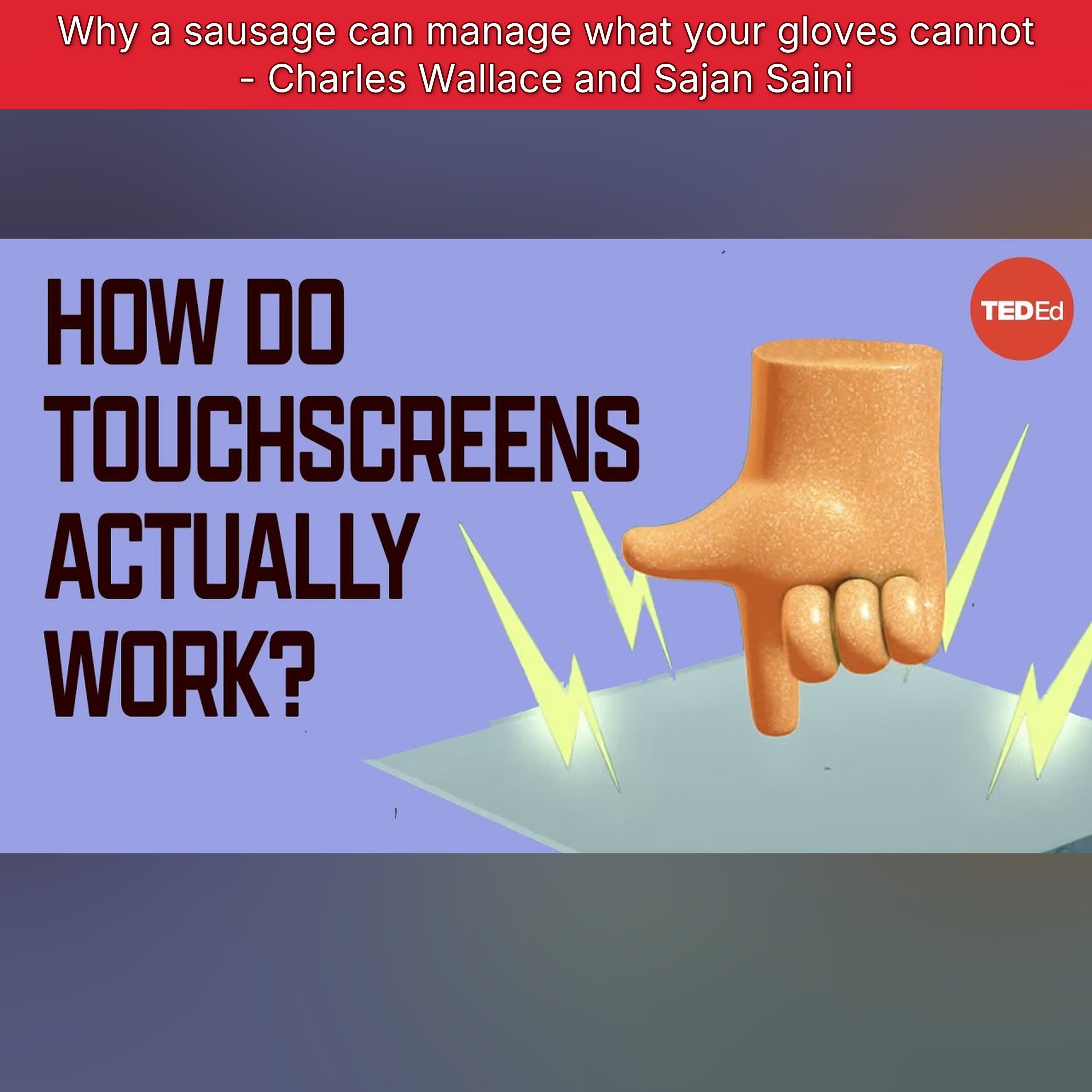
Dig into the science of touchscreens, and find out the difference between the two most common types: capacitive and resistive. -- In 2010, South Korea experienced a particularly cold winter. People couldn’t activate their smartphones while wearing gloves, so they began wielding snack sausages— causing one company to see a 40% rise in sausage sales. So, what could sausages do that gloves couldn’t? In other words, how do touchscreens actually work? Charles Wallace and Sajan Saini dig into the science of touchscreens. Lesson by Charles Wallace and Sajan Saini, directed by Luis Torres, Mr. Flama. Support Our Non-Profit Mission ---------------------------------------------- Support us on Patreon: http://bit.ly/TEDEdPatreon Check out our merch: http://bit.ly/TEDEDShop ---------------------------------------------- Connect With Us ---------------------------------------------- Sign up for our newsletter: http://bit.ly/TEDEdNewsletter Find us on Twitter: http://bit.ly/TEDEdTwitter Peep us on I
To some, Marxism is the solution to all capitalism’s problems. To others, it’s a major threat to democracy. But what did Karl Marx really say about capitalism and communism, and how can that help shape our discussions today? Crash Course Political Theory #6 Introduction: "The Specter of Communism" 00:00 Who Was Marx 0:37 The Problem of Capitalism 4:17 The Mondragon Corporation 6:22 The Proletariat Revolution 8:04 Critiquing Marx 10:04 Review & Credits 11:41 Sources: https://docs.google.com/document/d/1u5zJCbVA0xCurLbQwWzcxXEdlqXAPpAyYVS1quwKIis/edit?usp=sharing *** Support us for $5/month on Patreon to keep Crash Course free for everyone forever! https://www.patreon.com/crashcourse Or support us directly: https://complexly.com/support Join our Crash Course email list to get the latest news and highlights: https://mailchi.mp/crashcourse/email Get our special Crash Course Educators newsletter: http://eepurl.com/iBgMhY Thanks to the following patrons for their generous monthly contributio
Have you spent this year working on yourself, yet still find yourself falling back into self-doubt, anxiety or overthinking? Join Joseph Clough for Discover the Unconscious Hidden Root Cause, a three-hour live Zoom workshop exploring the deeper patterns that may be keeping you stuck. Joseph will guide you through a process to explore what may be holding you back and begin changing what you uncover—with the aim of leaving you with greater clarity and a practical next step. This is Joseph's final live workshop of 2026, with no workshop currently scheduled for 2027. Places are limited, and bookings are now open. Saturday, December 5, 2026 10 a.m.–1 p.m. Pacific 12–3 p.m. Central 1–4 p.m. Eastern 6–9 p.m. UK Join live on Zoom for $27. Book your place: https://www.josephclough.info/hidden Set aside three hours for yourself before heading into another year.
Dr Andrew Tridgell of the Ardupilot project discusses flight control software for autonomous and remote controlled aircraft. This field has advanced considerably in recent years, and autonomous vehicles are playing an increasingly important role in many industries -- from package delivery to scientific surveying and film-making -- as well as in the consumer market. Host Jason Davey speaks with Tridgell about the fundamental concepts required to keep a drone in the air, the hardware and software architecture behind these vehicles, and how development and testing are handled in Ardupilot, one of the leading open source flight control software stacks.
View full lesson: http://ed.ted.com/lessons/can-robots-be-creative-gil-weinberg Uploaded 19-03-15 People have been grappling with the question of artificial creativity -- alongside the question of artificial intelligence -- for over 170 years. For instance, could we program machines to create high quality original music? And if we do, is it the machine or the programmer that exhibits creativity? Gil Weinberg investigates this creative conundrum. Lesson by Gil Weinberg, animation by TOGETHER.
In which John Green examines JD Salinger's novel The Catcher in the Rye. John pulls out the old-school literary criticism by examining the text itself rather than paying attention to the biographical or historical context of the novel (that's for next week). Listen, words matter. The Catcher in the Rye has managed to endure without a movie adaptation because a lot of its quality arises from the book's language. Find out how Holden's voice, his language, and his narrative technique combine to make the novel work. Also, Thought Bubble gives us a quick rundown of the plot, in which Ikea Monkey may or may not appear. Consider supporting local bookstores by purchasing your books through our Bookshop affiliate link https://bookshop.org/shop/complexly or at your local bookseller. Crash Course is on Patreon! Want to find Crash Course elsewhere on the internet? Facebook - http://www.facebook.com/YouTubeCrashCourse Twitter - http://www.twitter.com/TheCrashCourse Instagram - https://www.instagram
In this episode of the Medical English Podcast, we follow a consultation with Robert, a patient admitted to the emergency department after a chest infection develops into sepsis, and his daughter Emma, as the doctor explains what's happening and why every hour of treatment matters. You'll learn how to: Use key vocabulary including "sepsis," "septic shock," "deteriorating," "fluid resuscitation," and "broad-spectrum antibiotics" Explain how a manageable infection can spiral into organ dysfunction, and why early recognition changes outcomes Discuss falling blood pressure and the warning signs of septic shock with a frightened family member Translate urgent treatment steps like IV fluids and empirical antibiotics into language a worried carer can follow Reassure a family while being honest about the seriousness of a patient's condition We explore a full sepsis consultation from initial explanation through to escalation of care and family reassurance, and how clear, calm communication make
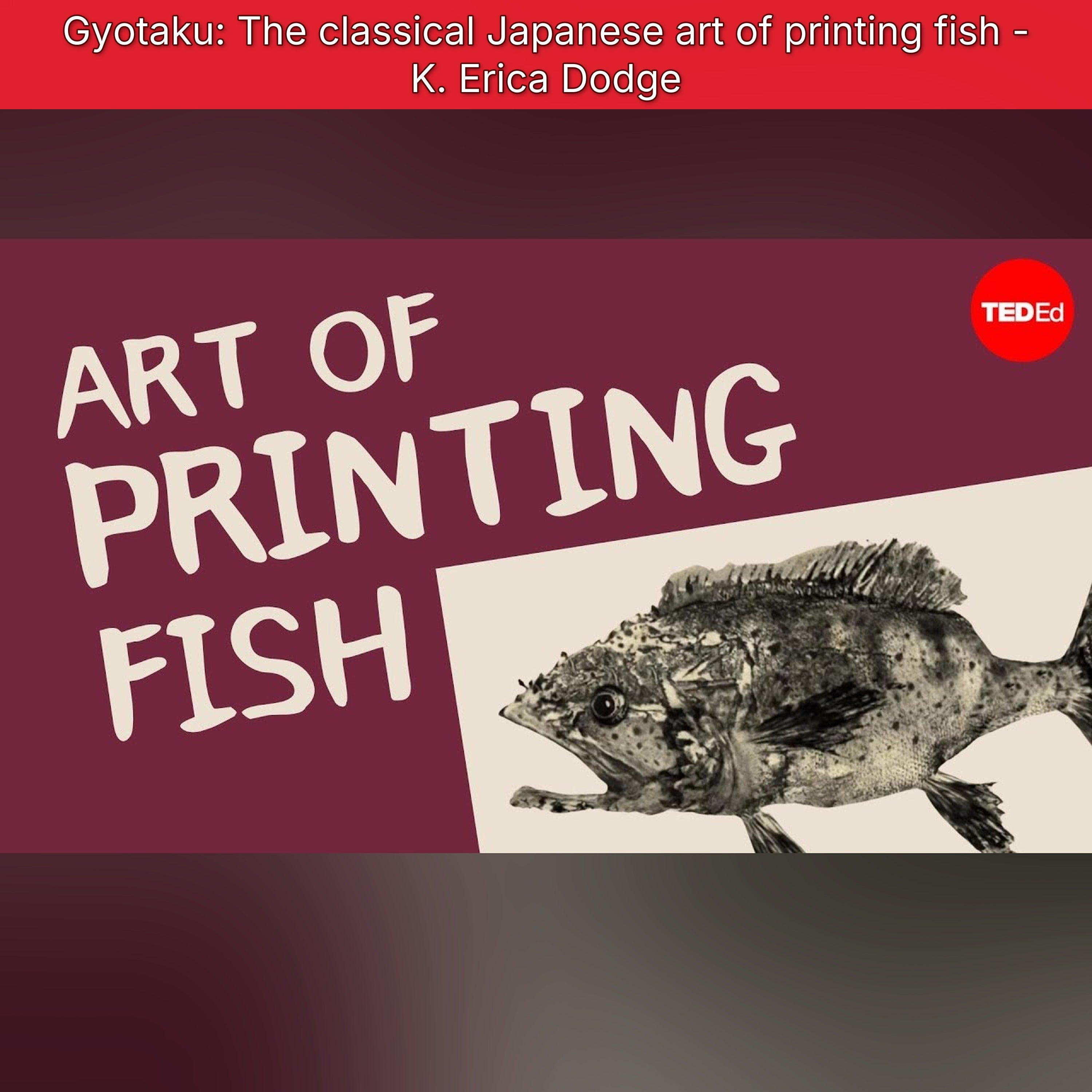
View full lesson: http://ed.ted.com/lessons/gyotaku-the-ancient-japanese-art-of-printing-fish-k-erica-dodge How did fishermen record their trophy catches before the invention of photography? In 19th century Japan, fishing boats were equipped with rice paper, sumi-e ink, and brushes in order to create gyoktaku: elaborate rubbings of freshly caught fish. K. Erica Dodge recounts the story of this competitive fishing culture, plus some tips on how to make your very own etchings. Lesson by K. Erica Dodge, animation by Franco Barroeta.
What happens when you combine a classic Porsche 356 with a modern 718 Boxster? For Peter Lamb from Melomotive, it's an ambitious restomod project blending vintage styling with modern performance. Drawing on decades of experience building concept cars, Peter is using traditional craftsmanship and cutting-edge technology to create a truly one-of-a-kind Porsche. Use the code ‘PODCAST500’ to get $500 OFF HPA's VIP Package:https://hpcdmy.co/podvip In this episode of Tuned In, Peter shares his journey from modifying mini trucks to working in Holden's concept car development team. We explore how concept cars are created, from initial sketches and clay modelling to 3D scanning, CNC machining and composite body panels, and why traditional hands-on techniques still have a place in modern automotive design. We dive into the art of coachbuilding and vehicle restoration, covering sheet metal shaping, welding techniques, rust repair and the challenges of achieving a perfect finish. Peter explains th
Seven headnoted appellate decisions, three from the High Court, in the Court of Appeal edition of Wednesday 4 November 2026, with the New South Wales, Western Australia and Tasmania editions of the same day folded in. Payroll tax on rideshare fares; a wash sale and the limits of dividend stripping; jury advantage in a murder appeal now sent back; estoppel on a promise nobody signed; the hearing rule; councillors removed for absence; and family provision in a small estate. The murder appeal concerns a death after an argument between partners and is reported as legal doctrine only. Tax and Revenue Desk (opening story). Uber Australia Pty Ltd v Chief Commissioner of State Revenue [2026] HCA 40 - under the contractor provisions of the Payroll Tax Act 2007 (NSW), a service is supplied to a designated person who is owed a contractual obligation to provide it, even if supplied simultaneously to another (s 32(1)(b)); supply is under a contract at least where the contract is the source of the o
Eight decisions in the Federal Courts edition for Wednesday 4 November 2026: three from the High Court of Australia and five from the Federal Court of Australia, four with Judicial Ledger headnotes. The opening story: receivers caught between competing secured creditors can get directions from the Court only on a legal question, not on commercial prudence, and may sell despite a prior security interest when the statutory conditions are met and the proceeds are held in trust. Then a worked example on extending time to challenge a migration decision, and the registry. The three High Court decisions air at depth in today's Courts of Appeal brief. Commercial Law Desk (opening story). Healey v I'm Organic Pty Ltd, in the matter of AC Invest Hospitality Trading Pty Ltd (Receivers and Managers Appointed) [2026] FCA 1641 (Younan J, 3 November 2026) - JL p. 14. The power under s 424 of the Corporations Act 2001 (Cth) to give directions to a receiver appointed under an instrument is broad but do
The Petal's New Zealand edition for Wednesday 4 November 2026 carries 8 decisions newly reported from the Supreme Court and the High Court. Seven are aired, as six items. The thread is the gap between a wish and a promise: matching wills that carried a hope rather than a binding agreement, an equal share that met a parent's duty whatever one child hoped for, a settlor's wish read as care, and counter-intuitive evidence that explains how children respond without proving what happened. Commercial Law Desk (lead). Perpetual Guardian Trustee Holdings Ltd v Meersma [2026] NZHC 3009 - wills made before 1 November 2007 fall under the equitable doctrine of mutual wills, not s 30 of the Wills Act 2007; a constructive trust needs corresponding wills and an agreement, intended to bind each testator, not to revoke, proved on the balance of probabilities with very great care; an honourable understanding or mutual expectation is not enough, and the absence of any written agreement despite legal advi
A quiet day in the Tribunals edition of Wednesday 4 November 2026: six decisions from two state tribunals, none with a headnote, and two worked examples from synopses. What happens when a retail lease longer than five years was never registered or caveated and the premises are sold; and how to prove that a prohibited weapon is necessary for a business, and why evidence the applicant wrote carries little weight. Tribunals Desk: an unregistered retail lease and a sale (lead; framework from the synopsis). Luv Bridal Pty Ltd and Eva Investments Aust Pty Ltd [2026] WASAT 132 - synopsis: s 68 Transfer of Land Act 1893 (WA) extinguishment and priority where a lease over five years is neither registered nor caveated (Leros Pty Ltd v Terara Pty Ltd [1992] HCA 22); tenancy at will or other lease after extinguishment; the s 13 Commercial Tenancy (Retail Shops) Agreements Act 1985 (WA) statutory option or minimum term and the Form 3 notice; the evidentiary record; s 16(1) jurisdiction needs an exi
There are times in life when you know something isn’t right. You might struggle to explain it, find the words to describe it or even convince yourself that what you are feeling is legitimate. However, deep down, you know when something is off. It might be a relationship, a friendship, your workplace, your leadership, your […] The post EP 3886 You know when it is off (https://www.thestronglifeproject.com/the-strong-life-podcast/ep-3886-you-know-when-it-is-off/) appeared first on The Strong Life Project (https://www.thestronglifeproject.com/).
The word anarchy is synonymous with chaos, but what does it mean to political theorists? In this episode of Crash Course Political Theory, we explore the theories and practices of anarchism. Crash Course Political Theory #7 Introduction: 00:00 What Is Anarchy 0:42 Classical Anarchy 3:28 Collectivism 4:54 Anarchist Communism 5:39 Modern Anarchy 6:39 Review & Credits 10:30 Special thanks to Chris Boland for the use of his portrait of Rebecca Solnit / www.chrisboland.com Sources: https://docs.google.com/document/d/1u5zJCbVA0xCurLbQwWzcxXEdlqXAPpAyYVS1quwKIis/edit?usp=sharing *** Support us for $5/month on Patreon to keep Crash Course free for everyone forever! https://www.patreon.com/crashcourse Or support us directly: https://complexly.com/support Join our Crash Course email list to get the latest news and highlights: https://mailchi.mp/crashcourse/email Get our special Crash Course Educators newsletter: http://eepurl.com/iBgMhY Thanks to the following patrons for their generous monthly
Priyanka Mattoo (https://www.primattoo.com/) is the author of How To Be Less Useful (https://www.penguinrandomhouse.com/books/763243/how-to-be-less-useful-by-priyanka-mattoo/) and the memoir Bird Milk & Mosquito Bones (https://www.penguinrandomhouse.com/books/677112/bird-milk-and-mosquito-bones-by-priyanka-mattoo/) . What do you find Weirdly Helpful? Call me at 844-935-2378 THE WEIRDLY HELPFUL MERCH STORE!!!! (https://cottonbureau.com/people/zak-rosen) Become a WH Patron and listen to the show ad-free. (https://www.patreon.com/c/weirdlyhelpful)
How divided government, state regulation, and local opposition to data centers could reshape America’s AI industry. The US midterm elections delivered surprising results. But beyond the immediate political consequences, what do they mean for AI companies, data centers, and the future of American artificial intelligence? In this solo episode of Beginner’s Guide to AI, I examine why sweeping national AI regulation may remain unlikely while political pressure moves to states, governors, utility regulators, and local communities. Texas offers an important case. New restrictions on data-center development could respond to concerns about electricity, water, pollution, and property rights. This does not necessarily mean the end of new data centers. It could mean longer approval processes, higher costs, environmental requirements, and more serious negotiations with affected communities. ️ Key questions in this episode: Will divided government preserve the federal status quo? Could state regula
Michael Jaco welcomes back astrologer, sound healer, and multidisciplinary artist George H. Lewis for an extraordinary conversation about the cosmic alignments, energetic shifts, and global transformations George believes are shaping humanity's future. After traveling through 107 countries and 47 American states, George shares what he's witnessed firsthand across America and why he believes the nation is entering a remarkable period of spiritual renewal. THE COMING GOLDEN AGE! George explains why he believes humanity is moving toward a new era of consciousness, technological discovery, and spiritual transformation — and why America could play a central role. THE ASTROLOGICAL ALIGNMENTS CHANGING EVERYTHING! From Uranus in Gemini to the historic Saturn-Neptune conjunction in Aries, George breaks down the planetary patterns he interprets as signals of major institutional and societal change. 2027 — THE YEAR EVERYTHING CHANGES? George offers his striking prediction about NATO's future, the
Today on Crash Course Anatomy & Physiology, Hank breaks down the parts and functions of one of your body's unsung heroes: your epithelial tissue. Pssst... we made flashcards to help you review the content in this episode! Find them on the free Crash Course App! Download it here for Apple Devices: https://apple.co/3d4eyZo Download it here for Android Devices: https://bit.ly/2SrDulJ Chapters: Introduction 00:00 Proper Epithelium & Glandular Epithelium 1:38 We're All Just Tubes! 2:12 Cell Shapes: Squamous, Cuboidal, or Columnar 3:34 How Form Relates to Function 4:15 Layering: Simple or Stratified 5:26 Epithelial Cells: Apical & Basal Sides 7:06 Glandular Epithelial Tissue Forms Endocrine & Exocrine Glands 8:20 Review 9:16 Credits 9:54 *** Crash Course is on Patreon! Want to find Crash Course elsewhere on the internet? Facebook - http://www.facebook.com/YouTubeCrashCourse Twitter - http://www.twitter.com/TheCrashCourse Instagram - https://www.instagram.com/thecrashcourse/ CC Kids: http://w
What did the midterm elections reveal about the economy—and your household budget? Justin Wolfers examines the Democratic sweep through a puzzle: how can the economy grow while people feel so anxious? He contrasts GDP growth of 3.4% at an annual rate with record-low University of Michigan consumer sentiment. His argument is that distrust of economic leadership helps explain the gap—and the vote against the party in power. He also explains what prediction markets saw coming, and why picking the winner doesn't necessarily make a poll accurate. on YouTube on Substack the Podcast Follow on Social Media @PlatypusEconomics and @JustinWolfers
Get the Strength & Shield Tumbler → https://israelguys.link/strength-LWN Israel just issued a warning: Iran is preparing to use Chemical weapons against their enemies. Right before that announcement Iran also released a warning of their own, a photo, with the text quote: "An immediate response, without geographical limitations." This comes as rumors are brewing that the US is preparing to strike Iran hard possibly within the next few days, and also Trump just announced that the US will be stopping all aid to Israel. Ben Hilton breaks it all down for you in today's show. Source Links: Iran displays threatening billboard targeting President Trump https://www.forbes.com/sites/fionariley/2026/11/03/we-will-kill-trump-billboard-crops-up-in-tehran-in-latest-display-against-the-us-president/ Iran issues warning amid rising nuclear strike concerns https://www.jpost.com/middle-east/iran-news/article-913648 Netanyahu says Israel has come of age https://www.israelnationalnews.com/news/435563 Iran
Guerrero v. Johnson Docket No. 25-1003 Argued: 11/4/26 Lower Court: U.S. Court of Appeals for the Fifth Circuit Cert Granted: 6/15/26 Question Presented The Anti-Terrorism and Effective Death Penalty Act of 1996 (AEDPA) prohibits successive habeas applications by state prisoners with only narrow exceptions, including for claims that “rel[y] on a new rule of constitutional law, made retroactive to cases on collateral review by the Supreme Court, that was previously unavailable.” 28 U.S.C. § 2244(b)(2)(A). Near-identical language allows federal prisoners to file a successive habeas motion that contains “a new rule of constitutional law, made retroactive to cases on collateral review by the Supreme Court, that was previously unavailable.” Id. § 2255(h)(2). The courts of appeals are divided over whether claims rely on “a new rule . . . that was previously unavailable” when a claim based on the rule could have been raised in an earlier federal habeas petition but would not have succeeded. T
In this weeks Quicky of the Self Love Podcast, Kim explores the importance of putting down our phones, stepping away from the constant pull of notifications and social media, and reconnecting with nature and ourselves. She shares how spending time outdoors can reduce stress, lift our mood, restore our attention, and remind us that some of life’s greatest joys are completely free. Kim offers five simple invitations to bring more nature into our everyday lives, from starting the morning outside and taking phone free nature breaks to going on glimmer hunts and creating sunrise or sunset rituals. Kim also invites us to do a gentle challenge to swap 20 minutes of scrolling for 20 minutes in nature each day for the next seven days and notice how you feel. Self love doesn’t have to be complicated. Sometimes it starts with putting your phone down, taking a deep breath, and being present for the beautiful life unfolding around you. Links to follow: Website: https://twenty8.com/ Instagram: https
Explore the history of the Merriam-Webster Dictionary and find out how old words get redefined and how new words are added. Uploaded 04-05-21 -- While the concept of a dictionary dates back to ancient civilizations, the first English dictionary wasn’t published until 1604. In the centuries that followed, many more dictionaries were written by individual authors who chose what to include or exclude, with most quickly becoming outdated. One 19th century lexicon had a different fate. Ilan Stavans digs into the history of Webster's Dictionary. Lesson by Ilan Stavans, directed by Lisa LaBracio. Support Our Non-Profit Mission ---------------------------------------------- Support us on Patreon: http://bit.ly/TEDEdPatreon Check out our merch: http://bit.ly/TEDEDShop ---------------------------------------------- Connect With Us ---------------------------------------------- Sign up for our newsletter: http://bit.ly/TEDEdNewsletter Find us on Twitter: http://bit.ly/TEDEdTwitter Peep us on Inst