Uploaded 30-04-18 View full lesson: https://ed.ted.com/lessons/which-is-stronger-glue-or-tape-elizabeth-cox The oldest glue in the world is over 8,000 years old and comes from a cave near the Dead Sea. Today, we have enough types of tape and glue to build and repair almost anything. But what gives glue and tape their stickiness? And is one stronger than the other? Elizabeth Cox explores the world of adhesives. Lesson by Elizabeth Cox, animation by Sinbad Richardson. Thank you so much to our patrons for your support! Without you this video would not be possible! maxi kobi einy, Runarm, Misaki Sato, Levi Cook, Catherine Sverko, Robert Sukosd, Mark Morris, Tamás Drávai, Peter Liu, Leora Allen, Michal Salman, Julie Cummings-Debrot, Gilly, Ka-Hei Law, Aleksandar Srbinovski, Renhe Ji, Andrés Melo Gámez, Tim Leistikow, Moonlight , Megan Douglas, Barbara Smalley, Filip Dabrowski, Joe Giamartino, Clair Chen, Karen Goepen-Wee, Bryan Blankenburg, Bah Becerra, Stephanie Perozo, Marc Bilodeau, Ruby
From navigating a cross-country road trip (or just finding the nearest coffee shop), to analyzing election results, maps play a huge role in how we interpret the world! Today, we're going to talk about the differences between reference maps and thematic maps, take a closer look at how projections play a part in how we perceive maps, and discuss the role of the cartographer (or map maker) in all of this. Maps are incredibly powerful tools and play a crucial role in how we understand the world, but they are also made by people, so it is our job to think critically about how these stories are being presented to us. Watch our videos and review your learning with the Crash Course App! Download here for Apple Devices: https://apple.co/3d4eyZo Download here for Android Devices: https://bit.ly/2SrDulJ Crash Course is on Patreon! Thanks to the following patrons for their generous monthly contributions that help keep Crash Course free for everyone forever: Eric Prestemon, Mark, DAVID MORTON HUDS
View full lesson: http://ed.ted.com/lessons/mysteries-of-vernacular-dynamite-jessica-oreck-and-rachael-teel With an explosive meaning, the word dynamite's past is as historical as it is etymological. Jessica Oreck and Rachael Teel describe how Alfred Nobel invented dynamite. Lesson by Jessica Oreck and Rachael Teel, animation by Jessica Oreck.
Some people come into your life for a reason, some for a season, and some for a lifetime. Understanding the difference can have a profound impact on your relationships, emotional wellbeing and personal growth. In this episode of The Strong Life Project, Shaun O’Gorman explores the reality of human relationships, why people enter and leave […] The post EP 3889 A reason, A season or A lifetime (https://www.thestronglifeproject.com/the-strong-life-podcast/ep-3889-a-reason-a-season-or-a-lifetime/) appeared first on The Strong Life Project (https://www.thestronglifeproject.com/).
In which John Green teaches you a bit about the 4th of July. In this special short Crash Course, John celebrates American Independence Day by teaching you how the holiday came to be on the 4th of July, and the many ways that Americans celebrate the day. This is a little different than the normal Crash Course episode, so be prepared. Hey teachers and students - Check out CommonLit's free collection of reading passages and curriculum resources to learn more about the events of this episode. Famous abolitionist and freed slave Frederick Douglass ponders the history of the Fourth of July in the context of ongoing slavery in his famous "What to the Slave is the Fourth of July?” Speech: https://www.commonlit.org/texts/what-to-the-slave-is-the-fourth-of-july Chapters: Introduction 00:00 The Declaration of Independence 0:29 July 4, 1776 1:25 How Americans Celebrate Independence Day 1:43 July 4: When Presidents Die 3:56 Americans Love Eating! 4:15 Happy Fourth of July from Crash Course! 4:45 Cr
Nachos are great...if you are among the lucky ones whose bodies can digest them. When digestion goes according to plan, the small intestine performs most of your chemical digestion in the duodenum, while accessory organs including the liver, gallbladder, and pancreas contribute enzymes that all but finish the job. Then your large intestine, which is actually shorter than the small intestine, tries to extract the last bit of nutrition, including the occasional attempt to turn nachos into energy, which for most humans, ends in gassy failure. Pssst... we made flashcards to help you review the content in this episode! Find them on the free Crash Course App! Download it here for Apple Devices: https://apple.co/3d4eyZo Download it here for Android Devices: https://bit.ly/2SrDulJ Chapters: Introduction: Lactose Intolerance 00:00 The Small Intestine 1:41 Parts of the Small Intestine: Duodenum, Jejunum, Ileum 2:53 The Duodenum 3:16 The Liver 4:17 The Gallbladder 5:14 The Pancreas 5:35 The Large
This week on The Cigar Authority, we're talking wearing multiple hats in the cigar business with Melanie & Kevin Owners of The Elevated Humidor! Most new cigar companies require owners to be everything to everyone, let's talk about the pros + cons of being the ultimate decision maker of all things while launching the new Lady Marmalade cigar from The Elevated Humidor! Join Mr. Jonathan, David Garofalo and Ed Sullivan as we light up cigars and talk about them.
Explore the circular reasoning fallacy, which occurs when the end of an argument comes back to the start without having proven itself. -- It’s 1990. A prospective student has filed a complaint about Virginia Military institute’s admissions policy that excludes women. The state argues that VMI’s single sex education is an “important governmental objective” and that the exclusion of women from VMI is essential to that objective. Can you spot the problem with this argument? Elizabeth Cox explores the circular reasoning fallacy. Lesson by Elizabeth Cox, directed by TOGETHER. Support Our Non-Profit Mission ---------------------------------------------- Support us on Patreon: http://bit.ly/TEDEdPatreon Check out our merch: http://bit.ly/TEDEDShop ---------------------------------------------- Connect With Us ---------------------------------------------- Sign up for our newsletter: http://bit.ly/TEDEdNewsletter Find us on Twitter: http://bit.ly/TEDEdTwitter Peep us on Instagram: http://bit.l
When you can be thankful for anything, you are free. Even the problem in front of you can become the ladder to your highest self. In this best-of compilation from The Positive Mindset Podcast, Henry Lawrence pulls together his best moments on gratitude from two episodes: choosing who you want to be instead of living in reaction mode, why your perception is your reception, how gratitude is a ladder to your highest self, why the time you decide to say yes is the right time, and how to become the person who's thankful for the problem. In this episode: • "Your perception is your reception" • "The one thing that will truly get you through besides God Himself is gratitude." • "Gratitude is a ladder that taps you in to that version of yourself every single time." • "The time that you decide to say yes was the right time." • "Show that you can make something of anything and you will be given anything to make something of." • "When you can be thankful for anything, you are the one that's free."
Carbon-carbon double bonds are pretty common in nature, but triple bonds between carbons, called alkynes, are not. When alkynes do pop up in nature, it’s usually in a compound that’s toxic to humans, however, we can synthesize alkynes that are life saving medicines and materials. In this episode of Crash Course Organic Chemistry, we’ll learn about alkynes and some of the reactions we can use them in (hint: it’s a lot of the same reactions we used for alkenes!) Series Sources: Brown, W. H., Iverson, B. L., Ansyln, E. V., Foote, C., Organic Chemistry; 8th ed.; Cengage Learning, Boston, 2018. Bruice, P. Y., Organic Chemistry, 7th ed.; Pearson Education, Inc., United States, 2014. Clayden, J., Greeves, N., Warren., S., Organic Chemistry, 2nd ed.; Oxford University Press, New York, 2012. Jones Jr., M.; Fleming, S. A., Organic Chemistry, 5th ed.; W. W. Norton & Company, New York, 2014. Klein., D., Organic Chemistry; 1st ed.; John Wiley & Sons, United States, 2012. Louden M., Organic Chemistr
View full lesson: http://ed.ted.com/lessons/the-emergence-of-drama-as-a-literary-art-mindy-ploeckelmann When presented with the problem of hoards of illiterate commoners, English clergymen in the 11th century created plays to spread word about the Bible. Eventually, the plays moved out of the church and into the streets. Mindy Ploeckelmann tracks the development of drama from mystery plays to morality plays and, eventually, to Shakespeare. Lesson by Mindy Ploeckelmann, animation by Johnny Chew.
When it comes to animal reproduction, there’s no one-size-fits-all strategy. Some animals need a mate, others don’t, and for some, it depends! In this episode, we’ll learn about sexual and asexual reproduction, internal and external fertilization, and all the ways that life, uh… finds a way. Introduction: Reproduction 00:00 Asexual reproduction 01:33 Sexual Reproduction 04:48 Fertilization 05:58 Sexes 08:01 Review & Credits 11:11 This series was produced in collaboration with HHMI BioInteractive, committed to empowering educators and inspiring students with engaging, accessible, and quality classroom resources. Visit https://BioInteractive.org/CrashCourse (https://biointeractive.org/CrashCourse) for more information. Are you an educator looking for what NGSS Standards are covered in this episode? Check out our Educator Standards Database for Biology here: https://www.thecrashcourse.com/biologystandards Check out our Biology playlist here: https://www.youtube.com/playlist?list=PL8dPuuaL
Today, Craig is going to wrap up our discussion of discrimination by looking more closely at those “discrete and insular minorities” referenced in the 14th Amendment. We’ll talk about instances of discrimination of Asian, European, and Latino immigrants, Native Americans, non-English speakers, people with disabilities, and LGBT people. We’ll also talk about federal and state responses to this discrimination. It’s a lot to cover, and we’ll only scratch the surface of the battles these groups fought (and are still fighting) for equality, but we will give you some historical context for the discrimination that has occurred and the court decisioned made to help defend these groups. Produced in collaboration with PBS Digital Studios: http://youtube.com/pbsdigitalstudios Support is provided by Voqal: http://www.voqal.org (http://www.voqal.org/) All attributed images are licensed under Creative Commons by Attribution 4.0 Want to find Crash Course elsewhere on the internet? Facebook - http://w
You cannot keep praying for new love while holding on to the same old mindset, patterns, preferences, and behaviors that contributed to your previous experiences. Sometimes the reason your love life isn’t changing is because you’re still showing up as a version of yourself that God is calling you to outgrow.In today’s conversation, we’re talking about the importance of becoming the woman God has called you to be before trying to choose the person you want to spend your life with.You cannot keep picking people and assigning them to your future when you haven’t even discovered what God has anointed you to do.Your focus should be on the process, not the person. As you become who God has called you to be, you’ll be better positioned to recognize a love that aligns with your purpose, your values, and the woman you’re becoming. Stop focusing so much on who you’re going to marry that you neglect who God is calling you to become.Let’s talk about it. If you feel led to sow a seed into this word
Find out whether a honeybee, a tarantula hawk wasp, or a bullet ant has the most painful insect sting, and what each of their stings feel like. Uploaded 19-04-21 -- One of these three creatures is thought to possess the world’s most painful insect sting: there’s an ant that forages in rainforest canopies, a bee that protects a hive of delectable honey, and a wasp that paralyzes tarantulas. So which has the nastiest sting? Justin Schmidt describes and ranks the pain inflicted by each insect. Lesson by Justin Schmidt, directed by Nicholas Paim, Alopra Studio. Support Our Non-Profit Mission ---------------------------------------------- Support us on Patreon: http://bit.ly/TEDEdPatreon Check out our merch: http://bit.ly/TEDEDShop ---------------------------------------------- Connect With Us ---------------------------------------------- Sign up for our newsletter: http://bit.ly/TEDEdNewsletter Find us on Twitter: http://bit.ly/TEDEdTwitter Peep us on Instagram: http://bit.ly/TEDEdInstagr
The recent rise of Anakin Skywalker and Darth Vader memes reveals something interesting about the breakdown of the World War II consensus and the mythology of Star Wars. I look at why people are increasingly sympathetic to the Empire, what this reversal tells us about our changing understanding of authority and power, and the dangers of simply embracing the opposite side of a story that is falling apart.Getting Sith- YouTube version: https://youtu.be/JMsAbf_FlL8 Pilled on the Boomers, by Upper Canadian Cavalier: https://uppercanadiancavalier.substack.com/p/getting-sith-pilled-on-the-boomers Get Valiant Little Tailor now: https://talesforonceandever.com Join me and others on a cruise / pilgrimage to Alaska in 2027: https://www.inspirationtravel.com/event/orthodox-christian-conference-alaska-cruise-2027 Website, blog, courses: http://www.thesymbolicworld.com
View full lesson: http://ed.ted.com/lessons/the-science-of-static-electricity-anuradha-bhagwat Uploaded 09-04-15 We’ve all had the experience: you’re walking across a soft carpet, you reach for the doorknob and … ZAP. But what causes this trademark jolt of static electricity? Anuradha Bhagwat sheds light on the phenomenon by examining the nature of matter. Lesson by Anuradha Bhagwat, animation by Artrake Studio.
Life is chaos and the universe tends toward disorder. But why? If you think about it, there are only a few ways for things to be arranged in an organized manner, but there are nearly infinite other ways for those same things to be arranged. Simple rules of probability dictate that it's much more likely for stuff to be in one of the many disorganized states than in one of the few organized states. This tendency is so unavoidable that it's known as the 2nd Law of Thermodynamics. Obviously, disorder is a pretty big deal in the universe and that makes it a pretty big deal in chemistry - it's such a big deal that scientists have a special name for it: entropy. In chemistry, entropy is the measure of molecular randomness or disorder. For the next thirteen minutes, Hank hopes you will embrace the chaos as he teaches you about entropy. Pssst... we made flashcards to help you review the content in this episode! Find them on the free Crash Course App! Download it here for Apple Devices: https://
Language is constantly changing. Today’s small changes could lead to entirely new dialects or languages in the future. We can’t predict how these changes will occur, but we can better understand the path a language has taken through historical linguistics. In this episode of Crash Course Linguistics, we’ll learn about how and why languages change, what happens when languages come into contact with each other, how linguists piece together the history of a language, and more! Acknowledgment: Kirby Conrod Want even more linguistics? Check out the Lingthusiasm podcast, hosted by the writers of Crash Course Linguistics: https://lingthusiasm.com/ *** Watch our videos and review your learning with the Crash Course App! Download here for Apple Devices: https://apple.co/3d4eyZo Download here for Android Devices: https://bit.ly/2SrDulJ Crash Course is on Patreon! Thanks to the following patrons for their generous monthly contributions that help keep Crash Course free for everyone forever: Eric P
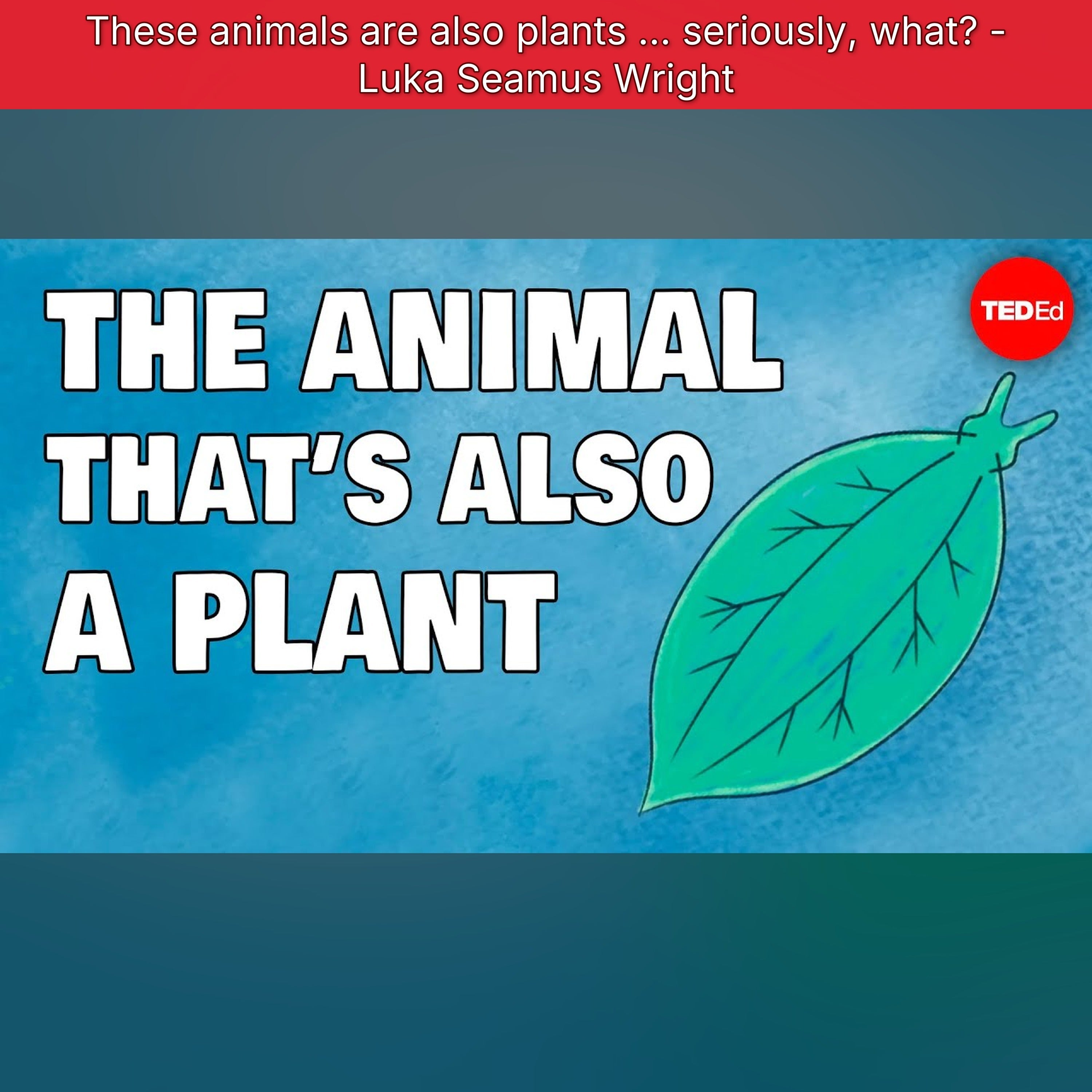
Explore the incredible adaptations of Elysia chlorotica, a species of sea slug that can photosynthesize food. -- The species of slug known as Elysia chlorotica may not look like much— it resembles a bright green leaf— but it’s one of the most extraordinary creatures on our planet. Living in marshes along the coast of North America, it can go about a year without eating. During that time, it lives like a plant. How is this possible? Luka Seamus Wright digs into the incredible adaptations of these mixotrophs. Lesson by Luka Seamus Wright, directed by Denis Chapon. Support Our Non-Profit Mission ---------------------------------------------- Support us on Patreon: http://bit.ly/TEDEdPatreon Check out our merch: http://bit.ly/TEDEDShop ---------------------------------------------- Connect With Us ---------------------------------------------- Sign up for our newsletter: http://bit.ly/TEDEdNewsletter Find us on Twitter: http://bit.ly/TEDEdTwitter Peep us on Instagram: http://bit.ly/TEDEdIn
Some narcissists keep descending until empathy shuts off completely. The accountability shock, the rage that builds inside, the empathy shutdown and the revenge-focused mind are the phases before a narcissist turns psychopathic. Chapters 00:00 Understanding Narcissistic Rage 01:58 The Five Phases of Narcissistic Descent 02:45 Phase 1: The Accountability Shock 04:42 Phase 2: Internal Rage Accumulation 06:28 Phase 3: The Empathy Shutdown 07:52 Phase 4: Revenge Focused Mindset 09:40 Phase 5: The Psychopathic Breakpoint Is this narcissistic abuse? Watch this episode on YouTube: youtu.be/W6sFAw9-C_s (https://youtu.be/W6sFAw9-C_s)
Send us Fan Mail (https://www.buzzsprout.com/2336717/fan_mail/new) ️ NVIDIA Compromised: A GIKN Deep Dive into the Case ️ GLOBAL INTELLIGENCE WEEKLY WRAP-UP — SPECIAL INVESTIGATION One of the world's most influential technology executives. A Chinese businesswoman allegedly identified as an intelligence asset. Billions of dollars in advanced artificial intelligence technology. And controversial American export decisions with significant national-security implications. Could foreign intelligence services be exploiting legitimate business relationships to gain access to the people shaping the future of artificial intelligence? In this special 32-minute investigation, Neil Bisson—retired CSIS Intelligence Officer, former CBSA Officer and Director of the Global Intelligence Knowledge Network—examines allegations involving NVIDIA CEO Jensen Huang, Chinese business executive Alice Huang and the strategic competition between Washington and Beijing. Drawing on reporting from The New York Times,
In this episode of How I Quit Alcohol, coach Ruby Williams shares her experience of weight loss surgery, her changing relationship with alcohol, and her path to recovery. We explore transfer addiction, how bariatric surgery can change the way the body responds to alcohol, and the emotional patterns that can continue after surgery. Ruby also shares how she learnt to respond to cravings and difficult feelings with greater awareness and self-compassion. We discuss: Ruby’s personal journey with food, weight loss surgery and alcohol. Changes in alcohol’s effects after bariatric surgery. How coping behaviours can shift between alcohol, food, sugar and other outlets. Recognising emotional triggers and understanding the needs beneath cravings. The role of trauma, identity and self-compassion in recovery. Mindfulness, daily practices and connection as sources of support. Building a fulfilling sober life through ongoing self-discovery and care. A conversation for anyone who has stopped one behav
If you keep asking yourself what you should do next, this episode is an invitation to ask a better question: who are you being? This was a special Saturday live, less structured than usual, where Henry works through a thought in real time — that doing can feel powerful, but if getting the thing means you keep changing who you are, your being has become negotiable. He talks about why we get so lost in the things that expire, why love without a choice isn’t love, and why “I am” is stronger than a to-do list. You’ll hear the I am practice he has used for years in coaching, and the one he is standing on now: I am pursuing Jesus. He isn’t asking you to take his statement. He’s asking you to choose yours, and to stop selling who you are just to get something done. In this episode: "Doing is nothing. Being is everything." "If the goal is to do the thing, then who you are, your being, is negotiable." "It's not about what I want to do. It's who do I want to be?" "You do not have to be your feel