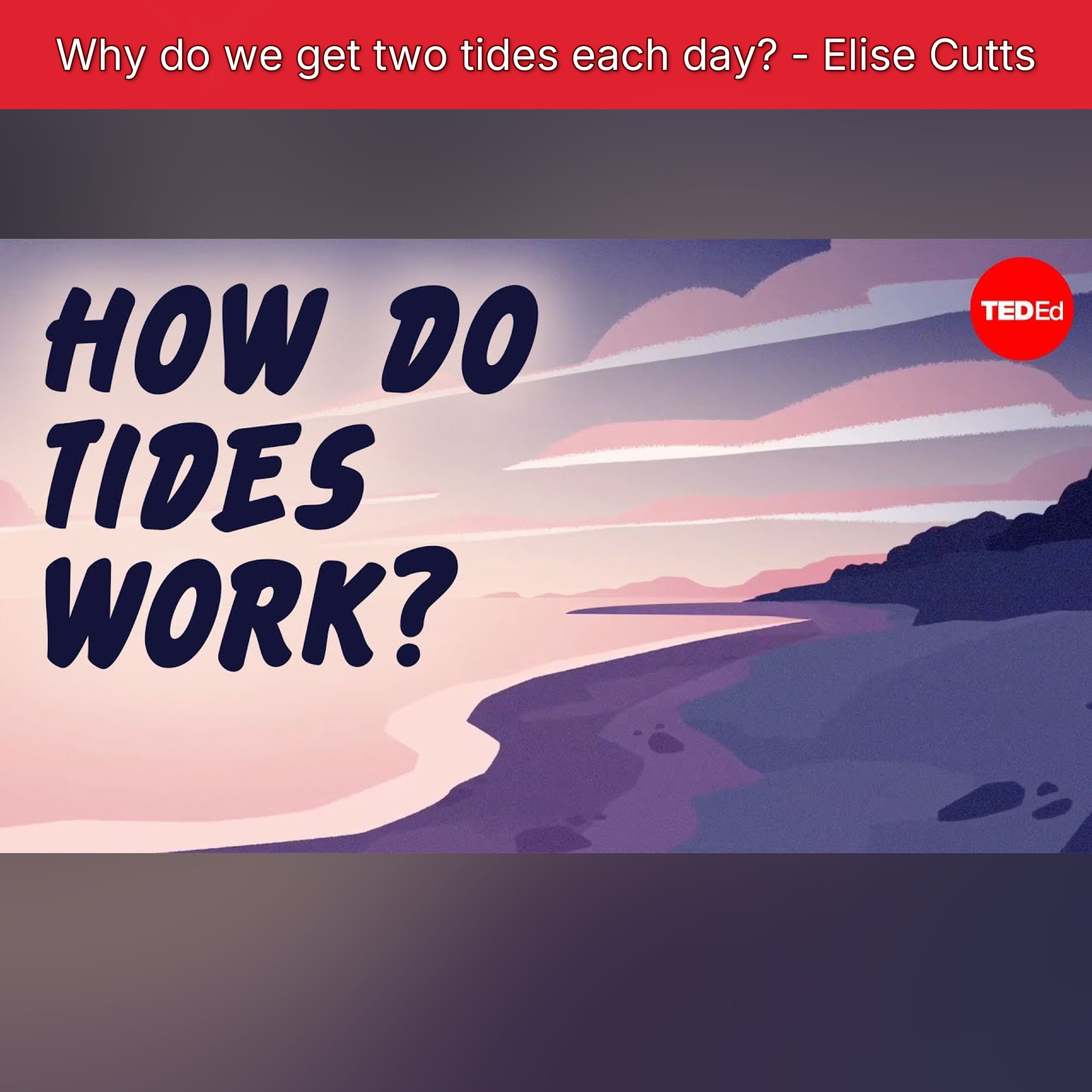
Dig into how the Sun and Moon are responsible for the tides on Earth, and what this force looks like on other celestial bodies. -- In the 17th century, Isaac Newton offered the first gravitational explanation of tides. As he correctly identified, tides are choreographed by the motions of celestial objects, and Earth’s tides in particular are mostly driven by the Moon. But the precise nature of this relationship is actually quite nuanced. Elise Cutts explains how the Sun and Moon are responsible for the tides. Lesson by Elise Cutts, directed by Rémi Cans, Atypicalist. Support Our Non-Profit Mission ---------------------------------------------- Support us on Patreon: http://bit.ly/TEDEdPatreon Check out our merch: http://bit.ly/TEDEDShop ---------------------------------------------- Connect With Us ---------------------------------------------- Sign up for our newsletter: http://bit.ly/TEDEdNewsletter Find us on Twitter: http://bit.ly/TEDEdTwitter Peep us on Instagram: http://bit.ly/TE
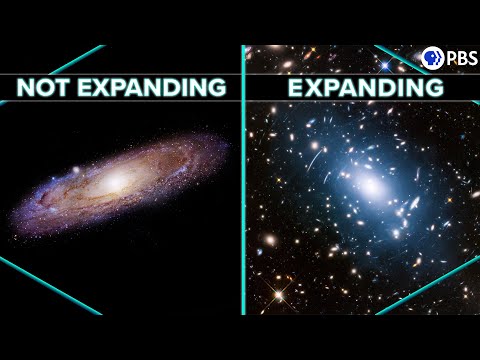
PBS Member Stations rely on viewers like you. To support your local station, go to:http://to.pbs.org/DonateSPACE Uploaded 04-05-22 Sign Up on Patreon to get access to the Space Time Discord! Space is big, and it’s getting bigger. But where does all that new space actually come from? And is it popping into existence all around you right now? Is that why the remote control is always further away than I thought? Check out the Space Time Merch Store Sign up for the mailing list to get episode notifications and hear special announcements! Hosted by Matt O'Dowd Written by Matt O'Dowd Post Production by Leonardo Scholzer, Yago Ballarini, Pedro Osinski, Adriano Leal and Stephanie Faria GFX Visualizations: Ajay Manuel Directed by Andrew Kornhaber Associate Producer: Bahar Gholipour Executive Producers: Eric Brown and Andrew Kornhaber Executives in Charge (PBS): Adam Dylewski, Maribel Lopez Director of Programming (PBS): Gabrielle Ewing Spacetime is produced by Kornhaber Brown for PBS Digital St
PBS Member Stations rely on viewers like you. To support your local station, go to: http://to.pbs.org/DonateSPACE ↓ More info below ↓ Uploaded 04-11-19 Sign Up on Patreon to get access to the Space Time Discord! Check out the Space Time Merch Store Why does it appear, that humanity is the lone intelligence in the universe? The answer might be that planet Earth is more unique than we've previously assumed. The rare earth hypothesis posits exactly this - that a range of factors made Earth exceptionally unusual and uniquely able to produce intelligent life. In upcoming episodes we’ll be exploring the anthropic principle and its two main versions - the strong and the weak anthropic principles. The strong anthropic principle tells us that the observed universe must be able to produce observers - including the contentious idea that this predicts the existence of universes beyond our own. But in today's episode we’re going to focus on the weak anthropic principle. It says that we must find ou
Uploaded 07-01-14 View full lesson: http://ed.ted.com/lessons/how-sugar-affects-the-brain-nicole-avena When you eat something loaded with sugar, your taste buds, your gut and your brain all take notice. This activation of your reward system is not unlike how bodies process addictive substances such as alcohol or nicotine -- an overload of sugar spikes dopamine levels and leaves you craving more. Nicole Avena explains why sweets and treats should be enjoyed in moderation. Lesson by Nicole Avena, animation by STK Films.
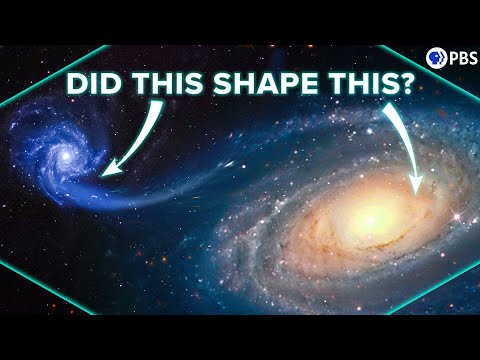
Search the Entire Space Time Library Here: https://search.pbsspacetime.com/ Uploaded 25-05-22 PBS Member Stations rely on viewers like you. To support your local station, go to :http://to.pbs.org/DonateSPACE Sign Up on Patreon to get access to the Space Time Discord! When we scan the heavens with giant telescopes we see galactic cannibalism everywhere. We see moments that appear frozen on the human timescale, but are really snapshots of the incredibly violent process of galaxy formation. This is how all galaxies are made. We can piece together a pretty good understanding of this process from countless snapshots. Looking into the distance means looking into the past, so it’s possible to stitch together a Frankenstein flip book of galaxy evolution. Check out the Space Time Merch Store Sign up for the mailing list to get episode notifications and hear special announcements! Hosted by Matt O'Dowd Written by Matt Caplan and Matt O'Dowd Post Production by Leonardo Scholzer, Yago Ballarini, P
Practice more problem-solving at https://brilliant.org/TedEd Uploaded 20-01-22 -- Your friend’s birthday is tomorrow, and he’s turning… well… you’ve forgotten. A ginormous cake has been prepared and your job is to sculpt his age as the chocolate centerpiece. The birthday boy is a giant, and you’re afraid that if your forgetfulness becomes known, you’ll become part of the feast. Can you figure out your friend’s age before the party? Marie Brodsky shows how. Lesson by Marie Brodsky, directed by Igor Coric, Artrake Studio. Support Our Non-Profit Mission ---------------------------------------------- Support us on Patreon: http://bit.ly/TEDEdPatreon Check out our merch: http://bit.ly/TEDEDShop ---------------------------------------------- Connect With Us ---------------------------------------------- Sign up for our newsletter: http://bit.ly/TEDEdNewsletter Find us on Twitter: http://bit.ly/TEDEdTwitter Peep us on Instagram: http://bit.ly/TEDEdInstagram -----------------------------------
Microsoft Announces Majorana 1 - Quantum Revolution is Coming! Deep Dive and 2050 Predictions Episode release date: 21 Feb 2025 Core Ideas: Metamodernism: Narratives and emergence view of reality - Reduce suffering - Increase prosperity - Increase understanding mantra: Seek knowledge. DISCLAIMER: This is a community-driven show. --------------------
ChatGPT as an Interpreter: Introducing the KB Microservice for autonomous AI entities Episode release date: 16 Jun 2023 Core Ideas: Metamodernism: Narratives and emergence view of reality - Reduce suffering - Increase prosperity - Increase understanding mantra: Seek knowledge. DISCLAIMER: This is a community-driven show. ---------- Keywords: machine autonomy, ai innovation, chatbots, david shapiro, ai research, ai safety
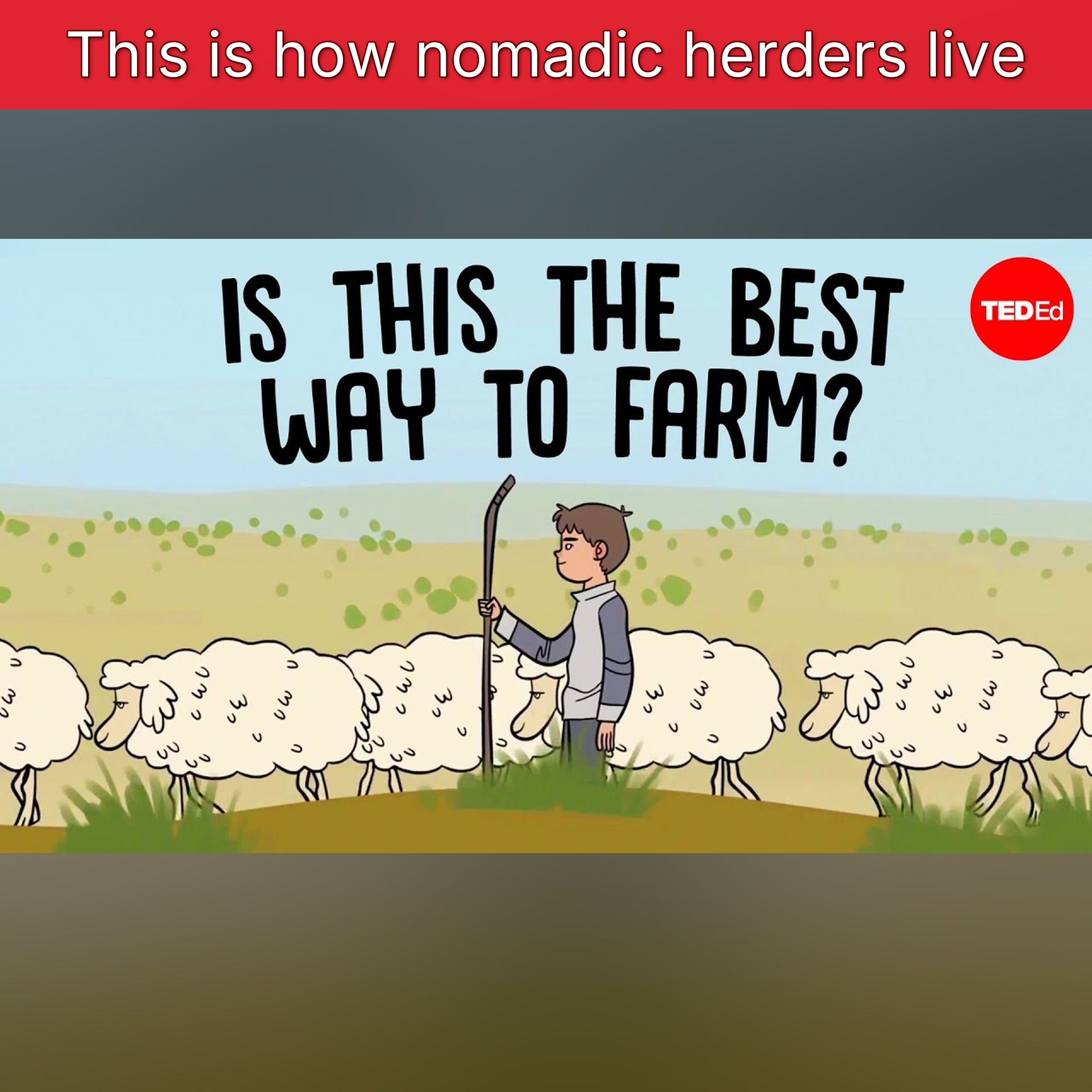
Dig into the challenges of modern pastoralism, a form of agriculture where farmers guide livestock to seasonal grazing areas. -- For millennia, livestock farmers strategically guided animals to seasonal grazing areas. This mobile way of life, known as pastoralism, provided them with wealth, social status, and political independence into the 20th century. But in the last century, political and economic policies have worked against these communities. Take a closer look at the challenges of modern pastoralism. Directed by Anton Bogaty. This video made possible in collaboration with Gates Ventures Learn more about how TED-Ed partnerships work: https://bit.ly/TEDEdPartner A special thanks to Graham Gerrity, Donald Nkrumah, and Obai Khalifa who provided information and insights for the development of this video. Support Our Non-Profit Mission ---------------------------------------------- Support us on Patreon: http://bit.ly/TEDEdPatreon Check out our merch: http://bit.ly/TEDEDShop ---------
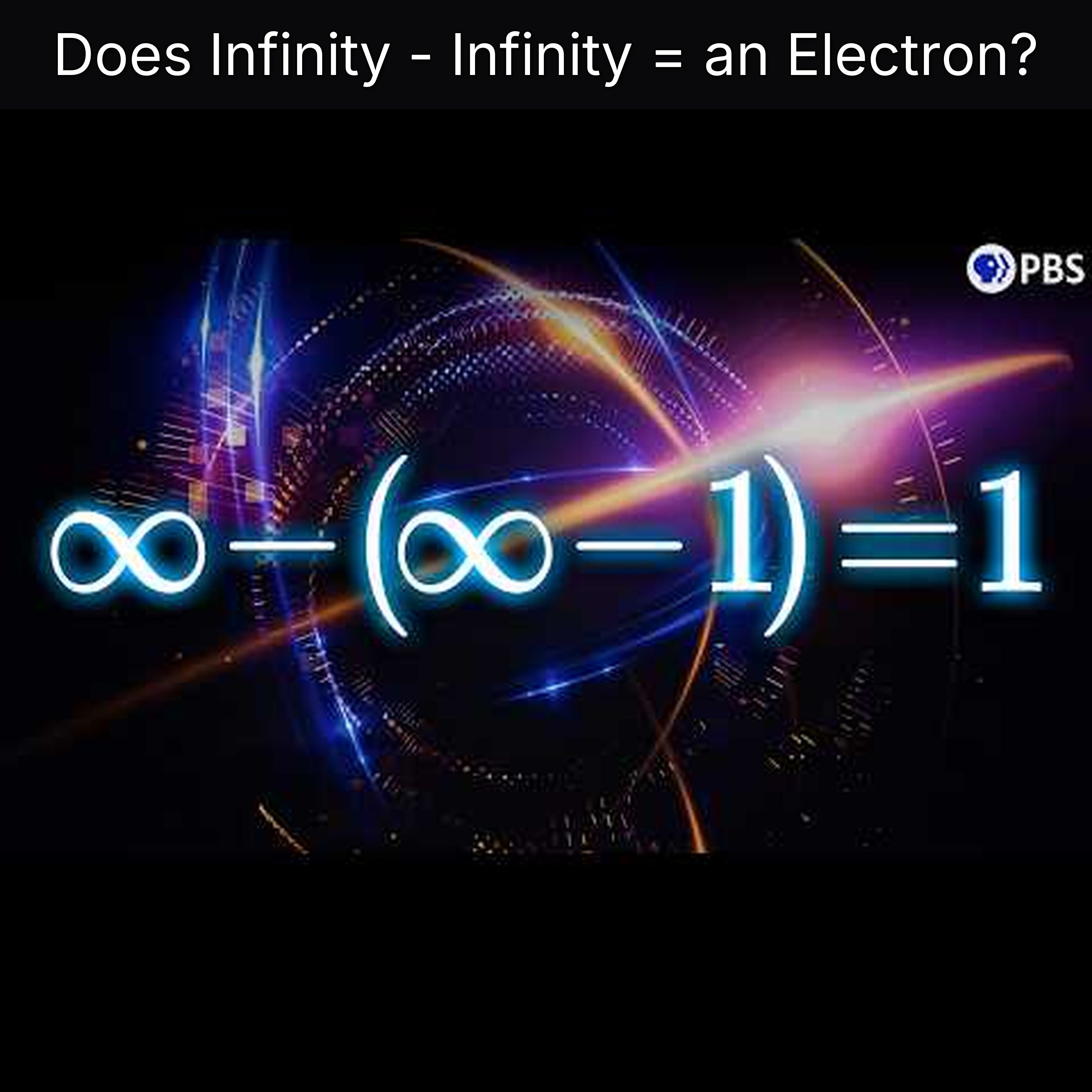
Thanks to Radiacode for sponsoring this video. Uploaded 19-12-24 What do you get if you take something that’s infinitely massive and combining with something else that’s negative infinitely massive? You get a single electron, at least that’s what it looks like in our most precise way of describing the quantum world. Sign Up on Patreon to get access to the Space Time Discord! Sign up for the mailing list to get episode notifications and hear special announcements! Search the Entire Space Time Library Here: https://search.pbsspacetime.com/ Hosted by Matt O'Dowd Written by Matt O'Dowd Post Production by Leonardo Scholzer, Yago Ballarini and Stephanie Faria Directed by Andrew Kornhaber Associate Producer: Bahar Gholipour Executive Producer: Andrew Kornhaber Executive in Charge for PBS: Maribel Lopez Director of Programming for PBS: Gabrielle Ewing Assistant Director of Programming for PBS: John Campbell Spacetime is a production of Kornhaber Brown for PBS Digital Studios. This program is p
Sign Up on Patreon to get access to the Space Time Discord! Uploaded 09-06-21 While recent news about the Chinese Long March 5 Rocket made a lot of people very nervous because a 22-ton rocket was going to fall out of the sky, this sort of thing happens all the time. Boosters, dead satellites, and sometimes even old space stations get dropped out of the sky fairly often. While the litter seems a little inconsiderate, this is probably far safer than the alternative. The accumulation of space junk poses a huge risk to all human operations in space especially if we cross the threshold into the chain reaction of exponentially growing collisions known as the Kessler Syndrome. Check out all the Leo Labs Space Debris Tracker Check out the Space Time Merch Store Sign up for the mailing list to get episode notifications and hear special announcements! Hosted by Matt O'Dowd Written by Matt Caplan and Matt O'Dowd Graphics by Leonardo Scholzer, Yago Ballarini, Pedro Osinski, Adriano Leal and Stepha
Explore how bacteria become resistant to antibiotics and turn into superbugs, and what scientists are doing to stop it. Uploaded 07-08-14 -- Right now, you are inhabited by trillions of microorganisms. Many of these bacteria are harmless (or even helpful!), but there are a few strains of ‘super bacteria’ that are pretty nasty -- and they’re growing resistant to our antibiotics. Why is this happening? Kevin Wu details the evolution of this problem that presents a big challenge for the future of medicine. Lesson by Kevin Wu, animation by Brett Underhill. Sign up for our newsletter: http://bit.ly/TEDEdNewsletter Support us on Patreon: http://bit.ly/TEDEdPatreon Find us on Twitter: http://bit.ly/TEDEdTwitter Peep us on Instagram: http://bit.ly/TEDEdInstagram View full lesson: http://ed.ted.com/lessons/how-antibiotics-become-resistant-over-time-kevin-wu
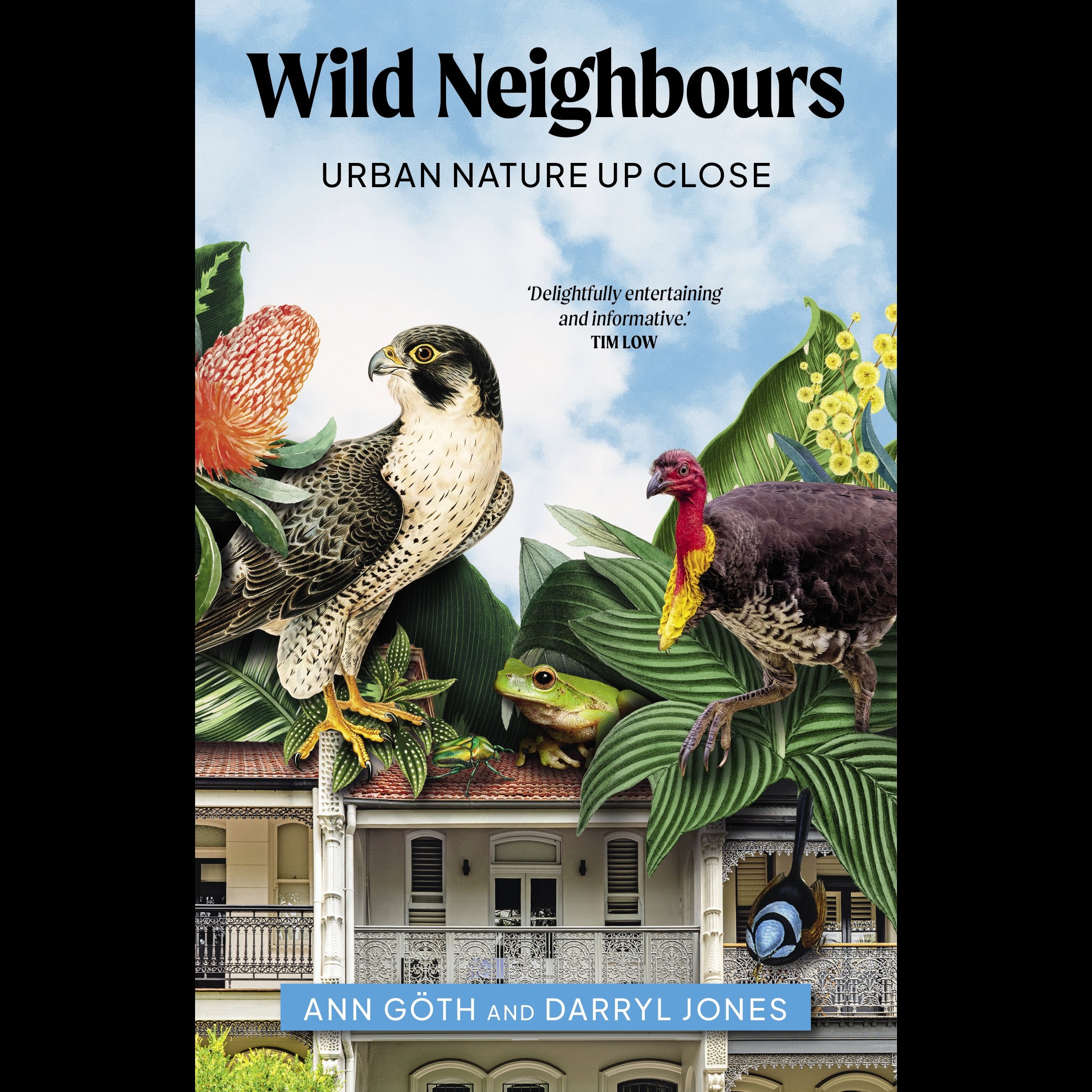
Birds, possums, blue-tongued lizards, all populate our cities and getting to know them is a project of ecologist Darryl Jones and science teacher Ann Göth. Wild Neighbours explores the habits, personalities, quirks, ingenuity and everyday dramas of the animals and plants that live among us.
It was founded in 1940 as a home for Australian poetry, fiction, essays, memoir, and criticism. Its name comes from a First Nations word for the area around central Brisbane. Meanjin was published for many years by Melbourne University Press and closed in 2025. But in 2026 it is reemerging, published by Queensland University of Technology with editor Ashley Hay.
An animated interpretation of Robert Frost's poem "The Road Not Taken" Uploaded 02-02-19 -- For an analysis of this poem, watch this video: http://bit.ly/TEDEdFrostAnalysis This animation is part of our series, "There's a Poem for That," which features animated interpretations of poems both old and new that give language to some of life's biggest feelings. Check out the full series here: http://bit.ly/TEDEdTheresAPoemForThat Poem by Robert Frost, directed by Ellen Su. Sign up for our newsletter: http://bit.ly/TEDEdNewsletter Support us on Patreon: http://bit.ly/TEDEdPatreon Find us on Twitter: http://bit.ly/TEDEdTwitter Peep us on Instagram: http://bit.ly/TEDEdInstagram #poetry
PBS Member Stations rely on viewers like you. To support your local station, go to: http://to.pbs.org/DonateSPACE ↓ More info below ↓ Uploaded 07-04-20 Sign Up on Patreon to get access to the Space Time Discord! Sign up for the mailing list to get episode notifications and hear special announcements! Check out the Space Time Merch Store In astronomy we talk about billions of years like it’s no big deal. But how can we be sure about timescales so far beyond the capacity for human intuition? Our discovery of what we now call deep time is very recent - as recent as our discovery of the true spatial vastness of our universe. And it came as scientists tried to measure the age of the Earth. What they found was as shocking and humbling as anything seen through the telescope. Hosted by Matt O'Dowd Written by Dan Falk and Matt O'Dowd Graphics by Leonardo Scholzer, Yago Ballarini, and Pedro Osinski Directed by: Andrew Kornhaber Executive Producers: Eric Brown and Andrew Kornhaber End Credits Mus
Viewers like you help make PBS (Thank you ) . Support your local PBS Member Station here: https://to.pbs.org/DonateSPACE Uploaded 05-09-18 Thanks to CuriosityStream for supporting PBS Digital Studios. You can learn more at https://www.curiositystream.com/spacetime and use the code "spacetime" during the sign-up process. You can further support us on Patreon at https://www.patreon.com/pbsspacetime Get your own Space Time t-shirt at http://bit.ly/1QlzoBi Tweet at us! @pbsspacetime Facebook: facebook.com/pbsspacetime Email us! pbsspacetime [at] gmail [dot] com Comment on Reddit: http://www.reddit.com/r/pbsspacetime Help translate our videos! Previous Episode: Is There Life on Mars? Hosted by Matt O'Dowd Written by Matt O'Dowd Graphics by Luke Maroldi Assistant Editing and Sound Design by Mike Petrow Made by Kornhaber Brown (www.kornhaberbrown.com) Black Holes should have no entropy, but they in fact hold most of the entropy in the universe. Let’s figure this out. If black holes exist – w
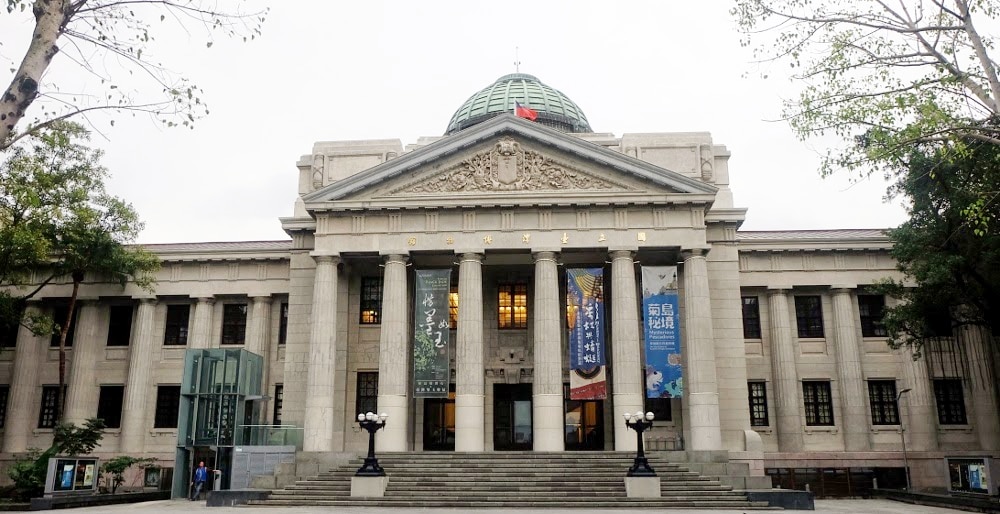
While interest in science amongst Australian school children is sometimes questioned, we contrast Australia with the situation in Taiwan. Fang Hui-Shih from the National Taiwan Museum describes interest in science amongst her country’s students as strong. Being educated, 90 per cent of the population accept the science of climate change, and the country has a strong community of citizen scientists.
Australian Museum director Kim McKay says the site of the present museum, founded in 1827 opposite St Mary’s Cathedral in Sydney, was the old convicts’ garden where their food was grown. McKay recalls discoveries made by museum scientists over the decades and describes how they have enhanced the nation’s education and culture.
We note the passing of Professor John Carmody, UNSW lecturer and researcher in the School of Physiology and Pharmacology and a prolific broadcaster on science and music on ABC Radio. On Ockham’s Razor he asked whether Australians relish science as much as they do sport. His answer was a resounding no!
Why Every Phone Will Have AGI by 2026 - DeepSeek R1 Proves It's Coming! Episode release date: 29 Jan 2025 Core Ideas: Metamodernism: Narratives and emergence view of reality - Reduce suffering - Increase prosperity - Increase understanding mantra: Seek knowledge. DISCLAIMER: This is a community-driven show. ----------------------
Dig into Moore’s Law and explore its 4 main limitations and how they could change how we are able to make progress in computing. -- Moore’s Law states that every 1 to 2 years the number of transistors that can fit on a given size computer chip will double. Thanks to this law, chips have gotten smaller, faster, more efficient, and cheaper. But today, there are four key problems that trip up this trend, potentially ending Moore’s Law and fundamentally changing how computing progresses. Sajan Saini and George Zaidan investigate. Lesson by Sajan Saini and George Zaidan, directed by Jeff Le Bars, JetPropulsion.space. A special thanks to Anuradha Murthy Agarwal who provided information and insights for the development of this video. Artists and artworks referenced in the animation: "The Persistence of Memory and The Disintegration of the Persistence of Memory" by Salvador Dalí "Composition VIII" by Wassily Kandinsky "Oh Jeff and Girl with Tear III" by Roy Lichtenstein "Black Square on a Whit
OpenAI Strawberry's Innards-How it works, and what comes next for OpenAIEpisode release date: 13 Sep 2024Spreading awareness about the works of some of the leading educators in the AI revolution. Core Ideas: Metamodernism: Narratives and emergence view of reality - Reduce suffering - Increase prosperity - Increase understanding mantra: Seek knowledge. ELABORATE: Add depth and detail to understanding, weaving comprehensive and nuanced explanations.DISCLAIMER: This is a community-driven show. ----------OpenAI Strawberry's Innards-How it works, and what comes next for OpenAIEpisode release date: 13 Sep 2024Spreading awareness about the works of some of the leading educators in the AI revolution. Core Ideas: Metamodernism: Narratives and emergence view of reality - Reduce suffering - Increase prosperity - Increase understanding mantra: Seek knowledge. ELABORATE: Add depth and detail to understanding, weaving comprehensive and nuanced explanations.DISCLAIMER: This is a community-driven show
View full lesson: http://ed.ted.com/lessons/the-nurdles-quest-for-ocean-domination-kim-preshoff Uploaded 04-08-14 Nurdles are the tiny, factory-made pellets that form the raw material for every plastic product that we use, from toys to toothbrushes. And while they look pretty harmless on land, they can really wreak havoc on our oceans. Kim Preshoff details the nurdles' quest for ocean domination, shedding light on the particular features that allow these pervasive polluters to persist for entire generations. Lesson by Kim Preshoff, animation by Reflective Films.