We’re all gonna die someday. But can statistics help us know when? In this episode of Crash Course Scientific Thinking, we’ll learn how to interpret the statistics we see in our daily lives. And we’ll explore why we need stats to make informed judgments, be more precise about what we don’t know, and get closer to what we can know. Introduction: When Will I Die? 00:00 Basic Statistics 0:44 Confidence Intervals 4:14 Relative & Absolute Risk 5:32 Correlation vs. Causation 7:22 Review & Credits 9:45 Sources: https://docs.google.com/document/d/1Kv2_mFsDxQURuFDxpflD45dy-pCxlqnM9iPSNYxigmQ/edit?tab=t.0#heading=h.vk5i2fgqyumq (https://docs.google.com/document/d/1Kv2_mFsDxQURuFDxpflD45dy-pCxlqnM9iPSNYxigmQ/edit?tab=t.0) *** Support us for $5/month on Patreon to keep Crash Course free for everyone forever! https://www.patreon.com/crashcourse Or support us directly: https://complexly.com/support Join our Crash Course email list to get the latest news and highlights: https://mailchi.mp/crashcourse
View full lesson: http://ed.ted.com/lessons/how-bees-help-plants-have-sex-fernanda-s-valdovinos Uploaded 17-06-14 Plants have a hard time finding mates -- their inability to get up and move around tends to inhibit them. Luckily for plants, bees and other pollinator species (including butterflies, moths and birds) help matchmake these lonely plants in exchange for food. Fernanda S. Valdovinos explains how these intricate pollination networks work and how it can all change from one season to the next. Lesson by Fernanda S. Valdovinos, animation by The Moving Company Animation Studio.
Deep beneath the French-Swiss border, the Large Hadron Collider accelerates trillions of protons to nearly the speed of light to probe the most infinitesimal components of reality. In this episode, we explore the deeply ambiguous question: What is the smallest particle in the universe? We trace the historic journey from J.J. Thomson’s 1897 discovery of the electron in cathode-ray tubes—proving that atoms are not indivisible—to James Chadwick’s 1932 identification of the elusive neutron. We examine the Standard Model's architecture of fermions and bosons, confronting the counterintuitive reality that fundamental particles have no physical volume, operating instead as zero-dimensional geometric points or excitations in pervasive fields. We trace how mass serves as the ultimate measure of smallness, culminating in the monumental July 4, 2012 discovery of the Higgs boson at CERN. Finally, we investigate the featherweights of the cosmos—from massless photons and gluons to neutrinos, whose u
Fortean Fifty: Indiana Indiana might be known for its cornfields and small towns, but hidden throughout the Hoosier State are some truly bizarre stories. From the terrifying Beast of Boonville and the mysterious Grey Lady haunting Willard Library to an enormous, one-eyed creature floating through the skies above Crawfordsville, Indiana has no shortage of unexplained encounters. This week, Holosky continues its Fortean Fifty journey with tales of giant turtles, strange tentacled creatures discovered in wells and industrial sludge pits, and the disturbing legends of the Ohio River's mysterious Mud Mermaids. Are these encounters forgotten pieces of American folklore, elaborate hoaxes, or evidence of something genuinely unexplained? Stay Safe • Stay Weird. Facebook and Twitter @holoskypodcast Instagram @ theholoskypodcast The number is going to be 1 (618) 556-0837 If you want to send us weird shit then please do! Holosky Podcast P.O. Box 145 Fieldon, IL 62031 https://discord.gg/GFsbY92NgU
In this episode, we discuss how deer browsing helps or harms plant communities and how you can balance cover, food plots, and wildlife objectives. Resources: The Skinny Hen Hypothesis | #206 (https://sites.libsyn.com/453219/WildTurkeyScience/the-skinny-hen-hypothesis-206) Turner, M. A., et al. (2026). Management scale and intensity limit forage availability on properties managed for white‐tailed deer. The Journal of Wildlife Management, 90(5), e70223. (https://pdfhost.io/v/TyUrKmVMFp_Turner) Turner, M.A., et al. (2026). Vegetation composition and structure influences female wild turkey survival during incubation. Journal of Wildlife Management. (https://pdfhost.io/v/neYCn8Q3fp_Turner) Westlake, S. M., et al. (2020). The magnet effect of fire on herbivores affects plant community structure in a forested system. Forest Ecology and Management, 458, 117794. (https://www.sciencedirect.com/science/article/pii/S0378112719318821) Our lab is primarily funded by donations. If you would like to h
Listen to the full episode (https://www.patreon.com/c/conspirituality) Russell Brand was sentenced to 10-and-a-half years in prison one week ago today. Derek looks at the response from the right and MAHA crew, which has been overwhelmingly certain the man is innocent—with one notable exception.
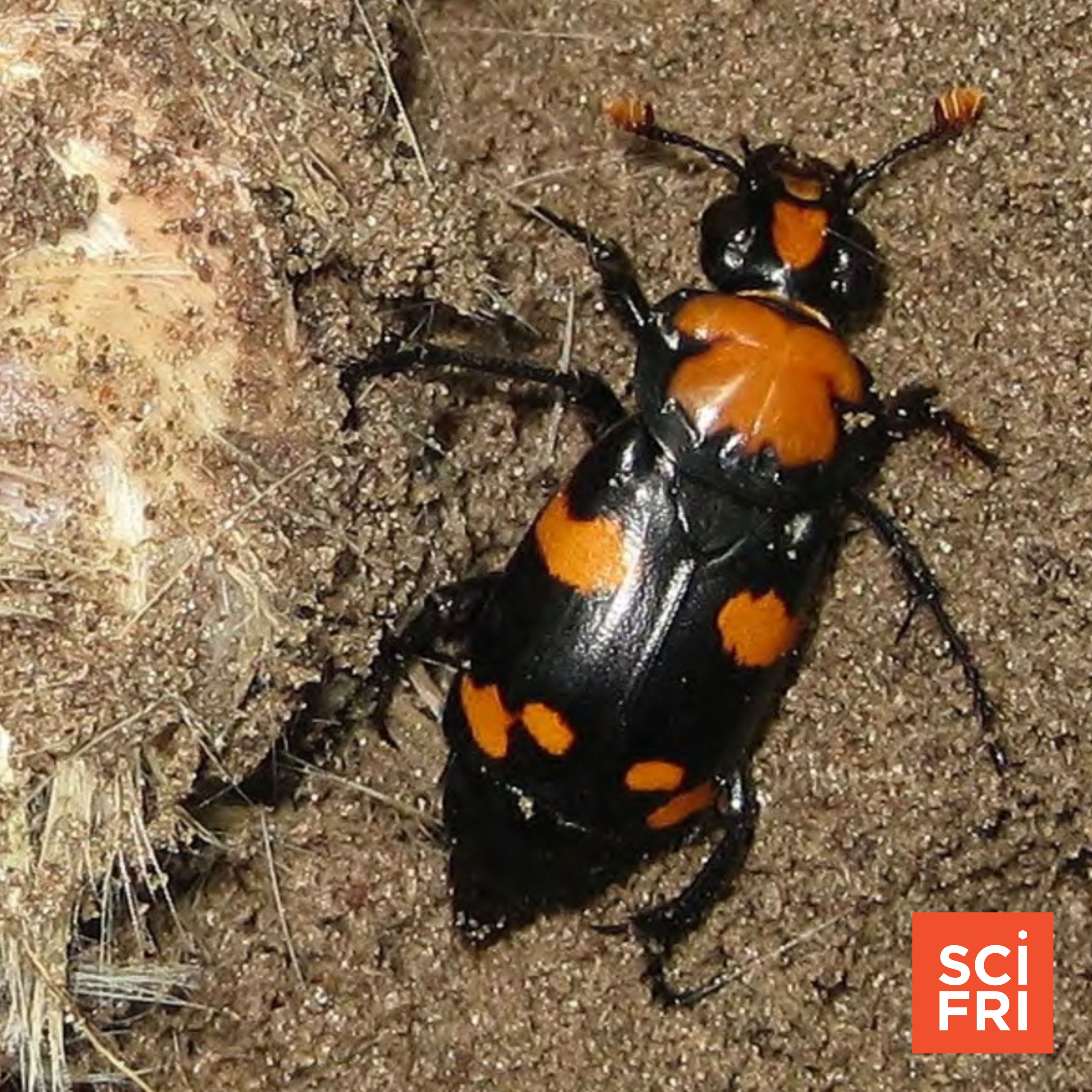
The American burying beetle is 2 inches long, has bright black-and-orange coloration, and provides an important ecological service: recycling carrion. The beetle finds dead bodies of small animals, buries them, mates on them, and then uses their remains to feed and shelter its larvae. It’s listed as threatened in the U.S., and is found only in a few places around the country. East of the Mississippi, one of the main populations is on Block Island, off the coast of Rhode Island. Researchers are working to reintroduce the beetle (https://www.sciencefriday.com/segments/american-burying-beetle-recovery/) to Nantucket, but it’s been a long and challenging process. Flora sits down with Hannah Petrarca, one of the researchers involved in the conservation effort to breed and release beetles into the wild. They chat about why this species is so special, and what its conservation prospects look like. Guest: Hannah Petrarca is a conservation specialist at the Roger Williams Park Zoo in Providence
Hard Takeoff Inevitable? Causes, Constraints, Race Conditions - ALL GAS, NO BRAKES! (AI, AGI, ASI!) Episode release date: 8 Mar 2024 Core Ideas: Metamodernism: Narratives and emergence view of reality - Reduce suffering - Increase prosperity - Increase understanding mantra: Seek knowledge. DISCLAIMER: This is a community-driven show. ----------- Keywords: ai philosophy, ai research, machine learning, future technology, ai innovation, cognitive ai, ai consciousness
In this week’s Science Quickly news roundup, we’ll dig into SciAm’s vast archives with senior editor for Earth and environment Andrea Thompson to find out what the magazine was covering 50, 100 and 150 years ago. We’ll also break down some surprising news about fossil fuel emissions and its implications for our energy-hungry future. Plus, we’ll learn about the real culprits behind a Roman-era frog massacre. Recommended Reading: Oil prices are so high that CO2 emissions from fossil fuels are dropping (https://www.scientificamerican.com/article/oil-prices-are-so-high-that-co2-emissions-from-fossil-fuels-are-dropping/) Scientific American Issue Archive (https://www.scientificamerican.com/archive/issues/) Our theme music was composed by Dominic Smith.
In which John Green teaches you the history of Islam, including the revelation of the Qu'ran to Muhammad, the five pillars of Islam, how the Islamic empire got its start, the Rightly Guided Caliphs, and more. Learn about hadiths, Abu Bakr, and whether the Umma has anything to do with Uma Thurman (spoiler alert: it doesn't). Also, learn a little about the split between Sunni and Shia Muslims, and how to tell if this year's Ramadan is going to be difficult for your Muslim friends. Let's try to keep the flame wars out of this reasoned discussion. Chapters: Introduction: Islam 00:00 Origins of Islam 0:51 The Quran 2:36 The Five Pillars of Islam 3:24 An Open Letter to the 72 Virgins 4:50 Sharia Law 5:48 Muhammad, Medina, and Mecca 6:27 The First Caliph 7:41 How did Islam spread? 9:26 The Islamic Empire's Legacy 11:10 Credits 12:18 Crash Course is on Patreon! Want to find Crash Course elsewhere on the internet? Facebook - http://www.facebook.com/YouTubeCrashCourse Twitter - http://www.twitte
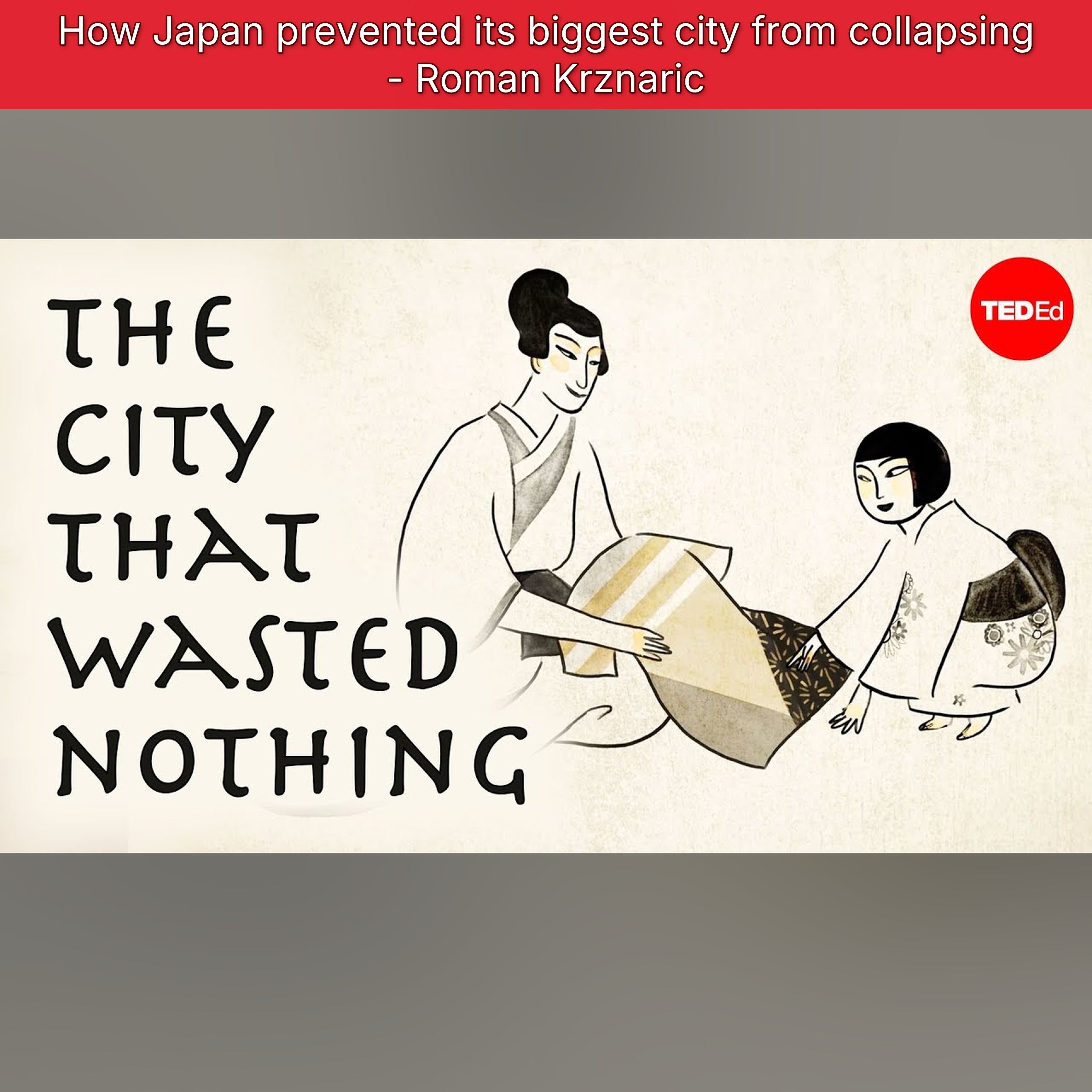
Dig into Edo, Japan’s circular economy, and how it helped transform the city into a thriving ecological and cultural center. -- 400 years ago, Edo was on the verge of ecological collapse. Years of intense logging had led to massive deforestation and the city faced timber shortages, severe erosion, and frequent flooding. But over just a few decades, Edo became one of the most sustainable and efficient cities in history. So, how did this come about? Roman Krznaric explores Edo's transformation into a circular economy. Lesson by Roman Krznaric, directed by Héloïse Dorsan-Rachet. Support Our Non-Profit Mission ---------------------------------------------- Support us on Patreon: http://bit.ly/TEDEdPatreon Check out our merch: http://bit.ly/TEDEDShop ---------------------------------------------- Connect With Us ---------------------------------------------- Sign up for our newsletter: http://bit.ly/TEDEdNewsletter Find us on Twitter: http://bit.ly/TEDEdTwitter Peep us on Instagram: http://
Reinforcement learning is particularly useful in situations where we want to train AIs to have certain skills we don’t fully understand ourselves. Unlike some of the techniques we’ve discussed so far, reinforcement learning generally only looks at how an AI performs a task AFTER it has completed it. And when an AI completes that task figuring out when and how to reward an AI, called credit assignment, is one of the hardest parts of reinforcement learning. So today, we’re going to explore these ideas, introduce a ton of new terms like value, policy, agent, environment, actions, and states and we’ll show you how we can use strategies like exploration and exploitation to train John Green Bot to find things more efficiently next time. Crash Course AI is produced in association with PBS Digital Studios: Crash Course is on Patreon! Thanks to the following patrons for their generous monthly contributions that help keep Crash Course free for everyone forever: Eric Prestemon, Sam Buck, Mark Bro
Google/Meta LEAST trusted in AI! Anthropic/Musk MOST trusted? Claude weighs in on alignment! Episode release date: 20 Mar 2024 Core Ideas: Metamodernism: Narratives and emergence view of reality - Reduce suffering - Increase prosperity - Increase understanding mantra: Seek knowledge. DISCLAIMER: This is a community-driven show. --------------- Keywords: singularity, machine autonomy, tech singularity, ai research, ai innovation, artificial general intelligence, david shapiro, ai future
Today Hank talks about your central nervous system. In this episode, we'll explore how your brain develops and how important location is for each of your brain's many functions. Pssst... we made flashcards to help you review the content in this episode! Find them on the free Crash Course App! Download it here for Apple Devices: https://apple.co/3d4eyZo Download it here for Android Devices: https://bit.ly/2SrDulJ Chapters: Introduction: Broca's Aphasia 00:00 Central Nervous System Structure & Function 1:48 Brain Development: Neural Tube 3:27 Brain Development: 3 Primary Vesicles 3:47 Brain Development: 5 Secondary Vesicles 4:04 Brain Development: Major Adult Brain Regions 4:18 Brain Development: Cerebellum & Brain Stem 4:42 Brain Development: Reptilian Brain 5:45 Brain Development: Cerebral Hemispheres 6:35 The Brain's Lobes 7:35 Review 9:14 Credits 9:48 *** Crash Course is on Patreon! Want to find Crash Course elsewhere on the internet? Facebook - http://www.facebook.com/YouTubeCrashCo
View full lesson: http://ed.ted.com/lessons/how-to-take-a-great-picture-carolina-molinari Uploaded 29-07-13 Have you ever looked at your camera and wondered what all of those buttons actually do? For manual photography, the aperture, shutter speed and ISO sensitivity can all be manipulated to get just the right amount of light. Carolina Molinari suggests the best exposure for an action photo, a stunning portrait or a nighttime landscape. Lesson by Carolina Molinari, animation by TED-Ed.
Sleep better with Pillow: https://pillow.app/bettersleep Immerse yourself in soothing rainy city traffic sounds, perfect for deep sleep, meditation, and relaxation. This calming ambient noise helps reduce stress, improve focus, and create a peaceful atmosphere for restful nights and mindful moments. This episode includes AI-generated content.
This episode of the Organic Grower Podcast was recorded live from the Organic Growers Gathering. This is part 2 and core to this episode is building resilience and working within your limits. Whether the challenge is weeds, water, labour, fertility, policy or land access success comes from Systems Efficient infrastrctuce Healthy Soils Collobrations Realistic scaling All the growers I spoke to in this episode talk about scaling at a manageable pace, that is creating a farm that is productive, profitable and enjoyable for the long term. As Danny from Earth Farmers says "Rome wasn't built in a day" and after all we are all working on our own mini Romes. Guests Adam Payne - Arwen Organics, West Wales Steven Jacobs - Organic Growers Alliance Adam Beer & Rita Oldenburg, Pitney Farm Market Garden, Somerset Danny - Earths Farm, West Wales Host - Liv James As ever these conversations we enjoyable, informative and full of laughs. I couldn't do this without such fantastic guests who match my enth
In December 2024, four youth ice hockey teams attended a weekend tournament in a rural Alberta arena. After lunch, several players began complaining of nausea, dizziness and headaches. As the symptoms spread through one of the teams, parents began searching for a cause. At first, Dan Moir, a parent and firefighter, thought it could be the flu, but the speed with which the symptoms were spreading didn’t fit. Another possibility was food poisoning, but some players improved when they stepped outside. Eventually, Mr. Moir suspected carbon monoxide, and he called the local fire department to test the arena’s air. When they did, the alarms went off, signalling the need to evacuate the building. Dan Moir called Laurie Lee, a nurse practitioner who assists the team with medical issues, and she told him that everyone in the arena that day needed to go to the emergency department. This triggered a cascade of events that culminated in a Code Orange at Alberta Children’s Hospital. On this episode
What changes when you stop thinking of every colony as a honey producer and start giving colonies different jobs? In this episode, Becky takes over the studio and welcomes Siouxland Beekeepers Phil Breed and Phil Westra for a practical conversation about building a sustainable northern beekeeping operation. Phil Westra describes a management system influenced by Michael Palmer, with production colonies supported by resource hives, overwintered nucs, locally raised queens, and carefully selected genetics. His goal is simple: maintain enough queens, brood, food, and colony resources within the operation that problems can be solved without constantly buying replacements. The conversation covers apiary location, nutrition, queen castles, double nucs, winter preparation, upper entrances, recordkeeping, and the realities of managing bees through drought, flooding, unpredictable nectar flows, and harsh northwest Iowa winters. Phil also explains his queen-rearing calendar, why he waits for ade
-If you’re ever injured in an accident, you can check out Morgan & Morgan. You can start your claim in just a click without having to leave your couch: https://ForThePeople.com/WHY Visit https://whyfileslovesgold.com, text FILES to 638257, or call (888) 949-9172. -Ready to give your liver the support it deserves? -Get up to $20 off your first eligible purchase—search Whatnot in the app store and take a shopping trip live. Terms apply. Dr. Julia Mossbridge has kept a dream journal since she was seven, and the entries keep coming true. As a cognitive neuroscientist, she set out to measure that pull from the future in the lab. Her work runs from killer whale songs in Antarctica to brainwaves that react before a choice is made. It leads to a room-temperature device in her office closet built on one idea: light carries information about what comes next. She also opens up about a childhood gifted program, the unexplained tests, and the questions they left behind. Then the conversation turns
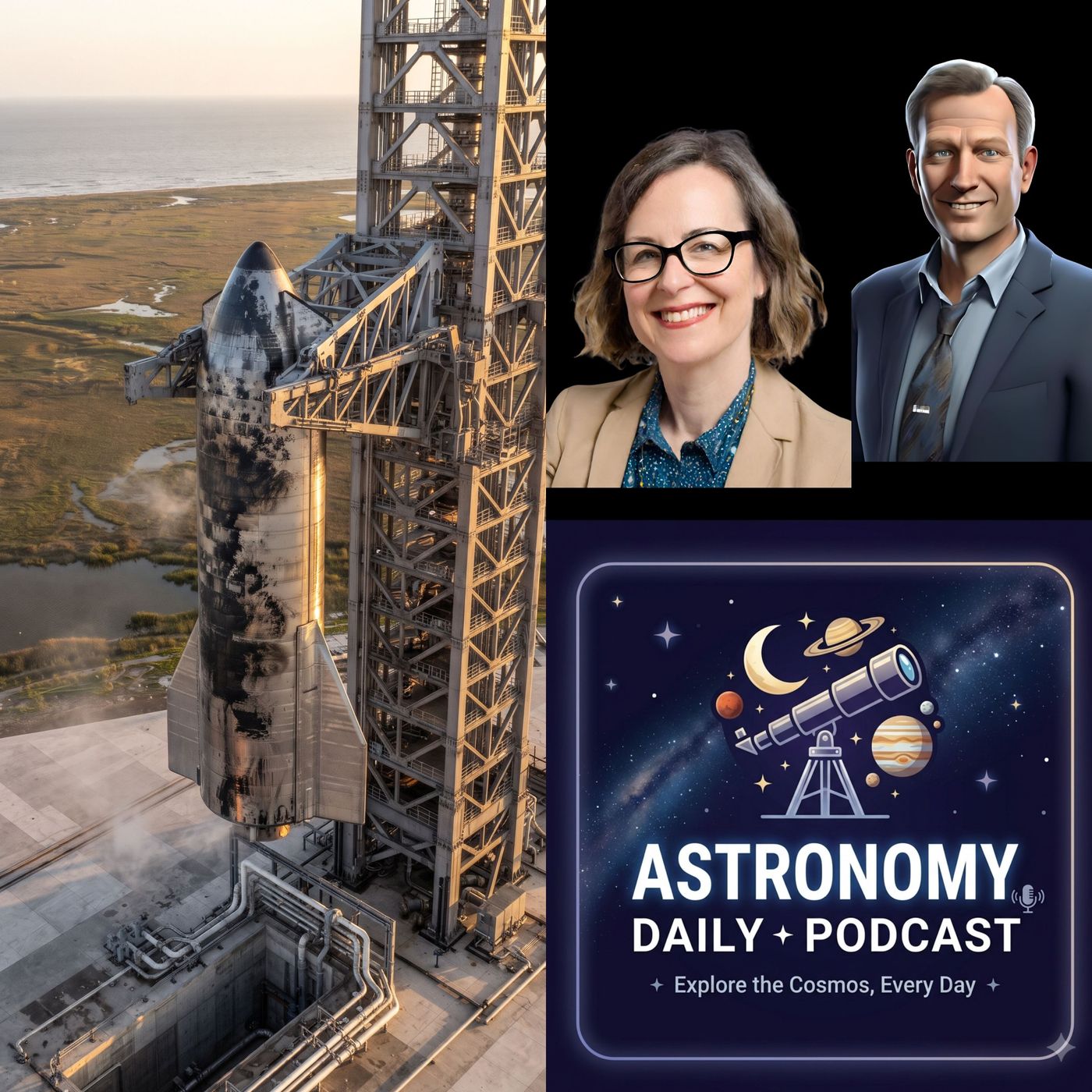
SpaceX has caught a Starship upper stage with its launch tower for the first time, after a 22-hour orbital flight, though the Super Heavy booster was lost and the cause is still under investigation. Anna and Avery tell the full story of Flight 15, then turn to a four-person CSIRO team in Perth that has independently confirmed the famous 2019 image of the M87 black hole. Also: a nearby Type Ia supernova still brightening in the southern galaxy NGC 1433, gravitational-wave hints of stars that collapsed without exploding, Hera's arrival at Didymos, Voyager 1 at one light-day, and a both-hemispheres guide to the Leonids. In this episode · Starship Flight 15: the ship comes home · CSIRO confirms the M87 black hole image · Supernova SN 2026ahvu in NGC 1433 · The stars that didn't explode · Quick hits: Hera, Voyager 1, BepiColombo · Skywatch: Leonids, Mars and Jupiter, the supernova Sources Story Source Starship Flight 15 Space.com launch, abort and live coverage, 13–15 Nov 2026; NASASpaceFli
Answer complex questions from an arbitrarily large set of documents with vector search and GPT-3 Episode release date: 26 Jun 2022 Core Ideas: Metamodernism: Narratives and emergence view of reality - Reduce suffering - Increase prosperity - Increase understanding mantra: Seek knowledge. DISCLAIMER: This is a community-driven show. --------------- Keywords: david shapiro, chatbots, cognitive ai
Today we’re going to talk about urban planning — which is the design and regulation of space within urban areas. Urban planning helps weave together economic, social, and environmental goals within a region from work, to play, and living, and unsurprisingly, has a tremendous influence on people’s lives! So today, we’re going to discuss some models we’ve used to describe existing cities such as the Latin American Model, take a look at a planned city and the capital of Brazil, Brasília, and look at the impacts of the US highway system and redlining on minority Americans starting in the 1960s. #CrashCourse #Geography #UrbanGeography SOURCES Planning History Latin America/Brazil Urban Renewal/Redlining Sharma, Madhuri (2018) "Community Perspectives on Neighborhood Characteristics and Home-Buying Decisions," International Journal of Geospatial and Environmental Research: Vol. 5 : No. 1 , Article 3. Available at: https://dc.uwm.edu/ijger/vol5/iss1/3 General Sources For a free and open source
Dig into the mystery of Nicolas Bourbaki— one of the most influential mathematicians of all time… who never actually existed. Uploaded 06-07-20 -- When Nicolas Bourbaki applied to the American Mathematical Society in the 1950s, he was already one of the most influential mathematicians of his time. He’d published articles in international journals and his textbooks were required reading. Yet his application was firmly rejected for one simple reason: Nicolas Bourbaki did not exist. How is that possible? Pratik Aghor digs into the mystery. Lesson by Pratik Aghor, directed by Província Studio. Animator's website: http://www.provincia.network (http://www.provincia.network/) Sign up for our newsletter: http://bit.ly/TEDEdNewsletter Support us on Patreon: http://bit.ly/TEDEdPatreon Find us on Twitter: http://bit.ly/TEDEdTwitter Peep us on Instagram: http://bit.ly/TEDEdInstagram View full lesson: https://ed.ted.com/lessons/the-greatest-mathematician-that-never-lived-pratik-aghor Thank you so m