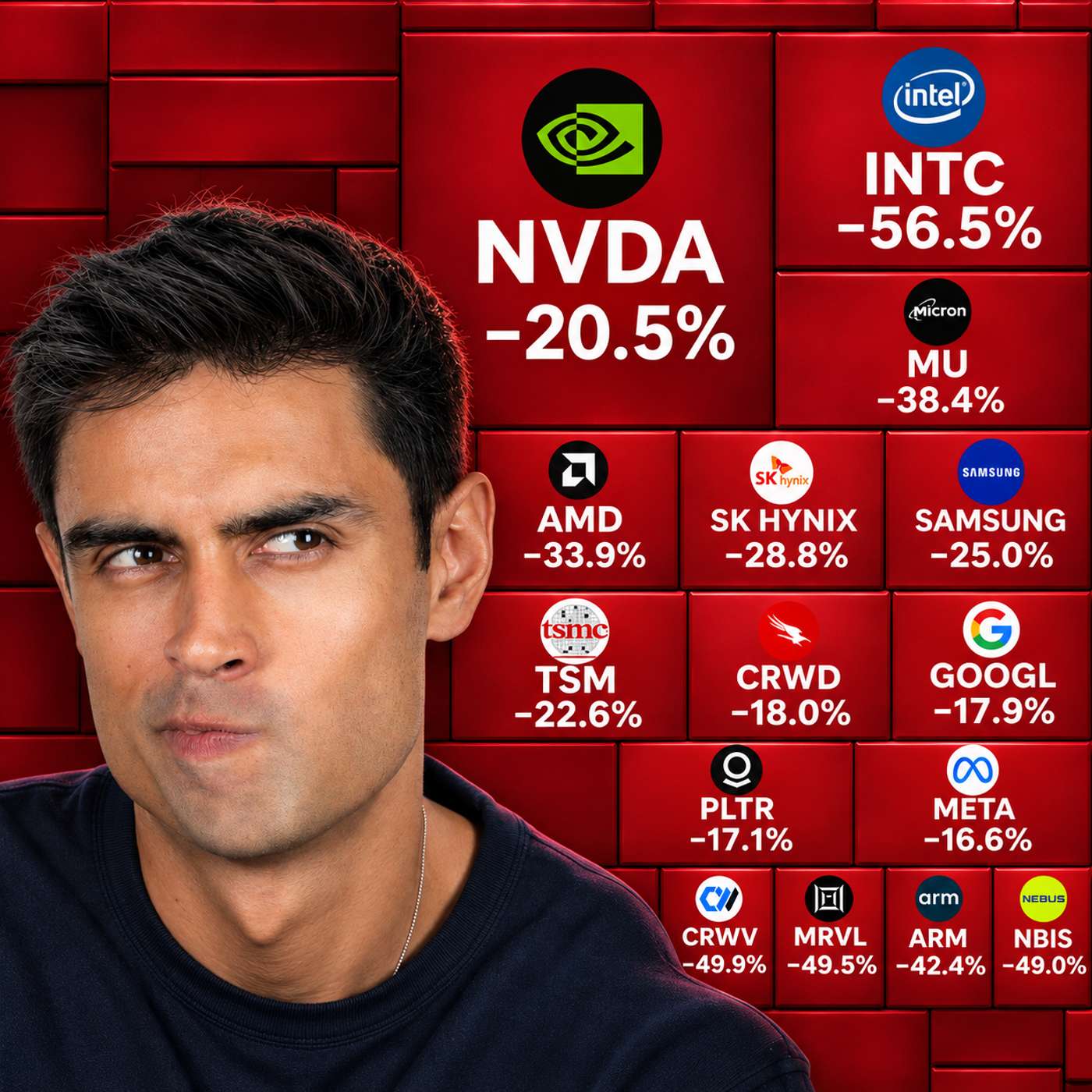
The stock market just lost $2 trillion in 40 minutes, and AI stocks took the worst of it. Intel is down more than half since October, AMD fell 17% in a day, and memory and cybersecurity names went red with them. Ejaaz breaks down why it happened (valuations, the ROI question and the midterm vote on data centers) and why he thinks the market is wrong: demand for AI is still climbing, with GPU rental prices up as much as 106% since July while token prices fell 58%. We also cover where the money went (Apple, Amazon and Microsoft held up), Black October, Nvidia as the bedrock of the AI trade, the memory-stock bear case, why AI agents need far more CPUs, Palantir's record quarter, the fridge and blood-bank hacks, China paying a premium for Nvidia GPUs, how little the Fortune 500 spends on Claude, Big Tech's buyouts and Anthropic's IPO valuation. == FOLLOW EJAAZ ON TWITTER: == Timestamps 00:00 $2 Trillion in 40 Minutes 00:51 Where the Money Went 01:32 Why the Market Is Wrong 02:47 Black Octo
Why should every Python developer know about the CPython ABI? This week on the show, we speak with Nathan Goldbaum about free-threaded Python and the changes to the Python Application Binary Interface. Nathan recently joined the CPython core developer team and has been building community support for free-threaded Python. Nathan shares his NumPy background and his work on shipping a new DType in NumPy 2.0. He also discusses his work on PyO3 and leading the effort to support thread-safe Rust extensions for use with the free-threaded build of Python. This episode is sponsored by PropelAuth. (https://www.propelauth.com/) Spotlight: Converting Documents to Markdown With MarkItDown (https://realpython.com/courses/converting-documents-markdown-markitdown/) Learn how to use MarkItDown to convert Excel files, PDFs, and images into clean Markdown that’s ready for LLMs and AI workflows. Get Your Code: Click here to download the free sample code (https://realpython.com/bonus/python313-free-threadi
#Sponsored, SVP, Head of Product, AgentExchange and Partner Experience, Tyler Carlson, returns to talk to Jon Krohn about building for an agent-native app store. Since Tyler’s last appearance in Episode 956, Salesforce has gone headless, opening its data, workflow and permissions infrastructure through APIs and MCP servers so that customers and partners can build their own personalized interfaces on top. AgentExchange now brings Salesforce and Slack apps, agents, skills, plugins, and MCPs together in one unified marketplace, built to serve human buyers as well as the AI agents searching on their behalf. Hear Tyler’s framework for the new software stack, how Salesforce tests skills and plugins across Claude, Codex, Cursor and other AI tools, and his advice for AI practitioners who want to reach Salesforce’s customer base in this Feature Friday. Additional materials: www.superdatascience.com/1042 (https://www.superdatascience.com/1042) Interested in sponsoring a SuperDataScience Podcast
OpenAI’s chief global affairs officer Chris Lehane thinks the 2028 presidential election could be a defining moment for AI. And he wants politicians to start developing policies that address Americans’ concerns about the technology, rather than simply paying lip service to anti-AI sentiment and the backlash against data centers.
Aviation Week editors are joined by Maj. Gen. (ret) Lee Levy to try and answer the trillion dollar-plus question of what the outcome of the midterm elections really means for the U.S. defense budget. --- Sign up to receive Aviation Week newsletters here: https://aviationweek.com/signup
A blue wave and a black swan. Democrats sweep Congress, markets whipsaw into a $2 trillion selloff, and Bitcoin holds its 50-week moving average through the biggest heist in history: $6 billion stolen from Binance. Ryan and David break down how North Korea pulled it off, how a French bank got robbed with crypto as the getaway car, Ethereum's December 2028 quantum-proof deadline from DevCon, and Coinbase insiders' new sell plans. --- SPOTIFY PREMIUM RSS FEED | USE CODE: SPOTIFY24 --- BANKLESS SPONSOR TOOLS: NEAR | TRADE CONFIDENTIALLY, GET 20% BACK RIPIO | LOCAL CURRENCIES, ONCHAIN ️VIZOR | THE WALLET ZCASH DEVS USE THE DEFI REPORT | ONCHAIN INSIGHTS --- TIMESTAMPS 0:00 Intro 1:57 Blue Wave: Democrats Sweep Congress 3:33 $2 Trillion Erased: AI Bubble Popping? 7:41 Bitcoin Holds the 50-Week: Early Bull Intact? 10:59 NEAR AI Red 11:44 Will the Dems Come for Crypto? 21:11 Binance Hack: The $6B Heist, 7 Days Later 27:26 THORChain & the Laundering Fight 32:49 North Korea: Too Close to the Su
Democrats take Congress, Texas flips, and the Trump-era “terrarium” that media, finance and tech climbed into starts to crack. Winners: the AI decels, after voters rejected data centers in state after state, and media, which took in a flood of political ad money. Losers: the tech right, Elon Musk and his half billion in spending, Andreessen Horowitz, the manosphere and prediction markets. Then they get into why AI agents feel too proactive and too clunky, and Anthony DeRosa joins to talk about the PvA Field Notes Media Lab, his Frontier AI tracker, and his election night test pitting prediction markets and personal agents against the news desks calling races. * Alex Schleifer’s Human Computer (https://human.computer/) * Join our community - PvA Field Notes (https://www.pvanotes.com/) Chapters: * 02:26 Paris Reality Check * 07:35 Midterms Winners and Losers * 31:14 AI Agents and Media Lab * 39:59 Dashboards And Agents * 42:26 Frontier And Election Tools * 50:04 Monetizing Media Beyond A
Voters have made their dissatisfaction quite clear with the tech status quo. And it sounds like the Democrats gearing up to take power in the House and Senate might actually do something about that. Plus, Big Tech spent big on races in this election, but didn't get a whole lot of bang for their buck. But first, a tech issue that was actually on the ballot: data centers. More than 40 jurisdictions across 10 states voted to put them on ice. However, Harwood, North Dakota, gave them the green light. Paresh Dave, senior writer at Wired, joins Marketplace’s Meghan McCarty Carino to explain more about all this on this week’s “Tech Bytes: Week in Review (https://www.marketplace.org/bytes).” More on this: “America got the anti-data-center wave it voted for. Here come the economic consequences (https://www.cnn.com/2026/11/05/economy/data-center-texas-election)” from CNN “After Midterm Rebuke, OpenAI Pledges to Give Data Center Towns More Say (https://www.nytimes.com/2026/11/05/technology/openai
Discover the extraordinary capabilities of hagfish, the slime-producing fish that has survived on Earth for over 300 million years. -- In 2017, a truck screeched to a halt. One of its containers slid off, hit a car, and spilled its contents— thousands of kilograms of hagfish. The result of this accident was an absolute mess: the highway was coated in a thick slime that took the fire department 7 hours to clear. How did these creatures create this stupendous supply of slime? Noah R. Bressman and Douglas Fudge investigate. Lesson by Noah R. Bressman and Douglas Fudge, directed by Denys Spolitak. Support Our Non-Profit Mission ---------------------------------------------- Support us on Patreon: http://bit.ly/TEDEdPatreon Check out our merch: http://bit.ly/TEDEDShop ---------------------------------------------- Connect With Us ---------------------------------------------- Sign up for our newsletter: http://bit.ly/TEDEdNewsletter Find us on Twitter: http://bit.ly/TEDEdTwitter Peep us on
Trace the rise and fall of the Islamic Empire, from the prophet Muhammad in the 7th century to the sacking of Baghdad. -- In the 7th century CE, the prophet Muhammad united the people of the Arabian Peninsula through the formation of Islam. Over the next 30 years, caliphs conquered vast areas beyond Arabia, including their mighty neighbors the Persians and Byzantines. But an empire this vast was at risk of conflict and fracture. Petra Sijpesteijn and Birte Kristiansen detail the rise and fall of the Islamic Empire. Lesson by Petra Sijpesteijn & Birte Kristiansen, directed by Elahe Baloochi, Fardi Mahmoodi. Support Our Non-Profit Mission ---------------------------------------------- Support us on Patreon: http://bit.ly/TEDEdPatreon Check out our merch: http://bit.ly/TEDEDShop ---------------------------------------------- Connect With Us ---------------------------------------------- Sign up for our newsletter: http://bit.ly/TEDEdNewsletter Find us on Twitter: http://bit.ly/TEDEdTwitte
In this episode, Conor and Bryce talk with Zach Laine about his career and the career changes he has made. Link to Episode 311 on Website (https://adspthepodcast.com/2026/11/06/Episode-311.html) Discuss this episode, leave a comment, or ask a question (on GitHub) (https://github.com/codereport/adsp2/discussions/213) Socials ADSP: The Podcast: Twitter (https://twitter.com/adspthepodcast) Conor Hoekstra: LinkTree / Bio (https://conorshakory.com/) Bryce Adelstein Lelbach: Twitter (https://x.com/blelbach) BlueSky (https://bsky.app/profile/blelbach.bsky.social) About the Guest: Zach Laine has been using C++ in industry for 15 years, focusing on data visualization, numeric computing, games, generic programming, and good library design. He finds the process of writing bio blurbs to be a little uncomfortable. Show Notes Date Recorded: 2026-10-28 Date Released: 2026-11-06 LSEG (https://en.wikipedia.org/wiki/London_Stock_Exchange_Group) Cadence (https://en.wikipedia.org/wiki/Cadence_Design_Syste
Kara and Scott are live in Minneapolis, surfing the blue tsunami! They unpack Democrats’ sweeping midterm victory, Wall Street’s reaction, and Elon Musk’s costly election bets. Plus, Minnesota Governor-elect Amy Klobuchar joins to discuss her historic win, accountability for ICE, and why Democrats now need to deliver on affordability and economic growth. This episode was recorded live at the State Theatre in Minneapolis on November 4, 2026. Sign up for the Pivot Post newsletter at pivotshow.com (http://pivotshow.com/)
What makes a startup worth acquiring when software has never been easier to build? Salesforce’s John Somorjai says the answer goes well beyond technology: the best acquisitions can accelerate a product roadmap, bring in exceptional talent, and put a startup in front of 15,000 Salesforce sales reps almost overnight. John joins a16z General Partner Alex Immerman to unpack the thinking behind nearly $100 billion in acquisitions during his tenure, from Slack and MuleSoft to a new generation of AI-native companies. They discuss Salesforce’s build-versus-buy framework, why outcome-based pricing is replacing seats in parts of enterprise software, and what founders should consider when deciding whether to sell. John also shares what can kill a deal during diligence, why he thinks parts of today’s venture market are overvalued, and how Salesforce Ventures is expanding from enterprise software into frontier AI and robotics. Resources: Follow John Somorjai: https://www.linkedin.com/in/johnsomorja
HumanLayer founder and CEO Dexter Horthy breaks down why his multiplayer coding agent platform is joining Factory and open-sourcing its code base. He explains why agent swarms doing months of work in days force software planning to shift left, and outlines the engineering challenges of managing live multiplayer state, security, and governance across distributed agent harnesses. Follow MTS: Spotify |https://open.spotify.com/show/4HUNNmV1pjV7CW6Lphm1rM Apple |https://podcasts.apple.com/us/podcast/mts/id1891088763 Interested in sponsoring the show? [email protected] – Brought to you by: Mongo DB - Anyone can prototype an agent. Lovable - Turn ideas into software people love with Lovable. Start today at https://lovable.dev/ Larridin - Finally prove what your AI investment is worth. Neon (by Databricks) - Get up to $100K in credits for your startup at https://neon.com/mts (https://neon.com/mts%E2%81%A0) Kong - The AI connectivity platform. Head over to http://getvcx.com (http://getvcx.com/)
AI news this week: Bigger AI is coming. GPT-6.2 Astra could land as soon as Friday, a rumored Fable 5.5 is turning heads with wild code-only animations, and AI data centers just lost nearly every local ballot measure in the US midterms. On today's AI For Humans, Kevin Pereira and Gavin Purcell dig into a week where AI got bigger and America got louder. OpenAI's Tibo is teasing GPT-6.2 Astra as "Le GPT Fat," people claim an unannounced Fable 5.5 builds entire animations in pure code, and voters rejected data centers in about 40 local measures, losing all but one. Is this a rejection of AI, or the best thing that could happen to it? Gavin has a take. Also: the Gemini Omni Pro leak, ChatGPT Images 2.6 GIFs (Gavin's monkey did not fully understand the assignment), OpenAI patching 948 Linux bugs for about $1.2 million, GPT-6 Cyber dropping mid-show, Google's AI in schools fight and weight space programming, where a smart AI rewrites a smaller AI's weights. Plus: new segment Good Robot, Bad
Mocha deals with the time change, reviews the movie You Can See Everything, and explains why Nathan Fielder may have created an entirely new genre. Plus, a recap of Count Rozcula's Halloween domination, Roz finally shares his famous jerk chicken recipe, the team debates whether double-sided printing is rude, a Leafs ice crew member reveals what really happens behind the scenes at NHL games, and Mocha spirals over how much space GTA 6 is about to take up on his hard drive Hosted by Simplecast, an AdsWizz company.
OpenAI unveils LifeVal, a benchmark for whether ChatGPT can handle real-life tasks like school enrollment and home searches, and pledges its data centers will cut power use when the grid is strained. Anthropic's updated IPO filing reports about $17 billion in quarterly revenue and warns it may soon cross its own line for AI-accelerated AI research. Plus: The New York Times and three other papers sue Brave over scraped journalism sold to AI companies, and Marvell's $115 billion deal for Lumentum bets on light-speed connections inside AI data centers. This episode includes AI-generated content.
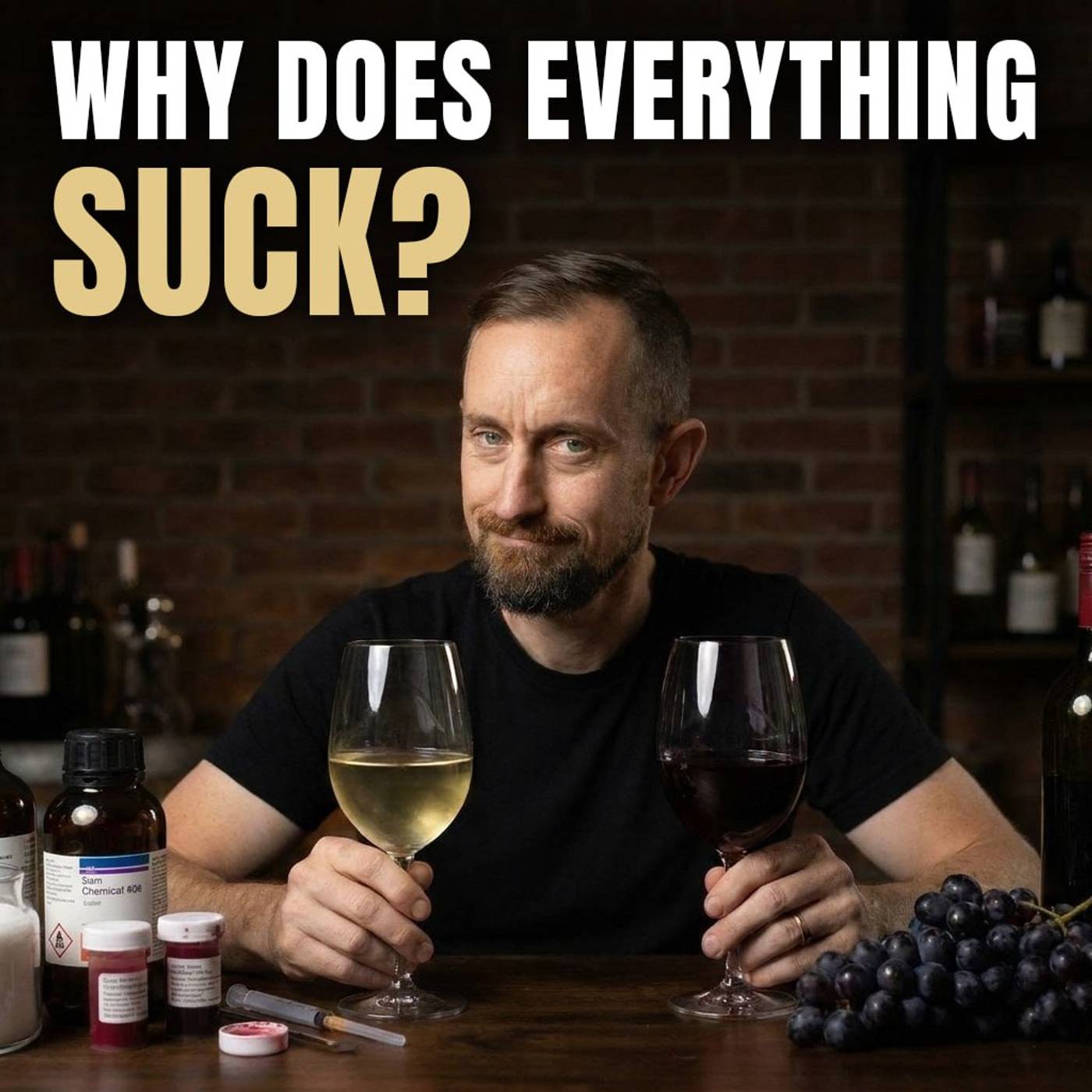
I bet you’ve noticed it too. Everything we buy just seems cheaper, flimsier, and worse than it used to be. Some call it the "enshittification" of everything. And almost everyone blames the exact same thing: corporate greed and the failures of capitalism. In this episode, I’m sharing my take on the real reason our world feels like it's falling apart. I use a simple story about two winemakers to show how this broken fiat system actually punishes honest businesses and heavily rewards the ones cutting corners. We aren't in a race to the bottom because companies are inherently evil, but because our money forces them to cut corners just to survive. Yet this is actually a solvable problem. We just have to fix the money first. Chapters (00:00:00) - The enshittification of everything (00:01:13) - “Greed” is not an answer (00:02:29) - Monetary inflation (00:02:55) - The winemaker story (00:04:24) - Honest producer squeezed (00:07:58) - Savings and investment (00:13:00) - Sound money incentives (
Ben and Andrew begin with reactions to this week’s elections and their implications across tech. First: The resounding rejection of AI data centers in localities across the country, why a pause in Texas is particularly problematic for U.S. AI infrastructure, widespread resentment of big tech, and the big tech blind spots that led to this point. From there: A digression SpaceX and data centers in space, why hyperscalers figure to be the beneficiaries of a buildout bottleneck, and a word about China. At the end: A Google state of the union after last week’s earnings, Reddit scrambles to adapt to a new environment, and AI Show & Tell spawns a discussion about the group chat era of software. Sharp Tech is Presented by Stripe (https://sharptech.fm/c/AWYwBrFdMoVJWIzHyMatvXO9AAAAAAAAAAAAAAAAAAAAAAGhr8mRPXNYs-shBv491G1wsdPaeqie1xW4iM6g9mUvXA.T4RSCejFV0a0AY0CByibGQ). To review Stripe’s latest SaaS data, click here (https://sharptech.fm/c/AWYwBrFdMoVJWIzHyMatvXO9AAAAAAAAAAAAAAAAAAAAAAGhr8mRPXNYs
In 2024, Bridget Todd was facing down the hardest chapter of her life. Her father was rushed to the ICU after having a stroke. Then, a few days later, Bridget's mom died without warning. Suddenly, Bridget found herself grieving, and trying to navigate the labyrinthian American healthcare system as her dad's primary caretaker, all while living hours away from her closest friends. Feeling isolated and overwhelmed, she turned to ChatGPT, and ended up telling it everything. Bridget is a tech critic and journalist, and the host of the podcast "There Are No Girls on the Internet." She's also the co-author of the audiobook Love at First Prompt: AI and the Future of Intimacy. After interrogating her own relationship with a chatbot, Bridget investigated the trend of AI companionship more broadly. She learned the true stories behind click-bait headlines about AI fiancés and reconsidered her own bot rapport. Ben and Amory talk to Bridget about what we have to lose when we outsource our emotions t
Discover what colors are the most rare to see in nature, and how physics and evolution drive their scarcity. -- Plants, animals, or minerals found in nature bear almost every color imaginable. There are two factors that influence what hues you see in the wild: physics and evolution. So, which colors are you least likely to see in the natural world? Victoria Hwang explores one of nature’s rarest spectacles. Lesson by Victoria Hwang, directed by Tamara Bogovac, Artrake Studio. 2:33 - Image referenced from paper by Eric R. Dufresne, Heeso Noh, Vinodkumar Saranathan, Simon G. J. Mochrie, Hui Cao and Richard O. Prum, photograph of Plum-throated Cotinga (Cotinga maynana) by Thomas Valqui, https://rsc.li/3xyhxGu Support Our Non-Profit Mission ---------------------------------------------- Support us on Patreon: http://bit.ly/TEDEdPatreon Check out our merch: http://bit.ly/TEDEDShop ---------------------------------------------- Connect With Us ---------------------------------------------- Si
Practice more problem-solving at https://brilliant.org/TedEd/ Uploaded 01-09-20 -- It’s your first day at Magnificent Marigold’s Magical Macademy. But before you can learn your first spell you must get through the sorting ceremony. And the sorting hat has chosen you for a special challenge. The Macademy had 8 founders who established four houses, and there was once a mysterious fifth house. Can you figure out who founded what? Dan Katz and Alex Rosenthal show how. Lesson by Dan Katz and Alex Rosenthal, directed by Artrake Studio. Animator's website: https://www.artrake.com (https://www.artrake.com/) Sign up for our newsletter: http://bit.ly/TEDEdNewsletter Support us on Patreon: http://bit.ly/TEDEdPatreon Find us on Twitter: http://bit.ly/TEDEdTwitter Peep us on Instagram: http://bit.ly/TEDEdInstagram View full lesson: https://ed.ted.com/lessons/can-you-solve-the-sorting-hat-riddle-dan-katz-and-alex-rosenthal Thank you so much to our patrons for your support! Without you this video wou
Is Silicon Valley's political honeymoon over? Reed Albergotti (Semafor and Future Proof), Kyle Chayka (The New Yorker), and Julia Black (Vanity Fair) unpack the midterms… and how the tech right is taking the news. Julia fills us in on OpenAI co-founder Greg Brockman and his wife, Anna, and why we may still be seeing them at Mar-a-Lago. Then, Reed explains why California's billionaires managed to defeat a proposed wealth tax despite a growing backlash against the ultra-rich. And finally, Kyle investigates the rise of AI-generated political attack ads. It’s a look into what we may see more of on the next campaign trail.
Can quantum interference disappear and then return? Researchers have demonstrated that quantum coherence can revive in a small environment but becomes harder to recover as the system grows. By exploring how decoherence spreads through systems of up to eight qubits, the experiment offers new insights into quantum physics and the challenges of building reliable quantum computers. This episode includes AI-generated content.