1043: AI-Powered Precision Nutrition, with Viome’s Dr. Guru Banavar
74 min
Listen through the publisher, then discuss the episode here or arrange an in-person Roundtable. Your city determines where to meet.
Roundtables are designed for groups of four, with a shared subject and room for everyone to speak. Come for discussion, with no dating expectation.
In Episode #1043, Dr. Guru Banavar (Founding CTO of Viome) joins Jon Krohn for a technical masterclass on the biology inside your gut. Viome has assembled what Guru calls the largest dataset on human biology ever collected, roughly 100 quadrillion nucleotides of RNA from people in more than 150 countries, and uses it to tell individuals which foods help them and which harm them. Before Viome, Guru was the first VP to lead IBM's Watson AI team, and he holds a PhD in computer science from the University of Utah. In this episode, he explains why RNA rather than DNA holds the key to chronic disease, how a continuous-glucose study of 1,100 people became a predictive model for your blood sugar, why keto dieters come out biologically older than vegetarians, and what makes computational biology such a rare skill. Additional materials: www.superdatascience.com/1043 (https://www.superdatascience.com/1043) Interested in sponsoring a SuperDataScience Podcast episode? In this episode you will learn: (00:09:02) Why RNA rather than DNA (00:21:24) The tug-of-war inside your gut (00:31:15) Predicting which foods spike your blood sugar (00:35:22) Biological age, keto diets and vegetarians (00:55:33) What it takes to be a computational biologist
Episode information is provided by the publisher. Listening takes place on the publisher’s service.
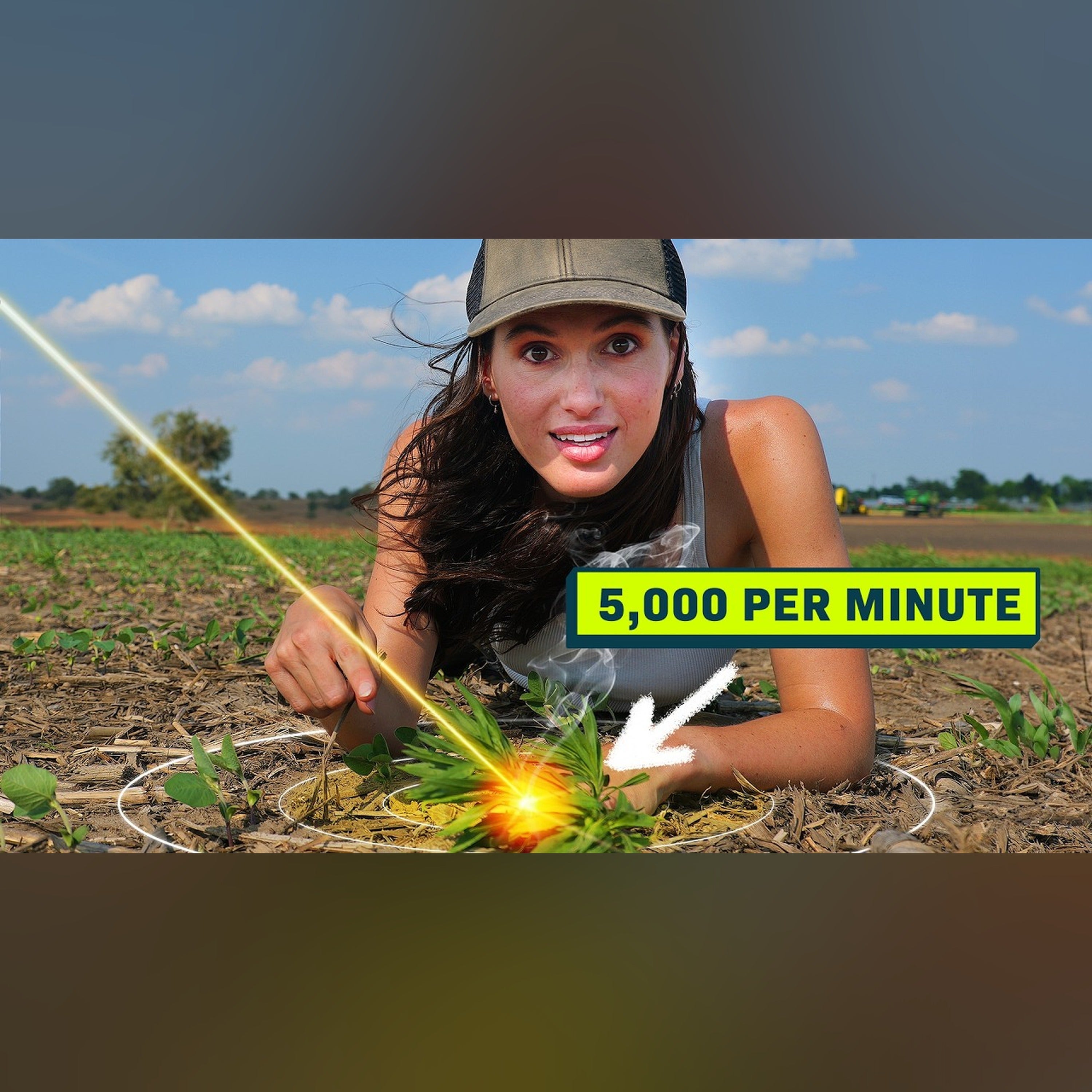
Growing food doesn’t look like I thought… Learn more about Dropbox for teams: https://www.dropbox.com/cleo Thanks Dropbox for sponsoring this video! Right now, we’re living through one of the most pivotal moments in food history… and most people have no idea it’s happening. Experts are calling the “Fourth Agricultural Revolution” and it’s here because we’re facing a big problem: The world’s population is rising, so experts say we’ll need to increase food output to catch up with our current population and feed those new people. But we’ve got to do it in ways that actually protect the Earth long term. Right now, farmers are in a fight to feed the world. So let me show you some of the coolest machines they’re using to do it… Chapters: 0:00 What’s the fourth agricultural revolution? 01:15 Why do we need more food? 1:54 Where does farming tech get tested? 3:00 What were the first 3 agricultural revolutions? 3:58 How do we feed billions more people… better? 4:31 How do farmers grow more food
Explore what makes polio so dangerous, what is causing the 21st century resurgence of cases, and how we can eradicate the disease. -- In 1952, polio was everywhere: killing or paralyzing roughly half a million people annually. Yet just 10 years later, paralytic polio cases in the US dropped by 96% and we were on track to get rid of polio for good. But in recent years, the virus started striking back. So, what’s behind these recent spikes? Explore the dangers of poliovirus and the possibility of eradicating this deadly disease. Directed by Anton Bogaty. This video made possible in collaboration with Gates Ventures Learn more about how TED-Ed partnerships work: https://bit.ly/TEDEdPartner A special thanks to Ananda Bandyopadhyay, Amber Zeddies, and Kathleen O'Reilly who provided information and insights for the development of this video. Support Our Non-Profit Mission ---------------------------------------------- Support us on Patreon: http://bit.ly/TEDEdPatreon Check out our merch: htt
Check Out Rogue History On PBS Origins: https://youtu.be/xuT35ud41QQ PBS Member Stations rely on viewers like you. To support your local station, go to:http://to.pbs.org/DonateSPACE Sign Up on Patreon to get access to the Space Time Discord! The Standard Model of particle physics is arguably the most successful theory in the history of physics. It predicts the results of experiments with a numerical precision unmatched by any other branch of science, and it does so almost unfailingly. The theory is encapsulated in a single equation known as the Standard Model Lagrangian. Today we’re going to explain to you how it works! Want to Dive Deeper into the Standard Model Lagrangian? Check out: Check out the Space Time Merch Store Search the Entire Space Time Library Here: https://search.pbsspacetime.com/ Hosted by Matt O'Dowd Written by Fernando Franco Felix & Matt O'Dowd Post Production by Leonardo Scholzer, Yago Ballarini, Pedro Osinski, Caique Oliveira, Adriano Leal & Stephanie Faria Direct
Superhuman CEO Shishir Mehrotra joins MTS to discuss the company’s new agent platform, Superhuman Go, and how embedding AI directly into existing workspaces solves the “last mile” problem of enterprise adoption. He also breaks down Grammarly’s custom model infrastructure, the challenge of measuring human-agent productivity, and his prediction for a massive surge in AI inference over the next year. -- MTS chronicles the singularity, live. Monitoring the situation of tech and AI. Follow MTS: Spotify |https://open.spotify.com/show/4HUNNmV1pjV7CW6Lphm1rM Apple |https://podcasts.apple.com/us/podcast/mts/id1891088763 – Brought to you by: Mongo DB - Anyone can prototype an agent. Lovable - Turn ideas into software people love with Lovable. Start today at https://lovable.dev/ Factory - A 24/7 system turning signals into production software. Visithttps://factory.com/ Neon (by Databricks) - Scale your startup on Neon. The Postgres backend for apps and agents. Built by Databricks.https://neon.com
Project Synapse: Markets in Freefall, Fragile Infrastructure, and AI's Perfect Storm The hosts banter through the show's intro before focusing on a sense that "things are out of control," citing a WallStreetBets suicide-hotline post amid a market crash and discussing cascading system failures involving Microsoft, the FAA, and a reported NSA internal communications outage. They argue politicians and leadership lack technical competence and clear messaging, increasing panic, while emphasizing that many problems stem from aging, underfunded infrastructure and complex, brittle software (PHP, NGINX, Java), not proven AI attacks—more a "perfect storm" of crises. They debate whether AI should help fix complexity, stressing critical thinking, accountability, and using multiple AIs to verify each other. In a lightning round they cover Anthropic's IPO performance, mixed reactions and token limits with ChatGPT 6.2 (favoring "Sol" over "Astra"), Google's cheaper Neon model and confusing UX, Loblaw
One evening, a mother was putting her three-year-old son to bed, just as she'd done countless times before. She read him a story, rubbed his back, and waited for him to fall asleep. But for no apparent reason, she suddenly became overwhelmed by sadness. The feeling was so intense that she began to cry. Later that night, she woke to the unmistakable sounds of someone playing with her son's favorite building blocks. When she went to investigate, she found him sound asleep and his toys put away. But something in the room wasn't quite as she'd left it. Over the following nights, that same unexplained sadness returned. It wasn't until she thought about the time of year, and a heartbreaking loss she'd experienced a decade earlier, that she began to wonder whether these strange occurrences might be connected. Could someone she'd lost have found a way to visit? #RealGhostStoriesOnline #TrueGhostStories #SpiritVisitations #AfterDeathCommunication #SignsFromBeyond #ChildSpirit #ParanormalEncount
In Episode #1045, Ben Hein (CEO of the Electronics business at Merck KGaA, Darmstadt, Germany) joins Jon Krohn to explain how the chips behind the AI boom are actually made. His company is 358 years old, began as a pharmacy, and now supplies materials, systems and services across all six steps of semiconductor fabrication, a process of more than 1,500 steps that can take six months for a single chip. Ben succeeded Kai Beckman, who appeared on this show in Episode #875 and he has spent time in Taiwan and Boston on the way to the role. In this episode, he explains why performance per watt is the industry’s single biggest problem, why five decades of shrinking has given way to building upward, how AI-driven simulation lifted his R&D hit rate more than fivefold, and why he expects affordable high-quality healthcare in our lifetimes. Additional materials: www.superdatascience.com/1045 (https://www.superdatascience.com/1045) Interested in sponsoring a SuperDataScience Podcast episode? In thi
In this month's episode of ICYMI, Jon Krohn moves from the fears that surround AI to the work it makes possible when we use it well. Hear from Richard Socher, Carly Taylor, Jeff Hancock, Kate Niederhoffer and John Renne, discussing why the founder of a company built to create recursively self-improving superintelligence is not afraid of the idea, how inviting your fears to tea helps you keep growing, why AI-generated “workslop” that is harmless fun on social media becomes infuriating at work and how two hours of AI-assisted research can now do the work of a half-million-dollar grant. Additional materials: www.superdatascience.com/1044 (https://www.superdatascience.com/1044) Interested in sponsoring a SuperDataScience Podcast episode? In this episode you will learn: (00:20) Recursive Self-Improvement: The Eureka Machine (08:21) Workslop, Glass Cliffs and Inviting Your Fears to Tea (14:49) Workslop: The Hidden Cost of AI-Generated Work (21:58) AI for Real Estate, Walkable Cities and Clim
#Sponsored, SVP, Head of Product, AgentExchange and Partner Experience, Tyler Carlson, returns to talk to Jon Krohn about building for an agent-native app store. Since Tyler’s last appearance in Episode 956, Salesforce has gone headless, opening its data, workflow and permissions infrastructure through APIs and MCP servers so that customers and partners can build their own personalized interfaces on top. AgentExchange now brings Salesforce and Slack apps, agents, skills, plugins, and MCPs together in one unified marketplace, built to serve human buyers as well as the AI agents searching on their behalf. Hear Tyler’s framework for the new software stack, how Salesforce tests skills and plugins across Claude, Codex, Cursor and other AI tools, and his advice for AI practitioners who want to reach Salesforce’s customer base in this Feature Friday. Additional materials: www.superdatascience.com/1042 (https://www.superdatascience.com/1042) Interested in sponsoring a SuperDataScience Podcast
An athlete's recovery should take priority over pressure to return for an important game.
Share your view, then see how readers voted. No sign-in required. This poll is shared across stories.
Do you agree or disagree?
Common Quandary
A Common Quandary to discuss
Another conversation to explore, separate from this news story.
The night before the wedding, your friend admits serious doubts. Do you tell their partner?
On the night before a wedding, your closest friend says they are unsure they should marry but insists it is ordinary panic. They make you promise secrecy and plan to proceed. Their partner asks you directly whether everything is okay.
When does loyalty require breaking a confidence before an irreversible choice?