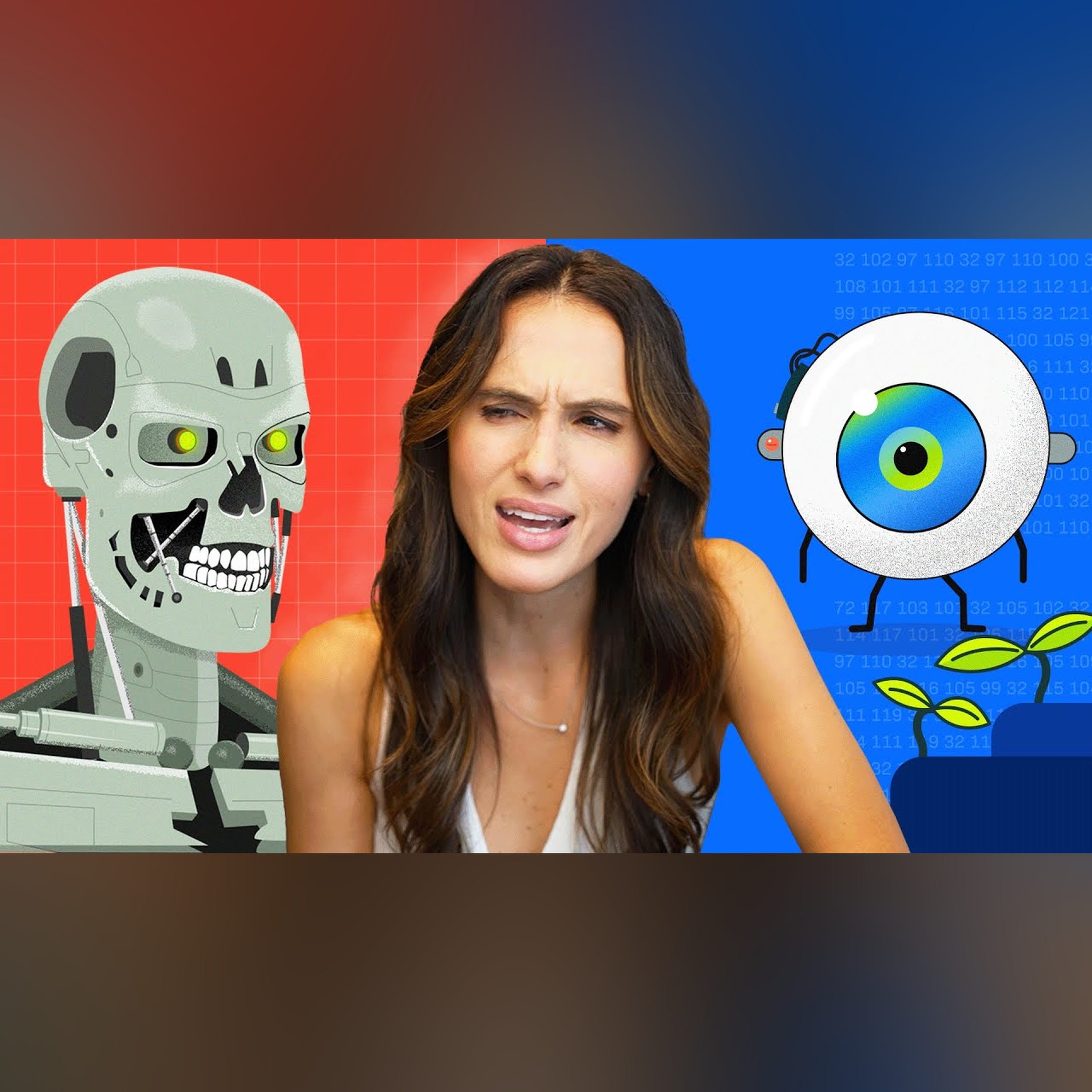
AI is here. Now what? Everyone’s talking about artificial intelligence and machine learning. There are lots of names thrown around - OpenAI’s ChatGPT and DALLE-2, Google’s Bard, Meta’s LLaMa 2, Midjourney, AlphaFold… Right now, we’re in this weird moment where lots of smart people agree we’re on the cusp of a truly world-changing technology. But some seem to be saying it's going to lead to human extinction while others are saying it’s “more profound than fire.” But it all feels so VAGUE. I want to know: How specifically would AI kill me? Or totally transform my life for the better? In this video, that’s what I’m going to try to learn. We dive into what the most extreme bad and good AI futures actually look like, so that you and I can get ready. And more importantly, so we can make sure that we get our real future RIGHT. Chapters: 00:00 Why is AI so confusing? 1:13 What is AI? 2:37 Why is everyone talking about AI now? 5:12 Why is AI dangerous? 6:22 How would AI kill me? 8:08 Should we
Former OpenAI Chief Futurist Joshua Achiam joins Theo and Sofia to discuss Anthropic researcher Levent Alpöge’s AI breakthrough on the Riemann hypothesis and what it signals for math, physics, and superintelligence timelines. He also weighs in on the new Trump-Xi AI guardrails deal, the threat of AI-driven rolling internet outages, and why overly aggressive US chip export controls on China could backfire. Check out our sponsor Lovable: https://lovable.dev (https://lovable.dev/). Turn ideas into software people love. --https://x.com/jachiam0-- MTS chronicles the singularity, live. Monitoring the situation of tech and AI. Follow MTS: Spotify |https://open.spotify.com/show/4HUNNmV1pjV7CW6Lphm1rM Apple |https://podcasts.apple.com/us/podcast/mts/id1891088763 – Brought to you by: Mongo DB - Anyone can prototype an agent. Lovable - Turn ideas into software people love with Lovable. Start today at https://lovable.dev/ Factory - A 24/7 system turning signals into production software. Visithttps
How can you make your voice heard in a noisy world? The key is public speaking and presentation literacy, and we can help: http://bit.ly/TMCPSApp Uploaded 14-01-21 -- Storytelling is an ancient art; as humans developed language and culture, we learned to share our stories, thoughts, and dreams. And that storytelling evolved into public speaking, and our audience— thanks to the internet— is the whole world, not just a campfire. So how can we make our voices heard in such a busy space? Chris Anderson digs into why presentation literacy is the skill of the future. Lesson by Chris Anderson, directed by Avi Ofer. Support Our Non-Profit Mission ---------------------------------------------- Support us on Patreon: http://bit.ly/TEDEdPatreon Check out our merch: http://bit.ly/TEDEDShop ---------------------------------------------- Connect With Us ---------------------------------------------- Sign up for our newsletter: http://bit.ly/TEDEdNewsletter Find us on Twitter: http://bit.ly/TEDEdTwit
Project Synapse: Markets in Freefall, Fragile Infrastructure, and AI's Perfect Storm The hosts banter through the show's intro before focusing on a sense that "things are out of control," citing a WallStreetBets suicide-hotline post amid a market crash and discussing cascading system failures involving Microsoft, the FAA, and a reported NSA internal communications outage. They argue politicians and leadership lack technical competence and clear messaging, increasing panic, while emphasizing that many problems stem from aging, underfunded infrastructure and complex, brittle software (PHP, NGINX, Java), not proven AI attacks—more a "perfect storm" of crises. They debate whether AI should help fix complexity, stressing critical thinking, accountability, and using multiple AIs to verify each other. In a lightning round they cover Anthropic's IPO performance, mixed reactions and token limits with ChatGPT 6.2 (favoring "Sol" over "Astra"), Google's cheaper Neon model and confusing UX, Loblaw
Zvi does the reading on OpenAI’s system card for GPT-6.2 Astra and Sol: the first externally deployed model to meet OpenAI’s High threshold for AI self-improvement, already at Critical for cybersecurity. He works through the preparedness results, the safeguards against misuse, distillation and model escape, and the alignment and monitorability findings, including rising evaluation awareness, reasoning that happens without visible chain of thought, and UK AISI’s tour of misaligned behaviours, asking what the numbers do and don’t show. This has been an Askwho Casts audio conversion. Thanks for listening. * 00:00 - Introduction * 01:10 - Table of Contents * 02:45 - Safety Overview (1) * 05:19 - Internal Deployment (1.2) * 05:32 - Preparedness Assessment (2) * 06:40 - Biological Threats (2.1.1) * 09:55 - Cyber Threats (2.1.2) * 11:36 - AI Self-Improvement Threats (2.1.3) * 14:32 - OpenAI Epoch Capabilities Index (OECI) * 16:10 - Safeguards (2.2) * 17:34 - AI Self-Improvement Threat Modelin
At a concert, most listeners hear the melody. A trained singer hears the breath control that carries a difficult phrase. At a football match, the crowd follows the ball while a coach notices the defender who quietly closes off an attack. Knowing more changes who seems extraordinary. Audiences have traditionally borrowed that knowledge from commentators, critics, and friends, whose explanations help determine which achievements receive applause and which pass unnoticed. AI could make that guidance a routine part of watching almost anything. Tools already track players’ movements, analyze musical pitch and timing, and explain technical processes. As those abilities become integrated into broadcasts and personal assistants, viewers could ask what made a particular passage difficult or why a player chose one route over another. Instead of receiving occasional commentary, someone could explore an entire performance with detailed explanations tailored to their questions. The consequential sh
Jumping off the downturn in the Australian data centre market, we talk about how susceptible this industry is to investment risk from even localized forms of community resistance and financial skepticism, even despite the sheer force of capital and ideology pushing the data center industry. We then have another entry in our analysis of the Great Degeneracy — or what happens when gambling is the only game in town. Australian data centre group falls 44% on profit warning https://www.ft.com/content/023caf76-40df-485d-8a28-0ff62aa7ec6f AI data centres are springing up in communities across the country. Now, residents are fighting back https://www.theage.com.au/national/ai-data-centres-are-springing-up-in-communities-across-the-country-now-residents-are-fighting-back-20261003-p60xhb.html Insurer Rolls Out Policy to Protect Data Centers Against Growing Backlash https://www.insurancejournal.com/news/national/2026/10/20/889680.htm How Everything Became Gambling https://www.nytimes.com/2026/10/
Officials should distinguish confirmed facts from uncertainty during developing incidents.
Share your view, then see how readers voted. No sign-in required. This poll is shared across stories.
Do you agree or disagree?
Common Quandary
A Common Quandary to discuss
Another conversation to explore, separate from this news story.
Your coworker bends a dumb rule to help people. Do you report it?
An underpaid coworker quietly bends a company rule to help colleagues receive benefits they were technically denied. No customer is harmed, but the records are inaccurate and you are asked to certify them.
Where should loyalty end when a rule seems unjust?