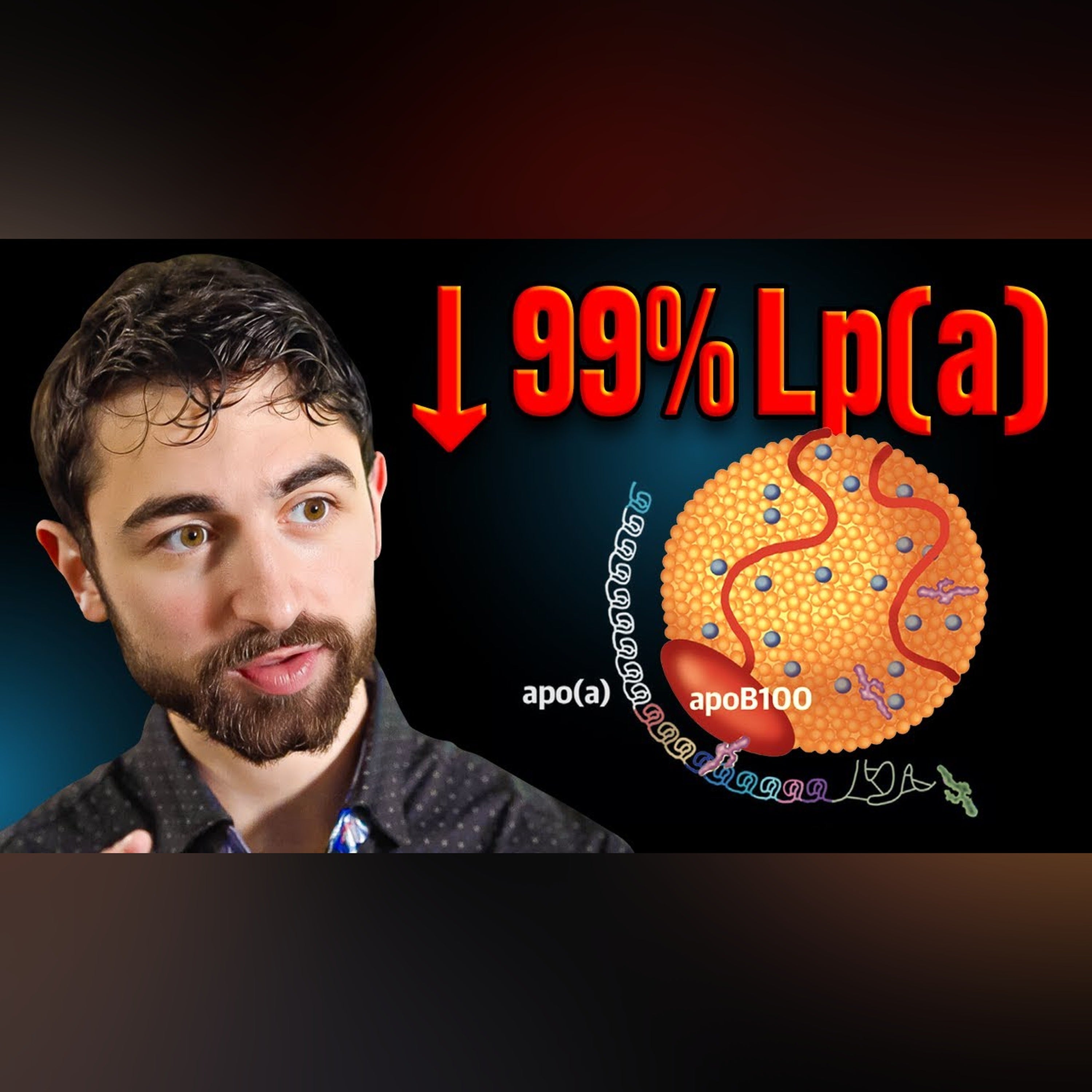
Lp(a), lipoprotein(a) is a major genetic risk factor for heart disease and one of the most talked-about topics in modern cardiology. It plays a significant role as a causal risk factor for cardiovascular disease and is thought to be largely genetically determined. What do you do if you’re genetically cursed, like me, with high Lp(a) levels? In this video, I promise on my own heart health, you'll gain a deeper understanding of Lp(a): what it is, why it’s so important for your heart and metabolic health, and what actionable steps you can take to manage your cardiovascular risk. To give you a roadmap, here’s what we’ll cover in the 8 chapters: 1. Defining Lp(a) 2. Guidelines on measuring Lp(a) and risk thresholds 3. Medications in development to reduce Lp(a) by as much as 99% 4. How to reduce cardiovascular risk 5. Why statins increase Lp(a) and what this means 6. Saturated fat can lower Lp(a) level 7. Oxidized phospholipids as the cargo of Lp(a) 8. Nuance notes for the nerds. This video
PBS Member Stations rely on viewers like you. To support your local station, go to:http://to.pbs.org/DonateSPACE Sign Up on Patreon to get access to the Space Time Discord! A fun nightmare sci-fi scenario is the sun being consumed by a black hole. Fortunately the chance of a black hole randomly wandering into our solar system is pretty tiny. That’s good news. But what if it’s already here, hiding in the core of the Sun and slowly eating it from the inside out? Hawking Stars Journal Papers: Search the Entire Space Time Library Here: https://search.pbsspacetime.com/ Hosted by Matt O'Dowd Written by Matt Caplan & Matt O'Dowd Post Production by Leonardo Scholzer, Yago Ballarini & Stephanie Faria Directed by Andrew Kornhaber Associate Producer: Bahar Gholipour Executive Producers: Eric Brown & Andrew Kornhaber Executive in Charge for PBS: Maribel Lopez Director of Programming for PBS: Gabrielle Ewing Assistant Director of Programming for PBS: John Campbell Spacetime is produced by Kornhaber
My guest today David Williams is a counselor at Jesuit College Preparatory School of Dallas, where he has spent 30 years working with adolescent boys including my own. He's also someone I've learned so much from over the years. I've shared things he's taught me in other podcast conversations, but I decided it was time to bring him on for an entire episode. Raising teenage boys comes with its own set of challenges in a world that constantly tells them to be faster, stronger, smarter, and better. In this conversation, David shares what boys are really navigating beneath the surface, why so many struggle to express emotions or ask for help, and how parents can create a home where they feel safe. We talk about breaking out of the expectations of the "act like a man box," knowing when to step in and when to give them room to grow, and how to raise boys with both high expectations and high support. We also explore the growing pressures of AI, social media, and gambling, and why our ultimate
Text me what you thought of the show (https://www.buzzsprout.com/1959372/fan_mail/new) Can working night shifts affect your fertility, ovulation or IVF success? After speaking with numerous women trying to fall pregnant while working shifts, including those undergoing expensive IVF treatment, I wanted to explore what the research actually tells us. In this episode of A Healthy Shift, we discuss how night shifts, disrupted sleep and circadian misalignment may affect reproductive health. We cover: Why the fertile window is so short. Shift work, reproductive hormones and menstrual irregularities. What research says about night shifts, fertility and IVF outcomes. The roles of sleep, stress, nutrition, weight and exercise. Practical steps for women trying to conceive while working shifts. Research links shift work with menstrual irregularities, but evidence that night shifts directly cause infertility or reduce IVF success remains uncertain. If you're trying to get pregnant while working ni
"Curing cancer," explained. We’re not looking for a “cure for cancer” anymore. Cancer is hundreds of diseases, so we’re really in a multi front fight against all of them. Cancer is a problem for us today in a way it wasn’t for previous generations. But, luckily, we also have more and more ways to fight back. I started this episode with endless questions: What is cancer? What causes it? How do we treat cancer? What are the symptoms? Why are some cancers easier to treat than others? Why is cancer so hard to cure? Why do so many people die of cancer? What I found is an incredible, complex, inspiring effort to treat and stop an insidious killer. In this video, we dive deep into how we treat cancer today. But I also found that we may not be helping the greatest number of people we can. In this episode of Huge If True, I want to make the case that while we have made enormous strides in the fight against cancer we have also largely ignored one of the single best ways to save the most lives. I
Join NCI University today to master human behavior and influence: Uploaded 05-11-21 This is a dive to discover the possibilities, not the case itself. Sirhan Sirhan, in full Sirhan Bishara Sirhan, (born March 19, 1944, Jerusalem), Palestinian-born Jordanian citizen who was convicted (1969) of fatally shooting U.S. Sen. Robert F. Kennedy on June 5, 1968. He received the death penalty, but the sentence was later commuted to life. Sirhan, a Christian Palestinian, was born in Jerusalem. In 1948 Jordan took control of East Jerusalem and what is now the West Bank, and the following year it granted citizenship to people living in those areas. It is believed that this is how Sirhan became a Jordanian citizen. In the 1950s, he and his family moved to the United States and eventually settled in Pasadena, California. There he attended Pasadena City College and later held odd jobs, notably working at a horse stable and later at a health food store. During this time, Sirhan became vocal in his oppo
Recognize immune checkpoint inhibitor (ICI) toxicities. Learn a practical head-to-toe approach to evaluating new symptoms, managing immune-related adverse events (irAEs), and deciding when it’s safe to rechallenge. Dr. Kerry Reynolds (https://www.massgeneralbrigham.org/en/doctors/r/kerry-reynolds-3003105), oncologist at Mass General Brigham Cancer Institute and director of the Severe Immunotherapy Complications Service (https://www.massgeneralbrigham.org/en/services/immunotherapy-complications) (SIC), joins The Curbsiders to discuss what every internist should know about irAEs. Claim CME for this episode at https://ce.vcuhealth.org/curbsiders! Patreon (http://patreon.com/curbsiders) | Episodes (https://thecurbsiders.com/category/curbsiders-podcast) | Subscribe (https://audioboom.com/channels/5034728.rss) | Spotify (https://open.spotify.com/show/3SKlzOLxyztvA1BkJfnf67) | YouTube (https://www.youtube.com/@thecurbsiders7326) | Newsletter (https://thecurbsiders.com/digest) | Contact | Swag
We have another classic episode for you. Confidently counsel on nutrition, as we discuss different dietary patterns and address common patient queries. We are joined by Dr. Joan Salge Blake (Boston University (https://www.bu.edu/sargent/profile/joan-salge-blake-ms-rd-ldn/)). Cut your wireless bill to 15 bucks a month at MINTMOBILE.com/curb (http://mintmobile.com/curb). Whether you’re simply curious or seriously considering a change, pop by Locumstory.com (http://locumstory.com/) to see if it’s something that makes sense for you
Public bodies should publish the evidence behind important decisions.
Share your view, then see how readers voted. No sign-in required. This poll is shared across stories.
Do you agree or disagree?
Common Quandary
A Common Quandary to discuss
Another conversation to explore, separate from this news story.
An old friend refuses to use someone's new name. Do you correct them at the reunion?
At a reunion, an old friend repeatedly uses the name a former classmate had years ago. They say shared history gives the old name affectionate meaning; the classmate has clearly introduced themselves with a different name.
When does preserving your shared past deny who someone is now?