A New Discovery Could Solve One of Quantum Computing's Biggest Problems
23 min
Listen through the publisher, then discuss the episode here or arrange an in-person Roundtable. Your city determines where to meet.
Roundtables are designed for groups of four, with a shared subject and room for everyone to speak. Come for discussion, with no dating expectation.
Researchers at TU Wien have developed a promising approach to make quantum communication far more reliable. By applying time-reversal symmetry and engineering how light travels through a waveguide, their simulations suggest that single photons could be absorbed with nearly perfect efficiency, overcoming a major limitation in qubit-to-qubit transfers. The technique could help pave the way for more efficient quantum computers and communication networks. This episode includes AI-generated content.
Episode information is provided by the publisher. Listening takes place on the publisher’s service.
Dig into Moore’s Law and explore its 4 main limitations and how they could change how we are able to make progress in computing. -- Moore’s Law states that every 1 to 2 years the number of transistors that can fit on a given size computer chip will double. Thanks to this law, chips have gotten smaller, faster, more efficient, and cheaper. But today, there are four key problems that trip up this trend, potentially ending Moore’s Law and fundamentally changing how computing progresses. Sajan Saini and George Zaidan investigate. Lesson by Sajan Saini and George Zaidan, directed by Jeff Le Bars, JetPropulsion.space. A special thanks to Anuradha Murthy Agarwal who provided information and insights for the development of this video. Artists and artworks referenced in the animation: "The Persistence of Memory and The Disintegration of the Persistence of Memory" by Salvador Dalí "Composition VIII" by Wassily Kandinsky "Oh Jeff and Girl with Tear III" by Roy Lichtenstein "Black Square on a Whit
Viewers like you help make PBS (Thank you ) . Support your local PBS Member Station here: https://to.pbs.org/DonateSPACE Uploaded 05-09-18 Thanks to CuriosityStream for supporting PBS Digital Studios. You can learn more at https://www.curiositystream.com/spacetime and use the code "spacetime" during the sign-up process. You can further support us on Patreon at https://www.patreon.com/pbsspacetime Get your own Space Time t-shirt at http://bit.ly/1QlzoBi Tweet at us! @pbsspacetime Facebook: facebook.com/pbsspacetime Email us! pbsspacetime [at] gmail [dot] com Comment on Reddit: http://www.reddit.com/r/pbsspacetime Help translate our videos! Previous Episode: Is There Life on Mars? Hosted by Matt O'Dowd Written by Matt O'Dowd Graphics by Luke Maroldi Assistant Editing and Sound Design by Mike Petrow Made by Kornhaber Brown (www.kornhaberbrown.com) Black Holes should have no entropy, but they in fact hold most of the entropy in the universe. Let’s figure this out. If black holes exist – w
A.I. for Building Self-esteem: Seeing Yourself More Clearly and Kindly, a practical, beginner-friendly look at how artificial intelligence can help you see yourself a little more clearly and kindly. Building Self-esteem? Press play on Episode 427 of A.I. for Beginners and learn exactly how artificial intelligence, especially ChatGPT, alongside a journaling app, can help you see yourself a little more clearly and kindly. WHAT YOU WILL LEARN IN THIS EPISODE - Why building self-esteem is so hard to handle alone, and what is actually going on underneath it - A specific way to use a journaling app to work through it, step by step - An example prompt you can copy word for word: "Help me notice when I'm judging myself far harsher than I'd judge a friend" - A second practical technique, with another ready-to-use prompt: "Help me write down three qualities I actually like about myself, beyond achievements" WHO THIS EPISODE IS FOR - Anyone currently working on building self-esteem - Anyone curio
Project Synapse: Markets in Freefall, Fragile Infrastructure, and AI's Perfect Storm The hosts banter through the show's intro before focusing on a sense that "things are out of control," citing a WallStreetBets suicide-hotline post amid a market crash and discussing cascading system failures involving Microsoft, the FAA, and a reported NSA internal communications outage. They argue politicians and leadership lack technical competence and clear messaging, increasing panic, while emphasizing that many problems stem from aging, underfunded infrastructure and complex, brittle software (PHP, NGINX, Java), not proven AI attacks—more a "perfect storm" of crises. They debate whether AI should help fix complexity, stressing critical thinking, accountability, and using multiple AIs to verify each other. In a lightning round they cover Anthropic's IPO performance, mixed reactions and token limits with ChatGPT 6.2 (favoring "Sol" over "Astra"), Google's cheaper Neon model and confusing UX, Loblaw
Palo Alto Networks has agreed to acquire the artificial intelligence startup Applied Compute in an all-stock transaction valued at $4.5 billion. Founded by former OpenAI researchers, Applied Compute specializes in helping businesses train and deploy customized open-weight AI models using their own proprietary data. This strategic purchase enables the cybersecurity giant to expand beyond traditional security offerings and embed protection directly into corporate AI infrastructure. Alongside the acquisition announcement, Palo Alto reported strong quarterly financial results that pushed its shares up significantly and led the company to raise its annual revenue forecast. Ultimately, the deal highlights a broader industry trend where major tech firms are rapidly absorbing specialized artificial intelligence capabilities to meet growing enterprise demand.
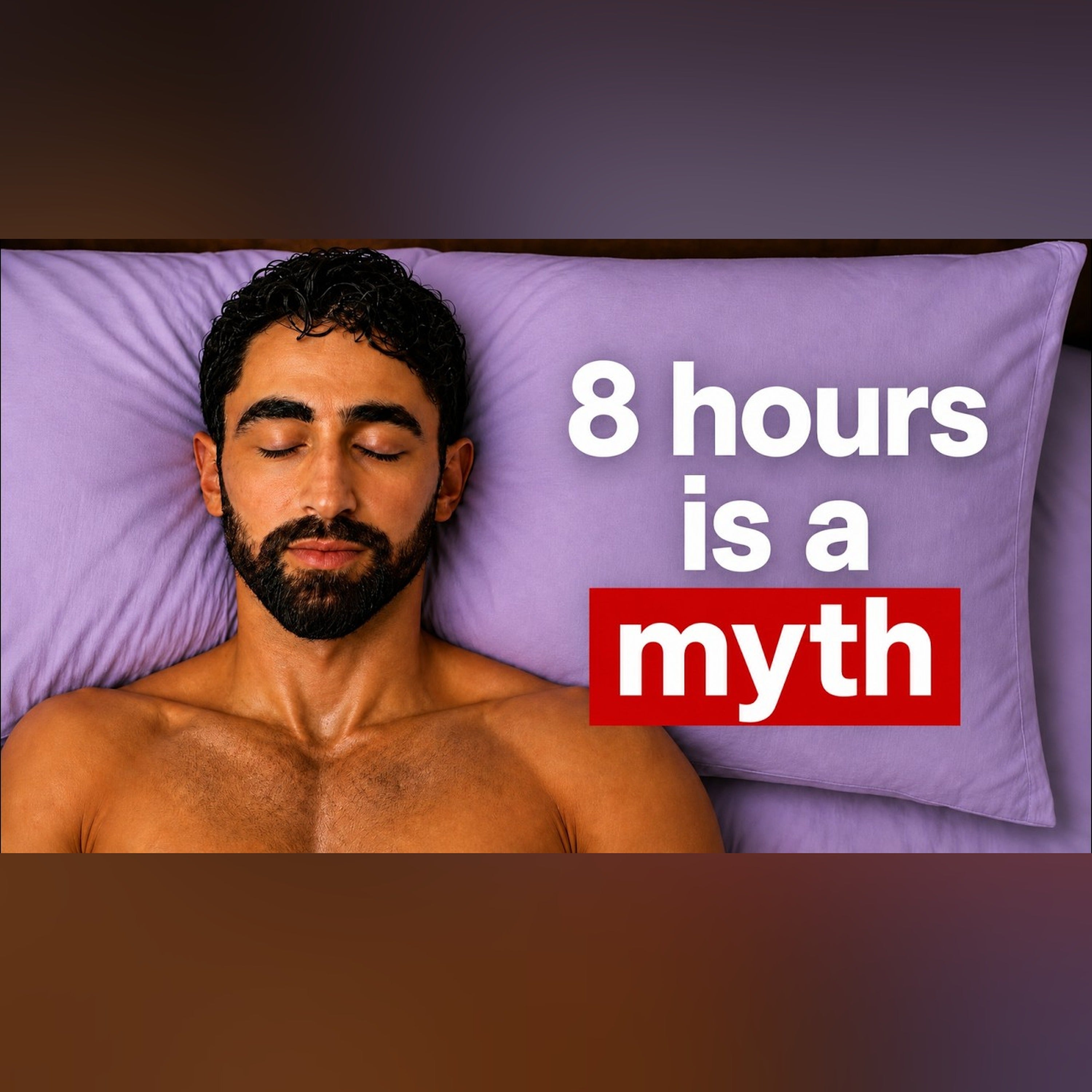
For a written breakdown, early access to content like this, and extra nuances, see the associated StayCurious Metabolism newsletter: https://open.substack.com/pub/staycuriousmetabolism/p/stop-chasing-8-hours-of-sleep?r=40ekz2&utm_campaign=post&utm_medium=web&showWelcomeOnShare=true (https://open.substack.com/pub/staycuriousmetabolism/p/stop-chasing-8-hours-of-sleep?r=40ekz2&showWelcomeOnShare=true) Pinealon Letter: https://staycuriousmetabolism.substack.com/p/why-im-trying-this-peptide-for-sleep?r=40ekz2 No Sleep Letter: https://staycuriousmetabolism.substack.com/p/what-if-you-didnt-need-to-sleep-this?r=40ekz2 Deep Sleep Masterclass: https://staycuriousmetabolism.substack.com/p/how-to-help-your-brain-clean-itself?r=40ekz2 I review several gamma entrainment devices in the Deep Sleep letter, along with the evidence supporting this tool. The only device I have personal experience with is Gamma Light Therapy, which was developed based on some of the early Nature research and is also one of
Scientists are rethinking how particles behave when moving at extreme speeds through matter. New research into quark-gluon plasma, the exotic fluid that existed moments after the Big Bang, reveals unexpected patterns in particle motion that challenge traditional physical models. The findings could offer a powerful new way to investigate the properties of the universe’s earliest matter. This episode includes AI-generated content.
Scientists have developed a powerful computational method that could dramatically expand the world of two-dimensional materials. By examining thousands of crystal structures, researchers have uncovered promising candidates with unusual electronic and magnetic properties. The discovery could open new possibilities for next-generation electronics, spintronics, and nanotechnology, revealing how much potential remains hidden in materials we already know. This episode includes AI-generated content.
After more than four decades of searching, physicists at CERN have found evidence of an extraordinarily rare particle transformation. Detected by the upgraded LHCb experiment, this elusive process offers a new way to investigate the limits of the Standard Model and search for signs of previously unknown physics. As future collider upgrades promise far more data, scientists are preparing to explore an even deeper frontier of the subatomic world. This episode includes AI-generated content.
Expanding universities should help pay for the pressures they create on surrounding neighborhoods.
Share your view, then see how readers voted. No sign-in required. This poll is shared across stories.
Do you agree or disagree?
Common Quandary
A Common Quandary to discuss
Another conversation to explore, separate from this news story.
You scratched a borrowed heirloom and repaired it perfectly. Do you confess?
You borrow a family heirloom for an event and accidentally leave a small scratch. A careful repair makes it almost invisible, and its owner happily accepts it back without noticing anything.
What is confession for when the harm has already been repaired?