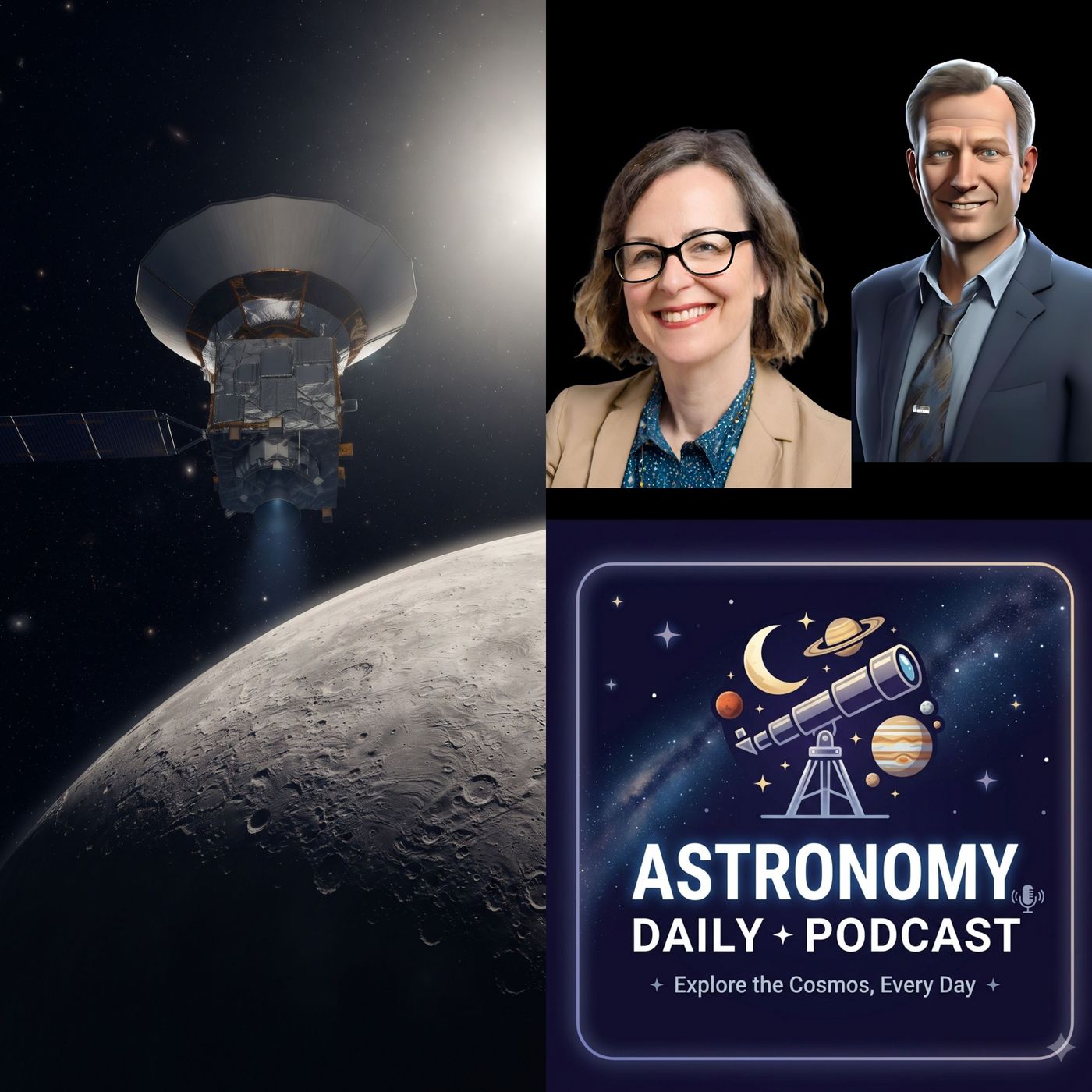
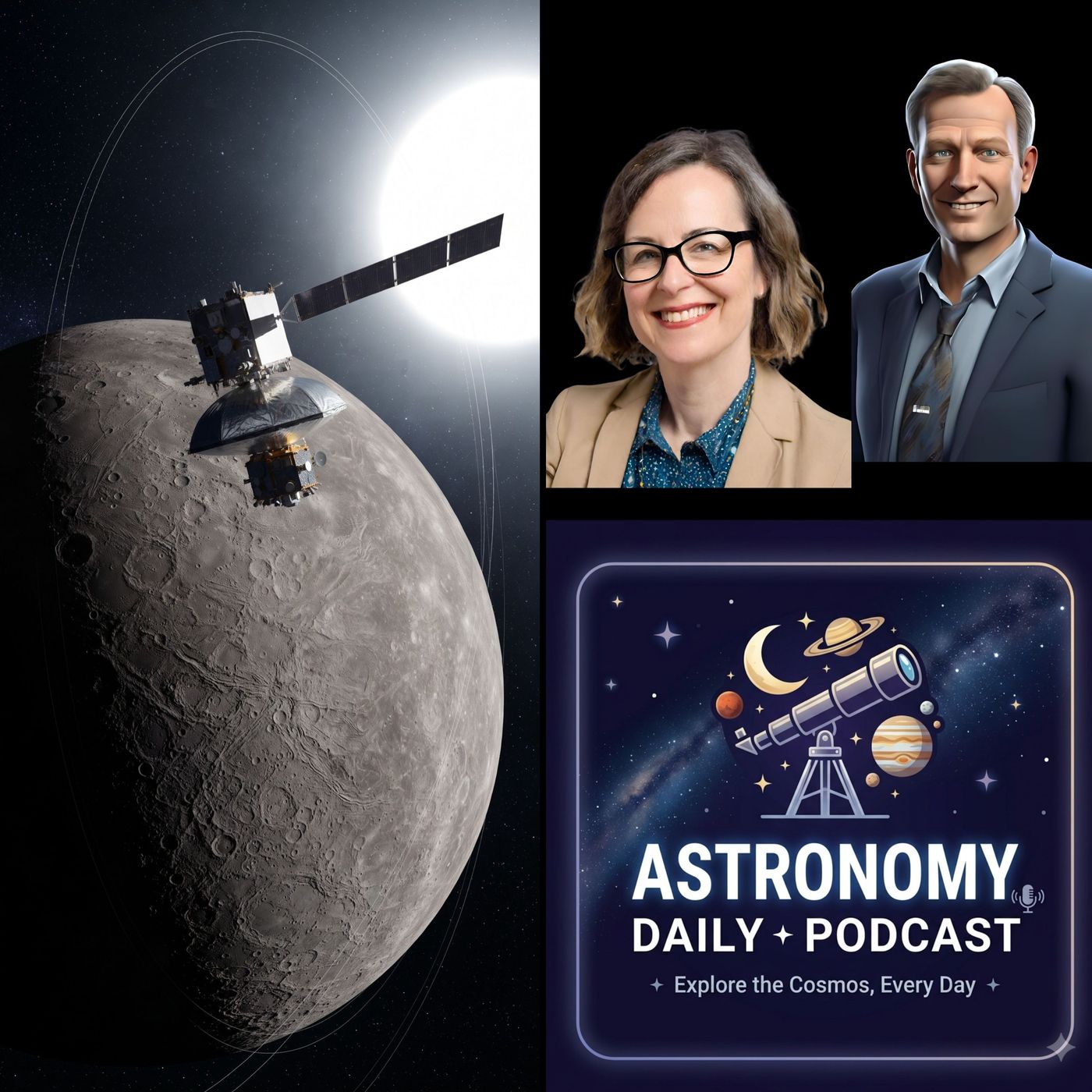
BepiColombo: Caught, But Not Quite to Plan
Listen through the publisher, then discuss the episode here or arrange an in-person Roundtable. Your city determines where to meet.
Roundtables are designed for groups of four, with a shared subject and room for everyone to speak. Come for discussion, with no dating expectation.
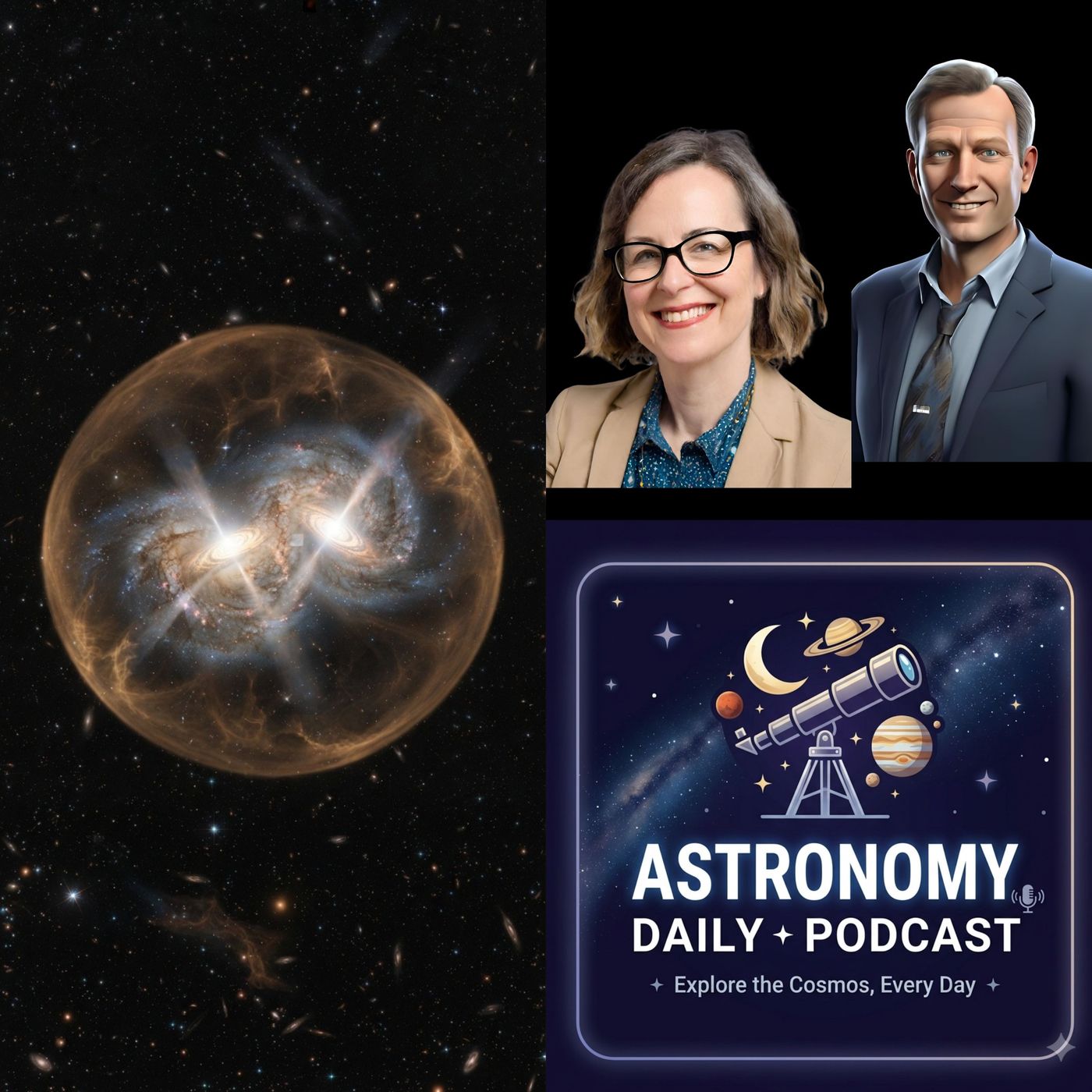
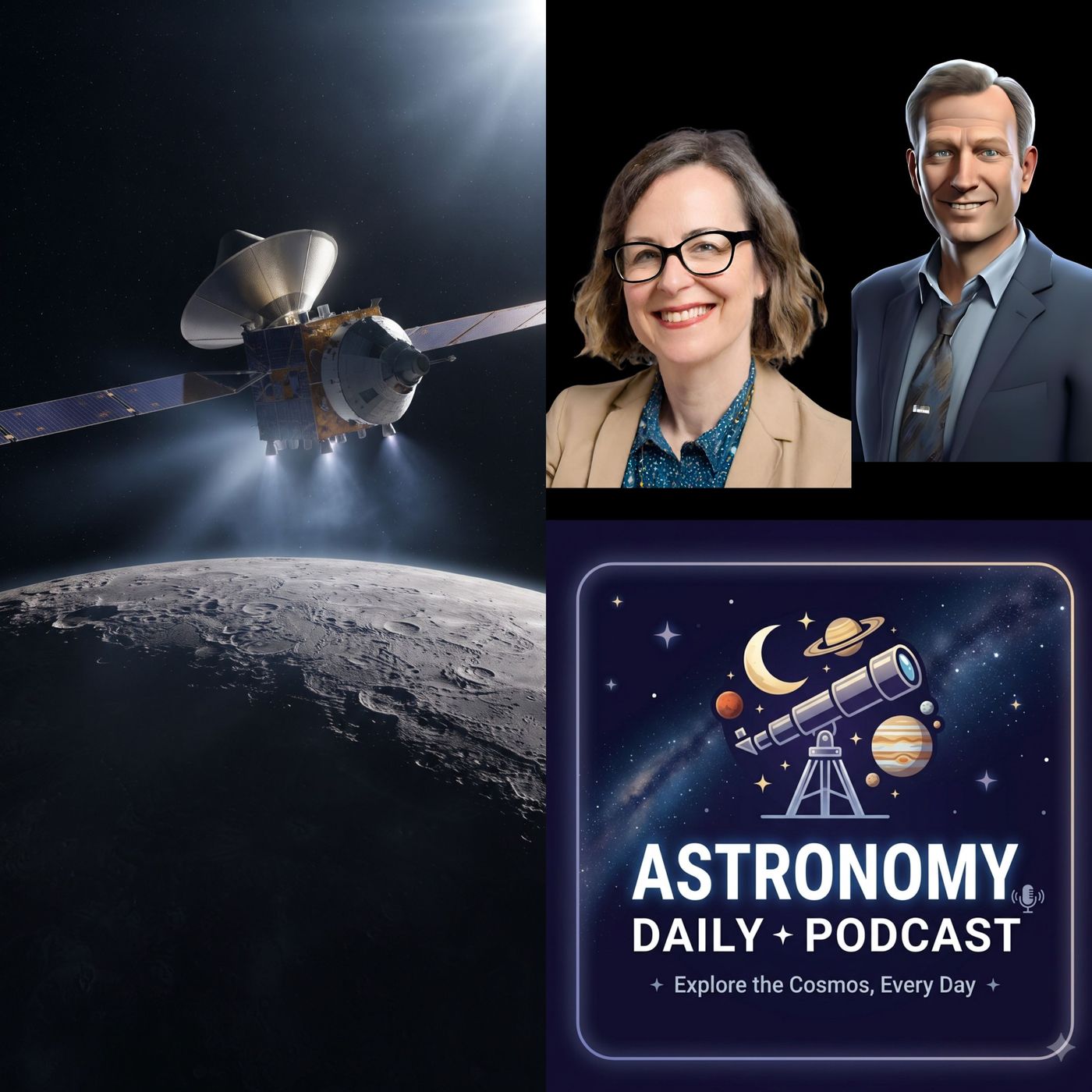
Show notes BepiColombo is in orbit around Mercury after an eight-year journey, but the capture burn ended early because of a software issue. We go through what is known, what isn't yet, and why the spacecraft is safe either way. Also: Europa's sodium cloud traced to the moon's own salt, a Sydney-led study finding the Milky Way's bar is long, slow and forming stars, and a theory for how an atom-sized black hole could blow up a star from the inside. Skywatch: Mercury at dawn, Mars and Jupiter, Saturn, and the Beaver supermoon. BepiColombo captured by Mercury, burn cut short ESA/JAXA's BepiColombo achieved orbital capture on 21 November 2026, becoming the second spacecraft ever to orbit Mercury. On 22 November the team reported the burn was shorter than planned due to a software issue; the spacecraft is safe and an update was promised for Monday. Mio separation is planned around 9–10 December and science from 6 April 2027. Europa's sodium cloud comes from its ocean Keck/HIRES data spanning more than 20 years show Europa's sodium cloud is remarkably stable regardless of Io's volcanism, pointing to Europa's own salt as the source (Lovett, Schmidt et al., JGR: Space Physics). The Milky Way's bar is long, slow and star-forming A University of Sydney-led team argues masers once assigned to the Norma arm trace the bar's shock front, giving a bar half-length of ~4.3 kpc and a slow pattern speed (Davis, Bland-Hawthorn et al., Nature Astronomy). How an atom-sized black hole could destroy a star Gottlieb (MIT) and colleagues show a captured primordial black hole could sink to a star's core, grow, form a disc and launch jets that blow the star apart, a possible new way to search for primordial black holes (ApJ). Quick hit: Hera and Roman dates ESA releases detailed Dimorphos images on 25 November; NASA unveils Roman's first images on 7 December at 3:30 pm EST (07:30 AEDT, 8 December). Sources • [BepiColombo] ESA — Latest updates: BepiColombo's arrival at Mercury — https://www.esa.int/Science_Exploration/Space_Science/BepiColombo/Latest_updates_BepiColombo_s_arrival_at_Mercury • [BepiColombo] ESA — BepiColombo entering orbit around Mercury (animation, 19 Nov 2026) — https://www.esa.int/media/about-us/directorates/science/bepicolombo-entering-orbit-around-mercury • [BepiColombo] Space.com — BepiColombo becomes 2nd ever to arrive in orbit around Mercury (updated 22 Nov) — https://www.space.com/space-exploration/missions/esa-jaxa-bepicolomobo-mission-mercury-orbit-arrival • [Europa] Keck Observatory — Astronomers reveal the oceanic origin of Europa's sodium cloud (19 Nov 2026) — https://keckobservatory.org/europa-sodium-cloud/ • [Europa] Lovett et al., Europa's Neutral Sodium Exosphere Is Quasi-Stable Over Decades, JGR: Space Physics, DOI 10.1029/2026JA035421 — https://doi.org/10.1029/2026JA035421 • [Galactic bar] Davis, Bland-Hawthorn, Tepper-Garcia, Agertz & Iles, The nature of the Norma arm as a bar-driven star-forming shock front, Nature Astronomy (20 Nov 2026) — https://www.nature.com/articles/s41550-026-03010-5 • [Galactic bar] arXiv:2610.38607 (29 Oct 2026) — https://arxiv.org/abs/2610.38607 • [Primordial black holes] MIT News — If tiny primordial black holes exist, here's how we might find them (19 Nov 2026) — https://news.mit.edu/2026/if-tiny-primordial-black-holes-exist-heres-how-we-might-find-them-1119 • [Primordial black holes] Gottlieb et al., The Life and Death of Stars that Capture Primordial Black Holes, ApJ, DOI 10.3847/1538-4357/aeb7e1 — https://doi.org/10.3847/1538-4357/aeb7e1 • [Hera] DLR — Hera spots its target (12 Nov 2026) — https://www.dlr.de/en/latest/news/2026/hera-spots-its-target-a-first-glimpse-into-the-study-of-the-didymos-binary-asteroid-system • [Roman] NASA — NASA Invites Media, Public to View Roman Telescope's First Images — https://www.nasa.gov/?p=1065857 Sponsor Details: Ensure your online privacy by using NordVPN. Get the best secure and private email on the planet. Do what we did and use ProtonMail. Commercial free episodes daily are only a click way... This episode includes AI-generated content.
Episode information is provided by the publisher. Listening takes place on the publisher’s service.
Listen at the source ↗