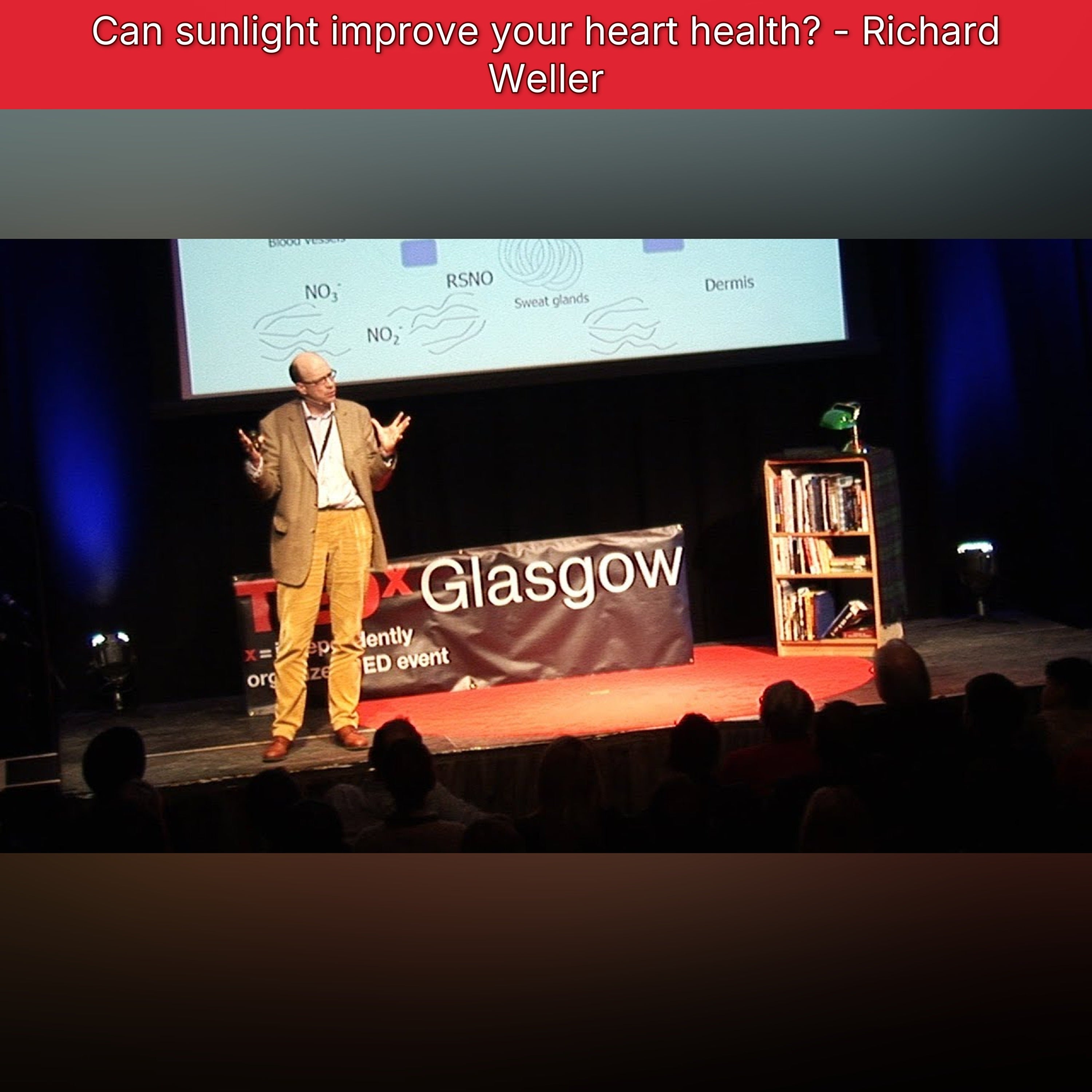
Can sunlight improve your heart health? - Richard Weller
17 min
Listen through the publisher, then discuss the episode here or arrange an in-person Roundtable. Your city determines where to meet.
Roundtables are designed for groups of four, with a shared subject and room for everyone to speak. Come for discussion, with no dating expectation.
Our bodies get Vitamin D from the sun, but as dermatologist Richard Weller suggests, sunlight may confer another surprising benefit too. New research by his team shows that nitric oxide, a chemical transmitter stored in huge reserves in the skin, can be released by UV light, to great benefit for blood pressure and the cardiovascular system. What does it mean? Well, it might begin to explain why Scots get sick more than Australians ... Talk by Richard Weller.
Episode information is provided by the publisher. Listening takes place on the publisher’s service.
Unleash the Power Within Virtual March 2025 – Virtual Event Recap Uploaded 26-03-25 The first Unleash the Power Within of 2025 is complete—and what an EPIC start to the year! 60,000+ attendees 156 countries 4 life-changing days 100% virtual—but just as powerful Whether it was breakthroughs in mindset, health, relationships, or business, this event delivered powerful transformation right into people's homes. The energy, the emotion, the connection—it was UNREAL. This is the power of Tony Robbins live events—where growth meets momentum and thousands come together to take control of their lives. Missed this UPW? Don’t worry—join us live in Anaheim, CA (or virtually!) on October 9–12. https://tonyr.co/4kKqpQ6 If you were part of this incredible weekend—drop your biggest takeaway in the comments below! Unleash the Power Within is the signature event designed by entrepreneur, best-selling author and #1 personal development leader Tony Robbins. This revolutionary four-day seminar has been att
In this calm and sleepy facts episode, we look up and explore the enormous, slowly turning galaxy that contains everything humanity has ever known. We begin with what the Milky Way actually is, a barred spiral galaxy roughly 100,000 light years across, home to somewhere between 100 and 400 billion stars, one of which is our own Sun, quietly orbiting about two thirds of the way out from the center. We trace the galaxy's structure from the dense central bulge and its bar of stars outward through the great spiral arms, past stellar nurseries where new stars are still being born in vast clouds of gas and dust, and into the faint stellar halo where ancient globular clusters orbit high above and below the galactic plane. At the very heart of it all sits Sagittarius A star, a supermassive black hole roughly four million times the mass of the Sun, hidden behind thick lanes of dust that block visible light but reveal themselves in infrared and radio waves. We explore the stellar population of t
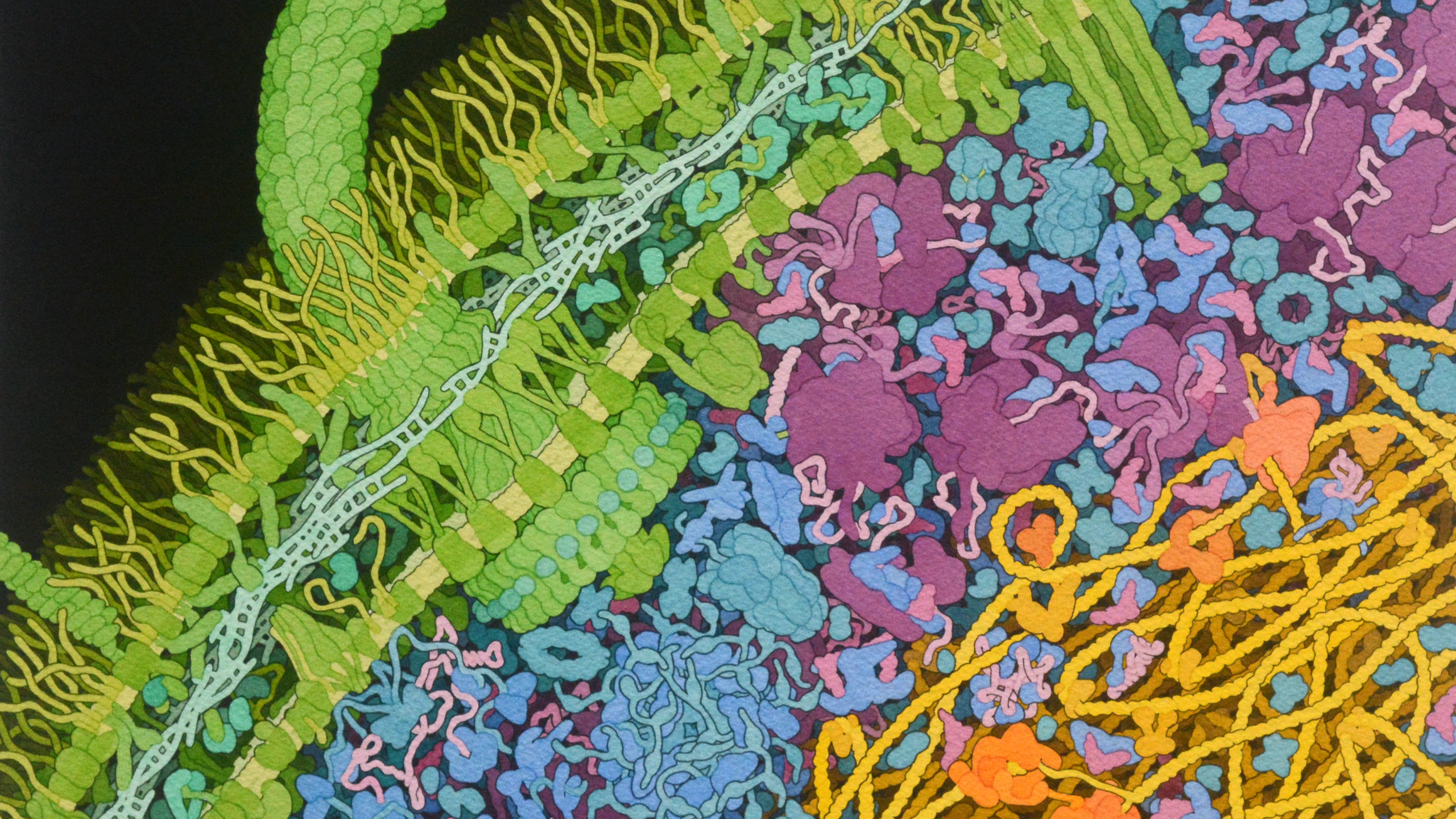
Humans have accomplished some amazing feats of engineering! There’s the Great Wall, the Great Pyramids, the Empire State Building. These are all wonders, to be sure. But it’s easy to forget the wonders that are much smaller than all that: wonders inside us, wonders that are keeping us alive! On today's ID The Future, Andrew McDiarmid is excited to read to you from The Robots Inside You, a new book designed for young people from biochemist Dr. Michael Behe. If you’ve watched the video series Secrets of the Cell, you know Dr. Behe has the ability to make complex scientific concepts easier to understand. In The Robots Inside You, Behe unpacks three amazing systems: the blood-clotting system that coordinates our body’s emergency response to bleeding, the molecular machines that maintain and repair our cells, and the superhero bugs at the heart of life that harness sophisticated machinery and extraordinary capabilities. Source (https://idthefuture.com/2295/)
Imagine taking a walk in the woods after a particularly busy week. You listen to the birds, watch the sunlight filter through the trees, and gradually notice little things you would normally walk past without a second thought. Nature has a way of bringing us back to the present moment. Hello everyone, and welcome to Daily English. Today's expression is “have a way of doing something.” When we say someone or something has a way of doing something, we mean that they have a particular ability or tendency to produce a certain effect, sometimes in a way that's difficult to explain. Let's look at a few examples. Imagine you're walking through a supermarket when you suddenly hear a song you used to listen to years ago. Within seconds, you're thinking about an old friend, a particular summer, and a version of yourself you haven't thought about in a long time. You might say: “Music has a way of bringing back memories we didn't even know we still had.” Now, imagine you've been worrying about a p
We’re about to time travel into the future Sam Altman is building… I interviewed Sam Altman, the CEO of OpenAI, the company behind ChatGPT. They’re trying to build a “superintelligence” that could far exceed humans in almost every field – and they just released their most powerful tool yet, GPT-5. A few years ago, that would’ve sounded like science fiction! Not anymore. In fact, they’re not alone. We’re in the middle of the most high stakes global race any of us have ever seen. Hundreds of billions of dollars and an unbelievable amount of human work… It’s a profound moment. Most people never see a huge technological shift like this in their lives and it’s happening all around us right now. So in this conversation, I’m going to try to time travel into the future with Sam Altman, to see what he’s trying to build… so you and I can really understand what’s coming. Welcome to HUGE* Conversations. Chapters: 0:00 What future are we headed for? 2:06 What can GPT-5 do that GPT-4 can’t? 6:57 Wha
Age doesn't mean decline. Believing it does could cost you seven and a half years. Gina sits down with Lyndsey Simpson, CEO of 55/Redefined and author of The Age Rebellion: Supercharge the Second Half of Your Life, to tear up the old script: work hard, retire, fade out. Lyndsey explains the Yale research on how negative thoughts about aging shorten your life. When you tell yourself you can't do something at your age, "your brain believes you and restricts your body." She also explains why stopping work all at once may be one of the worst things you can do for your health. Lyndsey also shares everyday learning habits that keep your brain sharp as you age. Your age isn't a countdown. It's a level, and you're still unlocking new ones. Where to Find Lyndsey: Instagram: https://www.instagram.com/simpson.lyndsey Her book - The Age Rebellion: Supercharge The Second Half Of Your Life: https://www.the-age-rebellion.com/ This podcast aligns with Day 73 of our Fall Program, members can find video
Dig into the slippery slope fallacy, which assumes that one step will lead to a series of events that lead to an extreme— often bad— scenario. Uploaded 19-08-21 -- It’s 1954. Vietnamese nationalists are on the verge of securing an independent Vietnam under communist leader Ho Chi Minh. U.S. President Eisenhower claims that by virtue of the "falling domino principle," communist control of Vietnam would lead to the global spread of authoritarian communist regimes. Can you spot the problem with this argument? Elizabeth Cox explores the slippery slope fallacy. Lesson by Elizabeth Cox, directed by TOGETHER. Support Our Non-Profit Mission ---------------------------------------------- Support us on Patreon: http://bit.ly/TEDEdPatreon Check out our merch: http://bit.ly/TEDEDShop ---------------------------------------------- Connect With Us ---------------------------------------------- Sign up for our newsletter: http://bit.ly/TEDEdNewsletter Find us on Twitter: http://bit.ly/TEDEdTwitter Pe
View full lesson: http://ed.ted.com/lessons/how-do-we-measure-distances-in-space-yuan-sen-ting Uploaded 09-10-14 When we look at the sky, we have a flat, two-dimensional view. So how do astronomers figure the distances of stars and galaxies from Earth? Yuan-Sen Ting shows us how trigonometric parallaxes, standard candles and more help us determine the distance of objects several billion light years away from Earth. Lesson by Yuan-Sen Ting, animation by TED-Ed.
As machines take on more jobs, many find themselves out of work or with raises indefinitely postponed. Is this the end of growth? No, says Erik Brynjolfsson -- it's simply the growing pains of a radically reorganized economy. A riveting case for why big innovations are ahead of us ... if we think of computers as our teammates. Be sure to watch the opposing viewpoint from Robert Gordon. Uploaded 30-08-13 Talk by Erik Brynjolfsson.
A rule should not be introduced unless it can be enforced fairly.
Share your view, then see how readers voted. No sign-in required. This poll is shared across stories.
Do you agree or disagree?
Common Quandary
A Common Quandary to discuss
Another conversation to explore, separate from this news story.
Scientists can edit mosquitoes until a deadly disease disappears. Who gets to say yes?
Scientists can potentially release modified mosquitoes whose genes would spread through wild populations and sharply reduce a deadly disease. The ecological effects could cross borders and may be impossible to reverse.
Who may authorize an irreversible change intended to save lives?