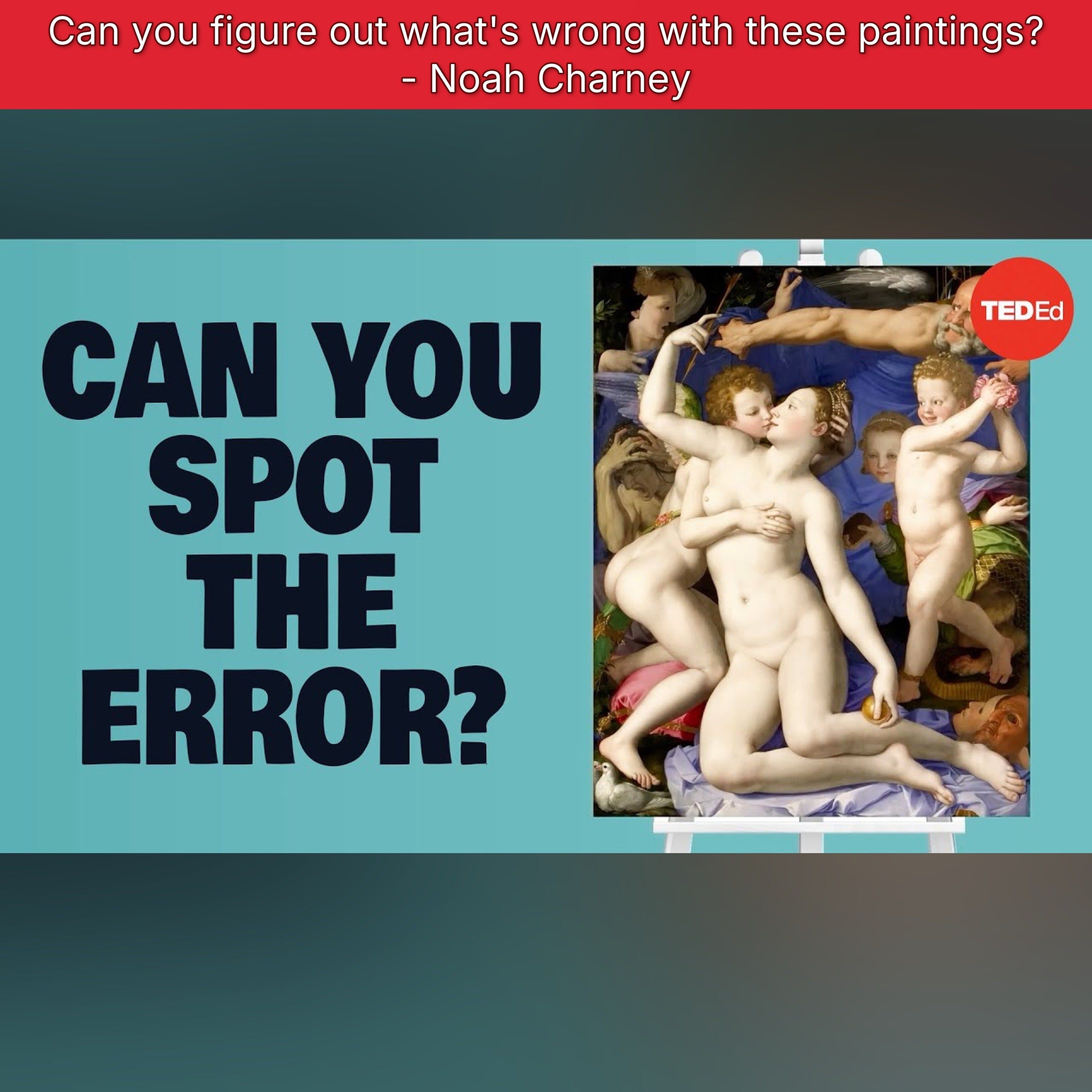
Can you figure out what's wrong with these paintings? - Noah Charney
Listen through the publisher, then discuss the episode here or arrange an in-person Roundtable. Your city determines where to meet.
Roundtables are designed for groups of four, with a shared subject and room for everyone to speak. Come for discussion, with no dating expectation.
Discover the scientific process art conservators use to restore centuries-old paintings and fix the damage of past restorations. -- Prior to the mid-20th century, art restorers took a heavy-handed approach, often drastically altering paintings in the name of “improving” art. Today, they focus on keeping the original work intact with minimal intervention, and must regularly contend with past modifications. So, how is damaged artwork repaired? Noah Charney explains the painstaking process of restoring priceless artifacts. Lesson by Noah Charney, directed by Michael Kalopaidis, Zedem Media. Image credit for the Portrait of Isabella de Medici: Gift of Mrs. Paul B. Ernst This video made possible in collaboration with Marriott Hotels Learn more about how TED-Ed partnerships work: https://bit.ly/TEDEdPartners Support Our Non-Profit Mission ---------------------------------------------- Support us on Patreon: http://bit.ly/TEDEdPatreon Check out our merch: http://bit.ly/TEDEDShop ---------------------------------------------- Connect With Us ---------------------------------------------- Sign up for our newsletter: http://bit.ly/TEDEdNewsletter Find us on Twitter: http://bit.ly/TEDEdTwitter Peep us on Instagram: http://bit.ly/TEDEdInstagram ---------------------------------------------- Keep Learning ---------------------------------------------- View full lesson: https://ed.ted.com/lessons/can-you-guess-what-s-wrong-with-these-paintings-noah-charney Dig deeper with additional resources: https://ed.ted.com/lessons/can-you-guess-what-s-wrong-with-these-paintings-noah-charney#digdeeper (https://ed.ted.com/lessons/can-you-guess-what-s-wrong-with-these-paintings-noah-charney) Animator's website: https://www.zedemanimations.com (https://www.zedemanimations.com/) ---------------------------------------------- Thank you so much to our patrons for your support! Without you this video would not be possible! Kack-Kyun Kim, Michael Braun-Boghos, zjweele13, Anna-Pitschna Kunz, Edla Paniguel, Thomas Mungavan, Jaron Blackburn, Venkat Venkatakrishnan, ReuniteKorea, Aaron Henson, Rohan Gupta, Begum Tutuncu, Brian Richards, Jørgen Østerpart, Tyron Jung, Carsten Tobehn, Katie Dean, Ezgi Yersu, Gerald Onyango, alessandra tasso, Doreen Reynolds-Consolati, Manognya Chakrapani, Ayala Ron, Eunsun Kim, Phyllis Dubrow, Ophelia Gibson Best, Paul Schneider, Joichiro Yamada, Henrique Cassús, Karthik Cherala, Clarence E. Harper Jr., Vignan Velivela, Ana Maria, Exal Enrique Cisneros Tuch, Tejas Dc, Khalifa Alhulail, Martin Stephen, Jose Henrique Leopoldo e Silva, Mandeep Singh, Abhijit Kiran Valluri, Morgan Williams, Devin Harris, Pavel Zalevskiy, Karen Goepen-Wee, Filip Dabrowski, Barbara Smalley, Megan Douglas, Tim Leistikow, Ka-Hei Law and Hiroshi Uchiyama.
Episode information is provided by the publisher. Listening takes place on the publisher’s service.
Listen at the source ↗