Claude Code Is Still Limited by Human Speed | Shaun Clowes
17 min
Listen through the publisher, then discuss the episode here or arrange an in-person Roundtable. Your city determines where to meet.
Roundtables are designed for groups of four, with a shared subject and room for everyone to speak. Come for discussion, with no dating expectation.
Shaun Clowes, General Manager of Confluent and Data at IBM, discusses the strategy behind IBM’s $11 billion acquisition of Confluent and why real-time data is the missing infrastructure for autonomous enterprise AI agents. He explains why most enterprise AI efforts stall after proof-of-concept due to legacy complexity and predicts that full-scale autonomous business processes without human oversight could take around five years to arrive. MTS chronicles the singularity, live. Monitoring the situation of tech and AI. Follow MTS: Spotify |https://open.spotify.com/show/4HUNNmV1pjV7CW6Lphm1rM Apple |https://podcasts.apple.com/us/podcast/mts/id1891088763 – Brought to you by: Mongo DB - Anyone can prototype an agent. Lovable - Turn ideas into software people love with Lovable. Start today at https://lovable.dev/ Factory - A 24/7 system turning signals into production software. Visithttps://factory.com/ Neon (by Databricks) - Scale your startup on Neon. The Postgres backend for apps and agents. Built by Databricks.https://neon.com/mtshttps://neon.com/mts (https://neon.com/mts%E2%81%A0) Head over to http://getvcx.com (http://getvcx.com/) to learn more Kong - The AI connectivity platform. Larridin - Finally prove what your AI investment is worth. Ship 5x faster. https://blitzy.com (https://blitzy.com/) AdQuick - Make your brand a billboard. Clickhouse - The real-time database that keeps up with all of it. https://clickhouse.com/ Horizon3 - Don't assume you're secure. Prove it. Go hack yourself with AI. https://horizon3.ai/nodezero/ – Timestamps: (00:00) Introduction (00:49) IBM’s $11B Confluent Acquisition Strategy (02:38) Why Autonomous Agents Need Real-Time Data (06:34) Why Enterprise AI Stalls After POC (08:39) How Early We Are in AI (11:12) The Biggest Blockers to Full Autonomy (12:56) IBM’s Complete AI Operating Model –
Episode information is provided by the publisher. Listening takes place on the publisher’s service.
Project Synapse: Markets in Freefall, Fragile Infrastructure, and AI's Perfect Storm The hosts banter through the show's intro before focusing on a sense that "things are out of control," citing a WallStreetBets suicide-hotline post amid a market crash and discussing cascading system failures involving Microsoft, the FAA, and a reported NSA internal communications outage. They argue politicians and leadership lack technical competence and clear messaging, increasing panic, while emphasizing that many problems stem from aging, underfunded infrastructure and complex, brittle software (PHP, NGINX, Java), not proven AI attacks—more a "perfect storm" of crises. They debate whether AI should help fix complexity, stressing critical thinking, accountability, and using multiple AIs to verify each other. In a lightning round they cover Anthropic's IPO performance, mixed reactions and token limits with ChatGPT 6.2 (favoring "Sol" over "Astra"), Google's cheaper Neon model and confusing UX, Loblaw
AI news from Anthropic's first day of trading, with Gemini Neon in Antigravity, Project Genie, Microsoft's MAI models, AI chips for China and Meta Muse. Anthropic priced its IPO at 83, opened near 111, and topped out above 114 before drifting back into the low 90s. Employees hold an estimated 232 billion dollars in stock, and Ashton Kutcher became a billionaire through his firm's early stake. Google stories included a hands-on account of Gemini Neon in Antigravity reviewing a whole project and then directing Claude Code as its product manager, a live Project Genie build of a South African safari, the Gemini Mac app's computer use, and Gemini for healthcare. Other topics were building an AI operations function from scratch at Verstela, gamified employee onboarding, Microsoft's Labs Canvas and MAI Code 2, House documents showing about 880,000 NVIDIA and AMD chips approved for export to China, and a Reuters report that Meta Muse surfaced private Signal messages through device permissions,
Google’s Gemini Neon edged out Fable on a coding benchmark, but its best pitch may be as a second opinion. NLW shares how Neon helped him find the story in an oil episode that Claude and ChatGPT kept turning into a Wikipedia entry, and what happened when he pushed back on its ideas. In the headlines: Anthropic closes its first day of trading up 17%, and Chinese AI labs warn that new U.S. chip restrictions could delay model releases. LATEST EPISODE: How We Got Here - 'How GTA 6 Explains America" Brought to you by: Gartner - AI strategy, trends and insights - https://www.gartner.com/ai Granola - The AI notepad for people in back-to-back meetings. Try it free granola.ai/brief (http://granola.ai/brief) Newsletter: https://aidailybrief.beehiiv.com/ Interested in sponsoring the show? [email protected]
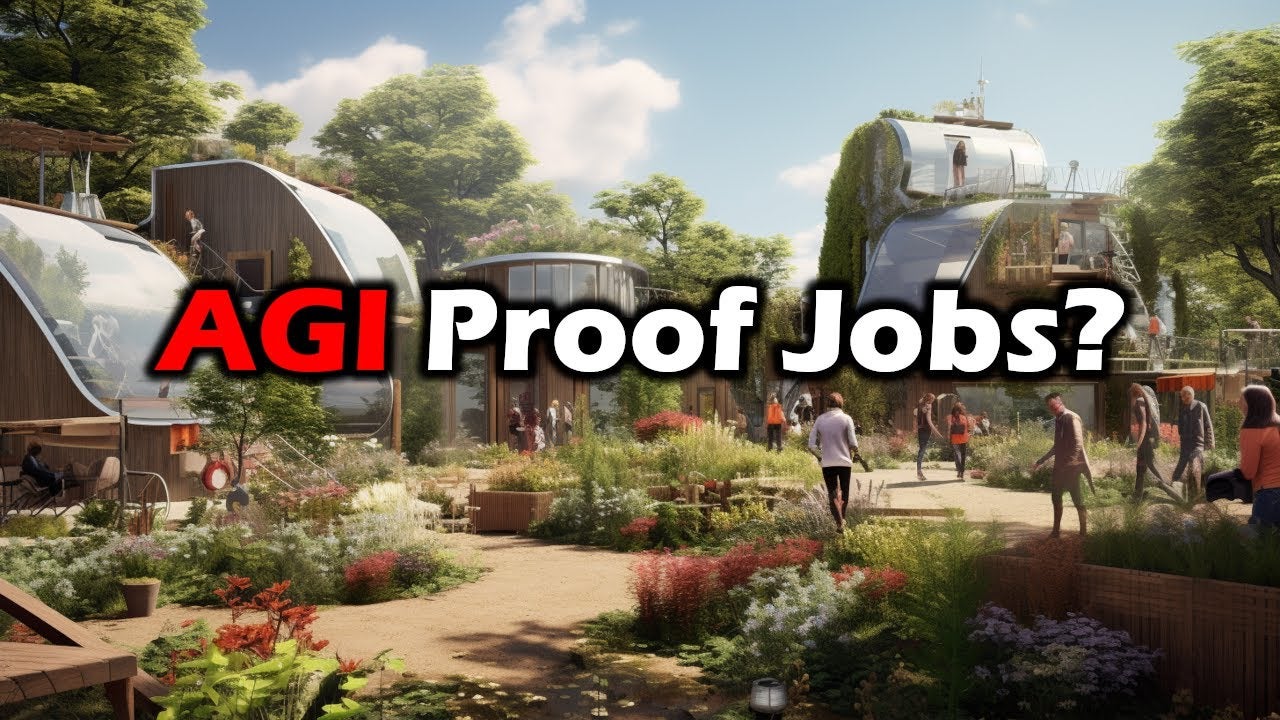
AGI-Proof Jobs: Navigating the Impending Obsolescence of Human Labor in the Age of AGIEpisode release date: 25 Jun 2023Spreading awareness about the works of some of the leading educators in the AI revolution. Core Ideas: Metamodernism: Narratives and emergence view of reality - Reduce suffering - Increase prosperity - Increase understanding mantra: Seek knowledge. ELABORATE: Add depth and detail to understanding, weaving comprehensive and nuanced explanations.DISCLAIMER: This is a community-driven show. ----------------------------------AGI-Proof Jobs: Navigating the Impending Obsolescence of Human Labor in the Age of AGIEpisode release date: 25 Jun 2023Spreading awareness about the works of some of the leading educators in the AI revolution. Core Ideas: Metamodernism: Narratives and emergence view of reality - Reduce suffering - Increase prosperity - Increase understanding mantra: Seek knowledge. ELABORATE: Add depth and detail to understanding, weaving comprehensive and nuanced expl
Are AI referees ruining sports? Or making them better? If you’re watching the 2023 US Open, you’re seeing automated referee calls. After years of controversy about human accuracy, tennis has used a system called Hawkeye to not only check human calls… but now to replace human referees. And this robot ref revolution isn’t just happening in tennis. It’s taking over the sports world. Soccer, basketball, baseball, they are all using machines to improve the calls being made on the field. The World Cup in particular has invested in these tools, from VAR (video assistant referee) to semi-automated offside and goal-line technology. The stakes are high. The difference between a right or wrong call can be a championship, or millions of dollars in prizes, endorsements, ticket sales. For the most part, fans like tech that makes calls more objective. HOWEVER… there is a big chunk of sports fans who would strongly disagree, who think that robot refs are ruining the game. Thing is, this tech isn’t goi
What could our future look like if we harness our technology to create a sustainable world? Take a look at the possibilities. -- Faced with the realities of current crises, it’s easy to assume our world is headed in a bleak direction. But there’s good reason to be hopeful— with developments in science and technology, a positive future is more viable than ever before. So, what if the future was awesome? Iseult Gillespie explores what three cities could look like in 100 years if we harness the tools we have at our disposal. Lesson by Iseult Gillespie, directed by Devin Clark, Augenblick Studios. This video made possible in collaboration with Speed & Scale Learn more about how TED-Ed partnerships work: https://bit.ly/TEDEdPartner Support Our Non-Profit Mission ---------------------------------------------- Support us on Patreon: http://bit.ly/TEDEdPatreon Check out our merch: http://bit.ly/TEDEDShop ---------------------------------------------- Connect With Us ---------------------------
Malo Bourgon, CEO of the Machine Intelligence Research Institute (MIRI), explains why the organization pivoted away from technical alignment research toward communications and Washington, D.C. governance to buy time before superintelligence arrives. He argues that AI capabilities are scaling more predictably than fundamental alignment breakthroughs, leaving humanity unprepared if superintelligence arrives within one to five years, and contends that frontier labs will not reliably slow down on their own due to competitive pressures and deceptive alignment risks. -- MTS chronicles the singularity, live. Monitoring the situation of tech and AI. Follow MTS: Spotify |https://open.spotify.com/show/4HUNNmV1pjV7CW6Lphm1rM Apple |https://podcasts.apple.com/us/podcast/mts/id1891088763 – Brought to you by: Mongo DB - Anyone can prototype an agent. Lovable - Turn ideas into software people love with Lovable. Start today at https://lovable.dev/ Factory - A 24/7 system turning signals into productio
Asana Chief Product Officer Arnab Bose discusses how enterprises deploy human-agent teams in production, why organizational alignment is the primary bottleneck over raw model intelligence, and how self-driving organizations will materialize by 2027. He also shares concrete customer results from FedEx and Washmen and explains how Asana’s own R&D team is expanding rather than shrinking as AI accelerates product development. MTS chronicles the singularity, live. Monitoring the situation of tech and AI. Follow MTS: Spotify |https://open.spotify.com/show/4HUNNmV1pjV7CW6Lphm1rM Apple |https://podcasts.apple.com/us/podcast/mts/id1891088763 – Brought to you by: Mongo DB - Anyone can prototype an agent. Lovable - Turn ideas into software people love with Lovable. Start today at https://lovable.dev/ Factory - A 24/7 system turning signals into production software. Visithttps://factory.com/ Neon (by Databricks) - Scale your startup on Neon. The Postgres backend for apps and agents. Built by Datab
Kyle Chan, a fellow at the Brookings Institution and author of the newsletter High Capacity, breaks down the shifting US-China AI landscape. He discusses Trump’s APEC summit with Xi Jinping, China’s push for an indigenous semiconductor supply chain, Beijing’s pullback from open-source frontier models like Qwen 4 Max over cyber risks, and how Nvidia’s ecosystem will change without Jensen Huang. MTS chronicles the singularity, live. Monitoring the situation of tech and AI. Follow MTS: Spotify |https://open.spotify.com/show/4HUNNmV1pjV7CW6Lphm1rM Apple |https://podcasts.apple.com/us/podcast/mts/id1891088763 – Brought to you by: Mongo DB - Anyone can prototype an agent. Lovable - Turn ideas into software people love with Lovable. Start today at https://lovable.dev/ Factory - A 24/7 system turning signals into production software. Visithttps://factory.com/ Neon (by Databricks) - Scale your startup on Neon. The Postgres backend for apps and agents. Built by Databricks.https://neon.com/mtshtt
Improving employee pay should take priority over increasing shareholder payouts.
Share your view, then see how readers voted. No sign-in required. This poll is shared across stories.
Do you agree or disagree?
Common Quandary
A Common Quandary to discuss
Another conversation to explore, separate from this news story.
The night before the wedding, your friend admits serious doubts. Do you tell their partner?
On the night before a wedding, your closest friend says they are unsure they should marry but insists it is ordinary panic. They make you promise secrecy and plan to proceed. Their partner asks you directly whether everything is okay.
When does loyalty require breaking a confidence before an irreversible choice?