Cranberry farmers forced to adapt as climate change threatens harvest
Listen through the publisher, then discuss the episode here or arrange an in-person Roundtable. Your city determines where to meet.
Roundtables are designed for groups of four, with a shared subject and room for everyone to speak. Come for discussion, with no dating expectation.
Cranberries are a Thanksgiving fixture, and the United States produces most of the world's supply. But growing them relies on a narrow window of time with the right conditions. With climate change, those conditions are shifting. For our Tipping Point series, special correspondent Ben Tracy with Climate Central shows us how scientists and growers are working to save the seasonal favorite. Hosted on Acast. See acast.com/privacy
Episode information is provided by the publisher. Listening takes place on the publisher’s service.
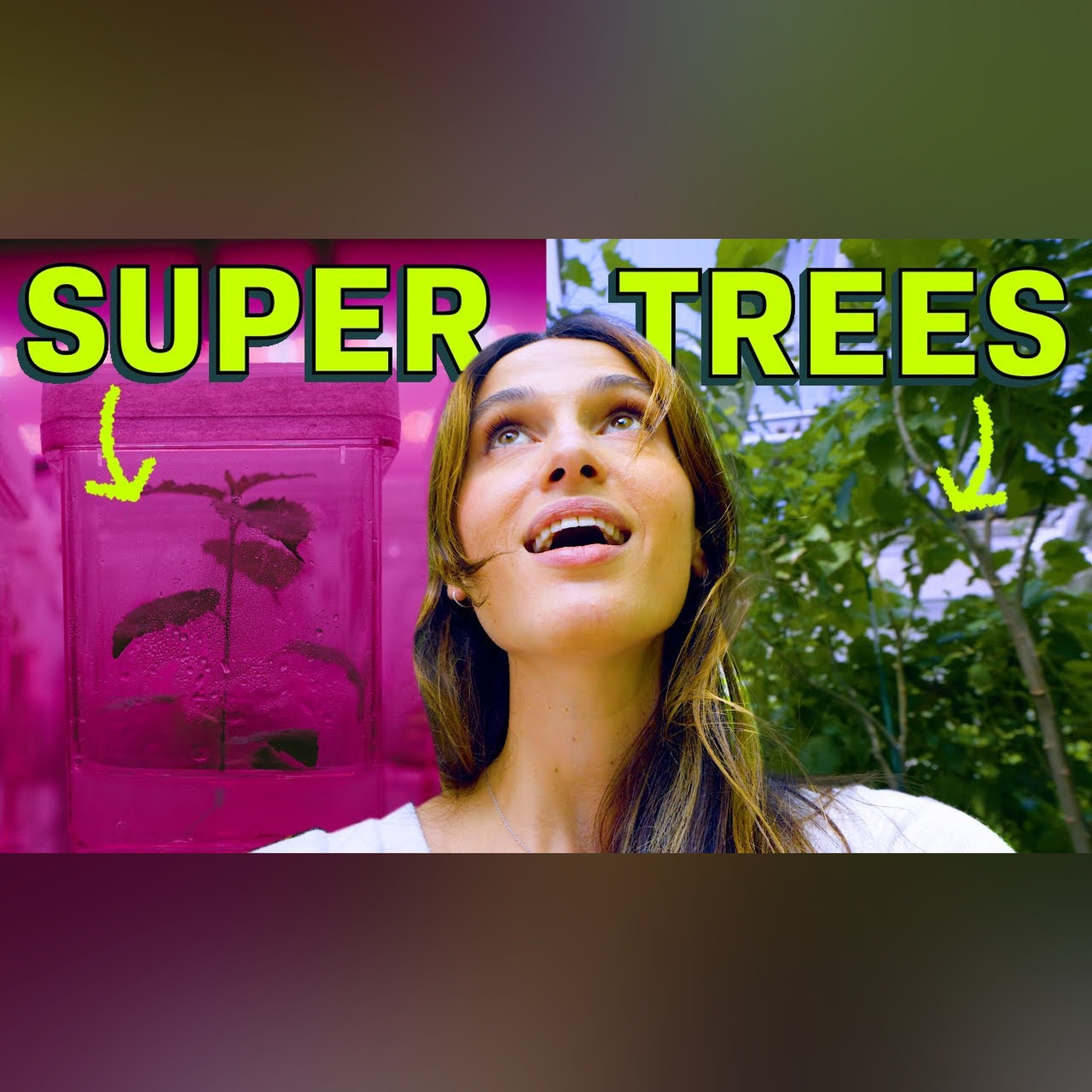
These trees have been genetically modified to capture more carbon. Should we use them? You may have heard that the United States Supreme Court recently weakened the power of the Environmental Protection Agency (EPA) to regulate emissions. That decision harms our ability to fight climate change. In this video, I look for hope in a new research effort - but it's important that new science be paired with regulation. As Mr Beast put it in this video, "we're going to need all the help we can get." Recently, I visited a greenhouse full of super trees. Over the past few decades, genetic engineering has given us the power to manipulate living things - crops, animals, even humans. At the same time, we’ve been unable to adequately slow climate change. The trees I saw are an effort to use one to help the other, led by a group of researchers at a company called Living Carbon. If it works, it could strengthen one of our best allies in this fight. Hold on though, easier said than done. In this video
Sign Up on Patreon to get access to the Space Time Discord! Uploaded 03-08-21 A new white dwarf has been discovered (poetically named: ZTF J1901+1458) that’s doing some stuff that no white dwarf should ever be able to do. In fact, it has multiple properties that are so extreme that it almost certainly did NOT form in the way that we thought all white dwarfs formed. This one peculiar point of faint light may change our understanding of not just white dwarfs, but of all cosmology. Professor Dave Explains: Debunking the Electric Universe Check out the Space Time Merch Store Sign up for the mailing list to get episode notifications and hear special announcements! Hosted by Matt O'Dowd Written by Matt Caplan and Matt O'Dowd Graphics by Leonardo Scholzer, Yago Ballarini, Pedro Osinski, Adriano Leal and Stephanie Faria Directed by Andrew Kornhaber Assistant Producer: Setare Gholipour Executive Producers: Eric Brown and Andrew Kornhaber End Credits Music by J.R.S. Schattenberg: https://www.you
Gluten Sensitivity, Gut Health, Chronic Inflammation, Food Addiction & Big Food Host Dave Asprey sits down with Dr. Peter Osborne, clinical nutrition expert, founder of the Gluten Free Society, and author of No Grain, No Pain, to explore gluten sensitivity, chronic inflammation, gut health, food cravings, brain fog, and the influence of the food industry on modern nutrition. In this special Thanksgiving episode, Dave and Peter challenge conventional thinking about grains, discuss the differences between celiac disease and non-celiac gluten sensitivity, and examine why certain foods may contribute to health problems even when people experience no immediate digestive symptoms. Peter explains how the digestion of gluten produces peptides known as gluteomorphins and discusses their potential relationship with opioid receptors, food cravings, and eating behavior. Dave shares his personal experiences with gluten, brain fog, and persistent carbohydrate cravings, while examining the relationsh
Is it bad to leave your phone charging overnight? Should you avoid using it while it's plugged in? And can the way you charge it shorten the life of the battery? There are plenty of myths about smartphone charging, and some of the advice you've heard may be completely wrong. Listen as I separate fact from fiction and reveal what really helps keep your phone's battery working longer. https://www.makeuseof.com/myths-misconceptions-charging-your-phone-debunked/ You probably think your brain simply takes in information and tells you what's happening around you. But that's not quite how it works. Your brain is constantly making predictions about what you're going to experience — and those predictions can actually shape what you feel and perceive. Even something as simple as expecting a shot to hurt can make it feel more painful. So how much of your reality is created by your own expectations? Andy Clark, professor at the University of Sussex and author of The Experience Machine: How Our Min
This is a Grave Talks CLASSIC EPISODE! PART TWO What if hearing the voices of the dead wasn’t strange—but simply your everyday reality? For Kelly McCarville, growing up meant living in a world where spirits were never far away. As a child, she didn’t question it. She assumed everyone else could hear them too. Whispers in quiet rooms, shadows that seemed to linger with intent, feelings of presence that were more real than imagined—all of this was as natural as breathing to her. In her home, among her family, it was simply part of life. But as she grew older, it became clear that not everyone had these same abilities. What Kelly thought was “normal” wasn’t the experience of most children. And instead of fading with time, her connection to the other side only deepened. The voices became clearer. The sensations stronger. The glimpses of spirits undeniable. Kelly’s gift was not meant to be silenced—it was meant to be used. Over the years, she embraced her abilities and learned how to harnes
For the first time ever, electric cooling needs have overtaken electric heating needs globally. This will continue to shift as developing nations increase their use of air conditioning, and as the world continues to get warmer. The IEA says cooling needs are overtaking heating for the first time - MACCUS (https://maccus.fr/en/cooling-overtaking-heating/) Hosted on Acast.
Have you ever been sitting on your couch, watching a TV show, and noticed your dog is paying attention to the screen? A recent social media trend has raised new questions about how our canine friends engage with shows and movies. William Brangham reports. Hosted on Acast. See acast.com/privacy
In a year scarred by deadly floods and heat waves, the planet's global temperature is on the verge of surpassing a critical threshold. Horizons moderator William Brangham explores the dangerous nature of climate change and the seeming inability to address the crisis with Kate Marvel and Michael Mann, two research scientists who have long wrestled with this issue. Hosted on Acast. See acast.com/privacy
President Trump has replaced the nation's top cybersecurity official following a string of seemingly unrelated technology outages over the last couple of weeks. Officials have repeatedly stressed that these outages were not the result of intentional attacks, but given the growth of AI, there's growing concern that attacks are on the horizon. William Brangham discussed more with Chris Krebs. Hosted on Acast. See acast.com/privacy
Individuals should control whether organizations share their personal information.
Share your view, then see how readers voted. No sign-in required. This poll is shared across stories.
Do you agree or disagree?
Common Quandary
A Common Quandary to discuss
Another conversation to explore, separate from this news story.
Your grandfather brought home an ancient artifact. A museum wants it back. Do you surrender it?
In your grandfather's attic you discover a beautiful ancient object he brought home while working overseas decades ago. Your family treasures it and his papers suggest the rules were murky. A museum from that country says it belongs to their collection and asks for its return.
Can a family inherit clear ownership of something acquired through unclear power?