Daily Roundup | ANI's Recommended Egetis Offer & BHB-1893 Heart Study: Most End on Starting Dose
10 min
Listen through the publisher, then discuss the episode here or arrange an in-person Roundtable. Your city determines where to meet.
Roundtables are designed for groups of four, with a shared subject and room for everyone to speak. Come for discussion, with no dating expectation.
ANI Pharmaceuticals made a recommended cash offer of about 5.3 billion kronor for Egetis Therapeutics, maker of Emcitate (tiratricol); the acceptance period is expected to open around November 20. Braveheart and Hengrui reported 52-week open-label data, with no comparison group, for oral BHB-1893 in adults with symptomatic obstructive HCM: 33 of 42 had a provoked gradient below 30 mmHg and 24 ended on the starting dose. Also: Amgen's real-world Repatha (evolocumab) vs. ezetimibe study; Lilly and Hims & Hers on Zepbound (tirzepatide) and Foundayo (orforglipron) self-pay access; Agios R&D role cuts; Moderna's norovirus cohort decision; and its Q3 revenue and raised outlook. This is the original Friday, November 6 edition, released late.
Episode information is provided by the publisher. Listening takes place on the publisher’s service.
In today's brief: Lake Erie, 1957: a newly released Air Force report says two boys saw a humming, bell-shaped craft near the Enrico Fermi Atomic Plant. Skinwalker Ranch: owner Brandon Fugal calls the new files landmark and recalls a daylight saucer over the mesa. Warship footage: a 20-second 2020 infrared clip shows a light crossing a US Navy ship in the Middle East, with no Pentagon assessment. Martha's Vineyard, 1957: a spiked, nickel-coloured object that the Air Force put down to a radar-reflector balloon. Loch Ness: reported sightings jump to 15 this year, up from six in 2025. The Book of Miracles: a 16th-century manuscript of comets, blood rain and multiple suns heads to auction at Christie's. Quick hits: a 1952 file blames the saucer wave on temperature inversions; more Pentagon UFO files are on the way. Every story and source: https://believepod.com/ufo-paranormal-news-22-november-2026/ New episodes every morning. Keep your eyes on the sky. Sources: FOX 2 Detroit: https://www.fo
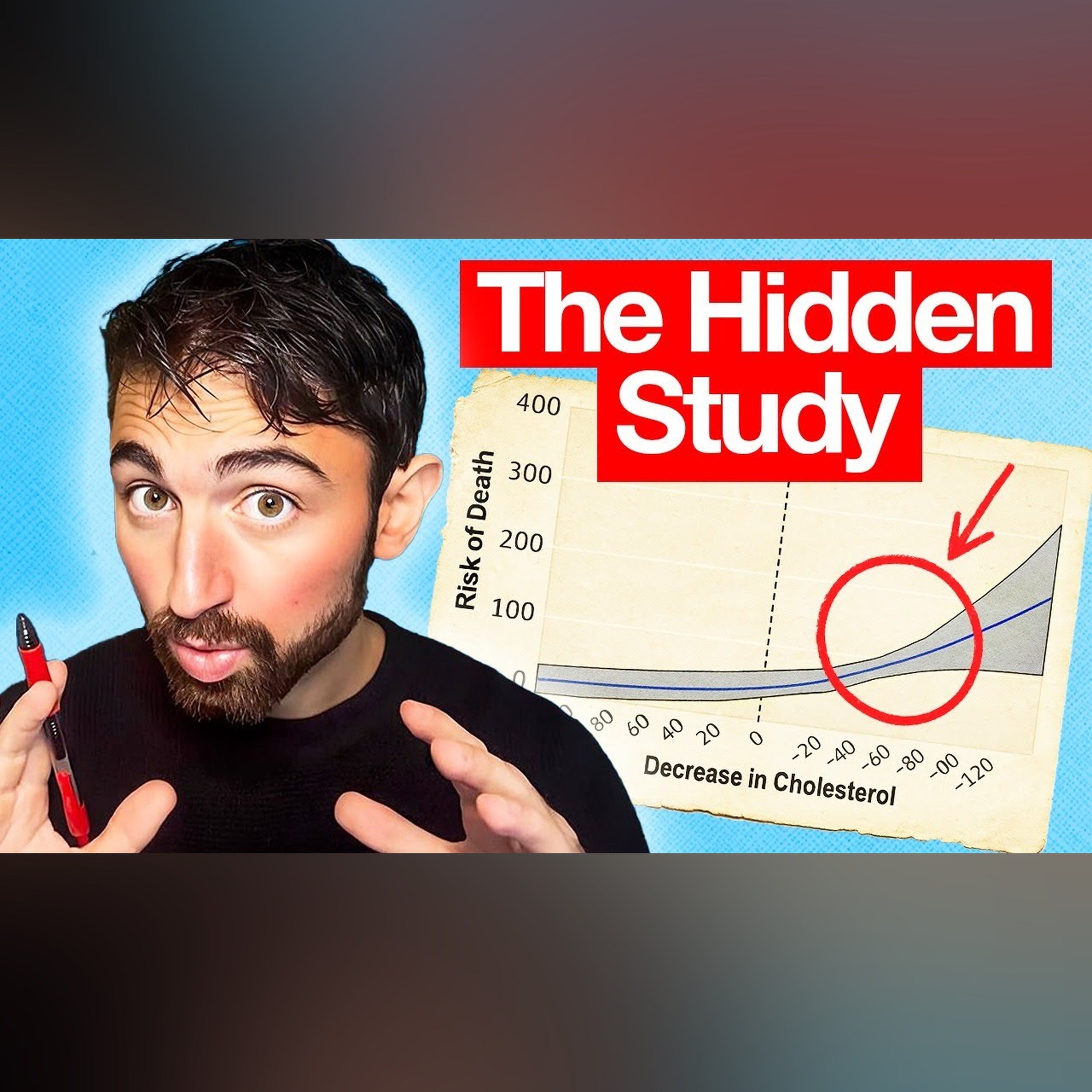
For the references, extra details and early access to context, see the newsletter: https://open.substack.com/pub/staycuriousmetabolism/p/lowering-cholesterol-killed-a-study?r=40ekz2&utm_campaign=post&utm_medium=web&showWelcomeOnShare=true (https://open.substack.com/pub/staycuriousmetabolism/p/lowering-cholesterol-killed-a-study?r=40ekz2&showWelcomeOnShare=true) Description: What if lowering cholesterol didn’t save lives—but actually increased the risk of death? In this video, I break down a forgotten ‘gold-standard’ randomized controlled trial from the late 1960s and early 1970s: the Minnesota Coronary Experiment. This uniquely rigorous study tested whether replacing saturated fat (butter, beef) with vegetable oils rich in linoleic acid would reduce heart disease and mortality. The results were shocking. Cholesterol dropped—but deaths increased. Even more unsettling, the greater the cholesterol reduction, the higher the risk of death. Cardiovascular outcomes didn’t improve either. The
THE SEARCH FOR THE ULTIMATE RED LIGHT THERAPY IS OVER! After decades of exploring wellness technologies, Michael Jaco sits down with Rob Rene, founder of Exodus Strong, to explore the Red Light+ Total Body Reset system, the science behind red and near-infrared light, and why this technology has become such an important part of their wellness conversation. Rob's remarkable personal journey—including surviving five near-death experiences—inspired his mission to develop practical wellness tools that people can incorporate into their everyday lives. Discover the full-body Red Light+ Mat, designed for convenient 20-minute sessions, and the portable Red Light+ Wand, created for targeted use on areas such as the knees, shoulders, hands, and lower back. Michael and Rob discuss the technology, personal experiences, and how red light therapy may support a daily wellness routine. BLACK FRIDAY–CYBER MONDAY LISTENER EXCLUSIVE! This is your opportunity to explore Exodus Strong's special holiday offe
Robot dogs are here. But why? You might think you already know Spot, the robot dog from Boston Dynamics. Maybe you saw a viral video of it opening a door, or dragging a truck, or dancing. But now, this robot has hit a HUGE milestone... Spot got a job! These robots are now out in the real world doing real work, for fire departments, factories, defunct nuclear power plants like Fukushima, ancient ruins like Pompeii, deep mines, and, more controversially, police departments. You might already be starting to see robot dogs walking around, and even if you’re not, they’re starting to affect your life. That’s why we went to visit Boston Dynamics. In this video, we put Spot to the test, to show you what it’s really capable of, and how our future could be even better with robot dogs. Chapters: 00:00 What is Boston Dynamics robot dog? 1:33 What does Boston Dynamics robot dog do? 2:50 Why robot dogs? 3:32 Taking Spot on an obstacle course 4:33 When Spot falls down 5:34 How Spot protects itself an
Eleven billion years ago two quasars blazed side by side, and this week astronomers weighed the invisible gas around them by the shadow it casts on the cosmic microwave background. There is 3.6 times more heat in it than gravity can explain. Plus a triple star 28 light-years away that 'should not exist', a pulsar found in ten hours with an algorithm borrowed from cryptography, The Week That Was, and the weekend sky from both hemispheres. In this episode Lead: Hot bubble around the dual quasar J1549+1245 at z = 2.37, measured with ALMA via the thermal Sunyaev–Zel'dovich effect (Hall, Zakamska et al., Nature Astronomy, 18 Nov 2026). Fresh item: Welopōʻai, the closest known triple with two white dwarfs, 28 light-years away (Artigau et al., A&A, 19 Nov 2026). Week That Was: Starship Flight 15 ship catch, CSIRO GenDIReCT and M87, SN 2026ahvu, failed supernovae in gravitational waves (E230); Voyager 1 one light-day, Beta Pictoris ices, heavy-oxygen water, Roman alignment (E231); Terra ends,
This is a Grave Talks CLASSIC EPISODE! In the heart of Calgary stands one of the city’s most infamous historic properties—Deane House. Built in 1906 by Captain Richard Burton Deane, the home’s history was marked by tragedy almost immediately, when Deane’s wife died during its construction. Decades later, the darkness deepened. In 1971, a brutal murder-suicide unfolded within its walls, casting a shadow that many believe still lingers today. Visitors and investigators report full-bodied apparitions, unexplained noises, sudden cold spots, and overwhelming feelings of unease. Some say they’ve encountered more than one spirit inside the historic residence. Others believe the energy there feels layered—built from grief, violence, and unresolved history. On this episode of The Grave Talks, we explore the chilling past of The Deane House, the paranormal experiences that continue to be reported, and the lingering question: what—if anything—still walks its halls? #DeaneHouse #HauntedCalgary #Ha
FDA again declines to approve Capricor’s Duchenne drug deramiocel, and Capricor disputes the agency’s reading of HOPE-3. Merck reports better overall survival with Kelun’s sacituzumab tirumotecan in advanced gastroesophageal cancer, while progression-free survival missed and the survival gain remains undisclosed. The roundup covers AstraZeneca’s sonesitatug vedotin priority review, PMV’s rezatapopt ovarian cancer data, Erasca’s ERAS-0015 pancreatic cancer plans and Germany’s ruling on Merck’s Keytruda SC. Also covered are Savara’s molgramostim review delay, J&J’s Tremfya (guselkumab) findings in axial psoriatic arthritis, CMS’s Medicare Advantage Part B proposal and FDA’s new biologics safety council. Delayed edition for Friday, November 20, 2026. Alex Mercer and Maya Patel host. Get the daily rundown in your inbox — subscribe at thepharmacloseout.com (https://thepharmacloseout.com/).
Delayed edition for Thursday, November 19, 2026. Celldex says it is ending barzolvolimab development in atopic dermatitis after its Phase 2 trial missed the primary itch endpoint. Revolution Medicines reports single-arm data for Rasonque (daraxonrasib) plus chemotherapy in first-line metastatic pancreatic cancer; a separate randomized study is designed to show what the drug adds. The roundup covers Pyxis Oncology’s Phase 1 micvotabart pelidotin data in head and neck cancer, the AbbVie–DISCO oncology discovery deal and Recursion’s proposed REC-4881 trial in familial adenomatous polyposis. Johnson & Johnson files to expand Caplyta (lumateperone) to manic or mixed episodes in bipolar I disorder, Novartis raises three peak sales forecasts, and a US biotech commission assesses China’s pharma competitiveness. Alex Mercer and Maya Patel host. Get the daily rundown in your inbox — subscribe at thepharmacloseout.com (https://thepharmacloseout.com/).
Pfizer commits $330 million upfront to license three autoimmune CAR-T programs from Starna Therapeutics before human trials — the lead in this delayed November 18 edition. Sanofi’s Infilbray (venglustat) is the first FDA-approved treatment for neurological symptoms of type 3 Gaucher disease, with clearer trial evidence for cognition than for movement alone. Regeneron reports FDA approval of Livsayis (cemdisiran), dosed every 12 weeks for AChR-positive adults with generalized myasthenia gravis. The roundup covers Biogen’s diranersen follow-up in early Alzheimer’s disease, Merck’s halt to Phase 3 nemtabrutinib in chronic lymphocytic leukemia and small lymphocytic lymphoma, and the FDA’s plan to expand review sharing for overseas filings. Alex Mercer and Maya Patel host. Get the daily rundown in your inbox — subscribe at https://thepharmacloseout.com (https://thepharmacloseout.com/).
News organizations should disclose major financial relationships that could influence their coverage.
Share your view, then see how readers voted. No sign-in required. This poll is shared across stories.
Do you agree or disagree?
Common Quandary
A Common Quandary to discuss
Another conversation to explore, separate from this news story.
Your coworker bends a dumb rule to help people. Do you report it?
An underpaid coworker quietly bends a company rule to help colleagues receive benefits they were technically denied. No customer is harmed, but the records are inaccurate and you are asked to certify them.
Where should loyalty end when a rule seems unjust?