English-language podcasts

PBS Space Time

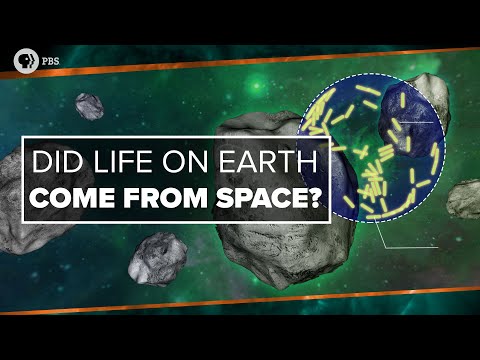
Did Life on Earth Come from Space?
24 min

Listen through the publisher, then discuss the episode here or arrange an in-person Roundtable. Your city determines where to meet.

Roundtables are designed for groups of four, with a shared subject and room for everyone to speak. Come for discussion, with no dating expectation.

PBS Member Stations rely on viewers like you. To support your local station, go to: http://to.pbs.org/DonateSPACE ↓ More info below ↓ Uploaded 06-12-18 Check out the new Space Time Merch Store! How did life on Earth get started? Did life on Earth originate on another planet? Either Mars, or in a distant solar system? Could Earth life have spread to have seeded life elsewhere? Let’s see what modern science has to say about the plausibility of panspermia. You can further support us on Patreon at https://www.patreon.com/pbsspacetime Tweet at us! @pbsspacetime Facebook: facebook.com/pbsspacetime Email us! pbsspacetime [at] gmail [dot] com Comment on Reddit: http://www.reddit.com/r/pbsspacetime Help translate our videos! Previous Episode: 'Oumuamua Is Not Aliens https://www.youtube.com/watch?v=wICOlaQOpM0&t=455s (https://www.youtube.com/watch?t=455s&v=wICOlaQOpM0) Hosted by Matt O'Dowd Written by Matt O'Dowd Graphics by Luke Maroldi Assistant Editing and Sound Design by Mike Petrow Made by Kornhaber Brown (www.kornhaberbrown.com) Life existing on Earth is odd. The oldest fossils are now dated to only a few hundred million years after the moment Earth first became habitable. Is it really reasonable to imagine that evolution turned an unliving chemical soup into the first true living cells in that geological eye-blink? Well, maybe. But the discovery of the early appearance of life on Earth was definitely a big “huh, that’s weird” moment. And it’s inspired some creative thinking. For example, what if the first genesis of life – abiogenesis – is actually incredibly unlikely – so unlikely that it only happened once in the entire galaxy. And that “once” was not on Earth. What if primitive life arrived on Earth after having traveled vast distances across the Milky Way. Some scientists think this is the case. This is the Panspermia hypothesis. Special thanks to our Patreon Big Bang, Quasar and Hypernova Supporters: Big Bang David Nicklas CoolAsCats Anton Lifshits Fabrice Eap Justin Lloyd Juan Benet Richard Senegor Shane Robinson Antonio Park Faisal Saud William James Sidis Quasar Tambe Barsbay Mark Rosenthal Mayank M, Methrotra Dean Fuqua ColeslawPurdie Joel Brinton James Flowers Vinnie Falco Josh Hypernova Chuck Zegar Jordan Young Joseph Salomone John Hofmann Martha Hunt Eugene Lawson Barry Hatfield Brent Mullins Danton B Spivey Science Via Markets Matthew O’Connor Ratfeast Brent Mullins Mark Heising Donal Botkin Shaun Williams Edmund Fokschaner Max Levine Vitaly Kovalenko Thanks to our Patreon Gamma Ray Burst Supporters: Alexander Rodriguez Alex Soto Alexey Eromenko Antonio Ruiz Brandon Cook Brandon Labonte Carlo Mogavero Conor Dillon Daniel Lyons David Crane David Matteson Dustan Jones Florian Stinglmayr Fabian Olesen Fauzan Ardhana Greg Allen Greg Weiss Jack Frosch James Hughes JJ Bagnell Jessica F Jinal Doshi Jon Folks John Pettit Joseph Emison Josh Thomas Kenneth F Leonard Kirk Mathews Loro Lukic Kevin Warne Malte Ubl Marc Lagarde Mark Vasile Nathan Leniz Nathan Hitchings Nicholas Rose Nick Virtue Peeter Durocher Scott Gossett Shannan Catalano Shawn Azman Tim Stephani Tommy Mogensen سلطان الخليفي

Episode information is provided by the publisher. Listening takes place on the publisher’s service.

Listen at the source ↗

Featured places to meet in Palo Alto, CA

Explore these places and arrange a conversation through ThinkMatch.

City guide for Palo Alto, CA

More from PBS Space Time

PBS Space Time

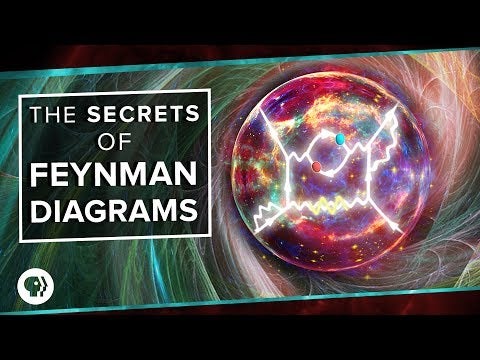
The Secrets of Feynman Diagrams

19 min

Viewers like you help make PBS (Thank you ) . Support your local PBS Member Station here: https://to.pbs.org/DonateSPACE Uploaded 26-07-17 Unlock the secrets of Feynman Diagrams. Part 5 in our Quantum Field Theory series. And if you're submitting an answer to our challenge question email your answer by August 2nd to pbsspacetime [AT] gmail.com with the subject line "Feynman Diagram Challenge." You can further support us on Patreon at https://www.patreon.com/pbsspacetime Get your own Space Time t­shirt at http://bit.ly/1QlzoBi Tweet at us! @pbsspacetime Facebook: facebook.com/pbsspacetime Email us! pbsspacetime [at] gmail [dot] com Comment on Reddit: http://www.reddit.com/r/pbsspacetime Help translate our videos! https://www.youtube.com/timedtext_cs_... Previous Episode: The Real Star Wars Feynman’s path integral shows us that, to properly calculate the probability of a particle traveling from point A to point B, we need to add up the contributions from all conceivable paths between tho

Discuss this episode

PBS Space Time

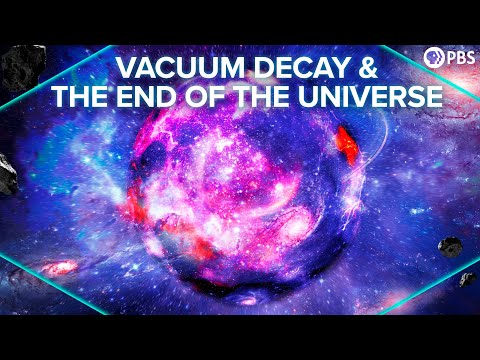
How Vacuum Decay Would Destroy The Universe

17 min

Sign Up on Patreon to get access to the Space Time Discord! Uploaded 18-08-21 The universe is going to end. But of all the possible ends of the universe vacuum decay would have to be the most thorough - because it could totally rewrite the laws of physics. Today I hope to help you understand exactly how terrified you should be. Check out the Space Time Merch Store Sign up for the mailing list to get episode notifications and hear special announcements! Hosted by Matt O'Dowd Written by Matt O'Dowd Graphics by Leonardo Scholzer, Yago Ballarini, Pedro Osinski, Adriano Leal and Stephanie Faria GFX Visualizations: Ajay Manuel Directed by Andrew Kornhaber Assistant Producer: Setare Gholipour Executive Producers: Eric Brown and Andrew Kornhaber End Credits Music by J.R.S. Schattenberg: https://www.youtube.com/user/MultiDroideka Special thanks to Our Patreon Sponsors Big Bang Supporters Ari Paul Kyle Bulloch Charlie Mrs. Tiffany Poindexter Leo Koguan Sandy Wu Matthew Miller Scott Gray Ahmad Jo

Discuss this episode

PBS Space Time

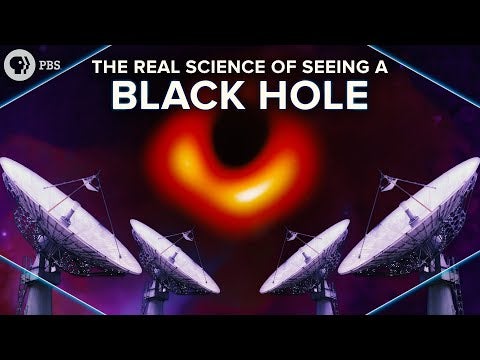
The Real Science of the EHT Black Hole

16 min

You can learn more about CuriosityStream at https://curiositystream.com/spacetime Uploaded 01-05-19 PBS Member Stations rely on viewers like you. To support your local station, go to: http://to.pbs.org/DonateSPACE How do you take a picture of a black hole and what can we learn from it? Our first ever actual bona fide photo of a black hole, made by the Event Horizon Telescope and revealed to the world in a press conference on April 10th. Since then it’s got plenty of coverage, because … I mean look at it. It’s a freaking black hole. It’s black, it’s holey, it’s everything we hoped it would be. Now that the giddiness has subsided and I personally have stopped spending hours on end staring at a black spot, we can take a breath and actually look at the real science here and discuss exactly how a picture like this could be taken and what we can learn from it. Check out the new Space Time Merch Store! Support Space Time on Patreon Need a Black Hole Refresher #Blackhole #astrophysics #spaceti

Discuss this episode

Community Poll

Environmental commitments should be judged by measured outcomes rather than announced targets.

Share your view, then see how readers voted. No sign-in required. This poll is shared across stories.

Do you agree or disagree?

Choose one answer

Common Quandary

A Common Quandary to discuss

Another conversation to explore, separate from this news story.

Your ex's streaming password still works. When does borrowing become stealing?

Months after a friendly breakup, your television remains logged into your ex's streaming account. They have never mentioned it, the service allows several screens, and your viewing does not increase their monthly bill.

Can silence count as permission when asking might end the benefit?

Explore this quandary