English-language podcasts

PBS Space Time

Does Quantum Immortality Save Schrödinger's Cat?
23 min

Listen through the publisher, then discuss the episode here or arrange an in-person Roundtable. Your city determines where to meet.

Roundtables are designed for groups of four, with a shared subject and room for everyone to speak. Come for discussion, with no dating expectation.

PBS Member Stations rely on viewers like you. To support your local station, go to: http://to.pbs.org/DonateSPACE ↓ More info below ↓ Uploaded 03-03-20 Check out Antarctic Extremes on PBS Terra: https://www.youtube.com/watch?v=EvRAuy1ZmTc Sign Up on Patreon to get access to the Space Time Discord! Sign up for the mailing list to get episode notifications and hear special announcements! Check out the Space Time Merch Store To quote eminent scientist Tyler Durden: "On a long enough timeline, the survival rate for everyone drops to zero." Actually… not necessarily true. If the quantum multiverse is real there may be a version of you that lives forever. Hosted by Matt O'Dowd Written by Matt O'Dowd Graphics by Leonardo Scholzer, Yago Ballarini, and Pedro Osinski Directed by: Andrew Kornhaber Executive Producers: Eric Brown and Andrew Kornhaber End Credits Music by J.R.S. Schattenberg: https://www.youtube.com/channel/UCRl6-nb4iOnsij-vnpAjp0Q If we can’t ever peer into these other realities that are used to explain quantum mechanics, how do we know they exist? In order to understand what happens to those different branches, and to understand why we find ourselves in one of them, we need to embrace one of the interpretations of quantum mechanics. For example the Copenhagen interpretation, which says that the wavefunction branches that we don’t observe somehow vanish at the moment of measurement. Or the Many Worlds interpretation, which states that those other branches are just as valid as ours - implying that reality may split and multiply in all possible ways. In that case we only see one branch because we live in that branch, and the others are rendered inaccessible by decoherence. But today I’m going to offer a test. Admittedly NOT a very useful one - but one that’s fun to think about. We’ll call this test quantum immortality. It’s based on the famous Schrodinger’s cat thought experiment. Special Thanks to Our Patreon Sponsors Big Bang Supporters Alexander Tamas David Barnholdt David Nicklas Fabrice Eap Juan Benet Morgan Hough Quasar Supporters Christina Oegren Mark Heising Vinnie Falco Hypernova Supporter Chuck Zegar Danton Spivey Donal Botkin Douglas Cantrell Edmund Fokschaner Hank S John Hofmann John Pollock John R. Slavik Jordan Young Joseph Salomone Julian Tyacke Justin Ash Mathew Matthew O'Connor Syed Ansar Timothy McCulloch Gamma Ray Burst Supporters A G Adrian Hatch Adrien Molyneux AlecZero Andreas Nautsch Angela Prigge Arefa Ahmad Bradley Jenkins Brandon labonte Brian Blanchard Craig Stonaha Dan Warren Daniel Lyons David Bethala DFaulk Eric Kiebler Frederic Simon Geoffrey Short Graydon Goss Greg Smith John Funai John Robinson Jonathan Nesfeder Josh Thomas Kevin Lee Kevin Warne Kyle Hofer Malte Ubl Michael Conroy Nick Virtue Nick Wright Nickolas Andrew Freeman Patrick Sutton Paul Rose Protius Protius Randall Sylvia Robert Ilardi Scott Gossett Sean Warniaha Shane Calimlim Sipke Schoorstra Steve Bradshaw Tatiana Vorovchenko Tim Stephani Tonyface Tybie Fitzhugh Yurii Konovaliuk

Episode information is provided by the publisher. Listening takes place on the publisher’s service.

Listen at the source ↗

Featured places to meet in Palo Alto, CA

Explore these places and arrange a conversation through ThinkMatch.

City guide for Palo Alto, CA

More from PBS Space Time

PBS Space Time

The Secrets of Feynman Diagrams

19 min

Viewers like you help make PBS (Thank you ) . Support your local PBS Member Station here: https://to.pbs.org/DonateSPACE Uploaded 26-07-17 Unlock the secrets of Feynman Diagrams. Part 5 in our Quantum Field Theory series. And if you're submitting an answer to our challenge question email your answer by August 2nd to pbsspacetime [AT] gmail.com with the subject line "Feynman Diagram Challenge." You can further support us on Patreon at https://www.patreon.com/pbsspacetime Get your own Space Time t­shirt at http://bit.ly/1QlzoBi Tweet at us! @pbsspacetime Facebook: facebook.com/pbsspacetime Email us! pbsspacetime [at] gmail [dot] com Comment on Reddit: http://www.reddit.com/r/pbsspacetime Help translate our videos! https://www.youtube.com/timedtext_cs_... Previous Episode: The Real Star Wars Feynman’s path integral shows us that, to properly calculate the probability of a particle traveling from point A to point B, we need to add up the contributions from all conceivable paths between tho

Discuss this episode

PBS Space Time

How Vacuum Decay Would Destroy The Universe

17 min

Sign Up on Patreon to get access to the Space Time Discord! Uploaded 18-08-21 The universe is going to end. But of all the possible ends of the universe vacuum decay would have to be the most thorough - because it could totally rewrite the laws of physics. Today I hope to help you understand exactly how terrified you should be. Check out the Space Time Merch Store Sign up for the mailing list to get episode notifications and hear special announcements! Hosted by Matt O'Dowd Written by Matt O'Dowd Graphics by Leonardo Scholzer, Yago Ballarini, Pedro Osinski, Adriano Leal and Stephanie Faria GFX Visualizations: Ajay Manuel Directed by Andrew Kornhaber Assistant Producer: Setare Gholipour Executive Producers: Eric Brown and Andrew Kornhaber End Credits Music by J.R.S. Schattenberg: https://www.youtube.com/user/MultiDroideka Special thanks to Our Patreon Sponsors Big Bang Supporters Ari Paul Kyle Bulloch Charlie Mrs. Tiffany Poindexter Leo Koguan Sandy Wu Matthew Miller Scott Gray Ahmad Jo

Discuss this episode

PBS Space Time

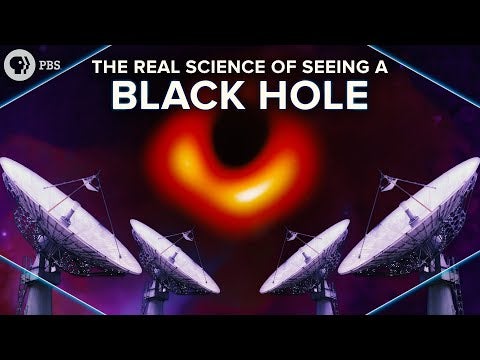
The Real Science of the EHT Black Hole

16 min

You can learn more about CuriosityStream at https://curiositystream.com/spacetime Uploaded 01-05-19 PBS Member Stations rely on viewers like you. To support your local station, go to: http://to.pbs.org/DonateSPACE How do you take a picture of a black hole and what can we learn from it? Our first ever actual bona fide photo of a black hole, made by the Event Horizon Telescope and revealed to the world in a press conference on April 10th. Since then it’s got plenty of coverage, because … I mean look at it. It’s a freaking black hole. It’s black, it’s holey, it’s everything we hoped it would be. Now that the giddiness has subsided and I personally have stopped spending hours on end staring at a black spot, we can take a breath and actually look at the real science here and discuss exactly how a picture like this could be taken and what we can learn from it. Check out the new Space Time Merch Store! Support Space Time on Patreon Need a Black Hole Refresher #Blackhole #astrophysics #spaceti

Discuss this episode

Community Poll

Public spaces should allow peaceful disagreement while preventing intimidation.

Share your view, then see how readers voted. No sign-in required. This poll is shared across stories.

Do you agree or disagree?

Choose one answer

Common Quandary

A Common Quandary to discuss

Another conversation to explore, separate from this news story.

Your coworker bends a dumb rule to help people. Do you report it?

An underpaid coworker quietly bends a company rule to help colleagues receive benefits they were technically denied. No customer is harmed, but the records are inaccurate and you are asked to certify them.

Where should loyalty end when a rule seems unjust?

Explore this quandary