Listen through the publisher, then discuss the episode here or arrange an in-person Roundtable. Your city determines where to meet.
Roundtables are designed for groups of four, with a shared subject and room for everyone to speak. Come for discussion, with no dating expectation.
Synopsis Today we honor one of America’s greatest patrons of chamber music, Elizabeth Sprague Coolidge, who died on this date in 1953. Born in 1864, Coolidge was the daughter of a wealthy wholesale grocer. She put her inheritance to good use. In 1924, she proposed to the Library of Congress that an auditorium be constructed in Washington, D.C., that would be dedicated to the performance of chamber music. A year later it was built, and Coolidge Auditorium at the Library of Congress still stands today. Not content with just a superb venue for chamber music, she diligently commissioned new works to be played there. The list of important chamber pieces her foundation commissioned is impressive, and includes Bartok and Schoenberg string quartets, the original chamber versions of Copland’s Appalachian Spring, Stravinsky’s Apollo ballets, and modern works by American composers as diverse as Samuel Barber, Milton Babbitt, George Crumb and John Corigliano. Coolidge was an amateur composer and accomplished pianist. Her passion for music and enthusiasm for the creation of new works was all the more remarkable considering that tragically she battled deafness from her mid-30s. Music Played in Today's Program Igor Stravinsky (1882-1971): Apollo ballet; Stockholm Chamber Orchestra; Esa-Pekka Salonen, conductor; Sony Classical 46667
Episode information is provided by the publisher. Listening takes place on the publisher’s service.
FROM THE VAULT: On this day in 1946, legendary rock and blues guitarist Duane Allman was born in Nashville, Tennessee. Alongside his younger brother Gregg, he founded the Allman Brothers Band in 1969, helping pioneer the sound of Southern rock before his life was tragically cut short in a motorcycle accident just two years later. In this classic episode of Professor of Rock, we explore the remarkable story of two brothers who lost their father as toddlers, found their passion for music, and built one of the most influential bands in rock history. Just as the Allman Brothers Band was on the verge of a major breakthrough, tragedy struck with Duane's sudden death. Devastated but determined to carry on, Gregg Allman, Dickey Betts, and their surviving bandmates channeled their grief into the music, eventually creating their biggest pop hit, "Ramblin' Man." It's a powerful story of brotherhood, heartbreak, resilience, and the enduring legacy of a Southern rock legend.
Heavy metal has always been built on pure adrenaline, raw talent, and unvarnished attitude, but the digital age is threatening to tear down everything the genre stands for. From artificial intelligence invading the songwriting process to the complete collapse of physical album sales and streaming payouts, the modern music business is pushing real musicians to the absolute brink. Can authentic heavy metal survive when technology takes over the creative process, or are fans witnessing the final curtain call for real, unscripted music? If you are hunting for the absolute best heavy metal content on the planet, look no further because this is the ultimate destination to satisfy your heaviest classic metal cravings! From hard-hitting album breakdowns to aggressive industry debates, we deliver pure power straight to your screen every single week. MYSTIC PROPHECY - IN METAL https://amzn.to/4zmliw0 Get commercial free and uncensored episodes without any delays, bonus posts and episodes, and TH
The first time I saw Violet Grohl perform, she was singing Joni Mitchell’s “Help Me” right in front of Joni herself. The occasion was the MusiCares tribute to Joni in 2022. Violet was just shy of 16, but her performance was poised and gorgeous. She’s 20 now and has just released her impressive debut album, “Be Sweet to Me.” Violet is, of course, the daughter of Foo Fighters front man Dave Grohl. But as you’ll hear, she also counts David Lynch, The Beatles, and her grandmother among her greatest influences. We share some ghost stories too. 00:00 — Welcome to Alchemy 01:32 — Releasing her debut album, "Be Sweet to Me" 02:11 — The record deal her dad didn't know about 03:35 — Singing backup on the road with her dad 07:08 — Writing her first song 08:49 — On being a "nepo baby" and finding her identity 10:14 — David Lynch and her love of the macabre 11:53 — The Beatles and seeing music in color 14:08 — Singing for Joni Mitchell at the MusiCares tribute 17:58 — The Taylor Hawkins tribute con
Give two music broadcasters a list of nationally significant songs, and they'll start weighing in before you know it. In Episode 49 of On The Record, Brian Wise and Michael Mackenzie consider the Australian National Songbook (https://www.nfsa.gov.au/stories/deep-dives/national-songbook), wrestle with a documentary about Elizabeth Holmes and find plenty of bad behaviour in a very expensive divorce. Show Notes You Can See Everything (https://youtu.be/HvW_N5p1q44) | Official Trailer HD | A24 WAR (https://youtu.be/ZybkHGaoPvQ) | Official Trailer | HBO Max Dustin Hoffman | SmartLess (https://youtu.be/rlnlTb2I2ic) Colman Domingo | SmartLess (https://youtu.be/uhQtTCTGK3Q) The Necks — the Boys (1998) (https://youtu.be/5JBa_Mt33c0?list=RD5JBa_Mt33c0) The National Songbook website (https://www.nfsa.gov.au/stories/deep-dives/national-songbook)
More great music (and song) from the world of bagpipes with visits to North Ireland, England, USA and Canada. Playlist Dram and Go with Maggie’s Pancakes and Dolina MacKay from Heads, Tails and Hearts Callum Beaumont with Anada Pa Gael, Breton Air, The Little Cascade, Smelling Fresh and Frances Morton’s from the Glenfiddich Champions Recital, Celtic Arts Foundation, Mount Vernon, Washington, USA. Vicki Swan and Jonny Dyer with Vigo’s Vagvisa and Dancing Out from Stones on the Ground Tony McManus with The Lochaber Dance and Chloe’s Passion from the Maker’s Mark Dr Angus MacDonald with Farewell my Love, Moll Roe, Hughie Travers, East at Glendart and P/M John MacDonald’s Exercise from a’Sireadh Spors Jarlath Henderson with Ye Rambling Boys of Pleasure from Hearts Broken Heads Turned Ross Ainslie and Jarlath Henderson with Old from Partners in Crime
House music at its best! It’s another glorious week for new house music with a lovely blend of piano house, funky grooves, deep emotive vocals, tribal beats and oldskool favourites in the first hour, before moving on to heavier tracks in the second hour as always. Tracks released on November 13 unless shown. 1. Keep On Running - Zac Samuel [Goodside Records] RELEASE DATE: NOV 27 2. Say My Name (Extended Mix) - Powered Djs, Zero Sugar, Sacha LMS [Future House Cloud] 3. What I Love (Extended Mix) - Ralph C [HouseU Tunes] 4. Superdisco (Extended Mix) - Jude & Frank feat. Leyla Diamondi [Myth of NYX] RELEASE DATE: NOV 20 5. U Call It Love (Extended Mix) - Midnight City [All Night Long Records] RELEASE DATE: NOV 27 6. All I Want To Do (Extended Mix) - Earth n Days [HouseU Music] RELEASE DATE: NOV 20 7. Only Love (Original Mix) - Jerome Sydenham, Fatima Njai [Ibadan Sound] 8. Make You Feel (Extended Mix) - Roger Da'Silva [PHXBLK] RELEASE DATE: NOV 27 9. Every Day - ZPLASH [ID] RELEASE DATE:
Synopsis In August, 2019, thousands of women took to the streets of Mexico City to protest the outrageous police indifference to violent crimes against women, which largely went unpunished. Their protest became known as the “revolución diamantina” (glitter revolution), since they showered Mexico City’s security chief with pink glitter during their inaugural demonstration. Their protest inspired Mexican composer Gabriela Ortiz to collaborate with her compatriot, Pulitzer Prize-winning Mexican author Cristina Rivera Garza, in the creation of a ballet score that would chronicle their history and honor their action. The result of their collaboration was Revolución Diamantina, a 42-minute work of surprising power and beauty. Ortiz said, “It was up to me to imagine the music by using not only aesthetic languages already known to me, but by taking risks, learning, and experimenting with new tools. In this ballet, it has been my hope that the audience will explore different pathways that radic
Synopsis In 1974, St. Petersburg was still called Leningrad and still part of what we now call the former Soviet Union. Back then, the most famous living Soviet composer was Dmitri Shostakovich, whose health was rapidly failing from the cancer that would claim his life the following year. On today’s date in 1974, Shostakovich’s String Quartet No. 15, his final, was given its premiere performance by the Taneyev Quartet. The work was supposed to have been premiered by the Beethoven Quartet, but its cellist died unexpectedly, and, mindful of his own mortality, Shostakovich was reluctant to postpone the scheduled premiere. After all, he might not be around by the time the Beethoven Quartet found a replacement cellist. When his String Quartet No. 1 had premiered in 1938, Shostakovich had described that work as “joyful, merry, lyrical” and “springlike.” His String Quartet No. 15, on the other hand, is obviously a “winter work,” written by someone who knows he might never see another spring.
Synopsis On today’s date in 1922, the British Broadcasting Corporation began daily radio transmissions from London, at first offering just news and weather — the latter read twice, in case anyone wanted to take notes. The following month, on Dec. 23, 1922, the BBC broadcast its first orchestral concert. Over time, the BBC became affectionately nicknamed “the Beeb,” or, less affectionately “Auntie,” due to the upper-middle class, slightly patronizing tone of its music announcers in the 1940s and ‘50s. That said, Auntie has proven to be hip in one aspect: The BBC has been a major commissioner of and advocate for new music by a wide range of composers — and not just British ones. In 2007, for example, the BBC Symphony premiered the Doctor Atomic Symphony, by American composer John Adams, live on-air at a BBC Proms Concert at the Royal Albert Hall. And it’s not just famous, big-name composers who get an airing on the Beeb either. Each year, BBC Radio 3 hosts a competition for teenage compo
Elected representatives should serve people who voted against them as seriously as their supporters.
Share your view, then see how readers voted. No sign-in required. This poll is shared across stories.
Do you agree or disagree?
Common Quandary
A Common Quandary to discuss
Another conversation to explore, separate from this news story.
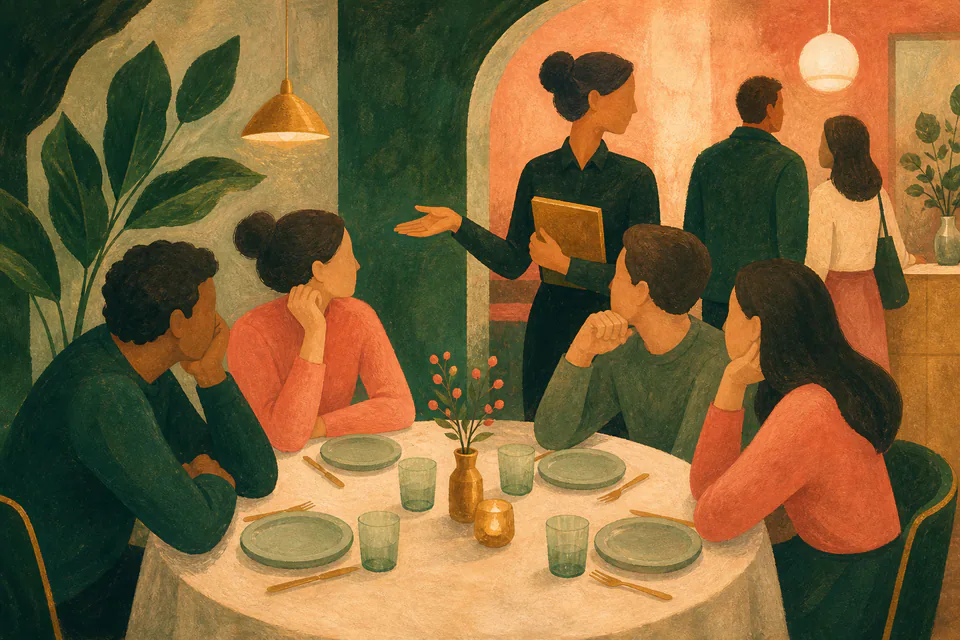
Your friend is forty minutes late. Can the restaurant give away their chair?
A busy restaurant seats your group only after everyone arrives. One friend is forty minutes late and keeps texting that they are almost there. A couple waiting nearby could use the empty place, and the server asks your group to order without them.
How long should one person's delay control everyone else's evening?