Farming on the fringe - Rachel Ward in Conversation
40 min
Listen through the publisher, then discuss the episode here or arrange an in-person Roundtable. Your city determines where to meet.
Roundtables are designed for groups of four, with a shared subject and room for everyone to speak. Come for discussion, with no dating expectation.
In this episode from the Farming on the Fringe Forum, we sit down with actor, filmmaker and regenerative farming advocate Rachel Ward from Rachel’s Farm. Rachel shares her personal journey of learning to farm holistically, the challenges and discoveries along the way, and how reconnecting with the land has reshaped her thinking about food and farming. She also introduces her latest venture, FarmThru, which aims to bridge the gap between regenerative farmers and consumers, making it easier for people to support farming practices that are better for the land, animals and communities. Watch Rachel's farm for free - https://www.youtube.com/watch?v=x597VmhNZdE More info visit - farmthru.com.au/au The Farming on the Fringe Forum was delivered by Local Land Services in partnership with the NSW Department of Climate Change, Energy, the Environment and Water under the Primary Industries Productivity and Abatement Program (PIPAP). This podcast was produced by Grow Love Project and supported by Greater Sydney Local Land Services’ Sustainable Agriculture Facilitator through funding from the Australian Government’s Natural Heritage Trust under the Climate-Smart Agriculture Program.
Episode information is provided by the publisher. Listening takes place on the publisher’s service.
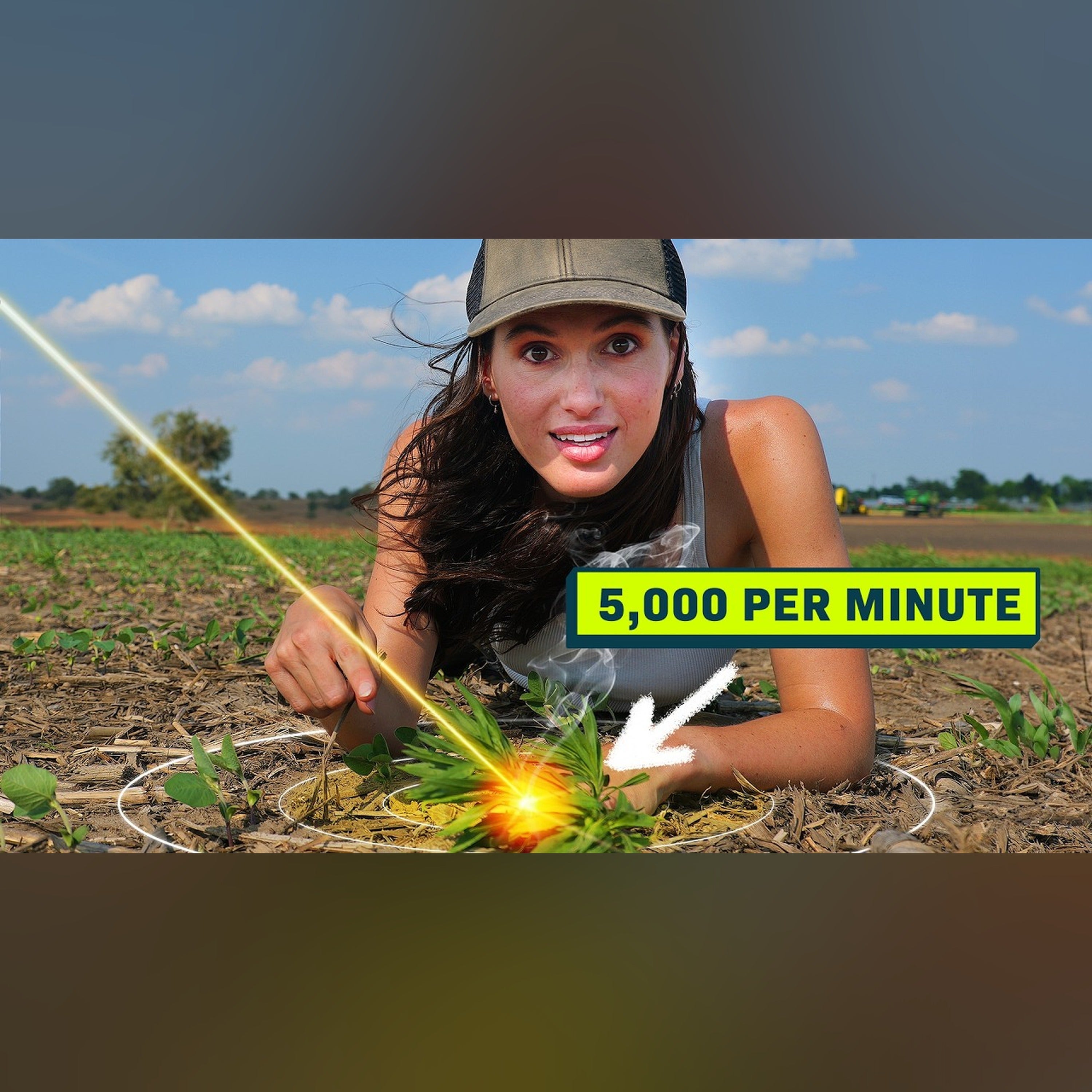
Growing food doesn’t look like I thought… Learn more about Dropbox for teams: https://www.dropbox.com/cleo Thanks Dropbox for sponsoring this video! Right now, we’re living through one of the most pivotal moments in food history… and most people have no idea it’s happening. Experts are calling the “Fourth Agricultural Revolution” and it’s here because we’re facing a big problem: The world’s population is rising, so experts say we’ll need to increase food output to catch up with our current population and feed those new people. But we’ve got to do it in ways that actually protect the Earth long term. Right now, farmers are in a fight to feed the world. So let me show you some of the coolest machines they’re using to do it… Chapters: 0:00 What’s the fourth agricultural revolution? 01:15 Why do we need more food? 1:54 Where does farming tech get tested? 3:00 What were the first 3 agricultural revolutions? 3:58 How do we feed billions more people… better? 4:31 How do farmers grow more food
Dig into the animal kingdom’s capacity for generosity, and find out how cooperation between animals may contribute to their survival. -- Charles Darwin introduced the notion of “survival of the fittest,” where the fittest animals are those who can survive long enough to produce healthy offspring. The fittest animal can also be the most stealthy, resourceful, or even the most cooperative. So what exactly does cooperation look like in the wild? Ashley Ward digs into the animal kingdom's capacity for generosity. Lesson by Ashley Ward, directed by Sharon Colman. Support Our Non-Profit Mission ---------------------------------------------- Support us on Patreon: http://bit.ly/TEDEdPatreon Check out our merch: http://bit.ly/TEDEDShop ---------------------------------------------- Connect With Us ---------------------------------------------- Sign up for our newsletter: http://bit.ly/TEDEdNewsletter Find us on Twitter: http://bit.ly/TEDEdTwitter Peep us on Instagram: http://bit.ly/TEDEdInstag
Viewers like you help make PBS (Thank you ) . Support your local PBS Member Station here: https://to.pbs.org/DonateSPACE Uploaded 28-06-17 Quantum Electrodynamics is the first true Quantum Field Theory. Part 2 in our series on Quantum Field Theory. Signup for your free trial to The Great Courses Plus here: http://ow.ly/D0Ne30beNrn You can further support us on Patreon at https://www.patreon.com/pbsspacetime Get your own Space Time tshirt at http://bit.ly/1QlzoBi Tweet at us! @pbsspacetime Facebook: facebook.com/pbsspacetime Email us! pbsspacetime [at] gmail [dot] com Comment on Reddit: http://www.reddit.com/r/pbsspacetime Help translate our videos! https://www.youtube.com/timedtext_cs_panel?tab=2&c=UC7_gcs09iThXybpVgjHZ_7g (https://www.youtube.com/timedtext_cs_panel?c=UC7_gcs09iThXybpVgjHZ_7g&tab=2) Thumbnail image created by epp.golp http://epp.ist.utl.pt/ Previous Episode: Anti-Matter and Quantum Field Theory Quantum mechanics is perhaps the most unintuitive theory ever devised. And
In this week's Podcast: I’ve just pumped out a 300kg barrel of honey and at the bottom was a thick, granulated layer of sugary goodness. It got me thinking about why honey granulates, the science behind it all, why that’s a good thing and how, we beekeepers, can use it to our advantage. Hi, I’m Stewart Spinks, welcome to Episode 418 of my podcast, Beekeeping Short and Sweet. References: Manikis, I., & Thrasivoulou, A. (2001). The relation of physicochemical characteristics of honey and the crystallization rate. Apiacta, 36(2), 106–112. Escuredo, O., Míguez, M., Fernández-González, M., & Seijo, M. C. (2014). Nutritional value and antioxidant activity of honeys produced in a European Atlantic area. Food Chemistry, 154, 44–51. Venir, E., Spaziani, M., & Maltini, E. (2010). Crystallization in “Tarassaco” (Dandelion) Italian honey studied by DSC. Food Chemistry, 122(2), 410–415. Krishnan, R., Mohammed, T., Kumar, G. S., & Arunima, S. H. (2021). Honey crystallization: Mechanism, evaluation a
What you’re about to hear is a conversation between myself and Dr. Aseem Malhotra, a renowned consultant cardiologist, and close friend of RFK Jr.. I mention that upfront to address the elephant in the room. Our conversation centers around the latest research that colleagues and I have published on LDL cholesterol, ApoB, and their implications for heart disease, particularly in the context of metabolic health. Why are these new findings so important for understanding cardiovascular risk? Is High LDL and ApoB dangerous in the context of Metabolic Health? How can meditation impact heart disease prevention and overall heart health? Why does the scientific community move slowly when it comes to adopting new research? I encourage you to keep an open mind. Scientific narratives, health models, and medical practices evolve as new data emerges. This is the essence of the scientific method. Please Watch THIS Video: https://youtu.be/a_ROZPW9WrY NEW Paper: https://www.jacc.org/doi/10.1016/j.jacad
In this calm and sleepy facts episode, we spend eight peaceful hours exploring some of the quietest wonders of the natural world. We begin beneath a gathering thunderstorm, following warm air as it rises into towering clouds and learning how a single flash of lightning can briefly heat the air to several times the temperature of the surface of the Sun. From there we settle into the hidden world of hibernation, where animals slow their breathing and their heartbeats to just a few beats a minute and wait out the long winter in stillness. Next, we wander among the trees, discovering how they lift water hundreds of feet into the air without a single moving part and quietly record each passing year in rings of wood. Finally, we cross the deserts, where the heat of the day gives way to cold, clear nights and some dunes hum softly as the sand slides down their slopes. Each story unfolds slowly and gently, with no sudden sounds, so the whole night can pass in calm and quiet wonder. Let these c
Travel providers should disclose meaningful environmental impacts alongside prices.
Share your view, then see how readers voted. No sign-in required. This poll is shared across stories.
Do you agree or disagree?
Common Quandary
A Common Quandary to discuss
Another conversation to explore, separate from this news story.
Your father is becoming a dangerous driver. Would you report him behind his back?
Your father values the independence his car gives him. He has not caused an accident, but his reactions have noticeably slowed and several recent drives frightened you. He refuses an assessment.