English-language podcasts

PBS Space Time

Fermions Vs. Bosons Explained by Statistical Mechanics!

21 min

Listen through the publisher, then discuss the episode here or arrange an in-person Roundtable. Your city determines where to meet.

Roundtables are designed for groups of four, with a shared subject and room for everyone to speak. Come for discussion, with no dating expectation.

Check Out Changing Planet: https://www.youtube.com/watch?v=ut0Qdvnsd_s&ab_channel=PBS Comment Repsonse Live Stream with Matt: https://www.youtube.com/live/HmOQrEdhsuI?feature=share Sign Up on Patreon to get access to the Space Time Discord! If I roll a pair of dice and you get to bet on one number, what do you choose? The smart choice is 7 because there are more ways for 2 dice to come up 7 than any other number. Well, it turns out that you can apply the same logic to predicting the behavior of the universe. Let’s see how some of our most powerful tools in physics are really a game of cosmic craps. Episode Companion Playlist: Check out the Space Time Merch Store Sign up for the mailing list to get episode notifications and hear special announcements! Search the Entire Space Time Library Here: https://search.pbsspacetime.com/ Hosted by Matt O'Dowd Written by Fernando Franco Felix & Matt O'Dowd Post Production by Leonardo Scholzer, Yago Ballarini, & Stephanie Faria Directed by Andrew Kornhaber Associate Producer: Bahar Gholipour Executive Producers: Eric Brown & Andrew Kornhaber Executive in Charge for PBS: Maribel Lopez Director of Programming for PBS: Gabrielle Ewing Assistant Director of Programming for PBS: John Campbell Spacetime is produced by Kornhaber Brown for PBS Digital Studios. This program is produced by Kornhaber Brown, which is solely responsible for its content. © 2023 PBS. All rights reserved. End Credits Music by J.R.S. Schattenberg: https://www.youtube.com/user/MultiDroideka Space Time Was Made Possible In Part By: Big Bang Sponsors Ian Jones Bryce Fort Peter Barrett David Neumann Sean Maddox Alexander Tamas Morgan Hough Juan Benet Vinnie Falco Fabrice Eap Mark Rosenthal Quasar Sponsors Vivaan Vaka Glenn Sugden Alex Kern Ethan Cohen Stephen Wilcox Christina Oegren Mark Heising Hypernova Sponsors Ivari Tölp Vyce Ailour Zachary Wilson Kenneth See Gregory Forfa Kirk Honour Joe Moreira Bradley Voorhees Marc Armstrong Scott Gorlick Paul Stehr-Green Ben Delo Scott Gray Антон Кочков John R. Slavik Donal Botkin John Pollock Edmund Fokschaner chuck zegar Jordan Young Daniel Muzquiz Gamma Ray Burst Sponsors Matthew Oldfield Lucas Kazakevicius Massimiliano Pala Thomas Nielson Joe Pavlovic Ryan McGaughy Chuck Lukaszewski Edward Hodapp Cole Combs Andrea Galvagni Jerry Thomas Nikhil Sharma Ryan Moser Jonathan Cordovano John Anderson David Giltinan Scott Hannum Bradley Ulis Craig Falls Kane Holbrook Ross Story teng guo Mason Dillon Matt Langford Harsh Khandhadia Thomas Tarler Susan Albee Frank Walker Matt Quinn Michael Lev Terje Vold James Trimmier Andre Stechert Paul Wood Kent Durham jim bartosh Ramon Nogueira Paul Suchy Ellis Hall John H. Austin, Jr. Diana S Poljar Faraz Khan Almog Cohen Alex Edwards Daniel Jennings Cameron Sampson Russ Creech Jeremy Reed David Johnston Michael Barton Andrew Mann Isaac Suttell Bleys Goodson Robert Walter Mirik Gogri Mark Delagasse Mark Daniel Cohen Nickolas Andrew Freeman Shane Calimlim Tybie Fitzhugh Robert Ilardi Eric Kiebler Craig Stonaha Graydon Goss Frederic Simon Dmitri McGuiness John Robinson Jim Hudson David Barnholdt David Neal John Funai Bradley Jenkins Jiri Brokovec Cody Brumfield Thomas Dougherty Dan Warren Patrick Sutton John Griffith Dean Faulk

Episode information is provided by the publisher. Listening takes place on the publisher’s service.

Listen at the source ↗

Featured places to meet in Palo Alto, CA

Explore these places and arrange a conversation through ThinkMatch.

City guide for Palo Alto, CA

More from PBS Space Time

PBS Space Time

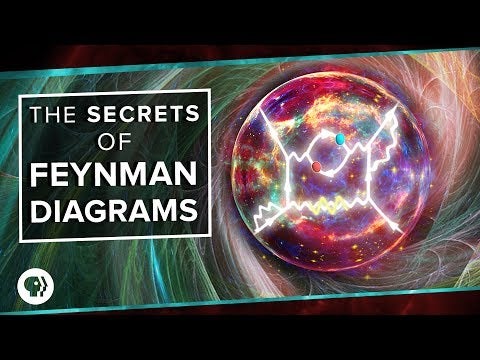
The Secrets of Feynman Diagrams

19 min

Viewers like you help make PBS (Thank you ) . Support your local PBS Member Station here: https://to.pbs.org/DonateSPACE Uploaded 26-07-17 Unlock the secrets of Feynman Diagrams. Part 5 in our Quantum Field Theory series. And if you're submitting an answer to our challenge question email your answer by August 2nd to pbsspacetime [AT] gmail.com with the subject line "Feynman Diagram Challenge." You can further support us on Patreon at https://www.patreon.com/pbsspacetime Get your own Space Time t­shirt at http://bit.ly/1QlzoBi Tweet at us! @pbsspacetime Facebook: facebook.com/pbsspacetime Email us! pbsspacetime [at] gmail [dot] com Comment on Reddit: http://www.reddit.com/r/pbsspacetime Help translate our videos! https://www.youtube.com/timedtext_cs_... Previous Episode: The Real Star Wars Feynman’s path integral shows us that, to properly calculate the probability of a particle traveling from point A to point B, we need to add up the contributions from all conceivable paths between tho

Discuss this episode

PBS Space Time

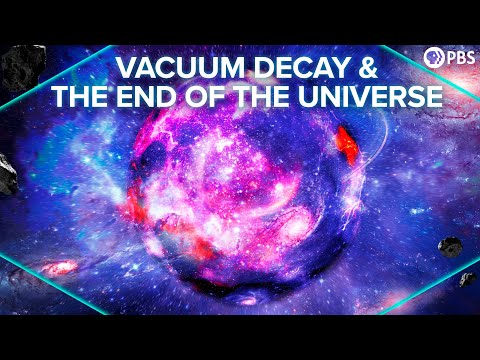
How Vacuum Decay Would Destroy The Universe

17 min

Sign Up on Patreon to get access to the Space Time Discord! Uploaded 18-08-21 The universe is going to end. But of all the possible ends of the universe vacuum decay would have to be the most thorough - because it could totally rewrite the laws of physics. Today I hope to help you understand exactly how terrified you should be. Check out the Space Time Merch Store Sign up for the mailing list to get episode notifications and hear special announcements! Hosted by Matt O'Dowd Written by Matt O'Dowd Graphics by Leonardo Scholzer, Yago Ballarini, Pedro Osinski, Adriano Leal and Stephanie Faria GFX Visualizations: Ajay Manuel Directed by Andrew Kornhaber Assistant Producer: Setare Gholipour Executive Producers: Eric Brown and Andrew Kornhaber End Credits Music by J.R.S. Schattenberg: https://www.youtube.com/user/MultiDroideka Special thanks to Our Patreon Sponsors Big Bang Supporters Ari Paul Kyle Bulloch Charlie Mrs. Tiffany Poindexter Leo Koguan Sandy Wu Matthew Miller Scott Gray Ahmad Jo

Discuss this episode

PBS Space Time

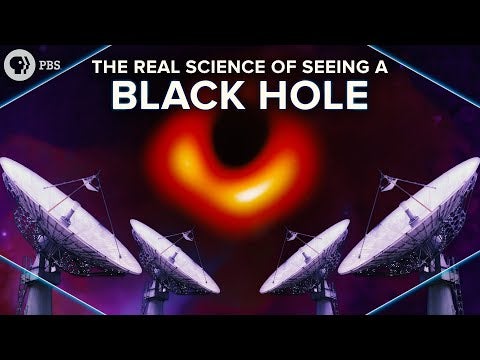
The Real Science of the EHT Black Hole

16 min

You can learn more about CuriosityStream at https://curiositystream.com/spacetime Uploaded 01-05-19 PBS Member Stations rely on viewers like you. To support your local station, go to: http://to.pbs.org/DonateSPACE How do you take a picture of a black hole and what can we learn from it? Our first ever actual bona fide photo of a black hole, made by the Event Horizon Telescope and revealed to the world in a press conference on April 10th. Since then it’s got plenty of coverage, because … I mean look at it. It’s a freaking black hole. It’s black, it’s holey, it’s everything we hoped it would be. Now that the giddiness has subsided and I personally have stopped spending hours on end staring at a black spot, we can take a breath and actually look at the real science here and discuss exactly how a picture like this could be taken and what we can learn from it. Check out the new Space Time Merch Store! Support Space Time on Patreon Need a Black Hole Refresher #Blackhole #astrophysics #spaceti

Discuss this episode

Community Poll

People leaving prison should receive practical help finding housing and work.

Share your view, then see how readers voted. No sign-in required. This poll is shared across stories.

Do you agree or disagree?

Choose one answer

Common Quandary

A Common Quandary to discuss

Another conversation to explore, separate from this news story.

Your roommate's partner sleeps over six nights a week. Are they now a roommate?

Your roommate's partner stays almost every night, showers daily, and keeps food in the kitchen. They are pleasant and spend weekends elsewhere, but pay no rent or utilities. The lease limits overnight guests.

When does welcome presence become an obligation to contribute?

Explore this quandary