Listen through the publisher, then discuss the episode here or arrange an in-person Roundtable. Your city determines where to meet.
Roundtables are designed for groups of four, with a shared subject and room for everyone to speak. Come for discussion, with no dating expectation.
View full lesson: http://ed.ted.com/lessons/free-falling-in-outer-space-matt-j-carlson Uploaded 06-07-13 If you were to orbit the Earth, you'd experience the feeling of free fall, not unlike what your stomach feels before a big dive on a roller coaster. With a little help from Sir Isaac Newton, Matt J. Carlson explains the basic forces acting on an astronaut and why you probably shouldn't try this one at home. Lesson by Matt J. Carlson, animation by Josh Harris.
Episode information is provided by the publisher. Listening takes place on the publisher’s service.
Viewers like you help make PBS (Thank you ) . Support your local PBS Member Station here: https://to.pbs.org/DonateSPACE Uploaded 22-02-17 Fomalhaut is a massive young star surrounded by a ring of dust debris that can tell us a great deal about the formation of our own solar system. Get your first two months of CuriosityStream free by going to http://curiositystream.com/spacetime and using the promo code “spacetime”. You can further support us on Patreon at https://www.patreon.com/pbsspacetime Get your own Space Time tshirt at http://bit.ly/1QlzoBi Tweet at us! @pbsspacetime Facebook: facebook.com/pbsspacetime Email us! pbsspacetime [at] gmail [dot] com Comment on Reddit: http://www.reddit.com/r/pbsspacetime Help translate our videos! https://www.youtube.com/timedtext_cs_panel?tab=2&c=UC7_gcs09iThXybpVgjHZ_7g (https://www.youtube.com/timedtext_cs_panel?c=UC7_gcs09iThXybpVgjHZ_7g&tab=2) Fomalhaut is an awe-inspiring star that could unlock many mysteries concerning how our own solar sys
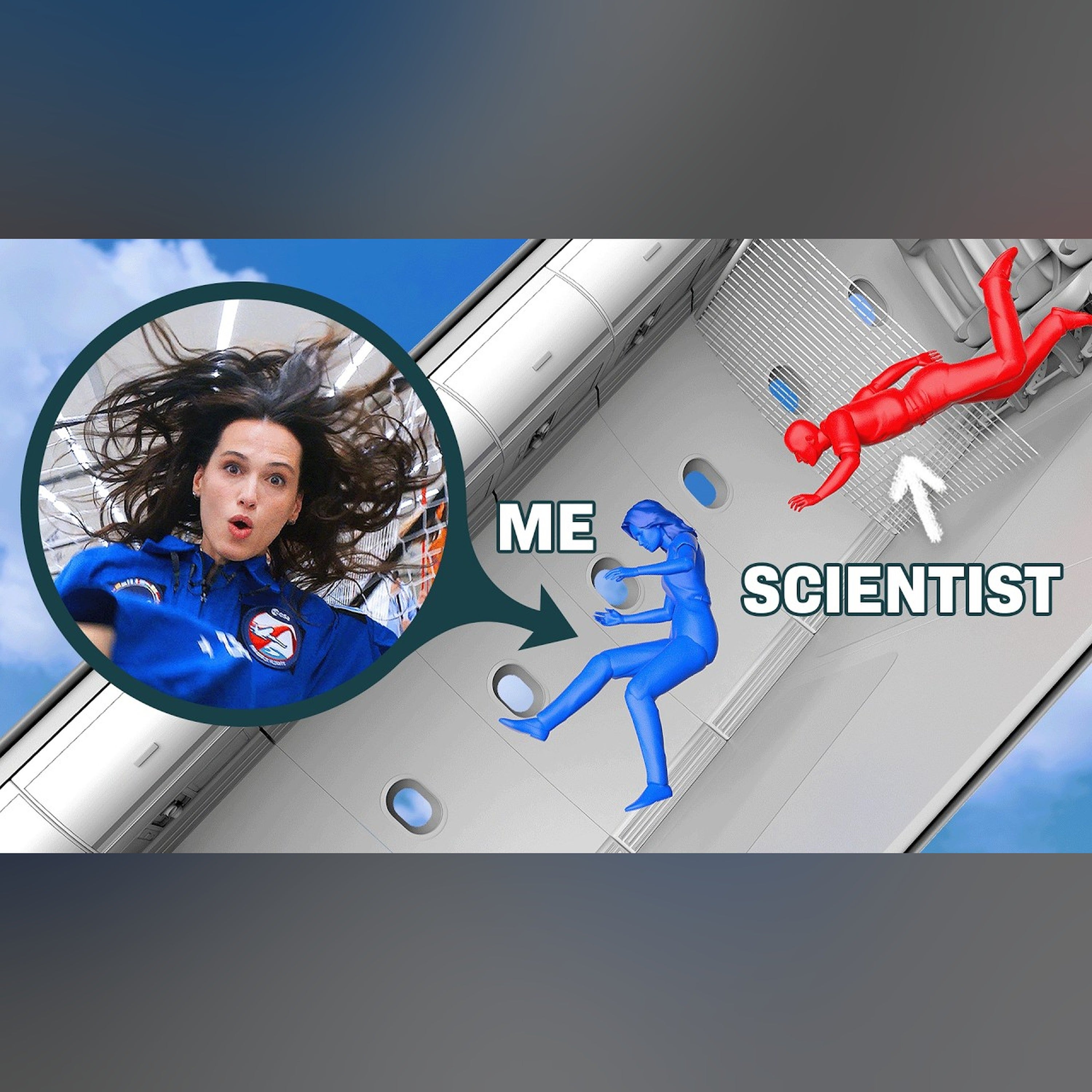
I tested 5 wild experiments in a zero gravity plane... Listen with me on Audible at https://www.audible.com/cleo I'm scanning my brain inside a plane that’s about to DIVE toward the ground… to test how weightlessness helps or hurts your brain. And it’s just one of the 5 crazy science experiments I got to test inside a Zero G plane. I recently went on this Zero G plane to explain a big debate about gravity, and while I was there, I also got exclusive access to experiments that can ONLY happen in zero gravity. I just knew you’d love to see it. So, in this extended cut, I’m going to give you a rare glimpse inside this falling laboratory and show you how the experiments they’re doing could be huge if true… Chapters: 0:00 What happens to your brain in space? 0:32 Why scientists want to fall from the sky 1:10 How do zero gravity planes work? 1:56 Experiment 1 3:58 Experiment 2 5:28 Experiment 3 7:23 Experiment 4 8:50 Experiment 5 10:27 Why these experiments are huge if true You can find me o
Master the skills that change lives — enroll in your free human behavior course today: https://nci.university/learn Uploaded 09-01-26 You were never reacting to chaos — you were responding to structure. Outcomes don’t appear suddenly; they’re assembled long before you notice them. Understanding how pressure is built changes how the world feels immediately. All influence follows patterns once you know where to look. Reality doesn’t break — it gets reshaped in layers. Every system depends on predictable human responses. Given the right conditions, behavior becomes almost automatic. Once you see the architecture, panic loses its leverage. Detection beats reaction — every time. Please note that the content provided in this broadcast is for informational and educational purposes only and should not be construed as legal, medical, financial, or professional advice. No material in this communication establishes any form of professional relationship that is privileged or confidential. The insi
When's the last time you asked yourself, who am I? Not the roles. Not the labels. Not the voice that says I'm not good enough or I don't even know who I am anymore. The real you. In this powerful opening from the She's Unstoppable Summit, Sage Robbins leads a deeply moving closed-eye experience, first naming the thoughts so many of us carry silently inside (I'm too much. I'm not enough. I'm all alone in this.) and then doing something extraordinary: reminding you of the truth of who you actually are. Uploaded 05-04-26 You are love. You are fierce. You are wild, wise, and a co-creator of this life. Sage shares vulnerably from her own journey, growing up in a blended family, navigating loss, miscarriage after miscarriage, and a moment where she feared losing Tony and how all of it, every painful and beautiful thread, shaped who she is today. This is not a motivational speech. This is a remembering. In this video: - A guided closed-eye practice to reconnect to your true identity - Why the
In this calm and sleepy facts episode, we look up and explore the enormous, slowly turning galaxy that contains everything humanity has ever known. We begin with what the Milky Way actually is, a barred spiral galaxy roughly 100,000 light years across, home to somewhere between 100 and 400 billion stars, one of which is our own Sun, quietly orbiting about two thirds of the way out from the center. We trace the galaxy's structure from the dense central bulge and its bar of stars outward through the great spiral arms, past stellar nurseries where new stars are still being born in vast clouds of gas and dust, and into the faint stellar halo where ancient globular clusters orbit high above and below the galactic plane. At the very heart of it all sits Sagittarius A star, a supermassive black hole roughly four million times the mass of the Sun, hidden behind thick lanes of dust that block visible light but reveal themselves in infrared and radio waves. We explore the stellar population of t
A seminar can change your mind — but how do you actually change your life? Motivational videos can inspire you in the moment. They can give you energy, clarity, and hope. But inspiration without direction fades. In this episode, Jim Rohn explains the structure of motivation — why some forms of motivation push you temporarily, while others can carry you for a lifetime. You’ll learn the three levels of motivation, how each one works, and why most people get stuck relying on the weakest fuel. This isn’t about feeling fired up. It’s about understanding what’s driving you — and choosing a better source of momentum. To help you apply these ideas, we include Action Guides that turn philosophy into practical steps. Action Guide for this lesson: You can find this action guide, along with other free resources, at: If you keep waiting, you’ll just keep waiting. Start changing your life now. **Follow, Start listening and let Jim Rohn’s legacy inspire your path forward.** ---
Dig into the slippery slope fallacy, which assumes that one step will lead to a series of events that lead to an extreme— often bad— scenario. Uploaded 19-08-21 -- It’s 1954. Vietnamese nationalists are on the verge of securing an independent Vietnam under communist leader Ho Chi Minh. U.S. President Eisenhower claims that by virtue of the "falling domino principle," communist control of Vietnam would lead to the global spread of authoritarian communist regimes. Can you spot the problem with this argument? Elizabeth Cox explores the slippery slope fallacy. Lesson by Elizabeth Cox, directed by TOGETHER. Support Our Non-Profit Mission ---------------------------------------------- Support us on Patreon: http://bit.ly/TEDEdPatreon Check out our merch: http://bit.ly/TEDEDShop ---------------------------------------------- Connect With Us ---------------------------------------------- Sign up for our newsletter: http://bit.ly/TEDEdNewsletter Find us on Twitter: http://bit.ly/TEDEdTwitter Pe
View full lesson: http://ed.ted.com/lessons/how-do-we-measure-distances-in-space-yuan-sen-ting Uploaded 09-10-14 When we look at the sky, we have a flat, two-dimensional view. So how do astronomers figure the distances of stars and galaxies from Earth? Yuan-Sen Ting shows us how trigonometric parallaxes, standard candles and more help us determine the distance of objects several billion light years away from Earth. Lesson by Yuan-Sen Ting, animation by TED-Ed.
As machines take on more jobs, many find themselves out of work or with raises indefinitely postponed. Is this the end of growth? No, says Erik Brynjolfsson -- it's simply the growing pains of a radically reorganized economy. A riveting case for why big innovations are ahead of us ... if we think of computers as our teammates. Be sure to watch the opposing viewpoint from Robert Gordon. Uploaded 30-08-13 Talk by Erik Brynjolfsson.
Classroom technology should prove educational value before becoming standard.
Share your view, then see how readers voted. No sign-in required. This poll is shared across stories.
Do you agree or disagree?
Common Quandary
A Common Quandary to discuss
Another conversation to explore, separate from this news story.
You are training the software that may replace your team. Do you warn them?
A manager is asked to help test software that could eliminate several jobs on their team. Leadership insists the project is uncertain and confidential, while employees are making major financial decisions.
When does loyalty to colleagues override professional confidentiality?