Listen through the publisher, then discuss the episode here or arrange an in-person Roundtable. Your city determines where to meet.
Roundtables are designed for groups of four, with a shared subject and room for everyone to speak. Come for discussion, with no dating expectation.
In this episode of Books to Battles, Dr. Brian McNeil discusses his new book, Frontiers of Need: American Humanitarianism and the Nigerian Civil War. Exploring the humanitarian crisis in Biafra, McNeil examines how domestic political pressures shaped American intervention during the Johnson and Nixon administrations. The conversation highlights the tensions between humanitarian ideals, national interests, and political realities, offering important lessons for understanding the challenges and unintended consequences of humanitarian intervention today.
Episode information is provided by the publisher. Listening takes place on the publisher’s service.
PBS Member Stations rely on viewers like you. To support your local station, go to: http://to.pbs.org/DonateSPACE ↓ More info below ↓ Uploaded 10-08-20 The second in our two event series about Theories of Everything! Watch the first one: https://www.youtube.com/watch?v=_izocEgArtQ Please subscribe to Brian Keating's YouTube Channel to watch one-on-one interviews with the guest speakers and more: https://www.youtube.com/DrBrianKeating Existing Theories of Everything have not yet produced experimental evidence that solves the fundamental challenges facing physics. That lack of progress has opened up a sea of controversy, from disagreements about the very necessity of TOEs, to questioning the cost/benefit of mega-billion dollar particle accelerators in search of them, to the emergence of competing TOEs from physicists outside of the academic community. In this 90 minute chat we dive into the existential questions around TOEs. Special thanks to Brian Keating, Lee Smolin, Sabine Hossenfelde
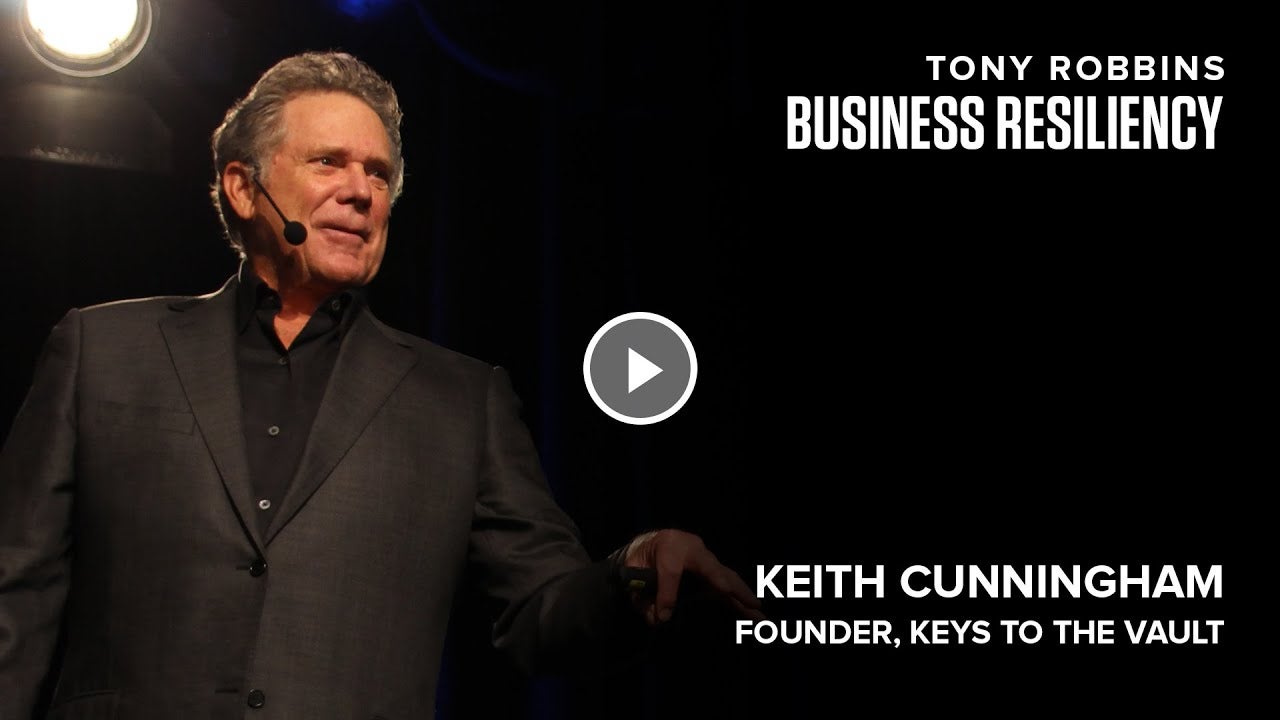
Keith Cunningham – renowned business expert, entrepreneur and speaker – highlights the critical crisis management questions that you must ask yourself to maximize periods of “thinking time.” Uploaded 28-04-20 What’s “thinking time”? Some business owners might call it an economic downturn. Tony Robbins calls it economic winter. But the most successful people call it an opportunity. They’re able to see that with the right mindset, a crisis can create breakthroughs, instead of breaking you. Hear what Tony had to say about creating breakthroughs on his podcast at https://www.tonyrobbins.com/podcasts/3-steps-breakthrough and get started creating yours today. Keith says in the video, “Cursing the wind doesn’t stop the hurricane.” In times of hardship, we have no choice but to play the hand we’ve been dealt. And as the saying goes, it’s not the hand you’ve been dealt, but how you play the hand that determines whether you win the game. How can you ensure you’re playing your hand in the best po
THE SEARCH FOR THE ULTIMATE RED LIGHT THERAPY IS OVER! After decades of exploring wellness technologies, Michael Jaco sits down with Rob Rene, founder of Exodus Strong, to explore the Red Light+ Total Body Reset system, the science behind red and near-infrared light, and why this technology has become such an important part of their wellness conversation. Rob's remarkable personal journey—including surviving five near-death experiences—inspired his mission to develop practical wellness tools that people can incorporate into their everyday lives. Discover the full-body Red Light+ Mat, designed for convenient 20-minute sessions, and the portable Red Light+ Wand, created for targeted use on areas such as the knees, shoulders, hands, and lower back. Michael and Rob discuss the technology, personal experiences, and how red light therapy may support a daily wellness routine. BLACK FRIDAY–CYBER MONDAY LISTENER EXCLUSIVE! This is your opportunity to explore Exodus Strong's special holiday offe
Puzzle through this classic ethical dilemma and decide: is community safety more important than individual privacy? -- Your government has introduced a plan to address record-breaking rates of traffic tickets and deadly hovercar accidents. They propose assigning “driver credit scores” to every citizen, but would need to install cameras and microphones in every vehicle. While it would make the roads safer, is this undeniable benefit worth the cost to drivers’ privacy? Michael Vazquez and Sarah Stroud investigate. Lesson by Michael Vazquez and Sarah Stroud, directed by Jeff Le Bars, JetPropulsion.space. This video made possible in collaboration with the Parr Center for Ethics Learn more about how TED-Ed partnerships work: https://bit.ly/TEDEdPartner Support Our Non-Profit Mission ---------------------------------------------- Support us on Patreon: http://bit.ly/TEDEdPatreon Check out our merch: http://bit.ly/TEDEDShop ---------------------------------------------- Connect With Us ------
November 21, 2026; 12pm: In almost every presidency, there comes a time when the president turns their attention overseas – usually after some sort of political defeat. President Trump’s attention is definitely overseas, but for personal reasons. Ruth Ben-Ghiat points out the red flags of Trump cozying up to notorious Strongmen; Democrats have never held this much power before and it’s not just in Congress, it’s at the state level too. State Rep.-elect Allie Phillips (D-TN) and State Senator-elect Robyn Vining (D-WI) explain how they will set their most important agenda items into action; MS NOW’s Rachel Maddow continues her discussion with Jacob Soboroff about her brand new book “The Department of Fate,” Stephen Miller’s rise, and much more. Hosted by Simplecast, an AdsWizz company.
Instant Access to the NCI Masterclass: https://nci.university/opt-in-page-808244 Uploaded 26-11-25 IN TIME FOR THE HOLIDAYS: Grab your copy of Chase’s new book, Tongue: A Cognitive Hazard https://a.co/d/5J14Grw You’ve carried more than just your own experiences into this life. Our behaviors, fears, and impulses often come from people we never met. Understanding this crazy inheritance changes how we see “US” forever. Ancient memories, childhood patterns, and generational instincts all shape us. Recognizing these influences helps us break cycles and reclaim our lives. Every one of us is shaped by stories older than our own. Genetic memory is a protective mechanim. Once you see the invisible forces that guide you, you start choosing/acting differently. Deep down, you’re more powerful than the ghosts that run your show. Snatch your copy of Chase’s new book, Tongue: A Cognitive Hazard https://a.co/d/5J14Grw
In this episode of Books to Battles, Dr. John Maurer joins the conversation to explore the past, present, and future of arms control. From Cold War agreements to today’s increasingly complex nuclear landscape, Maurer examines the strategic logic behind arms control, the challenges facing existing agreements, and the prospects for future cooperation. The discussion considers whether arms control can remain an effective tool for managing competition and reducing the risks of conflict.
A military can learn, adapt, and still lose the war. Dr. Wendy Whitman Cobb and Colonel Cory Hollon join Gregory Hospidor and Sanders Marble to discuss why in After America’s First Battles, 1861–2008. From amphibious operations to air campaigns in Europe and Vietnam, the conversation examines why forces can change how they fight while leaving their assumptions about victory intact. Commanders, service culture, and bureaucratic barriers shape which lessons move beyond the battlefield and which remain trapped at the tactical level. For strategists, the challenge is recognizing when better execution leaves the larger problem unsolved. If you have questions, comments, or episode recommendations, please email us at [email protected] The opinions expressed here are those of the hosts or the guests and do not necessarily represent the official position of the Department of the Air Force, the Depart of Defense or War, or the United States Government. Books Mentioned Charles E. Heller an
Officials should explain how public consultation changed their final decision.
Share your view, then see how readers voted. No sign-in required. This poll is shared across stories.
Do you agree or disagree?
Common Quandary
A Common Quandary to discuss
Another conversation to explore, separate from this news story.
Your father is becoming a dangerous driver. Would you report him behind his back?
Your father values the independence his car gives him. He has not caused an accident, but his reactions have noticeably slowed and several recent drives frightened you. He refuses an assessment.