English-language podcasts

Fun Facts Daily

Fun Facts About Stuffing
15 min

Listen through the publisher, then discuss the episode here or arrange an in-person Roundtable. Your city determines where to meet.

Roundtables are designed for groups of four, with a shared subject and room for everyone to speak. Come for discussion, with no dating expectation.

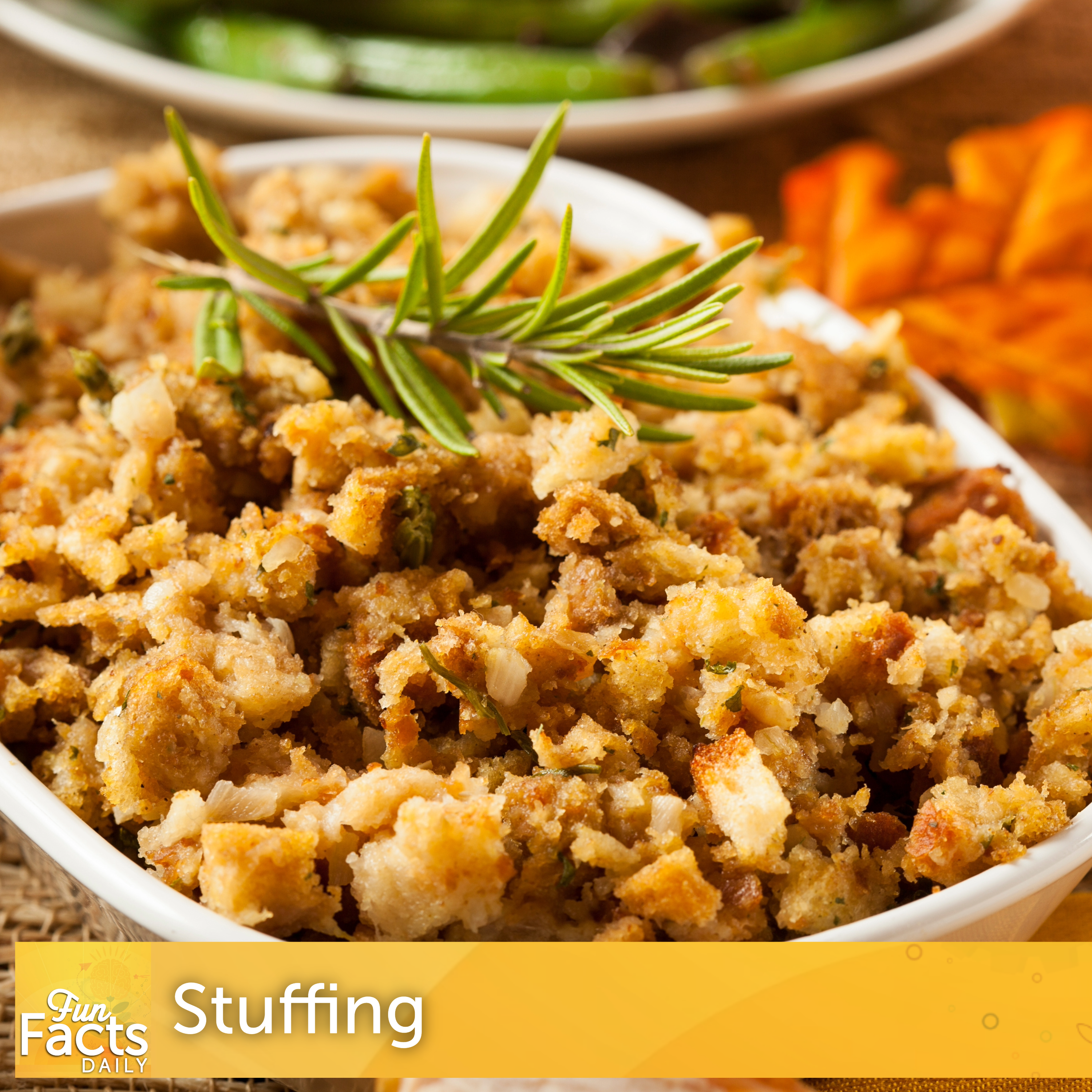
Whether you call it stuffing or dressing, this favorite holiday side dish has a surprisingly rich history. In the 1880s, Victorian etiquette guides encouraged Americans to use the word dressing because stuffing sounded too impolite for the dinner table. Today, the USDA officially defines stuffing as cooked inside the bird and dressing as baked in a separate pan. Even so, most cooks stick to their regional habits, with people in the South preferring dressing and folks in the Northeast and Midwest choosing stuffing. The culinary tradition even gave us the word farce, which comes from the Latin verb farcire, meaning to stuff or cram. Long before Thanksgiving turkeys took center stage, the oldest surviving Roman cookbook, De Re Coquinaria, included recipes for stuffed chicken, pig, and even edible dormice served as a status symbol at wealthy banquets. Centuries later, in 1807, a French food writer took the idea to the extreme by publishing a recipe that packed 17 different birds inside one another, a concept that eventually inspired the modern turducken. Across the United States, stuffing recipes grew out of local staple crops, giving rise to classics like Southern cornbread dressing, New England oyster stuffing, Midwestern sausage and apple blends, and Hawaiian stuffing made with Portuguese sweet bread. Making the dish from scratch used to take hours until home economist Ruth Siems invented Stove Top stuffing in 1972. She carefully engineered the crumb size and bread structure so the mix would hydrate quickly without turning to mush, and today about 60 million boxes sell during the Thanksgiving season alone. If you want to make great homemade stuffing from scratch, dry half-inch bread cubes in a 250-degree oven for 40 minutes instead of leaving bread out on the counter overnight. Oven-drying removes trapped moisture so each cube acts like a little sponge ready to soak up broth, melted butter, and herbs. Finally, keep food safety in mind if you cook stuffing inside a turkey, since the surrounding meat and bones insulate the cavity and cause the stuffing to heat up more slowly. Because raw poultry juices can drip into the bread and carry bacteria like salmonella, experts recommend baking stuffing in its own dish or using a digital thermometer to make sure the very center reaches 165 degrees Fahrenheit before serving. Want to learn more? Fun Facts Daily is an Airwave Media Podcast.

Episode information is provided by the publisher. Listening takes place on the publisher’s service.

Listen at the source ↗

Featured places to meet in Palo Alto, CA

Explore these places and arrange a conversation through ThinkMatch.

City guide for Palo Alto, CA

More from Fun Facts Daily

Fun Facts Daily

Fun Facts About the Wampanoag People

15 min

The Wampanoag, whose name means "People of the First Light," have lived in southeastern Massachusetts, Cape Cod, Martha's Vineyard, Nantucket, and eastern Rhode Island for more than 12,000 years. Historically, Wampanoag communities were led by councils and consensus-based leaders called sachems, including female leaders known as sunksquas. In 1621, the Wampanoag leader Ousamequin, often called by his title Massasoit, meaning Great Sachem, built a strategic alliance with Plymouth colonists, and around 90 Wampanoag men joined 53 surviving Mayflower settlers for the three-day harvest feast later known as the First Thanksgiving. Skilled builders and stewards of the land, Wampanoag families adapted to the New England seasons by building dome-shaped cedar homes called wetus, hollowing out dugout canoes called mishoons with controlled fire, and harvesting wild cranberries paired with maple. Wampanoag history also includes a remarkable story of language survival and revival. In 1663, a printin

Discuss this episode

Fun Facts Daily

Fun Facts About the Mayflower

17 min

Sailing from England to New England in 1620, the Mayflower carried 102 passengers across the Atlantic Ocean on a cramped 66-day voyage aboard a merchant cargo vessel. Originally planned as a two-ship journey alongside the Speedwell, repeated leaks forced the group to abandon the Speedwell, consolidate onto the Mayflower, and endure autumn storms that cracked a main midship beam, repaired at sea using a large iron screw brought from Holland and a wooden brace. Although the passengers held a land patent for northern Virginia near the Hudson River, rough seas and dwindling supplies brought the ship to anchor in Provincetown Harbor on Cape Cod on November 11, 1620, where 41 adult men signed the Mayflower Compact to form a civil body politic and selected John Carver as governor. While later generations popularized the label "Pilgrims," the passengers themselves were divided into Separatists or Saints and Strangers, and the Plymouth Rock landing story did not surface until 1741, 121 years af

Discuss this episode

Fun Facts Daily

Fun Facts About Clocks

18 min

From ancient sundials to modern atomic timekeepers, the history of clocks reveals how human societies have measured time with growing precision. Early mechanical clocks in the Northern Hemisphere adopted a clockwise motion to mirror the sweep of sundial shadows across the sky, while exceptions such as Prague's 16th-century Jewish Town Hall clock and La Paz's modified legislative clock demonstrate cultural and regional variations. Practical timekeeping milestones include Levi Hutchins's 1787 4:00 a.m. alarm clock, Antoine Redier's 1847 adjustable alarm patent, and the November 18, 1883 establishment of four North American standard time zones to replace chaotic local solar times across towns and railroads. Precision timekeeping spans from monumental pendulums to quantum-scale oscillators. London's Great Clock in Elizabeth Tower relies on a two-second pendulum regulated with pre-decimal pennies to adjust its daily rate by two-fifths of a second, whereas cesium-133 atomic clocks define the

Discuss this episode

Community Poll

Public projects should publish comparisons of promised and actual outcomes.

Share your view, then see how readers voted. No sign-in required. This poll is shared across stories.

Do you agree or disagree?

Choose one answer

Common Quandary

A Common Quandary to discuss

Another conversation to explore, separate from this news story.

The company allows an $80 dinner. Is ordering the lobster fair game?

During work travel, company policy permits an expensive dinner. A modest option is nearby, but colleagues choose the nicest restaurant because the company can easily afford it and everyone is within the stated limit.

Is following a rule enough when you are spending someone else's money?

Explore this quandary