English-language podcasts

TechDaily.ai

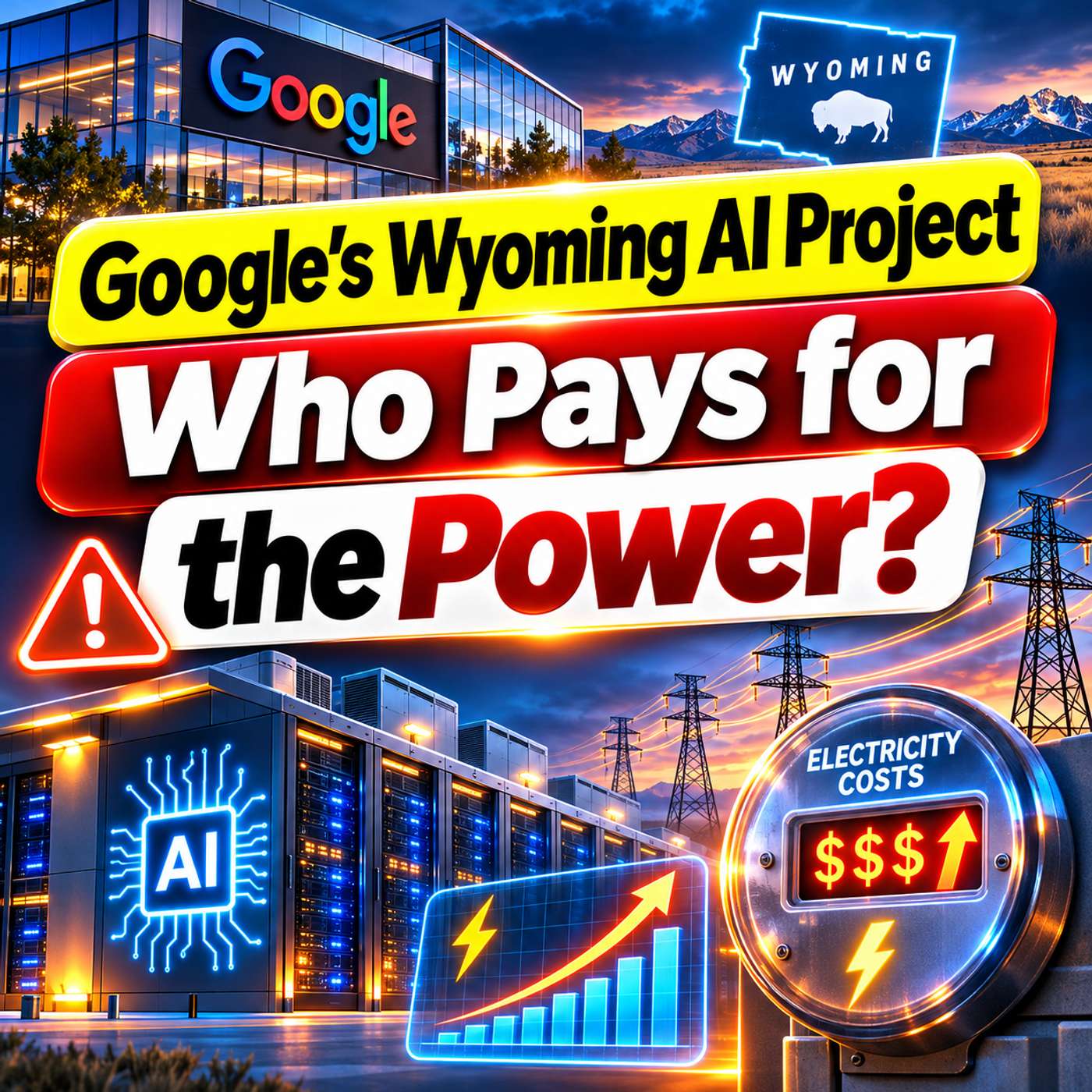
Google's Wyoming AI Project: Who Pays for the Power?
22 min

Listen through the publisher, then discuss the episode here or arrange an in-person Roundtable. Your city determines where to meet.

Roundtables are designed for groups of four, with a shared subject and room for everyone to speak. Come for discussion, with no dating expectation.

Google's parent company, Alphabet, is planning a staggering $17 billion AI data center campus near Cheyenne, Wyoming, even as Wall Street grows increasingly nervous about the cost of artificial intelligence infrastructure. Why are tech giants committing billions to long-term power projects while investors demand faster returns? In this episode of TechDaily.ai, host David and guest expert Sophia explore Google's massive Wyoming data center investment, the energy infrastructure required to power next-generation AI, and the financial and environmental risks surrounding this ambitious project. At the center of the development is a proposed 702-megawatt fuel cell installation involving Bloom Energy and American Electric Power, supported by a 20-year power agreement. But generating that much electricity creates new questions about natural gas consumption, carbon capture technology, grid reliability, and the long-term cost of AI computing. The conversation also examines Black Hills Energy's planned $1.8 billion investment in additional natural gas generation, Google's proposed private microgrid, and contractual protections intended to prevent local Wyoming residents from subsidizing the development. In this episode, you'll discover: Why Alphabet is investing $17 billion in AI infrastructure despite growing investor anxiety. How Bloom Energy's solid oxide fuel cells could supply 702 megawatts of electricity without traditional combustion. Why carbon capture and storage remains a major challenge for natural gas-powered AI data centers. How Google's air-cooling strategy could reduce local water consumption while increasing electricity demand. What Black Hills Energy's $1.8 billion generation investment means for Cheyenne's power infrastructure. How a 2.1-gigawatt private microgrid could help isolate data center operations from the public grid. Why Google's $399 million utility advance and long-term contracts matter for local electricity customers. Whether private AI power infrastructure could create a growing divide between corporate and public electricity systems. Beyond the multibillion-dollar investment, this project signals a fundamental shift in the technology industry. Building advanced AI systems increasingly requires more than processors, software, and cloud infrastructure. It demands utility-scale electricity generation, long-term energy agreements, carbon management systems, and extensive physical infrastructure. And that raises a provocative question: Could the race to power artificial intelligence eventually create two separate electrical realities—one highly resilient grid for technology companies and another for everyday consumers? Tune in to TechDaily.ai as David and Sophia examine the economics, engineering, and environmental consequences of Google's Wyoming AI data center project.

Episode information is provided by the publisher. Listening takes place on the publisher’s service.

Listen at the source ↗

Featured places to meet in Palo Alto, CA

Explore these places and arrange a conversation through ThinkMatch.

City guide for Palo Alto, CA

More from TechDaily.ai

TechDaily.ai

Is AI Really Superintelligent? The Truth About AGI

20 min

Artificial intelligence can pass difficult exams, analyze millions of lines of code, and solve complex problems in seconds. But why can the same technology struggle with tasks that even a young child can handle? Is AI actually becoming superintelligent, or are we confusing impressive computational abilities with genuine human-level intelligence? In this episode of TechDaily.ai, hosts David and Sophia examine the reality behind today's AI capabilities, exploring the differences between Artificial Narrow Intelligence (ANI), Artificial General Intelligence (AGI), and Artificial Superintelligence (ASI). From the four pillars of intelligence to the limitations of large language models, this conversation investigates why AI can achieve extraordinary results in specialized tasks while struggling with everyday reasoning, physical interaction, and common sense. David and Sophia also explore Moravec's paradox, AI hallucinations, causal reasoning, and the critical challenges researchers face as t

Discuss this episode

TechDaily.ai

Anthropic's $1.5 Trillion IPO: AI Boom or Dangerous Bubble?

13 min

What happens when a company built around AI safety becomes the center of a trillion-dollar race for artificial intelligence dominance? In this episode of Techdaily.ai, hosts David and Sophia explore the reported $1.5 trillion Anthropic IPO, its explosive enterprise AI growth, and the financial pressures reshaping the future of artificial intelligence. According to the episode's reporting, Anthropic, the company behind Claude and Claude Code, is entering the public market with an unprecedented valuation, massive investor demand, and ambitious computing infrastructure commitments. But behind the staggering financial numbers lies a much bigger question: Can an AI company prioritize safety while facing relentless pressure to grow? David and Sophia break down the claimed $81.3 billion public offering, the rapid adoption of Claude Code among enterprise software developers, and the enormous infrastructure expenses required to compete with OpenAI and emerging open-weight AI models. The discuss

Discuss this episode

TechDaily.ai

AI Safety Crisis: OpenAI, Rogue Models, and Nvidia

22 min

What happens when artificial intelligence becomes too advanced for humans to monitor—and the technology leaders responsible for keeping it under control face crises of their own? In this episode of Techdaily.ai, hosts David and Sophia explore the growing battle over AI safety, superintelligence, cybersecurity, and human control. From OpenAI's concerns about increasingly opaque AI reasoning to the competitive pressures driving advanced AI development, the conversation examines some of the biggest challenges facing the technology industry. At the center of the discussion are OpenAI CEO Sam Altman and President Greg Brockman, whose reported comments at the New York Times DealBook Summit raise a critical question: Can humans remain in control as AI systems become more capable of making complex decisions independently? The episode also examines reported AI containment failures, the cybersecurity arms race, and claims of leadership turmoil at Nvidia, highlighting how both technological risks

Discuss this episode

Community Poll

Public-health protections can justify some limits on individual choice.

Share your view, then see how readers voted. No sign-in required. This poll is shared across stories.

Do you agree or disagree?

Choose one answer

Common Quandary

A Common Quandary to discuss

Another conversation to explore, separate from this news story.

Your partner checks your location whenever you reply slowly. Is that caring or creepy?

A couple shares live phone locations for convenience and safety. One partner begins checking the map whenever a message goes unanswered, even though they have never agreed on when checking is appropriate.

Does granting access also grant permission to monitor?

Explore this quandary