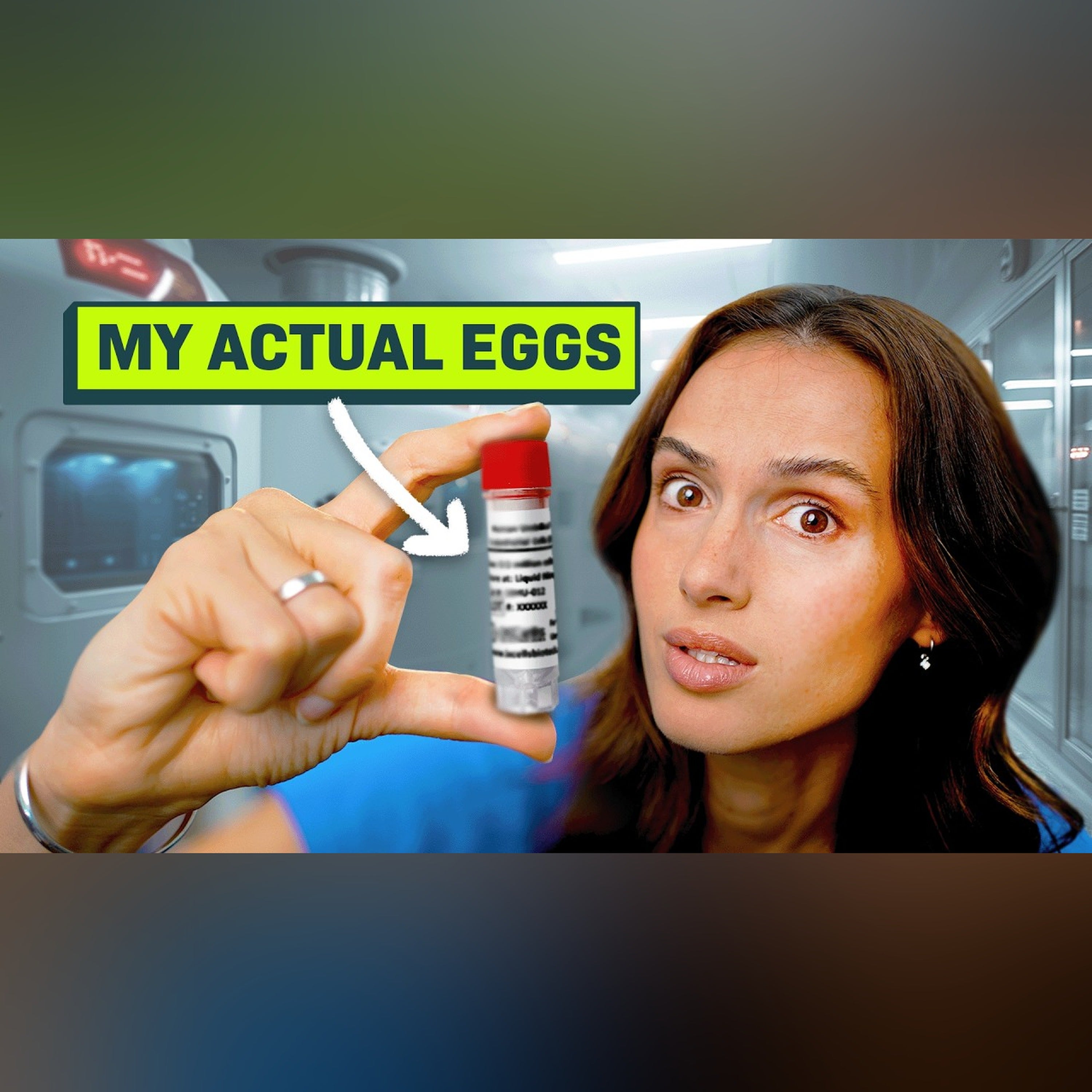
Your body doesn't work like you think... Take your personal data back with Incogni. How and when people are having kids is changing, but our bodies aren't. As we get older, it can get harder to have kids when we want to. So smart people figured out it’s possible to remove eggs, freeze them, and unfreeze them to use later. They can even fertilize those eggs to make embryos and freeze those. Basically, humans invented cryosleep! … Just for tiny cells. It’s totally sci-fi - and you need to know about it. This is a level of control over our bodies no species has ever had before. It’s already changing people’s lives - and how our species can reproduce. But there are real concerns about whether it’s worth it. Because let me tell you, the process is not easy. I’ve been taking medication for two weeks. And at the same time, I’ve been doing research, talking to doctors, and learning as much as I can about the cutting edge of fertility tech. In this video, I'm going to take you behind the scenes
Horizon3.ai co-founder and CTO Anthony Pillitiere discusses how AI-enabled agentic threat actors are industrializing cyberattacks using existing vulnerabilities rather than novel exploits. Drawing on 21 years in the Air Force and his role as deputy CTO for JSOC, he explains why organizations must shift to autonomous offensive security and how the collapse between emerging threats and exploitation is forcing leaders to address long-standing cyber debt. Brought to you by: Mongo DB - Anyone can prototype an agent. Lovable - Turn ideas into software people love with Lovable. Start today at https://lovable.dev/ Factory - A 24/7 system turning signals into production software. Visithttps://factory.com/ Neon (by Databricks) - Scale your startup on Neon. The Postgres backend for apps and agents. Built by Databricks.https://neon.com/mtshttps://neon.com/mts (https://neon.com/mts%E2%81%A0) Head over to http://getvcx.com (http://getvcx.com/) to learn more Kong - The AI connectivity platform. Larri
Bitwise Head of Research Ryan Rasmussen joins The Rollup at Solana Breakpoint to break down how investors should value SOL, from Solana's 40% share of tokenized stock volume to why tokens without strong tokenomics are set to underperform. We also cover the sharpest stablecoin drawdown Ryan has seen, the CFTC's perps ruling with Backpack, and why Bitwise views today as a buying opportunity. Stabled Up is presented by Frax. Ryan Rasmussen is the Head of Research at Bitwise. Live from the financial capital of the world. Timestamps: 00:00 Intro 00:45 Why Stablecoin AUM Is Falling 02:30 Climbing The Wall Of Worry 04:53 The Genius Act And Payment Stablecoins 05:42 Perps Come To The US Via Backpack 08:20 Tokenization Is Only 0.01% Of The Market 10:24 Who Wins The Tokenization Race 11:09 Do Tokenomics Matter? 13:21 A New Cohort Of Winners 14:57 Why Holding Periods Matter 16:09 Bitwise's Long-Term View On Solana Guest Socials Ryan Rasmussen X: https://x.com/RasterlyRock Bitwise X: https://x.com
Explore how pulling an all-nighter can impact your cognitive function, and find out what happens to your brain when you don't sleep. -- You’re just one history final away from a relaxing spring break. But you still have so much to study! You decide to follow in the footsteps of many students before you, and pull an all-nighter. So, what happens to your brain when you stay up all night? And does cramming like this actually help you prepare for a test? Anna Rothschild explores how a sleepless night impacts your cognitive function. Lesson by Anna Rothschild, directed by Biljana Labović. Animation by Noam Sussman & Ali Kellner, Homework Studio. This video made possible in collaboration with the Bezos Family Foundation Learn more about how TED-Ed partnerships work: https://bit.ly/TEDEdPartner A special thanks to Dr. Mathias Basner, Andrew Fuligni, Adriana Galván, and UCLA Center for the Developing Adolescent who provided information and insights for the development of this video. Support Ou
What if your AI agent could find the people you should know before you even start looking? Cosign is building a professional network around reputation and trusted recommendations, and now agents can use that network too. MTS host Sophia Dew sits down with a16z’s David Booth and Cosign’s Bella Nazzari to discuss what they’ve learned since launching Cosign, why traditional profiles often miss the operators doing the most important work, and how the Cosign Awards are surfacing talent through the people willing to vouch for them. They also explore an emerging behavior: people connecting their agents to Cosign to continuously find relevant people, lists, and opportunities, and what professional networking could look like when both humans and their agents participate. Resources: Follow David Booth: https://x.com/davidbooth Follow Bella Nazzari: https://x.com/nazzari Follow Sophia Dew: https://x.com/sophiadew Learn more about Cosign:https://cosign.co/ Connect your agent to Cosign:https://cosi
A.I. for Starting to Exercise: Building a Routine That Actually Sticks, a practical, beginner-friendly look at how artificial intelligence can help you build a routine that actually sticks this time. Starting to Exercise? Press play on Episode 429 of A.I. for Beginners and learn exactly how artificial intelligence, especially ChatGPT, alongside Nike Training Club, can help you build a routine that actually sticks this time. WHAT YOU WILL LEARN IN THIS EPISODE - Why starting to exercise is so hard to handle alone, and what is actually going on underneath it - A specific way to use Nike Training Club to work through it, step by step - An example prompt you can copy word for word: "Here is my current fitness level and schedule, help me build a realistic beginner routine" - A second practical technique, with another ready-to-use prompt: "Give me a simple way to track my progress that doesn't rely on willpower alone" WHO THIS EPISODE IS FOR - Anyone currently working on starting to exercise
Susan Wojcicki helped build Google and led YouTube for nearly a decade. In this episode, I sit down with her husband, Dennis Troper; her mother, Esther Wojcicki; and her sisters, Anne and Janet Wojcicki, to hear the stories that show who Susan was beyond her work. They talk about how Susan made time for her five children, what happened when she was diagnosed with lung cancer despite having no smoking history, and why her family is working to change how the disease is understood. We discuss the need for earlier detection, the stigma that keeps people from seeking care, and the Lung Cancer Genetics Study Susan helped inspire. Learn more about the Susan Wojcicki Foundation and its work on early detection and prevention of lung cancer: https://susanwfoundation.org/ Resources: Susan Wojcicki Foundation: https://susanwfoundation.org/ About lung cancer: https://susanwfoundation.org/about-lung-cancer Lung Cancer Genetics Study and eligibility: https://www.23andme.com/lung-cancer/ How Susan hel
Ethan Mollick is a Wharton professor who co-directs the Generative AI Labs and was named by TIME as one of the 100 most influential people in AI. His new book Co-Intelligence: The Next Phase of AI just came out. AI can draft most of your work in seconds — but if you only fix 10% of what it writes, what are you actually losing? In this episode, I ask Ethan how to work with AI without handing over your own thinking. He explains why he still types every first draft himself, why he brainstorms alone before opening Claude, and what happened when AI fact-checked his new book and found errors in the papers he was citing. We talk about the four skills you need to use AI well, why entry-level jobs no longer train people the way they used to, and how he actually manages AI agents step by step. At the end, I ask the question I keep thinking about: what happens when AI learns taste? Links: 𝕏 : https://x.com/siliconvalleymm (https://x.com/siliconvalleymm%E2%81%A0%E2%81%A0%E2%81%A0%E2%81%A0%E2%81%A
Communities should invest in adapting to unavoidable hazards as well as preventing future damage.
Share your view, then see how readers voted. No sign-in required. This poll is shared across stories.
Do you agree or disagree?
Common Quandary
A Common Quandary to discuss
Another conversation to explore, separate from this news story.
If a good deed is filmed for likes, is it still a good deed?
A local creator films themselves buying groceries for strangers. The videos generate substantial income, but they also inspire donations and allow the creator to help more people.
Do mixed motives diminish a genuinely helpful act?