English-language podcasts

TED-Ed

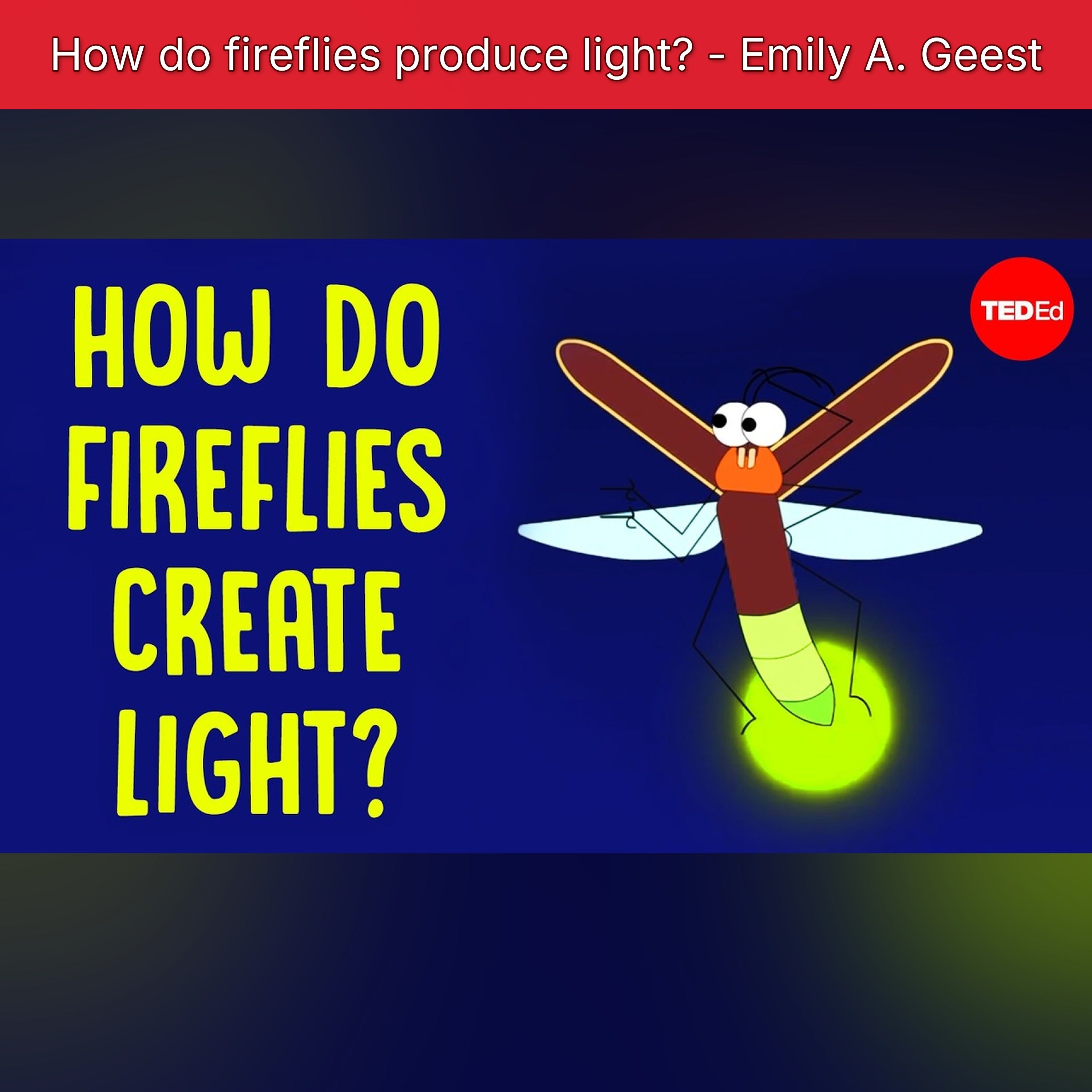
How do fireflies produce light? - Emily A. Geest
8 min

Listen through the publisher, then discuss the episode here or arrange an in-person Roundtable. Your city determines where to meet.

Roundtables are designed for groups of four, with a shared subject and room for everyone to speak. Come for discussion, with no dating expectation.

Dig into the science of how and why fireflies glow, and how their bioluminescent signals differ between males and females. -- The first firefly is thought to have lived over 100 million years ago, illuminating the night with a glowing green light. And today, there are around 2,000 firefly species, found all over the world, from forests and grasslands to marshes and deserts. So, why do these insects glow? Emily A. Geest digs into the bioluminescent signals of fireflies. Lesson by Emily A. Geest, directed by Lou Morton. Support Our Non-Profit Mission ---------------------------------------------- Support us on Patreon: http://bit.ly/TEDEdPatreon Check out our merch: http://bit.ly/TEDEDShop ---------------------------------------------- Connect With Us ---------------------------------------------- Sign up for our newsletter: http://bit.ly/TEDEdNewsletter Find us on Twitter: http://bit.ly/TEDEdTwitter Peep us on Instagram: http://bit.ly/TEDEdInstagram ---------------------------------------------- Keep Learning ---------------------------------------------- View full lesson: https://ed.ted.com/lessons/what-makes-fireflies-light-up-at-night-emily-a-geest Dig deeper with additional resources: https://ed.ted.com/lessons/what-makes-fireflies-light-up-at-night-emily-a-geest/digdeeper Animator's website: https://louisjmorton.com/Films-Index ---------------------------------------------- Thank you so much to our patrons for your support! Without you this video would not be possible! Sandra Tersluisen, Zhexi Shan, Bárbara Nazaré, Andrea Feliz, Victor E Karhel, Sydney Evans, Latora, Noel Situ, emily lam, Sid, Niccolò Frassetto, Mana, I'm here because of Knowledge Fight Facebook group., Linda Freedman, Edgardo Cuellar, Jaspar Carmichael-Jack, Michael Burton, VIVIANA A GARCIA BESNE, The Vernon's, Olha Bahatiuk, Jesús Bíquez Talayero, Chels Raknrl, Sai Pranavi Jonnalagadda, Stuart Rice, Jing Chen, Vector-Dopamine math, Jasper Song, Giorgio Bugnatelli, Chardon, Eddy Trochez, OnlineBookClub.org, Eric Shear, Leith Salem, Omar Hicham, Adrian Rotaru, Brad Sullivan, Karen Ho, Niklas Frimberger, Hunter Manhart, Nathan Nguyen, Igor Stavchanskiy, James R DeVries, Grace Huo, Diana Huang, Chau Hong Diem, Orlellys Torre, Corheu, Thomas Mee, Maryann H McCrory, and Blas Borde.

Episode information is provided by the publisher. Listening takes place on the publisher’s service.

Listen at the source ↗

Featured places to meet in Palo Alto, CA

Explore these places and arrange a conversation through ThinkMatch.

City guide for Palo Alto, CA

More from TED-Ed

TED-Ed

Withstanding a nuclear attack - Irwin Redlener

33 min

View full lesson: http://ed.ted.com/lessons/surviving-a-nuclear-attack-irwin-redlener The face of nuclear terror has changed since the Cold War, but disaster-medicine expert Irwin Redlener reminds us the threat is still real. He looks at some of history's farcical countermeasures and offers practical advice on how to survive an attack. Talk by Irwin Redlener.

Discuss this episode

TED-Ed

The true reason polio poses such a threat

10 min

Explore what makes polio so dangerous, what is causing the 21st century resurgence of cases, and how we can eradicate the disease. -- In 1952, polio was everywhere: killing or paralyzing roughly half a million people annually. Yet just 10 years later, paralytic polio cases in the US dropped by 96% and we were on track to get rid of polio for good. But in recent years, the virus started striking back. So, what’s behind these recent spikes? Explore the dangers of poliovirus and the possibility of eradicating this deadly disease. Directed by Anton Bogaty. This video made possible in collaboration with Gates Ventures Learn more about how TED-Ed partnerships work: https://bit.ly/TEDEdPartner A special thanks to Ananda Bandyopadhyay, Amber Zeddies, and Kathleen O'Reilly who provided information and insights for the development of this video. Support Our Non-Profit Mission ---------------------------------------------- Support us on Patreon: http://bit.ly/TEDEdPatreon Check out our merch: htt

Discuss this episode

TED-Ed

How to fool a GPS - Todd Humphreys

21 min

Todd Humphreys forecasts the near-future of geolocation when millimeter-accurate GPS "dots" will enable you to find pin-point locations, index-search your physical possessions ... or to track people without their knowledge. And the response to the sinister side of this technology may have unintended consequences of its own. (Filmed at TEDxAustin.) Uploaded 26-06-13 Talk by Todd Humphreys.

Discuss this episode

Community Poll

New owners should honor commitments to people who already depend on a business or property.

Share your view, then see how readers voted. No sign-in required. This poll is shared across stories.

Do you agree or disagree?

Choose one answer

Common Quandary

A Common Quandary to discuss

Another conversation to explore, separate from this news story.

The buffet is unlimited while you are inside. Can one sandwich leave in your pocket?

An expensive hotel brunch advertises unlimited food but forbids takeout. You are full, yet quietly assembling a sandwich for later would cost the hotel almost nothing. Several trays will likely be discarded after service.

Does preventing waste justify ignoring the boundary of a bargain?

Explore this quandary