English-language podcasts

TED-Ed

How one scientist took on the chemical industry - Mark Lytle

9 min

Listen through the publisher, then discuss the episode here or arrange an in-person Roundtable. Your city determines where to meet.

Roundtables are designed for groups of four, with a shared subject and room for everyone to speak. Come for discussion, with no dating expectation.

Discover the groundbreaking environmental work of Rachel Carson, whose book “Silent Spring” explores how human actions threaten the balance of nature. Uploaded 17-03-20 -- In 1958, after receiving a letter describing the deaths of songbirds due to the pesticide known as DDT, Rachel Carson began an investigation into the misuse of chemicals and their toll on nature. In 1962, she published her findings in “Silent Spring,” which immediately drew both applause and impassioned dissent. How did this biologist and writer ignite such controversy? Mark Lytle investigates. Lesson by Mark Lytle, directed by Héloïse Dorsan Rachet. Animator's website: https://www.heloisedr.com/ and https://www.instagram.com/helo.dr/?hl=fr Sign up for our newsletter: http://bit.ly/TEDEdNewsletter Support us on Patreon: http://bit.ly/TEDEdPatreon Find us on Twitter: http://bit.ly/TEDEdTwitter Peep us on Instagram: http://bit.ly/TEDEdInstagram View full lesson: https://ed.ted.com/lessons/how-one-scientist-took-on-the-chemical-industry-mark-lytle Thank you so much to our patrons for your support! Without you this video would not be possible! Angelo Urzua-Milla, Tommy Lewis, leorene, Mahina Bachiller, Marcus Andre Nery, Bruce Vieira Lopes, Chef, Charmaine Hanson, Michael Goldberg, Lydia Pflieger, Paul Aldred-Bann, Manav parmar, Susan Wang, Utkarsh Dubey, Thawsitt, Xuebicoco, Jezabel, Maeve, Kim Humphrey, Kristen Damas, JackKeyton, Matthew D. Vigil, Amin Shahril, Adriano Fontes, Xiao Yu, Fatima Kried, Aravind Battaje, Melissa Suarez, Jason Duncan, Brian A. Dunn, Francisco Amaya, Daisuke Goto, Matt Switzler, Chhunheng Veng, Leonardo Monrroy, Sumedh Ghaisas, Guhten, Amer Harb, Dowey Baothman, Norbert Orgován, Shafeeq Ansari, Gabriel Balsa, Maryam Sultan, Bethany Connor, Jeremy Shimanek, Adam Foreman, Sebastiaan Vleugels, Lâm Nguyễn, Mark Byers and Bradley Heinold.

Episode information is provided by the publisher. Listening takes place on the publisher’s service.

Listen at the source ↗

Featured places to meet in Palo Alto, CA

Explore these places and arrange a conversation through ThinkMatch.

City guide for Palo Alto, CA

More from TED-Ed

TED-Ed

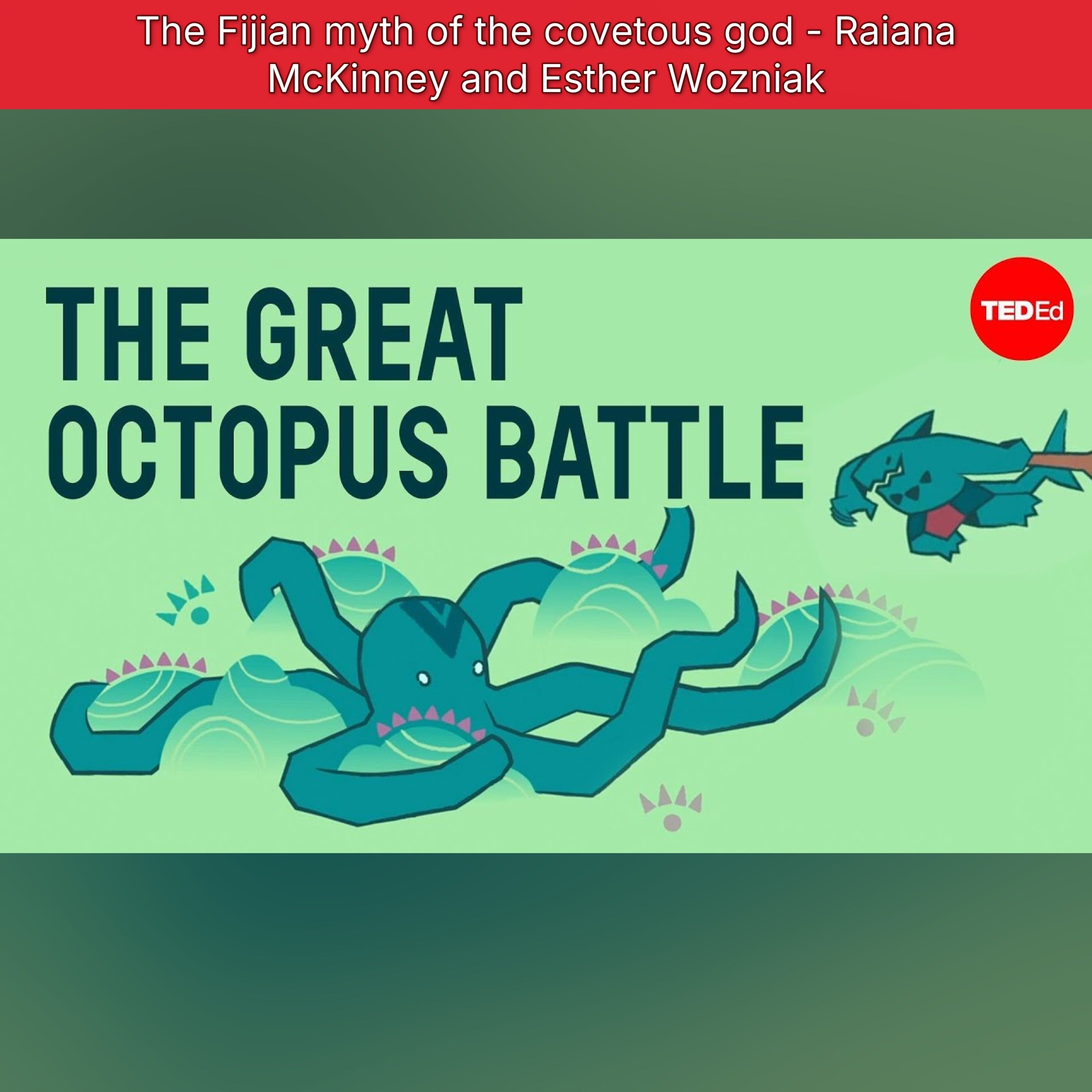
The Fijian myth of the covetous god - Raiana McKinney and Esther Wozniak

8 min

Dig into the Fijian myth of Dakuwaqa, the shape-shifting shark god who is determined to take over all of Fiji's islands. -- Long ago, the ancestral gods of Fiji settled on the Pacific archipelago. They eventually metamorphosed into various forms, with the god Dakuwaqa transforming into a shark. But he was unsatisfied. He became proud and greedy and wanted to establish himself as the mightiest god, and dominate all of Fiji’s islands. Raiana McKinney and Esther Wozniak share the tale of Dakuwaqa’s quest for power. Lesson by Raiana McKinney and Esther Wozniak, directed by KERO Animation. Support Our Non-Profit Mission ---------------------------------------------- Support us on Patreon: http://bit.ly/TEDEdPatreon Check out our merch: http://bit.ly/TEDEDShop ---------------------------------------------- Connect With Us ---------------------------------------------- Sign up for our newsletter: http://bit.ly/TEDEdNewsletter Find us on Twitter: http://bit.ly/TEDEdTwitter Peep us on Instagram

Discuss this episode

TED-Ed

HIV and flu -- the inoculation strategy - Seth Berkley

27 min

View full lesson: http://ed.ted.com/lessons/hiv-and-flu-the-vaccine-strategy-seth-berkley Seth Berkley explains how smart advances in vaccine design, production and distribution are bringing us closer than ever to eliminating a host of global threats -- from AIDS to malaria to flu pandemics. Talk by Seth Berkley.

Discuss this episode

Community Poll

People should receive a clear explanation before consenting to personal-data use.

Share your view, then see how readers voted. No sign-in required. This poll is shared across stories.

Do you agree or disagree?

Choose one answer

Common Quandary

A Common Quandary to discuss

Another conversation to explore, separate from this news story.

You inherit a fortune made in ways you despise. Can you keep it?

You inherit a substantial sum from a relative who accumulated it through practices you consider exploitative. Keeping it would improve your family's security; donating it could support people harmed by similar practices.

Can ownership be morally clean when its history is not?

Explore this quandary